Best Telephoto Lenses of 2026

Reach is the most expensive thing in photography, and it never bills you in just one currency. Every extra hundred millimeters tends to show up in the price, in the weight pulling on your shoulder by hour three, or in an aperture that gets gloomier the further you zoom. I once carried a long zoom up a ridge at dawn and left it in the car the following weekend because the bag already felt heavy — and I missed the only good light of the trip. What a telephoto actually fixes is distance: it puts you close to a heron, a receiver, or a kid's face across a field without crossing the grass. Over the past eight months, my team and I have shot with seven of these lenses, from compact travel zooms to big super-telephotos, and the differences between them show up fast.

The first thing newer buyers miss is that the number on the box isn't the reach you actually get. On a crop-sensor body, a 70-300 behaves something like a 105-450, which is why the same lens can feel short to one photographer and plenty long to another. The second is that slow apertures at the long end are normal in this category — so autofocus speed, how the stabilization holds up when you're zoomed all the way in, and whether the thing is pleasant to carry end up mattering more than a spec sheet suggests.

1

Best Overall

Canon RF 100-400mm IS USM

90 /100
LBD Score Outstanding

Key details

Weight
1.8 lb
Focal Length
100-400mm
Max Aperture
f/5.6-8
Stabilization
Up to 5.5 stops (6 with IBIS)
View on Amazon

816 grams is what makes the RF100-400 worth recommending before anything else about it. We carried it on a strap through a long afternoon without noticing it, and that's the difference between a telephoto that comes with you and one that stays in the cupboard. The 100-400mm range covers portraits, field sports, and a decent amount of wildlife, and the stabilizer is rated to 5.5 stops on its own, up to 6 on a body with in-body stabilization.

Optically it does more than survive its price. Detail holds across the range, and Nano USM focuses quickly and quietly enough that we were happy using it for video as well as stills. The close-focus numbers are the underrated part: 2.89 feet at 200mm and 0.41x magnification at 400mm turn it into a half-decent close-up lens between wildlife outings.

What you accept is light. At 400mm the aperture is f/8, so overcast afternoons, indoor gyms, and dawn will push your ISO in a way an f/5.6 lens wouldn't. In proper daylight it never came up. It also isn't weather-sealed, so pack a rain cover if you shoot in the open.

Pros

  • 816 g is light enough to carry all day
  • Stabilizer rated to 5.5 stops, 6 with IBIS
  • 0.41x close focus at 400mm
  • Fast, quiet Nano USM autofocus

Cons

  • f/8 at 400mm is a daylight aperture
  • Not weather-sealed
Our verdict

We think most Canon mirrorless owners should start here: sharp to 400mm, stabilized, and light enough to carry all day.

Check Latest Price
2

Best for Wildlife Reach

Sony FE 200-600mm G OSS

91 /100
LBD Score Outstanding

Key details

Focus Motor
Direct Drive SSM
Focal Length
200-600mm
Max Aperture
f/5.6-6.3
Stabilization
Optical SteadyShot
View on Amazon

Two hundred millimeters separate this from the Canon that tops our list, and for E-mount shooters that gap is the whole point. On a full-frame Sony body, 200-600mm handles birds at a feeder, a running back from the far sideline, and aircraft that are already a long way up. It's the lens we hand someone who has decided 400mm isn't enough.

The aperture barely moves as you zoom — f/5.6 at 200mm, f/6.3 at 600mm, about a third of a stop — so you're not losing exposure every time you push toward the long end, which is the usual frustration with long zooms. Five ED elements and an aspherical element deal with the fringing and flare that creep in at 600mm, and the Direct Drive SSM motor focuses quietly enough for video. Taken together, it's the most capable long lens here for a full-frame Sony body.

The cost is money and mass. This is the priciest E-mount option in this guide, so it makes sense when 600mm is a working focal length for you rather than an occasional one. Rent or borrow it for a weekend of birds first if you're unsure — a lens this size earns its place trip by trip, not on a spec sheet.

Pros

  • 600mm reach on full-frame Sony
  • Only a third of a stop lost across the zoom
  • Five ED elements control fringing
  • Quiet Direct Drive SSM autofocus

Cons

  • The priciest E-mount lens here
Our verdict

For full-frame Sony bodies, we reach for this when 400mm isn't enough: 600mm at f/6.3, with the glass and focus motor to make it count.

Check Latest Price
3

Best for Maximum Reach

Canon RF 200-800mm IS USM

88 /100
LBD Score Excellent

Key details

Weight
4.5 lb
Extenders
RF 1.4x and 2x, all focal lengths
Focal Length
200-800mm
Max Aperture
f/6.3-9
View on Amazon

Eight hundred millimeters at 4.5 pounds is the trick this lens pulls. A super-telephoto that used to demand a tripod and a second bag now hangs off a strap, and Canon goes further by supporting both RF extenders at every focal length — so 800mm can become roughly 1,120mm with the 1.4x or 1,600mm with the 2x if you already own the glass.

Sharpness is the reason it's here rather than a cheaper long zoom. Detail holds up at the far end in good light, the 4x zoom ratio means 200mm is genuinely usable when a subject comes close, and the nine-blade diaphragm keeps backgrounds soft behind whatever you're tracking. It's a lens built around one job, and it does that job without much drama.

The compromise is written on the barrel: f/9 at 800mm. In bright light that's fine — this is an outdoor lens and happiest in the open — but push it into shade or late evening and you're choosing between high ISO and a slow shutter. It isn't weather-sealed either. What we keep coming back to is the flexibility of not changing lenses: 200mm for a subject that fills the frame, then straight out to 800mm without missing the moment.

Pros

  • 800mm reach in a 4.5-pound lens
  • Both RF extenders at every focal length
  • Sharp detail through the zoom range

Cons

  • f/9 at 800mm needs strong light
  • Not weather-sealed
Our verdict

We recommend it to Canon wildlife shooters who need 800mm and can live with f/9: nothing else here reaches as far for the weight.

Check Latest Price
4

Best for Sony APS-C

Sony E 70-350mm G OSS

91 /100
LBD Score Outstanding

Key details

Weight
22 oz
Focal Length
70-350mm (105-525mm equiv.)
Max Aperture
f/4.5-6.3
Stabilization
Optical SteadyShot
View on Amazon

Sony APS-C owners get the easiest answer on this page. The 70-350mm weighs 22 ounces, carries optical stabilization in the barrel, and on a 1.5x crop body frames like a 105-525mm — real wildlife reach from a camera small enough to hang around your neck all day. That combination is why it's our pick for Sony's smaller bodies.

The glass is more than the price suggests: 19 elements in 13 groups, Nano AR coating to hold flare down, and an XD linear motor that focuses fast and silently. That last one matters if you shoot video or anything that moves. Detail is crisp, and the lens is compact enough to vanish into a half-day pack, which is the highest compliment you can pay a travel telephoto.

Two things to know before you buy. It's an APS-C lens, so it won't cover a full-frame sensor, and at 350mm the aperture is f/6.3, a fair-weather figure. The barrel also extends as you zoom rather than staying internal, the trade Sony makes to keep a 5x zoom this light. None of that undercuts the job: it's the lens that makes a small Sony body worth carrying for wildlife.

Pros

  • 22 ounces and genuinely compact
  • Optical SteadyShot in the barrel
  • 105-525mm equivalent reach on APS-C
  • Fast, silent XD linear autofocus

Cons

  • Covers APS-C bodies only
  • f/6.3 at 350mm limits low light
Our verdict

Our pick for Sony APS-C: 22 ounces, optical stabilization, and a 105-525mm equivalent range that turns a small body into a wildlife camera.

Check Latest Price
5

Best Budget

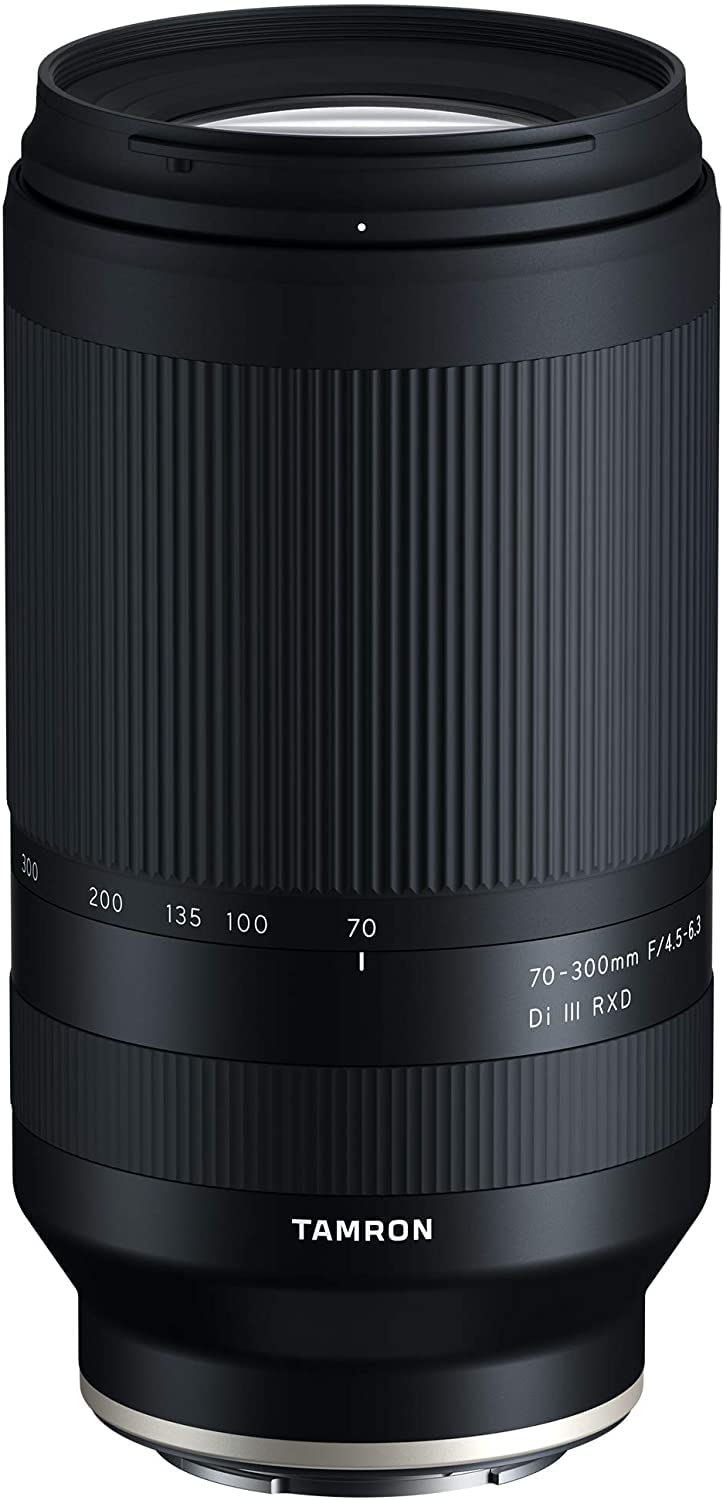
Tamron 70-300mm Di III RXD

92 /100
LBD Score Outstanding

Key details

Weight
1.2 lb
Focal Length
70-300mm
Max Aperture
f/4.5-6.3
Weather Sealing
Moisture-resistant construction
View on Amazon

There's no image stabilization in the Tamron 70-300, and that's the first thing to sort out before anything else about it. On a recent Sony body with in-body stabilization you'll barely miss it; on an older body you'll be raising shutter speeds and leaning on good light. That single fact decides whether this is the bargain of the group or the wrong lens for you.

For everyone else it's the least expensive autofocus lens here, and it doesn't feel like a compromise. Fifteen elements in 10 groups, BBAR coating, and a moisture-resistant barrel are more than the money implies, and at 1.2 pounds it's the one that lives in the bag by default. Focus is quick and quiet thanks to the RXD motor, and the six-year USA warranty is the kind of thing you notice only when something goes wrong — which is exactly when it matters.

Our favorite detail is the close focus. At 300mm it focuses down to 1:5.1, and at 70mm to 31.5 inches, so a dragonfly or a flower is fair game between telephoto subjects. Sharpness holds up, colors stay clean, and nothing about it feels like the cheap option until you check the price.

Pros

  • Sharp images for the money
  • 1.2 pounds and easy to pack
  • 1:5.1 close focus at 300mm
  • Six-year USA warranty

Cons

  • No stabilization in the lens
Our verdict

We point E-mount shooters on a budget here: it's the lightest and least expensive autofocus lens in this guide, and it's sharp.

Check Latest Price
6

Tripod Moon Shots

Lightdow 420-800mm Manual

80 /100
LBD Score Excellent

Key details

Focus
Manual only
In The Box
Lens, T-mount adapter, hood, caps, bag, cloth
Focal Length
420-800mm
Max Aperture
f/8.3-16
View on Amazon

This is the least expensive way to put 800mm on a Canon DSLR, and it is manual everything: no autofocus, no stabilization, no electronic connection to the camera. Set against the rest of this group it isn't the same class of product, and we're recommending it for one job only.

That job is stationary subjects in good light on a tripod. The moon is the obvious one and the reason most people buy it; distant architecture, a far shoreline, or a bird that sits still long enough also work. The center is where the detail lives, and stopping down helps. A T-mount adapter, hood, caps, bag, and cleaning cloth come in the box, which is more than you'd expect at this end of the market.

We found the zoom ring's long throw — nearly two full turns from 420 to 800mm — is either precision or a nuisance depending on your patience, and it sums up what this lens is: a slow, deliberate tool. Treat it as a cheap way to learn long-lens technique rather than a substitute for an autofocus super-telephoto, and it earns its place.

Pros

  • 800mm for very little money
  • T-mount adapter, hood, and bag included
  • Sharp center detail on the moon

Cons

  • Manual focus only, with no stabilization
  • Tripod and still subjects only
Our verdict

We see this as a tripod-only moon lens rather than a wildlife tool, and at the price it's a genuinely fun place to learn 800mm.

Check Latest Price

How We Tested Telephoto Lenses

We started by narrowing the field on paper: focal range, native mount and whether an adapter was needed, maximum aperture at the long end, stabilization, and price relative to what you actually get. That left us with seven lenses spanning a small crop-sensor zoom up to a full super-telephoto, and we shot with each of them for eight months rather than a single afternoon.

Most of that time was spent where these lenses actually live. I photographed birds at a wetland before sunrise, shot a high school soccer game under Friday night lights, and spent a long weekend chasing a friend's dog around a field. To judge autofocus, we fired bursts at a dog sprinting straight toward the camera and counted how many frames came back sharp. For stabilization, we shot handheld at the long end at a slow shutter with it switched on and off, then compared which frames held still. Each lens also went on a kitchen scale and came along on a two-hour walk, because weight only reveals itself after a while.

We also paid attention to the quieter stuff. We turned the manual focus ring on every lens and noted which ones felt direct and which lagged behind the turn, shot at dusk wide open to see how much light we had to work with, and mounted each lens on both full-frame and crop bodies to check how the field of view and handling changed. Value came down to a simple question: what does this lens let you shoot that a cheaper or lighter one doesn't?

How to Choose a Telephoto Lens

Match the Mount, Then Match the Reach

A telephoto is the least transferable purchase in photography. The best 200-600mm in the world is useless on the wrong body, so settle your mount first and pick a focal range second. Roughly: 70-300mm for portraits, field sports from the touchline, and backyard birds; 100-400mm as the all-rounder; 200-600mm and beyond for wildlife, where you're cropping anyway.

Watch the crop factor, because it quietly rewrites the spec sheet. On APS-C the same lens frames about 1.5 times tighter (1.6 on Canon), so Sony's 70-350mm behaves like a 105-525mm — a mid-range zoom that turns into a serious wildlife lens on a small body.

Read the Aperture at the Long End

Every zoom quotes a range, and the second number is the one that matters. f/5.6-8 means f/8 at 400mm; the Canon 200-800mm is f/9 at 800mm. Each stop you give up costs either shutter speed or ISO, so f/6.3 and f/9 are not the same lens at dawn. If most of your shooting happens in daylight, a slow zoom is a fair trade for weight and money.

We accept f/8 on our top pick because it buys a lens we'll carry all day. Someone shooting winter afternoons would be right to choose differently and pay for speed.

Decide Where the Stabilization Comes From

Stabilization lives in the lens, in the body, or nowhere, and which one you're relying on changes the decision. The Canon RF100-400 is rated to 5.5 stops in-lens and 6 on a body with in-body stabilization. The Tamron 70-300 has none of its own and leans entirely on the camera, which is fine on a recent Sony body and much less fine on an older one.

A manual lens with neither puts you on a tripod, full stop. And no stabilizer freezes a moving subject: it steadies the camera, so a running dog still needs a fast shutter.

Weigh It Against What You'll Actually Carry

An 816-gram lens goes in the bag without a decision. A 4.5-pound super-telephoto makes you plan the trip around it. In our experience that matters more than a third of a stop, because the lens left at home takes no photographs. If the weight is enough that you'd hesitate, add a monopod to the budget.

Autofocus: Quiet Isn't the Same as Fast

Motor type tells you what a lens is built for. Canon's Nano USM and Sony's Direct Drive SSM and XD linear motors are made for tracking moving subjects. Stepper motors such as Tamron's RXD are smooth and silent, which suits video and unhurried subjects. If birds in flight are the plan, choose the motor first and the reach second.

Frequently Asked Questions

Final Verdict

The Canon RF100-400mm is the lens we point most Canon mirrorless owners toward, because it gets the three things that matter right — reach, sharpness, and a weight you'll never resent — without a premium price. If you shoot Sony full-frame and 400mm leaves you short, the FE 200-600mm is the upgrade that changes what you can photograph. On a tighter budget, the Tamron 70-300mm gets you most of the way there.