Best Tabletop Tripods of 2026

A tabletop tripod has one job, and it's harder than it sounds: hold a camera still on a surface that was never built for it. I've balanced cameras on coffee cups, book stacks, and once a very patient friend's shoulder, and every one of those setups failed the moment the light got good. What actually fixes it is unglamorous — a wide enough footprint, legs that lock at the angle you set, and a head that doesn't creep after you frame the shot.

My team and I have spent the past six months with a dozen of these, from pocket-size metal pucks to 20-inch desktop models with fluid heads, setting them up on café tables, kitchen counters, and the tailgate of a truck. The maximum load rating printed on the box tells you less than you'd expect; a light mirrorless body on a tall, skinny-legged stand still shivers in a breeze. Height and leg material are the two things I check first, because they decide both how the stand behaves and how long it survives being tossed in a bag.

The shortlist below covers both ends of that range — stands for a phone or a webcam on a desk, and small tripods that will genuinely hold a camera rig steady. Each one earned its place the same way: it stayed put.

1

Best Overall

NEEWER TP29 Mini Metal Tripod

91 /100
LBD Score Outstanding

Key details

Head
360-degree ball head, dual U-notch
Weight
8.99 oz
Max Height
6.8 in
Load Capacity
6.61 lb
View on Amazon

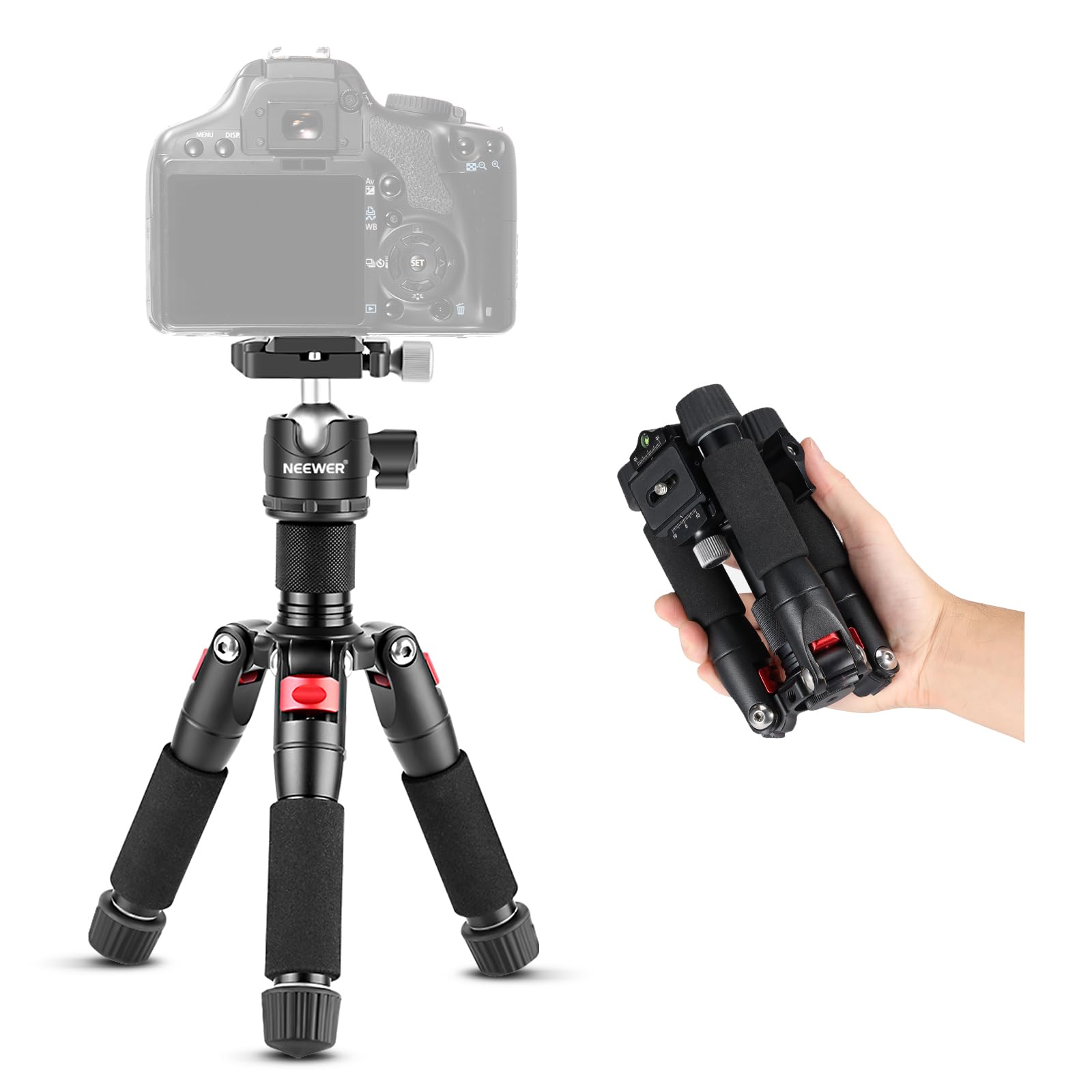
The TP29 is the tripod that stays on our desk. It is a 255-gram piece of aluminum with three legs that click into three positions and a ball head notched on two sides, and the whole thing folds to 18 centimeters. What we appreciate most is how little it asks of you: no plate to seat, no column to raise. You screw on a camera, aim, and it holds. The metal build is the reason. Nothing flexes when you tighten the head, and the 3-kilogram rating is more than a phone, a webcam, or a small mirrorless will ever ask of it.

The dual-notch head is what earns it the top spot. One notch drops the camera into a vertical frame, and together they let a phone or a compact camera shoot straight down at a notebook, a plate of food, or a product on the table, which is the overhead angle you would otherwise build out of stacked books. Each leg has a spring-loaded slider with three click stops, so the stance changes in a second, and the rubber feet are broad enough that the tripod does not skate when you nudge the head.

Working height runs from 2.9 to 6.8 inches, and that is the honest boundary of what this is: a desk tripod, not a stand-in for a full-size one. For macro, product shots, and a phone reading a script, the low height is the point, because a short tripod with a wide base does not tip. If your framing needs the camera at eye level, the JCWINY here reaches 18 inches.

Pros

  • All-metal build that does not flex under a camera
  • Dual-notch ball head flips to vertical or overhead
  • Three leg angles click into place on spring sliders
  • Folds to 18 cm and 255 g

Cons

  • Camera screws straight onto the head with no quick-release plate
Our verdict

This is the tripod we leave set up on the desk: all-metal, steady under a real camera, and small enough to forget about until you need it.

Check Latest Price
2

Best for Grab-And-Go

Manfrotto PIXI Mini Tripod

94 /100
LBD Score Outstanding

Key details

Head
Ball head, push-button lock
Mount
1/4-inch screw
Height
13.5 cm (fixed)
Weight
7.76 oz
View on Amazon

Press the button under the PIXI's ball head, aim the camera, and let go. The head locks where you left it. That single control is the whole design, and it is why the tripod earns a place in a camera bag rather than a drawer.

We found the push-button lock more useful than it looks on paper. There is no separate knob to tighten, so one hand can hold a phone steady while the other sets the angle, and the ball does not drift once you release it. The tripod is 13.5 centimeters tall and weighs 0.22 kilograms, the legs close together into a handgrip for handheld video, and the whole thing slips into a side pocket.

The mount is a plain 1/4-inch screw. A compact camera, a mirrorless body, or an action-cam adapter goes straight on, and a phone needs a clamp you supply, since the screw is the only mount on the head. Manfrotto rates the tripod for compact system cameras and entry DSLRs, and the push-button head holds those bodies at any angle you set.

Pros

  • Push-button lock sets and holds an angle one-handed
  • Legs close into a handgrip for handheld video
  • Light 0.22 kg and short enough for a bag pocket

Cons

  • Height is fixed at 13.5 cm with no adjustment
Our verdict

One button frees the head and locks it again, which makes this our pick for a camera bag or a desk where you shoot in a hurry.

Check Latest Price
3

Best for Video

SmallRig 5025 Carbon Fiber Tripod

90 /100
LBD Score Outstanding

Key details

Head
Fluid head, fixed damping
Max Height
17 in
Folded Size
11.4 in
Load Capacity
6.61 lb
View on Amazon

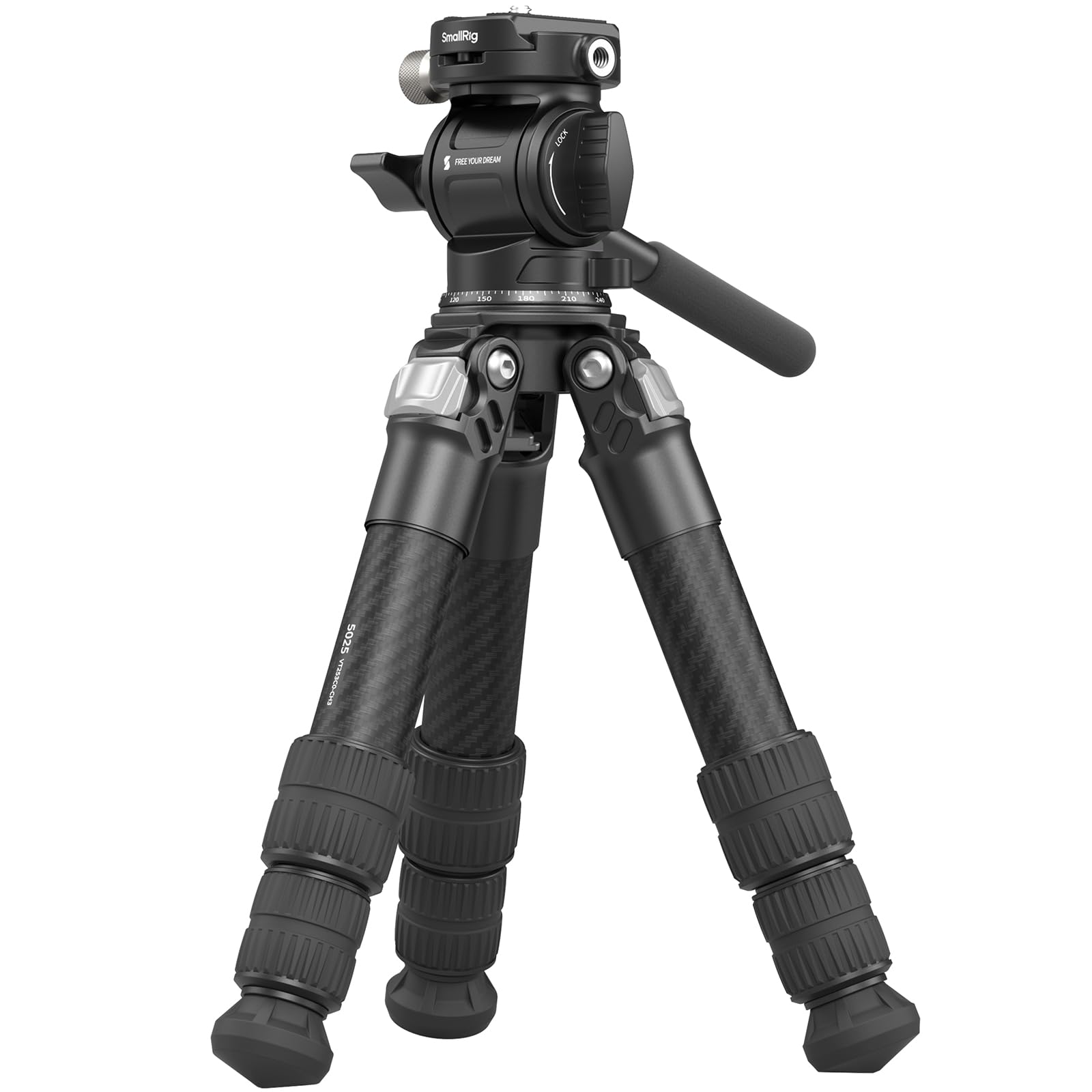
This is the most expensive tripod in this group by a wide margin, and the only one built around a fluid head. If you shoot video on a table, whether a product turning, hands demonstrating something, or a monitor that has to travel slowly across a frame, that head is the entire argument.

The rest of the tripod is built to match. The tubes are carbon fiber, 25.5 mm across, on a three-section leg set that runs from 11.4 to 17 inches. The head tilts 90 degrees one way and 70 the other, swivels a full turn, and carries a pan handle that moves the camera at one speed instead of lurching. An Arca-compatible plate sits on top, there is a 3/8-inch thread underneath for a slider or a light stand, and the feet take replaceable metal spikes for outdoor work.

We think it earns its price for video and not much else. For stills on a desk, the NEEWER TP29 is metal, holds a camera just as securely, and takes up less room. What the SmallRig buys is movement: fixed damping that resists a nudge rather than flopping, a pan handle you can work with one finger while your other hand stays on the camera, and 17 inches of height when you need to clear a laptop screen.

Pros

  • Fluid head with fixed damping for smooth pans
  • Carbon legs and a 3 kg rating
  • Arca-compatible plate and a 3/8-inch base thread
  • Folds to 11.4 inches with a storage bag

Cons

  • Heavy at 845 g for a tabletop tripod
Our verdict

We think it is worth the premium if you shoot video at a desk: the only fluid head here, and the pans are the reason to pay for it.

Check Latest Price
4

Best for Webcams

JCWINY Webcam Tripod Stand

88 /100
LBD Score Excellent

Key details

Weight
9.17 oz
In The Box
Tripod, phone holder, rotation platform
Height Range
11.5-18 in
Load Capacity
3.2 lb
View on Amazon

If the camera on your desk is a webcam, this is the stand built around it. The JCWINY reaches 18 inches through two extending sections, which is enough to meet most people's eye line at a desk, and at 260 grams it is a one-hand move from the office to the kitchen counter.

We like it for the boring reasons. The ball joint tilts and swivels to square up a shot in a video call, the feet are rubber-padded so the stand does not skate, and it ships with a phone holder and a rotating platform, two things you would otherwise buy separately. A proctored exam, a Teams call, and a phone propped up to record a demo are all the same job to this stand.

Push it with a real camera and it gets out of its depth. The frame mixes metal and ABS, the rating is 3.2 pounds, and this is a stand for a webcam, a phone, or a small light. A DSLR with a zoom wants the NEEWER TP29 instead.

Pros

  • Reaches 18 inches for eye-level webcam framing
  • Ships with a phone holder and rotating platform
  • Light 260 g and easy to move between rooms
  • Rubber-padded feet stay put on a desk

Cons

  • Two height steps only, with no fine adjustment
Our verdict

The webcam stand we recommend: it reaches 18 inches, ships with a phone holder, and stays put through a call.

Check Latest Price
5

Best Low-Profile Base

Zeadio Heavy Duty Tabletop Tripod

90 /100
LBD Score Outstanding

Key details

Weight
5.64 oz
Mounting
Three 1/4-inch holes, ARRI pins
Height Range
24-107 mm
Load Capacity
88.2 lb
View on Amazon

Twenty-four millimeters to 107: that is the entire height range of the Zeadio, and it tells you what the tripod is for. This is a base, not a stand. It is a CNC-machined aluminum plate on three legs, it weighs 160 grams, and it is rated to 40 kilograms, numbers that make sense the moment you put a gimbal, a monitor, or an action camera on it instead of something you plan to look through.

The top is where the design shows: three 1/4-inch-20 mounts with ARRI locating pins plus three auxiliary threads, which is more mounting than we expected on a plate this small. That is what makes it useful past cameras. A monitor arm, a microphone, a small light, or a field recorder all have somewhere to go, and the ARRI pins stop a gimbal from twisting loose on the thread.

Permanence is the appeal. Bolt a monitor or a small light to it and it holds the position it was set to, session after session. Mounting takes two hands and a moment's care, since you are threading a device onto a small plate rather than dropping it into a clamp, and that is the honest cost of a base this compact.

Pros

  • 40 kg rating on a 160 g aluminum base
  • ARRI locating pins plus three 1/4-inch threads
  • Three leg positions with rubberized feet
  • Small and light enough for a pocket

Cons

  • Tops out at 107 mm, so low-angle mounting only
Our verdict

For gimbals, monitors, and action cams at desk height, we have not seen anything here hold a load like it: 40 kilograms in a 160-gram plate.

Check Latest Price
6

Best for Height

NEEWER TP-AAM521 Tabletop Tripod

90 /100
LBD Score Outstanding

Key details

Head
360-degree ball head, Arca-type plate
Weight
1.7 lb
Height Range
6.7-19.7 in
Load Capacity
11 lb
View on Amazon

The other NEEWER here is a different animal. Where the TP29 sits low and stays put, this one is a five-section aluminum tripod that runs from 6.7 to 19.7 inches and folds down to 17 centimeters.

That range is the reason to consider it. At full extension the head clears a stack of books, which is what you want for shooting down onto a flat lay or over the top of a monitor; collapsed, it is small enough for a jacket pocket. The ball head swivels a full turn, the base carries a bubble level for getting a horizon straight, and the Arca-type quick-release plate lets a camera come off without unscrewing anything.

The plate is where it asks for care. Seat it fully and check the clamp before every setup, because a plate that is not locked down will let a camera tilt mid-shot, and carrying the rig by the legs is the surest way to work it loose.

Our verdict: if height is the whole point, buy this one. The TP29 is steadier and simpler at desk level; the TP-AAM521 buys you 20 inches on a table, and for product photography, flat lays, and shooting over a monitor that trade is worth making.

Pros

  • 6.7 to 19.7 inches of working height
  • 11 lb rating with an Arca-type plate and bubble level
  • Folds to 17 cm and weighs 1.7 lb
  • Three leg-angle positions

Cons

  • Legs feel springy at full extension with a heavy camera
Our verdict

Our pick when height is the point: five leg sections take it to 19.7 inches, with an 11-pound rating and a levelling bubble on the head.

Check Latest Price
7

Best Pan Head

Vanguard VS-82 Table Top Tripod

91 /100
LBD Score Outstanding

Key details

Head
Two-way pan head, 360 degrees
Weight
0.86 lb
Height Range
9-9.9 in
Load Capacity
5.5 lb
View on Amazon

A pan head with a handle, a full turn of rotation, and a wide aluminum stance: the VS-82 is the old-fashioned shape of tabletop tripod, and it is still the right shape for a spotting scope.

The numbers are unglamorous. It folds to 9 inches and extends to 9.9, so nearly all of the height comes from splaying the legs rather than telescoping them. That gives it a wide footprint for its size, more bench than a mini tripod takes, and it is the part to think about if you plan to leave it set up in a small space.

The head is a two-way pan rather than a ball, so it keeps a horizon level while it turns, and the handle lets you follow something moving without losing the frame. It is a scope head more than a video head: smooth, but without the damping that makes the SmallRig 5025's pans glide. Set the pan tension when it arrives, since a loose head will drift off a small target.

Five and a half pounds of rated capacity on a 0.86-pound frame is the honest summary. It holds a spotting scope, a compact camera, or a small DSLR steady on a bench, and the wide legs do work that a heavier head would otherwise have to.

Pros

  • 360-degree pan head with a handle
  • 5.5 lb capacity at 0.86 lb
  • Wide aluminum stance for bench work
  • Easy to fold and carry

Cons

  • Pan head is fixed to the legs, so it cannot be swapped
Our verdict

We keep this one for bench work, a scope, a small camera, a steady pan, because 5.5 pounds of capacity on a 0.86-pound frame is a rare ratio.

Check Latest Price
8

Arca-Swiss Rigs

SmallRig BUT2664 Mini Tripod

90 /100
LBD Score Outstanding

Key details

Head
360-degree ball head, Arca-Swiss clamp
Weight
14.5 oz
Max Height
11.2 cm
Load Capacity
44 lb legs, 4.4 lb head
View on Amazon

The clamp on top is what separates this SmallRig from every other desk tripod here: an Arca-Swiss compatible jaw with a rubber-padded plate, so a camera that already lives on a plate drops on and comes off without unscrewing anything.

Below the clamp sits a ball head engraved every 5 degrees from 0 to 330 for repeatable pans, with 360 degrees of swivel, -90 to +45 degrees of tilt, and three leg angles. The legs are rated to 44 pounds and the head to 4.4, and the whole thing weighs 410 grams. Height runs to 11.2 centimeters, so it is a desk-level platform rather than a stand.

That is a lot of precision for the money, and for someone already rigged for Arca it is the neatest desk tripod in the group. The catch is that it is fussier than a plain 1/4-inch screw: if you are mounting a bare camera and leaving it there, the NEEWER TP29 does the same job with less to think about. If you swap between a caged body, a monitor, and a slider, the clamp earns its keep every time.

Pros

  • Arca-Swiss clamp with a rubber-padded plate
  • Ball head engraved every 5 degrees for repeat pans
  • 44 lb leg capacity on a 410 g tripod
  • Three leg angles with rubber feet

Cons

  • Legs do not always lock firmly at the wider angles
Our verdict

If your rig already lives on an Arca-Swiss plate, we reach for this one: it clamps on in a second and pans on an engraved scale.

Check Latest Price

How We Tested Tabletop Tripods

We started with roughly 60 tabletop tripods pulled from retailer listings and photography forums, then narrowed by the specs that actually change the experience: folded length, maximum height, leg material, head type, and whether the mount uses a standard 1/4-inch thread or a quick-release plate. Anything with no stated height range, or that only worked with one kind of device, came off the list. Twelve made the cut, and we spent six months with them.

Each tripod lived where a tabletop tripod actually lives: a kitchen counter for overhead recipe shots, a desk for video calls, café tables, and the tailgate of a truck at dusk. We set each one up one-handed while holding a coffee and timed how long that took, then measured the true height with the legs fully extended. Height only counted if it was usable — we tapped the table, shot a 10-second exposure at full extension, and looked at which frames came back soft. A stand that shivered when extended got marked down no matter what it claimed on the box.

For adjustability and versatility, we mounted a phone, a webcam, an action camera, and a mirrorless body in turn, swapping plates one-handed to see whether the switch was quick or a fumble, and re-framing after each lockdown to check whether the ball head had drifted. Durability was less scientific: the stands rode loose in a tote bag next to a laptop and a water bottle, and every few weeks we re-checked each joint for play, each leg for splay, and each rubber foot for grip. Metal legs and a locking collar that still felt tight in month six separated the sturdy from the merely stiff.

How to Choose a Tabletop Tripod

Decide the Height Before Anything Else

Sit at your desk and notice where your eyes fall above the tabletop: that is roughly the number the tripod head has to reach. A low metal tripod like the NEEWER TP29 tops out at 6.8 inches, which is right for macro, product shots, and a phone reading a script, but it will not put a webcam at eye level. A stand like the JCWINY reaches 18 inches, and the NEEWER TP-AAM521 goes to 19.7.

Height is also where the money goes. Extra leg sections and a taller column add cost and, at full extension, a little flex. If you only ever shoot down at the table, buy the short one and pocket the difference.

Read the Load Rating That Actually Applies

Load ratings on these tripods are not interchangeable, and the generous number is usually the legs. The SmallRig BUT2664 is rated to 44 pounds at the legs and 4.4 pounds at the ball head, and the head is the figure that matters once a camera is on it. A body with a long lens can sit comfortably inside the leg rating and still droop the moment you let go.

Check the head's number against your camera-plus-lens weight, and if a listing gives only one figure with no head or leg qualifier, treat it as optimistic and keep a margin.

Match the Head to What You Shoot

Three head types show up here and they do different work. A ball head, as on the NEEWER TP29, the Manfrotto PIXI, and the SmallRig BUT2664, sets an angle in one movement and suits stills, overhead shots, and anything aimed at a fixed point. A pan head like the Vanguard VS-82 keeps a horizon level while it turns, which is what a spotting scope or a tracking shot wants. A fluid head, as on the SmallRig 5025, adds damping so a pan moves at one constant speed.

Pick the head first and the tripod usually follows: the ball-head models here are the compact ones, and the pan and fluid heads come on wider, heavier frames.

Plates, Threads, and the Footprint You Give Up

Almost everything here mounts on a 1/4-inch screw. The useful exception is the SmallRig BUT2664's Arca-Swiss clamp, which is faster if your camera already carries a plate. Two traps are worth knowing: a quick-release plate that is not fully seated can let a camera tilt mid-shot, so check it every time you set up, and folded length is not desk footprint. A tripod that packs to 18 centimeters still splays its legs across a corner of your desk, and a bench tripod like the Vanguard wants more room than a 160-gram base like the Zeadio.

Frequently Asked Questions

Final Verdict

Buy the NEEWER TP29 unless you have a specific reason not to. It is metal, it holds three kilograms, the ball head flips to a vertical frame, and it costs less than most of the alternatives here, which is why it is the tripod we leave on the desk instead of in a drawer.

Two requirements change that answer. If your camera is a webcam and you need it at eye level, the JCWINY WCM02 reaches 18 inches and comes with a phone holder. If you shoot video that has to pan smoothly, the SmallRig 5025's fluid head justifies the premium, and for a spotting scope on a bench the Vanguard VS-82 still has the right shape.