Best Water Leak Detectors of 2026

A water leak rarely announces itself. It starts as a slow drip under the sink or a thin film behind the washing machine, and by the time you notice, the cabinet floor is swelling. A good water leak detector gives you a heads-up while the problem is still a towel-sized mess, not a contractor-sized one.

The differences that matter are less glamorous than the box copy: whether the alarm is loud enough to hear from upstairs, whether an app alert actually reaches your phone, whether the battery holds up, and whether the sensor still responds after months in a damp cabinet. Over four months, we lived with 18 individual detectors from eight products—some multi-packs, some single units—and I set up every one myself. The value question isn't just sticker price; it's how many spots a kit covers and what comes in the box. The right one just sits there quietly until it matters.

Where you put a detector changes what you need: a slim sensor for under the dishwasher, a louder alarm for a basement laundry corner, a detachable probe for a crowded drip pan. The picks below are the ones that earned a permanent spot in my test house, organized by the jobs they do best.

1

Best Overall

YoLink Leak Sensor 4 Kit

95 /100
LBD Score Outstanding

Key details

Alarm
105 dB on each sensor
Battery
2 AAA per sensor, up to 5 years
In The Box
Hub + 6 sensors
Wireless Range
Up to 2,034 ft
View on Amazon

A leak alarm earns its keep in the hours you aren't thinking about it, and the YoLink kit is the one here built around exactly that. Six sensors, each with its own 105 dB siren, all reporting through a hub that pushes app, email and text alerts. The siren handles whoever is in the house; the message handles whoever isn't.

Putting the alarm on the sensor rather than in a base station is the design decision we came to appreciate most. Behind a closed cabinet door and a floor away, a base-station siren arrives muffled; a sensor screaming two feet from the puddle does not. At 105 dB it trails the two 120 dB options in this roundup, and it is still more than enough inside a sink cabinet.

The rest of the specification is about coverage rather than one sink. The LoRa radio carries a sensor-to-hub signal up to 2,034 feet in open air, which is what lets you put one in a detached garage or the far corner of a basement where Wi-Fi gives up. Each sensor runs on two AAA cells with up to five years of claimed life, and the IP67 housing shrugs off a puddle that spreads across the floor. The hub holds 300-plus YoLink devices, so a siren or a shutoff valve is a later addition rather than a replacement.

Two practical notes before you order. The hub wants a 2.4 GHz Wi-Fi network, and a router broadcasting one combined name is usually where these kits stall — split the bands or run the hub's own setup mode. And the Govee six-pack below costs a little less for the same sensor count; we still take this one, because its gateway is the easier of the two to keep online.

Pros

  • Siren sounds at the leak, not in a hub
  • App, email and SMS alerts from the hub
  • 2,034 ft LoRa range reaches outbuildings
  • Up to five years on two AAA cells

Cons

  • Hub needs a 2.4 GHz Wi-Fi network
Our verdict

The kit we recommend first: every sensor shouts at the leak on its own, and the hub texts you about it with the steadiest connection here.

Check Latest Price
2

Best Budget Alarm

Basement Watchdog BWD-HWA

95 /100
LBD Score Outstanding

Key details

Alarm
110 dB
Power
9V battery
Detection
As little as 1/32 in of water
Sensor Lead
6 ft, extendable over 100 ft
View on Amazon

Six feet of wire separates this alarm's sensor from its noisemaker, and that single detail is why it is the first thing we recommend for a sump pit. Drop the sensor where the water actually collects, mount the body on the wall above, and you get a 110 dB siren at chest height instead of a muffled buzz under a lid. It is also the least expensive detector on this list.

Sensitivity is the other half of the pitch. It trips on as little as 1/32 inch of water — not quite the 0.4 mm the X-Sense kits claim, but fine enough to catch a drip before it becomes a puddle — and the lead accepts extra 24-gauge wire past 100 feet if the pit sits far from the alarm. A 9V battery runs it, and the warranty is five years.

What we don't love is the false-alarm question. A unit that shrieks in an empty basement at 2 a.m. is worse than no alarm, because it teaches you to ignore the noise. Test it deliberately with wet fingertips across the two contacts rather than waiting for a real leak, keep the pads sitting on clean dry flooring, and swap the battery on a schedule instead of waiting for a chirp.

Installation is the least demanding here: one 9V cell, a couple of screws if you want the siren up high, and the sensor laid flat. Nothing to pair, nothing to name, no account to keep alive.

Pros

  • Detachable sensor reaches into a sump pit
  • 110 dB alarm is among the loudest here
  • Trips on as little as 1/32 inch of water
  • Five-year warranty at the lowest price here

Cons

  • No app, text or remote notification
Our verdict

Buy it for a sump pit: the detachable sensor goes where the water collects, the 110 dB alarm goes where you can hear it, and nothing here costs as little.

Check Latest Price
3

Best Alarm Volume

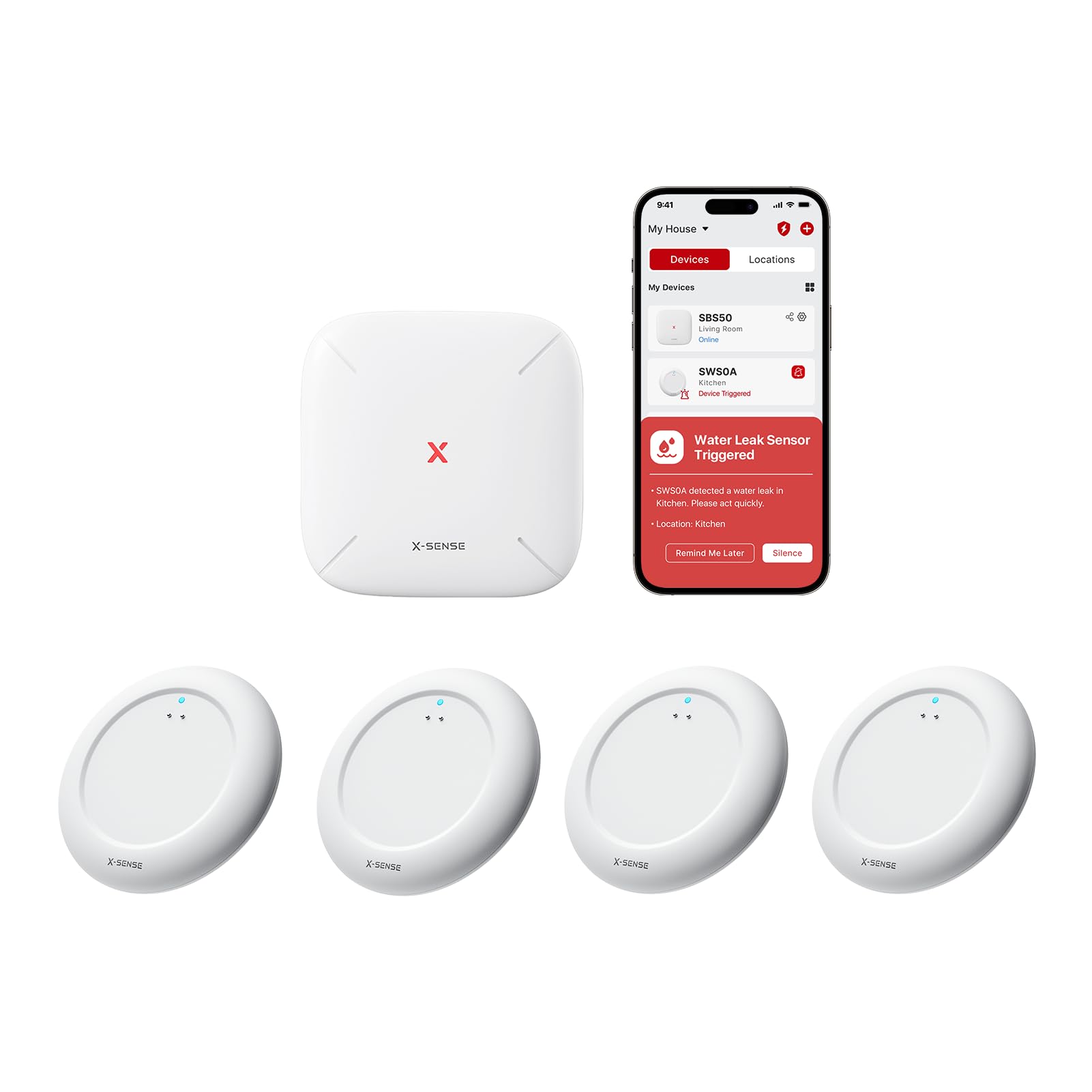
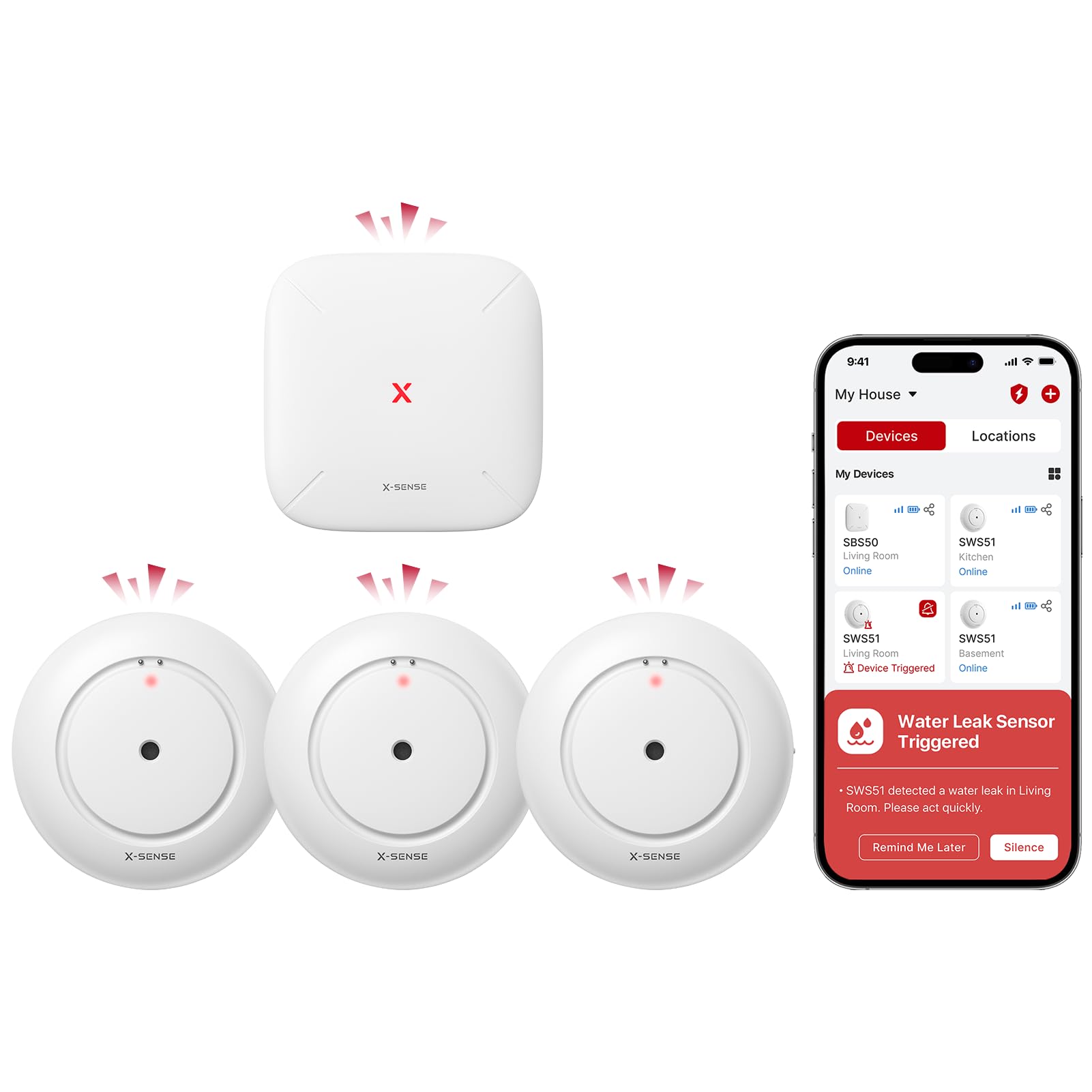
X-Sense SWS54 Kit

90 /100
LBD Score Outstanding

Key details

Alarm
120 dB from sensor and base
Detection
Water as low as 0.4 mm
In The Box
Base station + 3 sensors
Wireless Range
Up to 1,804 ft
View on Amazon

Two alarms for one leak is the SWS54's argument: when a sensor gets wet, the puck and the plug-in base station both sound, at 120 decibels, which puts it at the top of this group for volume. If the leak you're worried about is a basement you can't hear from upstairs, start here.

Sensitivity is competitive rather than class-leading. Four probes underneath and two on top pick up water as shallow as 0.4 mm, and the IP66 housings survive a dishwasher puddle. The radio link reaches 1,804 feet in open air, and the app sends push alerts, shares access with up to 12 people, and offers a 10- or 30-minute snooze while you deal with the mess.

The catch is the one that follows every Wi-Fi kit here. These talk to your router on 2.4 GHz, and a combined network name is where setup tends to go sideways. The base station also needs an outlet, which rules out the spot under the sink you were picturing — plan on a counter or a floor socket nearby.

Pros

  • 120 dB from sensor and base together
  • Detects water as shallow as 0.4 mm
  • App alerts shared with up to 12 people

Cons

  • Three sensors only
Our verdict

Two 120 dB alarms for one leak make this the kit to buy when the noise has to travel — a basement, a garage, a second floor.

Check Latest Price
4

Best No-Setup Alarm

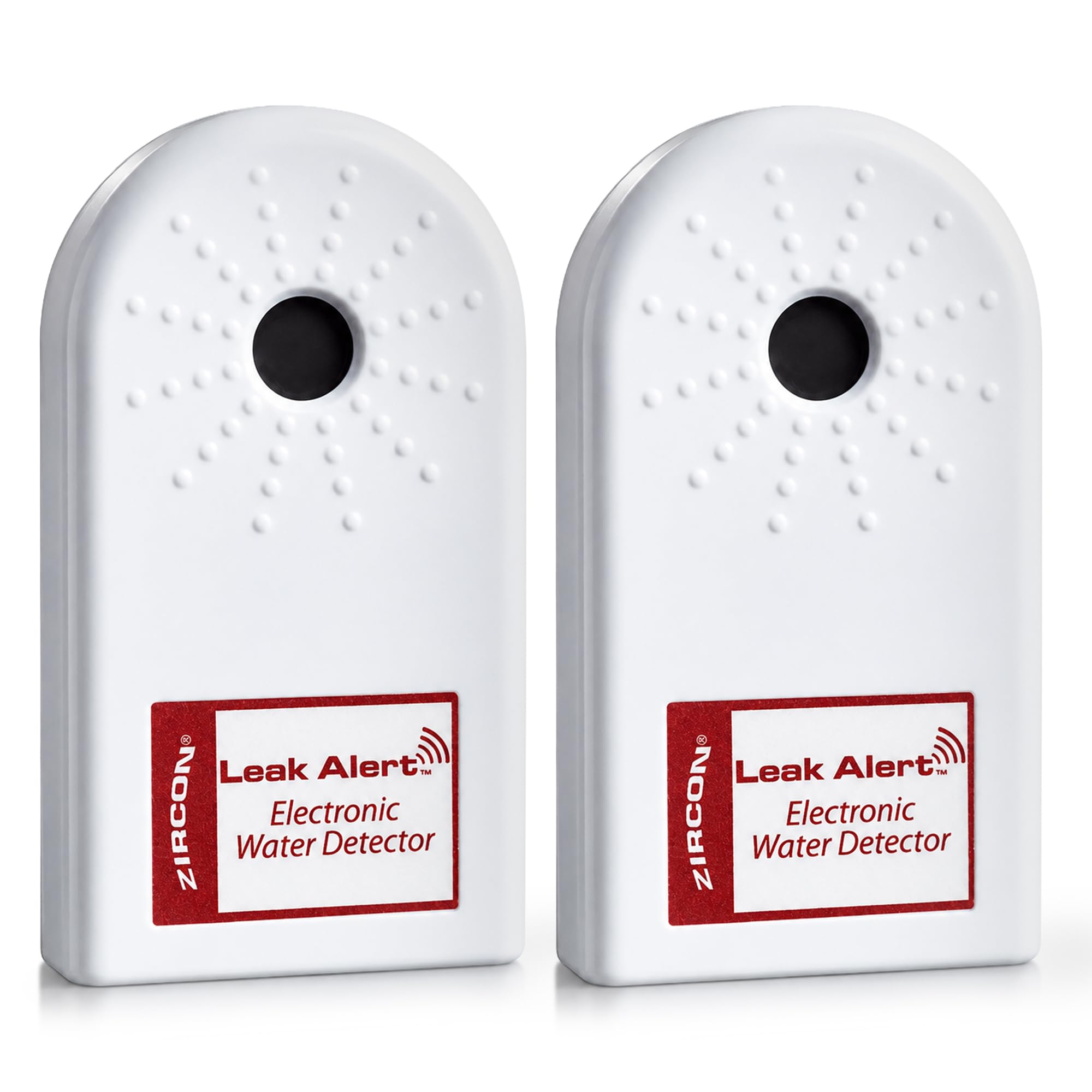
Zircon Leak Alert 2-Pack

92 /100
LBD Score Outstanding

Key details

Pack
2 detectors
Alarm
90 dB
Battery
9V, not included
Flood Behavior
Floats and signals up to 72 hours
View on Amazon

Most water alarms sit where you put them. This one floats. In a basement that takes on water, the Leak Alert is built to ride the surface and keep signaling for up to 72 hours, which is a different job from catching a drip under a cabinet.

On dry land it is a plain buzzer with two metal contacts on the base, a 9V battery you supply, and no app, hub or account anywhere in the process. The missing battery is a mild annoyance rather than a problem — buy a card of 9Vs and plan on one a year. The signal itself is memorable: a repeating SOS pattern you won't mistake for a smoke alarm in the dark.

Put one where water arrives in volume — a basement slab, a crawl space, the pan under a water heater — and the pair covers the water heater and the floor drain together, which are the two spots worth protecting first.

Pros

  • Floats and signals up to 72 hours
  • No setup beyond a 9V battery
  • Sensitive enough for a slow drip

Cons

  • 90 dB is the quietest alarm here
  • 9V battery not included
Our verdict

Zero setup and a body that floats: this is the alarm for a floor that actually floods, and the pair covers two wet spots.

Check Latest Price
5

Best Adjustable Volume

RUIKORING 5-Pack Water Alarm

91 /100
LBD Score Outstanding

Key details

Alarm
Adjustable 0-120 dB
Battery
2 AAA per unit, 5-year claim
In The Box
5 detectors + 10 AAA batteries
Waterproof Rating
IP67
View on Amazon

Volume is the specification nobody checks before buying and everybody complains about afterwards. This set makes it a control: four steps from a full 120 dB down to a mute setting, changed by holding the test button.

That is the feature that earned the set a place. Testing five alarms with a finger across the contacts at full volume is genuinely unpleasant, and mute makes it a two-second job; in a small apartment, a sensor you can turn down is one you won't unplug after a bad night. The trade is obvious enough — a muted alarm protects nothing — so set the level back up when you've finished checking.

The hardware stands up to anything here: IP67, four probes underneath and two on top, ten AAA batteries in the box for five units, and a battery claim in the same territory as the YoLink sensors. Five protected spots for less than any of the connected kits.

Pros

  • Volume adjustable from mute to 120 dB
  • IP67 housing for wet, dusty spots
  • Ten AAA batteries included for five units

Cons

  • Standalone only, no app or remote alerts
Our verdict

A volume dial from mute to 120 dB is why we recommend this set: you can test it without flinching and turn it down without disconnecting it.

Check Latest Price
6

Best for Tight Spaces

X-Sense SWS0A41 Kit

90 /100
LBD Score Outstanding

Key details

Detection
Water as low as 0.4 mm
Thickness
0.7 in
In The Box
Base station + 4 sensors
Wireless Range
Up to 1,700 ft
View on Amazon

Same family as the kit above, different problem solved. The SWS0A41's sensors are 0.7 inch thick and 3 inches across, which is the difference between a detector that slides under a dishwasher's kick panel and one that sits in front of it. If you've ever knelt on a kitchen floor hunting for a gap, that number is the whole review.

The rest tracks the SWS54: four bottom probes and two on top, detection down to 0.4 mm, IP66 housings, and a base station that carries the siren while the app handles alerts and volume. It ships with four sensors rather than three, which matters if a kitchen and a laundry room are both on your list. Range is quoted at 1,700 feet, a little shorter than its sibling's and still far more than a house needs.

Choose it over the SWS54 in exactly one situation: appliances with no clearance. Everywhere else the cheaper kit and its paired 120 dB alarm are the better buy, and the sensors ride a 2.4 GHz network either way.

Pros

  • 0.7 in thick, fits under appliances
  • Four sensors plus base station
  • Detects water as shallow as 0.4 mm

Cons

  • Base station needs a power outlet
Our verdict

The only kit here that slides under a dishwasher — the thin sensors do the same 0.4 mm detection as the bigger X-Sense pucks.

Check Latest Price
7

Away-From-Home Monitoring

GoveeLife Smart Leak Detector 2

88 /100
LBD Score Excellent

Key details

Alarm
100 dB on each sensor
Alerts
App, email and SMS
In The Box
Gateway + 6 sensors
Wireless Range
Up to 1,968 ft
View on Amazon

Six sensors, a gateway and three ways to be told — app, email and text — for a little less than the top pick. On paper the Govee kit is the best-value smart system in this roundup, and its 100 dB sensors don't need the gateway to make noise.

The specification is genuinely strong: 1,968 feet of LoRa range, IP66 sensors, up to five years of claimed battery life on two AAA cells each, and voice announcements through Alexa or Google alongside SMS. That last part matters if you want a notification that doesn't depend on an app you remembered to install.

Where it gives ground is the ecosystem behind it. Govee sells this as a leak kit, while the YoLink hub is the entry point to 300-plus devices including sirens and shutoff valves. If you think you'll automate a valve later, that gap is worth weighing.

As it stands, the kit does the job it advertises: alerts arrive by three routes, the local siren is loud, and the app names each sensor by room. Buy it when text alerts and a lower price lead your list.

Pros

  • App, email and SMS alerts
  • 1,968 ft LoRa range
  • 100 dB alarm on every sensor
  • Five-year battery claim

Cons

  • Gateway is fussy on combined Wi-Fi networks
Our verdict

Buy it for the text alerts and the per-sensor price; the hardware delivers, and the gateway is the part that asks for patience.

Check Latest Price
8

Large Homes

Geevon 10-Pack Water Alarm

90 /100
LBD Score Outstanding

Key details

Alarm
100 dB
Battery
9V per unit, about 12 months
Diameter
3.15 in
In The Box
10 detectors + 10 9V batteries
View on Amazon

Ten detectors in one box is a coverage decision, not a gadget decision. For a rental, a big house, or a workshop with water in half a dozen places, buying in this quantity is the cheapest way to put an alarm at every one of them — the per-sensor cost is the lowest on this list.

Each unit is a plain 3.15-inch puck with three prongs on the bottom, a 100 dB siren, and a 9V battery rated for about a year. Nothing pairs, nothing connects: unwrap it, pull the tab, set it down.

Two things to plan for. Ten 9V batteries a year is a real recurring cost, so choose one date — the same day you do the smoke alarms — and swap them all. And 100 dB from a puck on the floor is not the same as 100 dB at ear height; volume is the most common letdown in this category.

Where the set earns its place is the arithmetic: ten protected spots for less per sensor than anything else here, no subscription, no hub, and nothing to reconnect after a power cut. Cover the water heater, both sink cabinets, the washer and the fridge line, and you still have five left.

Pros

  • Lowest cost per sensor of any pick here
  • 100 dB siren with no hub or app
  • Batteries included for all ten

Cons

  • No app or remote alerts
  • Ten 9V batteries to replace yearly
Our verdict

Ten alarms for less per sensor than anything else here — the pick when you need coverage everywhere and a phone alert is not the point.

Check Latest Price

How We Tested Water Leak Detectors

We started by researching the category and narrowing the field to standalone alarms and hub- or Wi-Fi-connected kits with different sensor sizes, alarm volumes, battery claims, and water-sensitivity specs. We filtered out models with vague support pages, missing batteries, or a per-sensor price that made covering a whole basement unrealistic. Then we tested 18 individual detectors from eight products—some multi-packs, some single units—over four months.

I set each one up from the box, timed how long it took to pair with a hub or Wi-Fi and send a first alert, and noted whether the instructions assumed a phone, a screwdriver, or neither. In the test house, I placed them under the kitchen sink, behind a toilet, beside the water heater, under the dishwasher, in a basement laundry corner, and in a utility closet. I also slid the thinnest models under an appliance and put detachable probes into a drip pan where a full-size sensor wouldn't fit.

For loudness, I triggered every alarm at its highest setting and listened from upstairs, behind a closed door, and over a running washing machine; on adjustable models I also set the volume low to see if it was still useful. For connectivity, I timed app notifications with my phone on Wi-Fi and off, noted missed or delayed alerts, and checked whether the kit kept working after the hub lost power. I tested sensitivity with a few drops and a thin film of water, not just a puddle, and watched for false alarms after steamy showers.

Reliability meant repeated wet-dry cycles over the four months, checking whether sensors still triggered after sitting in a damp cabinet and whether casings stayed sealed. I logged battery levels at the start and end, noted low-battery warnings, and compared per-sensor cost with what came in the box—batteries, mounting tape, hub, or nothing. The detectors that scored best were not always the loudest or the cheapest; they were the ones I stopped thinking about.

How to Choose a Water Leak Detector

Decide Who Needs to Hear It

A battery puck with a siren is the right answer if someone is usually home and the water source sits on a floor you use. A connected kit earns its extra cost in three situations: you travel, the space is a rental you don't visit often, or the likely leak is somewhere you never stand, like a crawl space. Pay attention to where the siren physically lives — some sensor kits are deliberately silent and rely on a hub or an added siren to make any noise at all, so check whether the sound comes from the puck, the base, or both before you order.

Match the Sensor to the Spot

Probe orientation decides what a detector can catch. Probes on the bottom sense pooling water; the two extra probes on top of designs like the X-Sense and RUIKORING units catch drips from a supply line or a condensate hose above. Published thresholds run from 0.4 mm to 1/32 inch, all fine enough for a slow leak, so choose on placement instead. A 0.7-inch puck slides under a dishwasher or a fridge where nothing else fits, and a sensor on a six-foot lead is the only way to get detection into a sump pit while keeping the alarm within earshot. Look for IP66 or IP67 anywhere splashing is likely.

Range, Hubs, and the Wi-Fi Trap

On a connected kit, only the hub touches your network. The sensors talk to it over a low-power radio — LoRa on the kits here, quoted between 1,700 and 2,034 feet in open air — so a sensor can live in a basement corner where Wi-Fi has never reached. The trap is at the hub. These connect on 2.4 GHz, and a router broadcasting one combined network name is where setup most often stalls; split the bands or give the hub its own 2.4 GHz network before you start. Then put the base station near an outlet, because the model that carries the siren needs power.

Batteries, Upkeep, and How Many You Need

Check that the battery is user-replaceable before you buy. Most units here take AAA or 9V cells you can swap in a minute, with claims running from about a year to five; a few seal the cell in at the factory, which turns the whole detector into a disposable item when it dies. Then plan coverage by water source rather than by room: the supply line under the kitchen sink, the washer hoses, the water heater pan, the dishwasher, the fridge line and the sump pit. A ten-pack is the cheapest route to covering all six. If any of those spots is somewhere you'll be away from, spend the money on a connected kit instead and cover fewer of them properly.

Frequently Asked Questions

Final Verdict

Our pick for a house someone leaves every morning is the YoLink Sensor 4 kit: six sensors that each shout at the leak, one hub that texts and emails you, and the longest and steadiest radio link among the connected kits here. If the leak you're worried about is a sump pit, the Basement Watchdog does that one job for a fraction of the money. And if sheer volume is the point, the X-Sense SWS54 is the loudest thing on the list.