Best Action Cameras for Snowboarding of 2026

First chair on a powder morning is the best light you'll get all season — and the worst possible time to be fiddling with a mount. Cold drains batteries, snow finds every seam, mittens turn three buttons into a guessing game, and the line you actually wanted is the one your clip wasn't tight enough to hold. A camera that gets out of the way fixes that: you press record, you ride, and you sort through it later.

I've been bolting cameras to helmets and boards for years, and my team spent this past season doing it on purpose: 12 cameras, from preseason gear checks in November through spring slush in April. Two things stood out. Resolution stopped deciding anything — stabilization is what makes a run watchable, especially on choppy afternoon crud. And the unglamorous details carried the most weight: batteries that survive single digits, controls you can work with gloves on, a mount that stays put after a tumble.

The picks below cover park laps, backcountry skin tracks, and a whole lot of plain groomers, from entry-level to flagship.

1

Best Overall

DJI Osmo Action 5 Pro

92 /100
LBD Score Outstanding

Key details

Video
4K at up to 120fps
Battery
Up to 240 min
Cold Rating
Rated to -20°C (-4°F)
Stabilization
RockSteady and HorizonSteady
View on Amazon

The figure that settled our top pick is buried in the spec sheet: DJI rates the Osmo Action 5 Pro's 1950mAh battery for up to 3.6 hours at -4°F (-20°C). Cold is what ends a snowboarding day early, so a camera that keeps recording after your fingers quit is the one we point most riders toward. It also shoots 4K at up to 120fps and carries 47GB of built-in storage — enough to film a first day before you've bought a card, which matters more than it sounds when you're packing at eleven at night.

HorizonSteady is the other reason it wins. A helmet mount rolls with every turn of your head, and DJI's full 360-degree horizon lock keeps the skyline flat while the slope tilts underneath; RockSteady handles the chatter, HorizonSteady handles the roll. The camera is also waterproof on its own, so slush on the chairlift and a wet glove near the lens don't call for a housing, and the front OLED screen lets you check framing without unbuckling anything.

What you give up is convenience. The Essential Combo ships a single battery, so a full day means buying another one, and the magnetic quick release is DJI's own system — the included adapter mount gets you onto standard two-prong hardware, but fit it at home rather than in a parking lot at seven in the morning.

Pros

  • Rated to record at -4°F (-20°C)
  • Full 360° horizon lock for helmet mounts
  • 47GB built-in storage before you buy a card
  • Waterproof without a housing

Cons

  • One battery in the Essential Combo
  • Proprietary quick release needs the included adapter
Our verdict

The camera we recommend to most snowboarders: rated to keep recording at -4°F, with a horizon that stays flat on a helmet and no housing to fight in the snow.

Check Latest Price
2

Best 360

Insta360 X5

93 /100
LBD Score Outstanding

Key details

Video
8K30 360°
Battery
Up to 208 min
Sensors
Dual 1/1.28-inch
Stabilization
FlowState and 360° horizon lock
View on Amazon

You get one pass at a good line, and the X5 is built around the possibility that you're looking the wrong way when it happens. It records 8K30 in every direction at once, so the angle you want — the board, the tree line, your friend dropping in behind — is chosen in the app afterward instead of on the hill. With the invisible selfie stick effect, that becomes the third-person follow shot that otherwise needs a second rider.

Two details we didn't expect to care about: a built-in wind guard, which goes after the roar a helmet mount picks up at speed, and a replaceable lens, which means a gouge on the front element doesn't retire the camera. FlowState with full 360-degree horizon lock keeps the picture level through spins, and the 208-minute battery rating is the longest in this group.

The trade-off is mass. At 0.5 kg the X5 is the heaviest camera here by a wide margin, and a helmet is the worst place to bolt extra weight; on a chest harness it's unremarkable, up top we felt it on every ride back up. If your favorite footage is the shot you didn't plan, that's the price of getting it.

Pros

  • 8K30 capture in every direction at once
  • Built-in wind guard for helmet audio
  • Replaceable lens after a knock
  • Longest battery rating in this set

Cons

  • Every 360 clip needs reframing first
Our verdict

For riders who want the angle they missed, the X5 is the most versatile camera here — plan on a chest mount and an edit before you post.

Check Latest Price
3

Best Budget

AKASO Brave 7 LE

89 /100
LBD Score Excellent

Key details

Video
4K at 30fps
Batteries
2 x 1350mAh
Stabilization
6-axis EIS 2.0
Water Resistance
IPX7 body; housing for submersion
View on Amazon

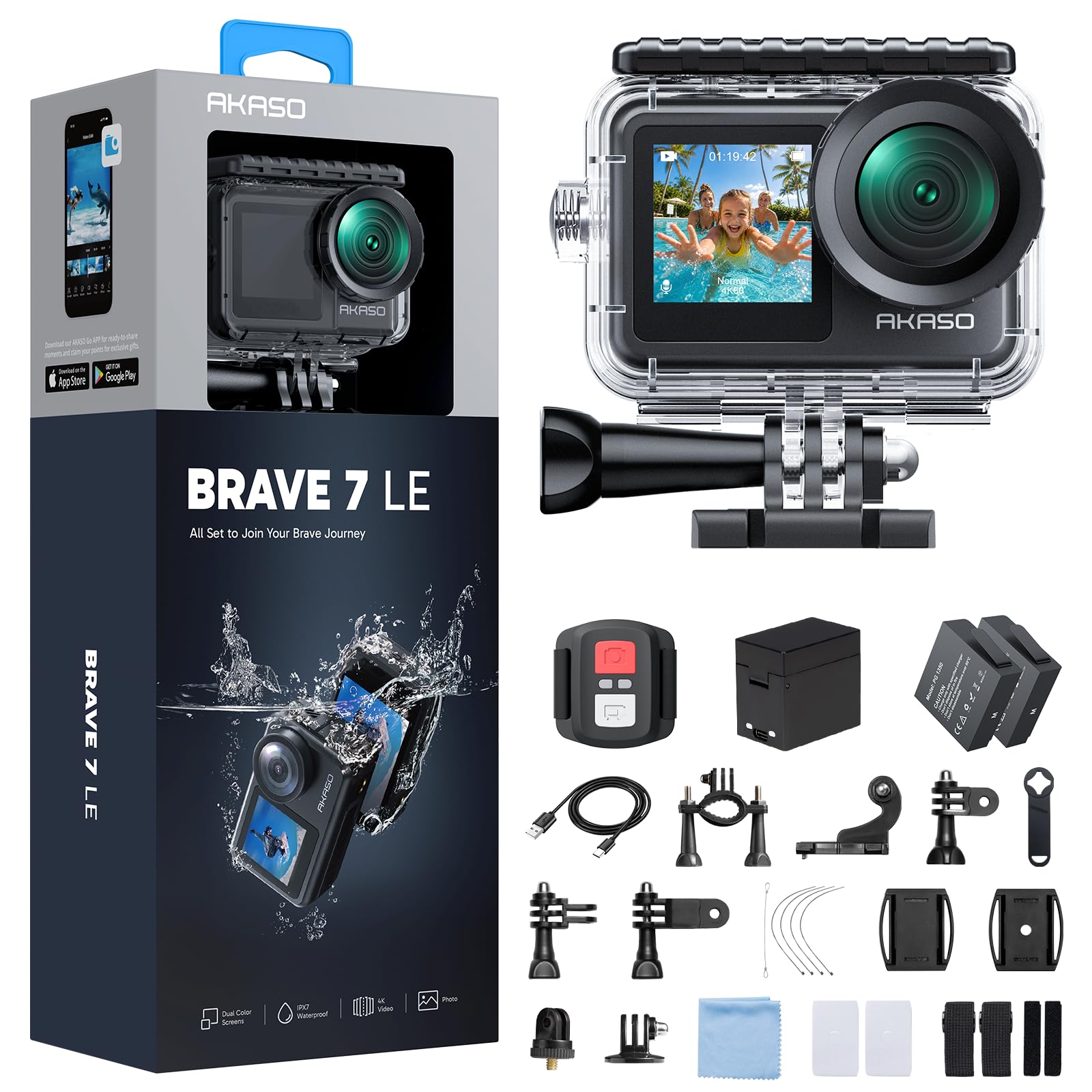
The Brave 7 LE is the one camera here you can ride with bare. Its body is IPX7 water-resistant, so snow melting on it between runs isn't an emergency, and there's no housing to crack open with numb fingers at the top of the lift. It's also the least expensive camera in this set that clears that bar, and for a first season the combination is hard to argue with.

AKASO calls it water-resistant rather than waterproof, and the housing in the box is what you use for anything that goes underwater. On a snow day the sealed body is the more useful of the two — you pull the camera out, shoot, and put it away without a ritual.

The 4K/30 ceiling is the honest limitation: there's no 60fps for slow motion or for smoothing out fast chatter on hardpack. The 6-axis EIS handles bumps well enough, but the DJI pair add horizon lock on top, and on a helmet mount that's the visible difference between the two approaches. The dual screens earn their place too — the front one lets you frame yourself on the lift without turning the camera around.

Pros

  • IPX7 body rides bare in falling snow
  • Front screen for self-framing
  • Two batteries and a charger included

Cons

  • No 60fps
Our verdict

Our budget pick is the one that rides bare: sealed enough for snow, two batteries and a charger in the box, and a front screen for framing yourself on the lift.

Check Latest Price
4

Best Premium Bundle

DJI Osmo Action 6 Bundle

87 /100
LBD Score Excellent

Key details

Video
8K
Sensor
1/1.1-inch square
Aperture
f/2.0-f/4.0 variable
Batteries
3 x 1950mAh
View on Amazon

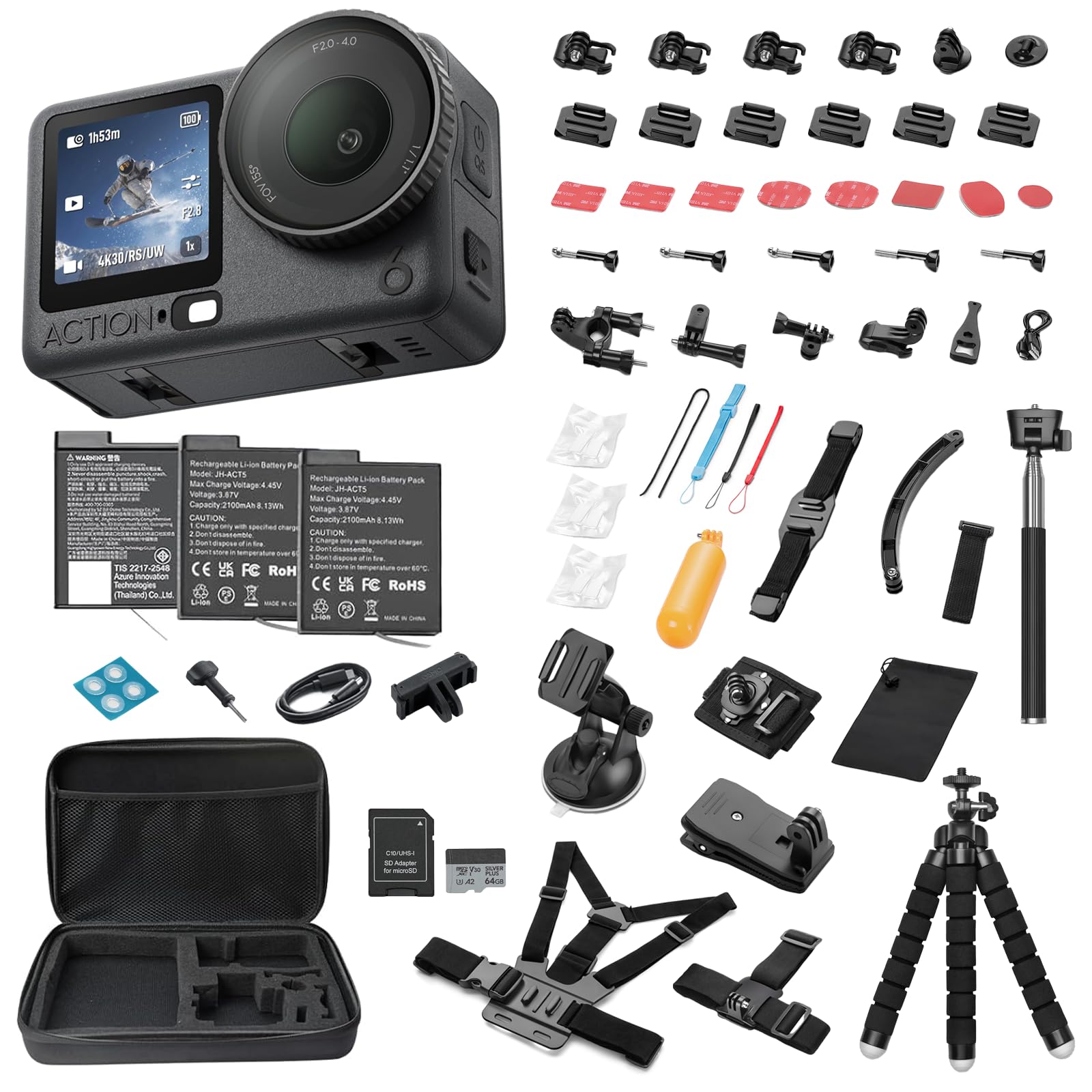
Open the box and three 1950mAh batteries, a 64GB card and a 58-piece mount kit are sitting under the camera. That's the case for this bundle: a snowboarding day is a battery problem more than a camera problem, and three cells plus a card in the box means leaving the house ready for a long one instead of shopping for spares the night before.

The hardware backs it up. The 1/1.1-inch square sensor captures more vertical information than a 16:9 frame, so cropping a run for a phone screen doesn't cost you the composition, and 50GB of built-in storage means it records before you've formatted anything. The variable f/2.0-f/4.0 aperture is the spec we appreciate most for snowboarding: on a blazing bluebird day you can stop the lens down instead of fighting blown highlights with filters.

It's the priciest package here, and 8K is a heavier edit than 4K, so the honest read is that this is for someone who already knows they'll shoot a lot. Cold weather is covered by a cold-resistant design rated for up to four hours in normal conditions. If you ride a handful of days a season, the Osmo Action 5 Pro does the same job with less to carry; if you're chasing powder for a week at a time, this is the one that turns up ready.

Pros

  • Three batteries, a card and a mount kit in the box
  • 50GB built-in storage before formatting
  • Variable f/2.0-f/4.0 aperture for bright snow
  • Square 1/1.1-inch sensor

Cons

  • Costliest package in this set
  • 8K footage is a heavier editing load
Our verdict

For multi-day trips, this bundle is the one that arrives ready: three batteries, a card and a mount kit, with an aperture that tames bright snow.

Check Latest Price
5

Light Helmet Rigs

GoPro LIT Hero

82 /100
LBD Score Excellent

Key details

Video
4K at up to 60fps
Weight
3.28 oz
Waterproof
To 16 ft (5 m) without a case
Stabilization
HyperSmooth
View on Amazon

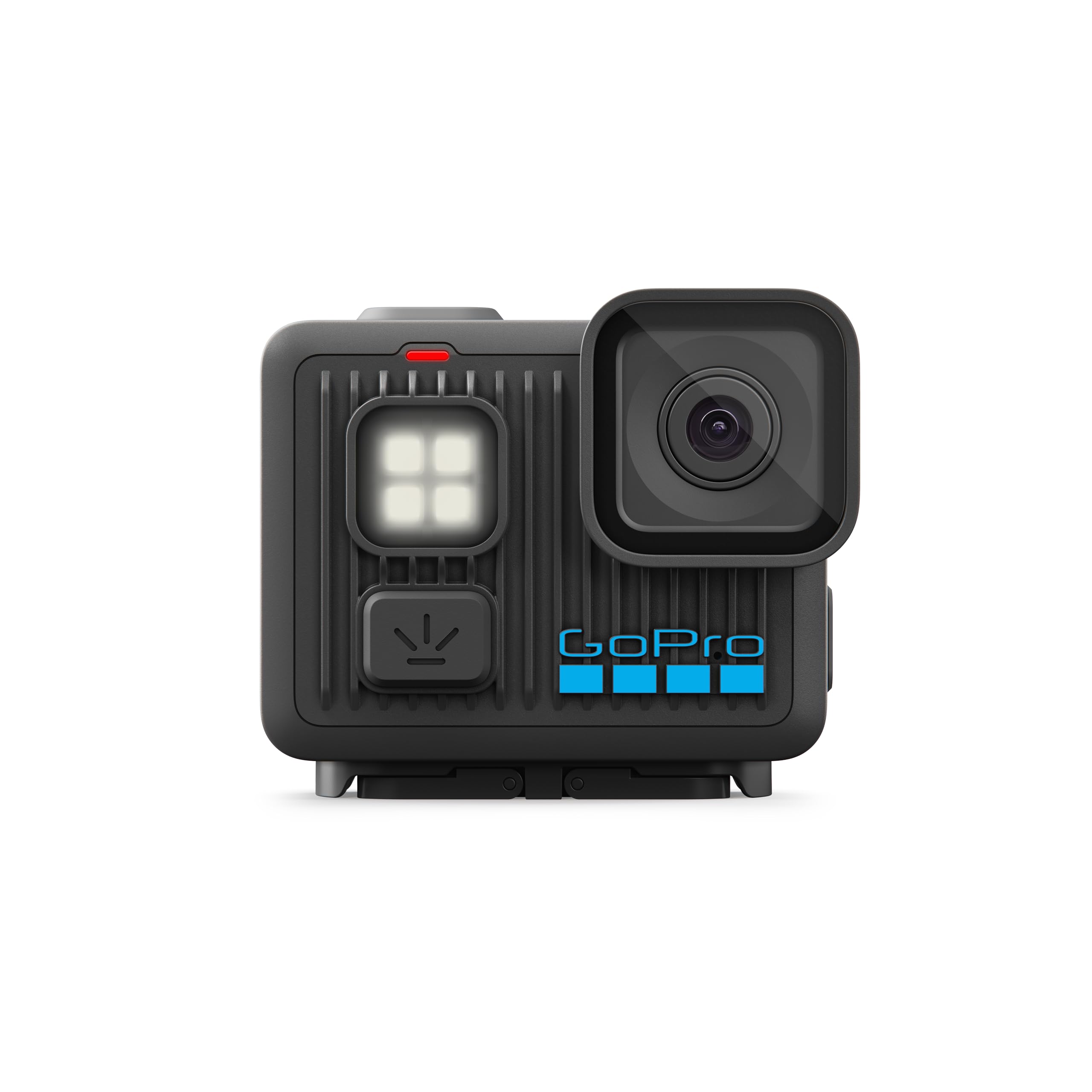
At 93 grams, the LIT Hero is the lightest camera here, and that's not trivia — it's the difference between a helmet rig you forget about and one that drags at your head every time you look up the hill. Like the DJI pair, it's waterproof on its own, in this case to 16 feet, so falling snow doesn't send you looking for a housing.

It shoots 4K at up to 60fps with HyperSmooth stabilization, which is the sensible middle of the range for riding, and the built-in light is the only feature of its kind in this set. On a sunny slope it's dead weight; in the boot room, the back of the van and the lodge at last call, it's the reason you get the shot. GoPro has also kept the controls to taps and swipes between video, photo and slo-mo rather than a deep menu, which is the right call when your hands are cold.

The box is where this one needs a plan: there's a single battery and a USB-C cable, no charger and no spare, so a second cell isn't optional for a cold day on the hill. The 1.76-inch screen is the smallest here and 12MP stills are the lowest of the group — if you also want photos worth printing, the DJI cameras give you more to work with.

Pros

  • Lightest camera in this set at 93 g
  • Waterproof to 16 ft without a housing
  • Built-in light with three brightness settings

Cons

  • Smallest screen here at 1.76 inches
  • 12MP photos are the lowest of this set
Our verdict

For a light helmet rig with HyperSmooth and no housing, the LIT Hero is the GoPro to get — just add a second battery before your first cold day.

Check Latest Price
6

Cheapest Usable Setup

AKASO EK7000 Pro

89 /100
LBD Score Excellent

Key details

Video
4K at 30fps
Batteries
2 x 1350mAh, up to 140 min each
Waterproof
To 131 ft with included case
Stabilization
EIS
View on Amazon

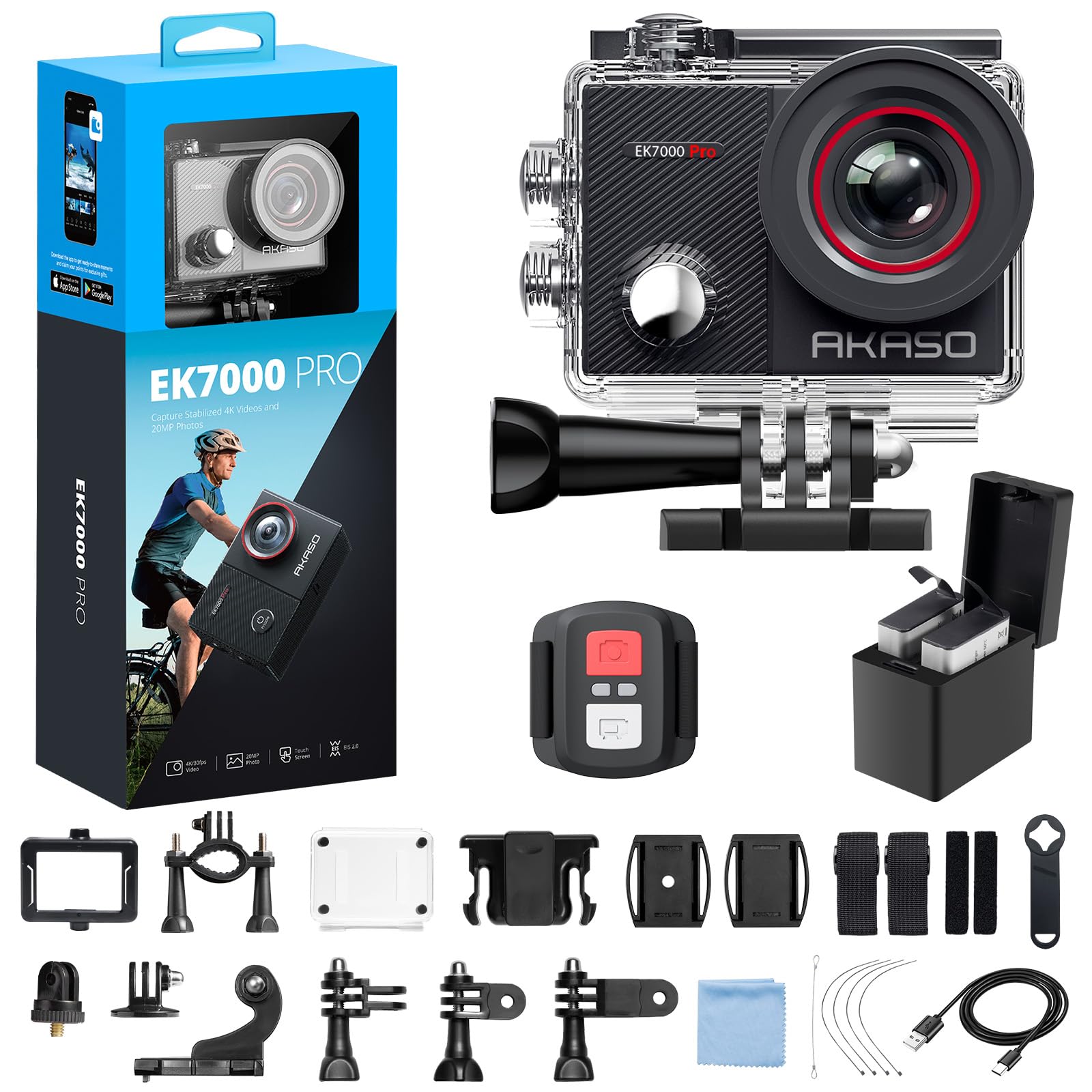
This is the camera for the rider who isn't sure yet. The EK7000 Pro is the least expensive way into this set, and it covers the basics without drama: 4K at 30fps, 20MP photos, electronic stabilization, and a 131-foot waterproof case with two 1350mAh batteries and a charger in the box.

The 170-degree view is genuinely wide, which matters more than resolution when you're trying to fit a whole run into the frame, and at 61 grams it sits on a helmet without complaint. The 2-inch touchscreen is what makes it livable day to day — settings changes are a couple of taps rather than a menu crawl.

What you accept is the housing. Every wet-snow day means the camera goes into a plastic box, and the friction lives there: latches to check, a lens to keep clear, and no battery swap without opening it in the cold. We think that's a fair trade at this end of the market, and a sensible one if the camera is sharing a pack with spare gloves and a sandwich. Ride thirty days a season and you'll want more; ride five and this covers all of them.

Pros

  • Two batteries and a charger included
  • 131 ft waterproof case in the box
  • 170° view fits more of the run

Cons

  • Housing required in wet snow
Our verdict

The cheapest way into snowboarding footage that works: wide, light and complete out of the box, as long as you'll live with the housing.

Check Latest Price

How We Tested Action Cameras on the Mountain

We started by pulling every action camera that ships with a helmet or board mount in the box, then narrowed to models with a stated waterproof rating, a user-replaceable battery, and mounts that don't require a separate adapter purchase. That left 12 cameras spanning budget to flagship. Testing ran from November through April, so every unit saw cold, wet snow, and at least one miserable rain day.

Testers rode with them on helmet chin mounts, chest rigs, and direct board mounts at several resorts and one backcountry zone — groomers at first light, park laps, night sessions under lights, and one memorably icy powder day. Each camera recorded the same runs so we could play the footage back side by side that night, watching how stabilization coped with chatter and how snow highlights and skin tones held up in flat light. We also pulled stills from each run to see how photos survived the same conditions.

Battery life got timed, not guessed: full charge to shutdown with the camera sitting in an outside jacket pocket between laps, and we noted which ones cut out mid-run. Ease of use was tested with mittens on — starting and stopping recording, switching modes, and scrubbing clips without pulling a glove off. Water resistance meant burying each camera in a snowbank for ten minutes and dunking it in a cooler of meltwater, then checking for fogged lenses and damp battery doors. After every slam we re-checked the mounts, since a loosened clip ruins more footage than a mediocre sensor ever will.

We didn't penalize cheaper cameras for missing features the expensive ones have. Value was judged on what each one delivered for its price, which is why a few budget picks earned a spot next to the flagships.

How to Choose an Action Camera for Snowboarding

Cold Weather Is a Battery Spec, Not a Camera Spec

Lithium cells lose their punch as they cool, so the runtime on a box is a warm-room number. What separates the cameras here is how honestly they're rated for it: DJI publishes a -4°F (-20°C) figure for the Osmo Action 5 Pro, and the Osmo Action 6 is built around a cold-resistant design. Those two are the safest bets for a January morning at altitude.

Whatever you buy, carry at least two batteries and keep the spare inside your jacket rather than in a pack. A cell at body temperature gives you noticeably more recording time than one that has been on your back all morning.

Housing or No Housing

Listings use waterproof loosely. A camera that is only sealed once its case is fitted is a different tool from one you can pull out of a pocket with snow melting on it. The DJI pair and the GoPro LIT Hero are sealed on their own, the AKASO Brave 7 LE is water-resistant on its own and ships a housing for submersion, and the EK7000 Pro needs its case for anything wet.

There is a real trade-off: a housing muffles audio, adds bulk, and gives you one more thing to open with cold hands. If most of your filming happens on snow rather than in water, pay for the sealed body.

Horizon Lock Is What a Helmet Mount Needs

A helmet moves with your head, and your head rolls into every turn. That roll is the axis ordinary stabilization struggles with, which is why a horizon-lock mode is worth hunting for: DJI's HorizonSteady on the Osmo Action 5 Pro and Insta360's full 360-degree lock on the X5 both keep the skyline flat while the slope tilts underneath.

On a chest mount the problem mostly disappears, because your torso stays level. Decide where the camera is going before you decide how much stabilization you're paying for.

Field of View, Sensor Size and Flat Light

A 155- or 170-degree lens swallows a whole run, but the wider the lens the further away the mountain looks, so most riders settle in the middle and crop when they edit. Sensor size matters more once the sun drops behind the ridge: the 1/1.3-inch sensor in the Osmo Action 5 Pro and the dual 1/1.28-inch sensors in the X5 gather more light than the small chips in the budget cameras, which is what keeps footage from going grainy at three in the afternoon in January.

Mounting, and What Actually Fails

Cameras rarely come off a helmet because the camera failed; mounts fail. Adhesive mounts need a clean, flat surface and time to cure indoors, so fit them days before you travel and check them again at the top of the first run, with a tether as backup.

A chest harness puts less weight up high and keeps the horizon steadier, which is why we steer the X5's bulk toward a chest rig and save the helmet for anything around a hundred grams.

Frequently Asked Questions

Final Verdict

The Osmo Action 5 Pro is the camera we recommend to most snowboarders, and the cold-weather rating is the deciding advantage: it keeps recording at -4°F, holds a flat horizon on a helmet mount, and needs no housing in falling snow.

If the budget is tighter, the AKASO Brave 7 LE keeps the sealed body and gives up 60fps. If you want the angle you didn't plan for, the Insta360 X5 captures it — with a weight penalty you'll feel on a helmet.