Best Action Cameras for Surfing of 2026

A camera that survives the paddle-out and then dies in your board shorts an hour later is a particular kind of disappointment. Salt water creeps into seams, sand finds every port cover, and the wave you actually wanted is usually the one you missed because the battery icon was already flashing. The real question isn't which one shoots the sharpest clip; it's which one is still rolling after the third duck dive.

I've been strapping cameras to boards and helmets for years, and my team and I just spent six months putting 12 of them through real sessions. Here's what nobody tells a first-time buyer: stabilization beats resolution in choppy surf, and the mounts in the box matter more than frame rate.

The picks below are the ones that came back working, with footage worth posting — a battery that outlasts a long session, an app that doesn't fight you in the parking lot, a body that doesn't cook in the sun. Some are flagship-level; a couple cost far less, which matters when the thing is strapped to a board you might lose.

1

Best Overall

DJI Osmo Action 5 Pro

92 /100
LBD Score Outstanding

Key details

Battery
1950mAh, up to 4 hours
Top Video
4K/120fps
Stabilization
HorizonSteady 360°
Water Resistance
Waterproof, no housing needed
View on Amazon

A rolling board swings the whole frame, so the first thing we look for in a surf camera is horizon lock. The Osmo Action 5 Pro's HorizonSteady holds the waterline through 360 degrees of roll, which means a cutback does not send the wave tilting off to one side. On a chest mount at the takeoff, that is the difference between a clip people watch to the end and one they close.

Just as important, this one goes in the water without a housing. No case to fog on a warm morning, no muffled audio, and no unsealing the camera on the beach to change a setting. DJI also built 47GB of storage into the body, which sounds like a small thing until the card is still in your laptop and the swell is building.

The 1950mAh Extreme Battery Plus is rated for up to four hours of recording, the longest claim in this group, and the dual OLED touchscreens stay readable in full sun. At 146 grams it sits on a helmet without dragging it sideways, and the magnetic quick-release adapter moves the camera from a board mount to a chest rig in about the time you get between sets.

The premium buys the lock, the battery, and the case-free body, and for anyone filming surf most weeks that is the right trade. The number DJI does not publish is a depth rating for the bare body, so if the same camera is coming on dive trips, confirm that before you take it past snorkeling depth.

Pros

  • 360-degree horizon lock keeps wave footage level
  • Waterproof without a housing
  • Up to 4 hours on the included battery
  • 47GB built in, so a missing card won't stop you

Cons

  • Costliest camera in this guide
  • No depth rating published for bare-body use
Our verdict

The surf camera we hand people first: 360-degree horizon lock, a body that goes in the water bare, and a battery that lasts a session.

Check Latest Price
2

Best Value

DJI Osmo Action 4

93 /100
LBD Score Outstanding

Key details

Battery
1770mAh
Top Video
4K/120fps
Field Of View
155°
Stabilization
RockSteady, HorizonBalancing
View on Amazon

If the Action 5 Pro's price is the sticking point, the Action 4 is where we point people. It uses the same 1/1.3-inch sensor size, shoots 4K at up to 120fps, and pairs it with a 155-degree lens — the widest view in this guide. On a nose-mounted camera that means the whole wave stays in frame instead of just the water directly ahead of you.

The compromise sits in the stabilization list. Where the 5 Pro holds the horizon through a full 360 degrees of roll, this one stops at HorizonBalancing, so a hard lean still tips the frame. Plenty of surfers never notice the difference; if level footage is the entire reason you are buying, notice it now.

Everything else about living with it is easy. The magnetic quick release swaps between mounts in seconds, the 1770mAh battery is rated to keep working at -20°C, and the body is waterproof without a case. What we did not love is the setup path: the DJI app and an account stand between you and your first clip, and that is the part of this camera that gets in its own way.

At 145 grams it makes a natural helmet camera, and 10-bit color with D-Log M leaves room to grade a sunset session rather than accepting whatever the camera decides. The 155-degree view does most of the work, though — wider than anything else here, and the reason board-mounted footage looks like riding rather than peering.

Pros

  • Widest field of view in this guide at 155 degrees
  • Same 1/1.3-inch sensor size as the top pick
  • Magnetic quick release swaps mounts fast

Cons

  • No 360-degree horizon hold like the top pick
  • Setup pushes you through the DJI app account
Our verdict

Buy this one for DJI footage and the widest lens here without top-pick money — you give up the full horizon lock to get it.

Check Latest Price
3

Best Image Detail

GoPro HERO12 Black

89 /100
LBD Score Excellent

Key details

Photos
27MP
Top Video
5.3K/60fps
Stabilization
HyperSmooth 6.0
Waterproof Rating
33ft (10m), no housing
View on Amazon

Long takes in still air are where the HERO12 Black gets uncomfortable: the body warms up, and in the wrong conditions it shuts down mid-clip. In the surf that rarely bites. A ride lasts seconds, the camera is wet most of the time, and you are back on the sand before heat becomes the story.

What you get in exchange is the most resolution here — 5.3K at 60fps, which GoPro puts at 91 percent more than 4K. That headroom is the point: you can crop into a wave and still deliver a 4K file, and the HDR mode holds detail in both the blown-out white of a breaking wave and the glare running off the water.

We also like that the 33-foot (10-meter) rating applies to the bare body. No housing, no fogging, no muffled audio, and the mounting buckle goes straight onto a board mount. HyperSmooth 6.0 includes horizon lock, so the camera can roll with the board and still keep the waterline level — the same job the DJI top pick does, with more pixels to spare.

The catch is in the box. You get one curved adhesive mount, a buckle, and a thumb screw, so a second board or a chest harness is another order. Budget for the mounts you actually need; the camera itself is ready for the water the day it arrives.

Pros

  • 5.3K/60 footage gives the most crop room here
  • Rated to 33ft with no housing
  • HyperSmooth 6.0 adds horizon lock

Cons

  • Ships with only one adhesive mount
Our verdict

Our pick for detail hounds: 5.3K you can crop, HyperSmooth with horizon lock, and a body rated to 33 feet with nothing around it.

Check Latest Price
4

Best Budget Bundle

AKASO Brave 4 Pro

90 /100
LBD Score Outstanding

Key details

Batteries
2 × 1350mAh
Top Video
4K/30fps
Stabilization
EIS 2.0, 6-axis
Waterproof With Case
131ft
View on Amazon

The box is the pitch here. AKASO ships the Brave 4 Pro with a floating hand grip, a carry bag, the waterproof housing, a helmet kit, two 1350mAh batteries, and a dual charger. For a surfer the float is the piece that matters: a camera that pops off a board mount does not come back on its own.

The camera is a 4K/30fps unit with EIS 2.0 and a six-axis gyro, dual color screens front and back, and a housing rated to 131 feet. Set your resolution and mode before you seal it, because inside the case you are working with the shutter button and not much else — the same trade every cased camera here makes, not a knock on this one specifically.

We think the value lands squarely in the middle of this guide. It costs a fraction of the DJI and GoPro picks and still puts a stabilized 4K clip on the card, with the accessories that usually cost extra already in the bag. Battery life is the weak spot, and the two included packs are the answer — swap at the halfway point of a long session instead of hoping one pack goes the distance.

The honest limit is 30 frames per second at 4K. If you want a cutback in slow motion, this is not the camera for that shot, and the frame rate lives in the HERO12 Black or the Action 4. Everything else about the kit is aimed at one thing: getting you filming on the first decent swell rather than shopping for mounts.

Pros

  • Floating hand grip included for water use
  • Housing rated to 131ft with mounts and two batteries
  • Dual screens for front and rear framing

Cons

  • 4K tops out at 30fps
  • Battery life trails the better cameras here
Our verdict

The kit we point first-timers to — floating grip, case, mounts, and two batteries in one box, with modest 4K30 footage to match.

Check Latest Price
5

Cheap First Camera

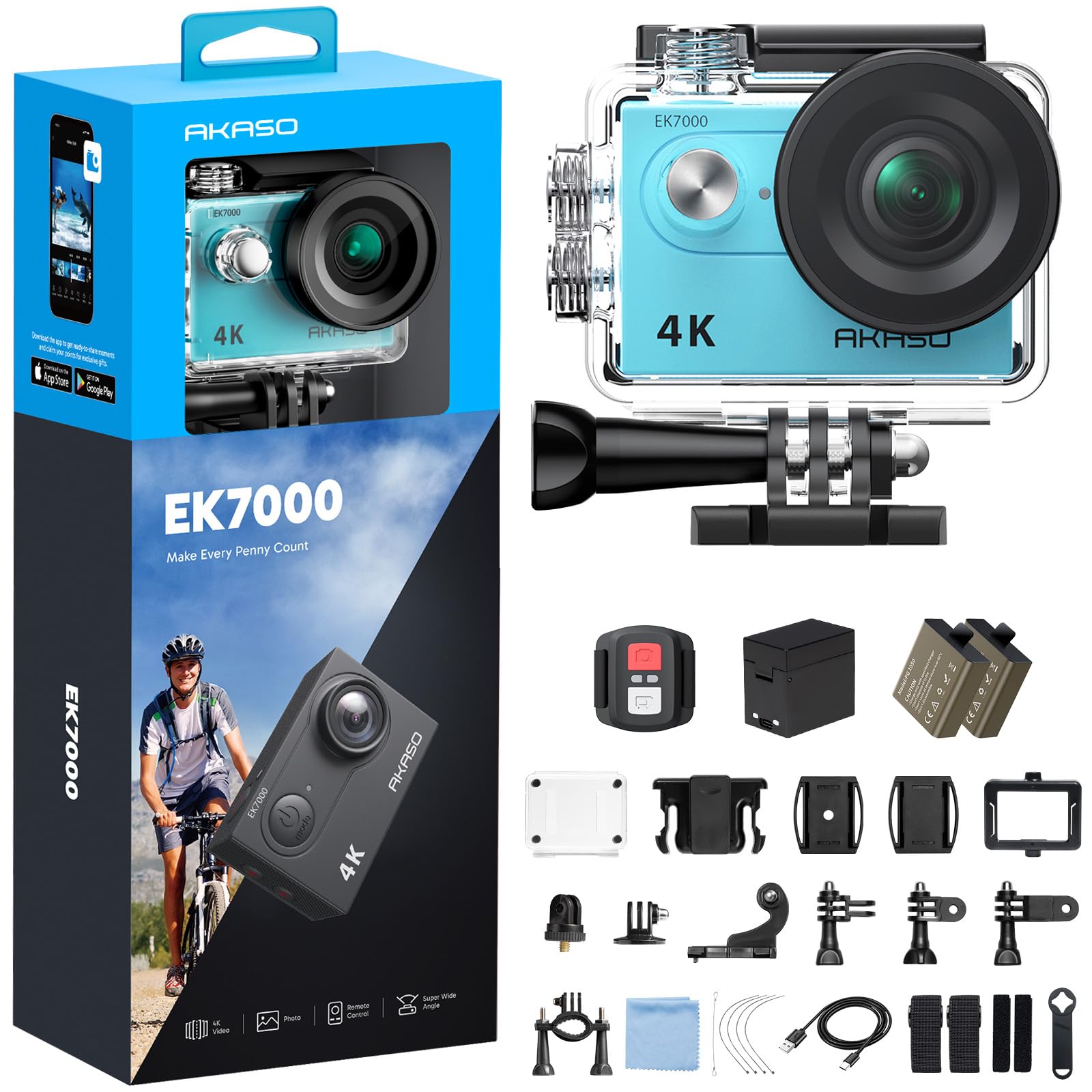
AKASO EK7000

89 /100
LBD Score Excellent

Key details

Weight
1.76 oz
Batteries
2 × 1050mAh
Top Video
4K/30fps
Waterproof With Case
131ft
View on Amazon

This is the camera for someone who is not sure yet. It is the least expensive AKASO in this guide and sits near the bottom of the range overall, and that is the right way to test the hobby: buy the cheap one, find out whether you actually watch the footage, and spend more later if you do.

What arrives is more than the price suggests — 4K at 30fps, 20MP stills, EIS, a housing rated to 131 feet, a 2.4G wrist remote, seven mounts, two clips, five tethers, and two 1050mAh batteries. At 1.76 ounces the body disappears on a helmet, which is not true of the DJI cameras once you add their mounts.

Where the price shows is stabilization and battery. The EIS is the basic kind, so chop and vibration come through more than they do on the DJI picks, and the battery is the weak link. Two packs and a charger in the box are the mitigation, and you should plan on using both across a morning.

The wrist remote is the detail we keep coming back to. It means you can start recording from the beach or from the lineup without reaching for a camera strapped to a board — a small thing that changes how much you actually shoot.

Pros

  • Very light at 1.76 ounces for helmet mounting
  • Wrist remote plus a full mount kit in the box
  • Housing rated to 131ft with two batteries

Cons

  • Basic EIS lets chop through
  • Battery life is the weak link
Our verdict

Cheapest sensible way to try surf filming: a light 4K body, a pile of mounts, and a case that keeps it dry at 131 feet.

Check Latest Price
6

Spare Angle Footage

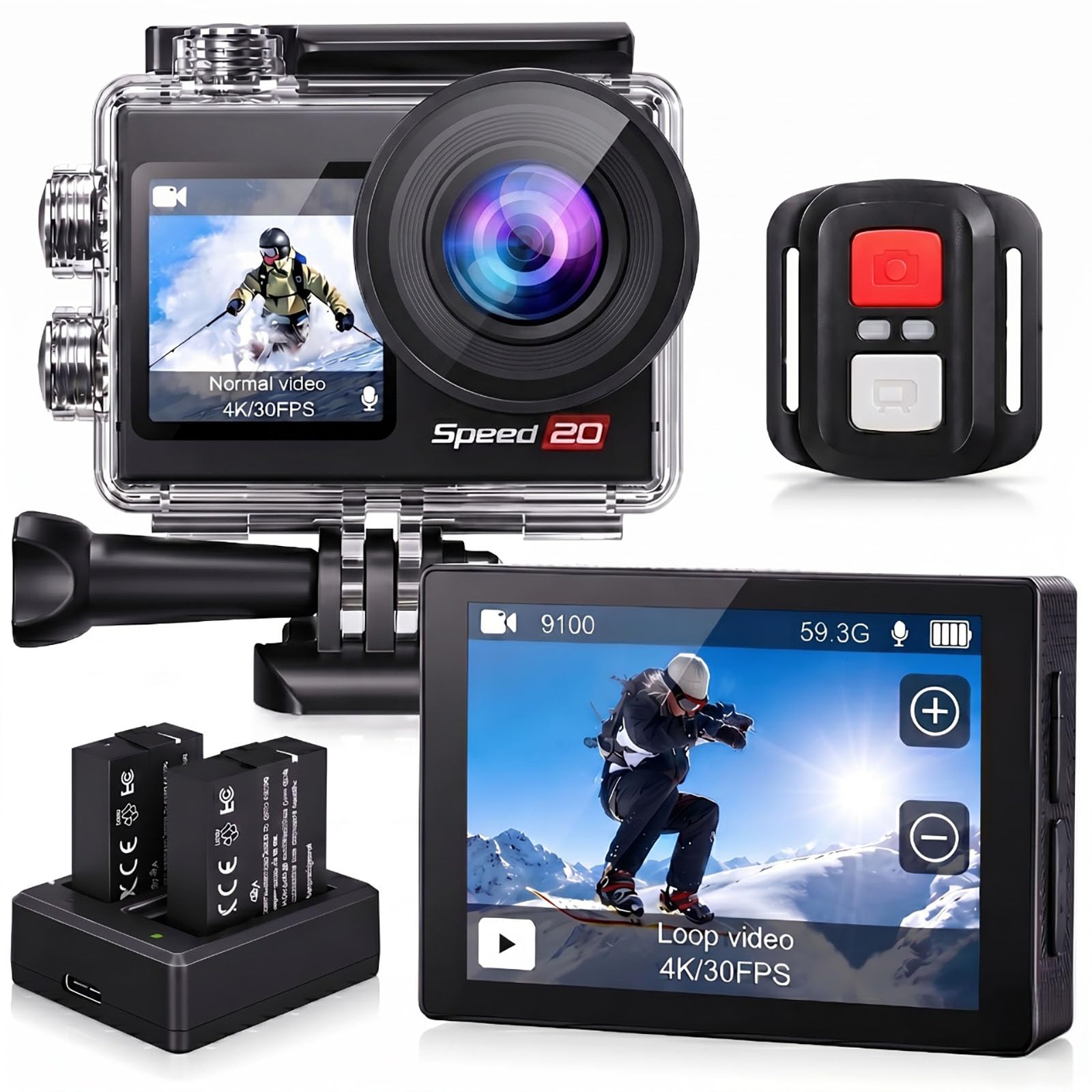
Hiicam Speed 20

83 /100
LBD Score Excellent

Key details

Screens
2-inch touch + 1.4-inch front
Top Video
4K/30fps
Field Of View
170°
Waterproof With Case
131ft
View on Amazon

Two screens for the money is the whole idea: a 2-inch touch display on the back and a 1.4-inch one on the front, so you can see yourself when the camera is pointed back at you. In a lineup that is mostly useful for checking your framing before you paddle out, rather than mid-ride.

We think it earns a place as a second camera. It shoots 4K at 30fps, takes 20MP stills, and comes with a 170-degree lens, a 131-foot housing, a remote, and two batteries for less than any other dual-screen option here. Bolted to the tail of a board as a spare angle, it does the job without putting an expensive camera in the impact zone.

Two things to weigh. The 170-degree lens is fixed, so there is no narrower view when the fisheye gets to be too much, and the warranty runs six months, the shortest in this guide. The 1/2.5-inch sensor is also smaller than the DJI and GoPro chips, which is a dawn-patrol consideration rather than a midday one.

Pros

  • Dual screens at the lowest price here
  • 170-degree lens fits a lot of wave in
  • Housing rated to 131ft with two batteries

Cons

  • Six-month warranty, the shortest here
  • Fixed 170-degree view with no narrower setting
Our verdict

A cheap second angle: dual screens, a 170-degree lens, and a housing good to 131 feet, as long as you accept a six-month warranty.

Check Latest Price

How We Picked and Tested Surf-Ready Action Cameras

To build the shortlist, I went through spec sheets and manuals for around 40 cameras and cut anything that needed an add-on housing to get in the water, anything without in-camera stabilization, and anything whose included mount kit skipped the adhesive bases you need for a board or helmet. That left 12, from budget models up to flagships, and each one came with the accessories it shipped with — no borrowed mounts, no extra batteries.

Those 12 went surfing with me and three other testers for six months, on head-high reef days and sloppy two-foot summer slop alike. We mounted them on shortboard noses, helmet sides, chest harnesses, and wrists, and we filmed a control clip from the beach with every camera so the same wave could be compared across files. Between sessions we soaked each one in a bucket of salt water for a minute, rinsed it, and checked the port covers and battery doors for seepage.

On the water, we logged how long each battery ran while recording continuously at its highest setting, and how quickly a spare could be swapped with wet, sandy hands. On hot, still afternoons we rolled long takes in direct sun and noted which cameras got warm enough to shut themselves down. Back in the parking lot, we timed how long it took to pull clips to a phone through each app with no cell service, and we handed every camera to friends who'd never used one to see how fast they reached a first recording. The best camera on a good wave is the one you can start without fumbling.

How to Choose an Action Camera for Surfing

Housing or No Housing

A sealed housing is what gets a cheap camera down to 130 feet, and it is also what fogs on a warm morning, muffles the sound of the wave, and limits you to pressing record. A camera with a waterproof body skips all of that. The GoPro HERO12 Black is rated to 33 feet (10 meters) with nothing around it, and the DJI bodies are built to go in the water bare, which is a large part of why both cost more than an AKASO in a case.

Our rule is to match the rating to the way you actually get wet. Surfing keeps you at the surface with brief dunkings, so a body rated for water covers it; if the same camera is coming on dive trips, buy for the housing instead.

Stabilization That Handles a Rolling Board

Two different jobs get called stabilization. One smooths the jolts of a bumpy ride. The other holds the horizon level while the camera itself rolls, and the second is what a surfer needs, because a board tilting under your feet swings the entire frame. HorizonSteady on the Osmo Action 5 Pro works through 360 degrees of roll, and HyperSmooth 6.0 on the HERO12 includes horizon lock.

Expect any lock to crop into your field of view, which is why the Action 4's 155-degree lens is worth having: you keep more of the wave after the crop. That camera lists HorizonBalancing rather than the full roll-axis hold, a real step down if level footage is the whole point for you.

Battery, Heat, and How Long You Can Shoot

Runtime claims are measured in easy conditions. In the sun, at a high frame rate, inside a sealed case, a camera gets warm, and a warm camera stops sooner than the number on the box suggests. Two batteries in the box — standard on the AKASO cameras here — matter more than one impressive claim, because you swap between sets instead of ending the session.

The Osmo Action 5 Pro's 1950mAh pack is rated for up to four hours, the longest figure in this group; treat it as a ceiling and carry a spare anyway. Shoot 4K at 30fps for long takes and save 120fps for the one wave you want in slow motion.

Mounts, Tethers, and What Comes in the Box

Almost every camera here includes some adapter for the standard three-prong mount that board mounts, chest harnesses, and helmet clips are built around, so the camera is rarely the problem. The count of extras is. The HERO12 Black ships with one curved adhesive mount, a buckle, and a thumb screw, so a second board or a chest rig is another order.

The AKASO bundles go the other way, with mounts, clips, and tethers in the box. Whatever you fit, tether it. A camera that comes free at speed is gone, and the ocean does not return calls.

Frequently Asked Questions

Final Verdict

Most surfers should buy the DJI Osmo Action 5 Pro. It is the only camera here that combines a body you can take in the water bare, horizon lock through a full 360 degrees of roll, and a battery that holds up across a session — and that combination is what separates a clip you post from a clip you delete.

If the price is the sticking point, the Osmo Action 4 keeps the same sensor size and the widest lens in this guide for less money, at the cost of the full horizon hold. If your mounts, spare batteries, and habits are already GoPro, the HERO12 Black is the one that fits, and its 5.3K footage leaves the most room to crop.