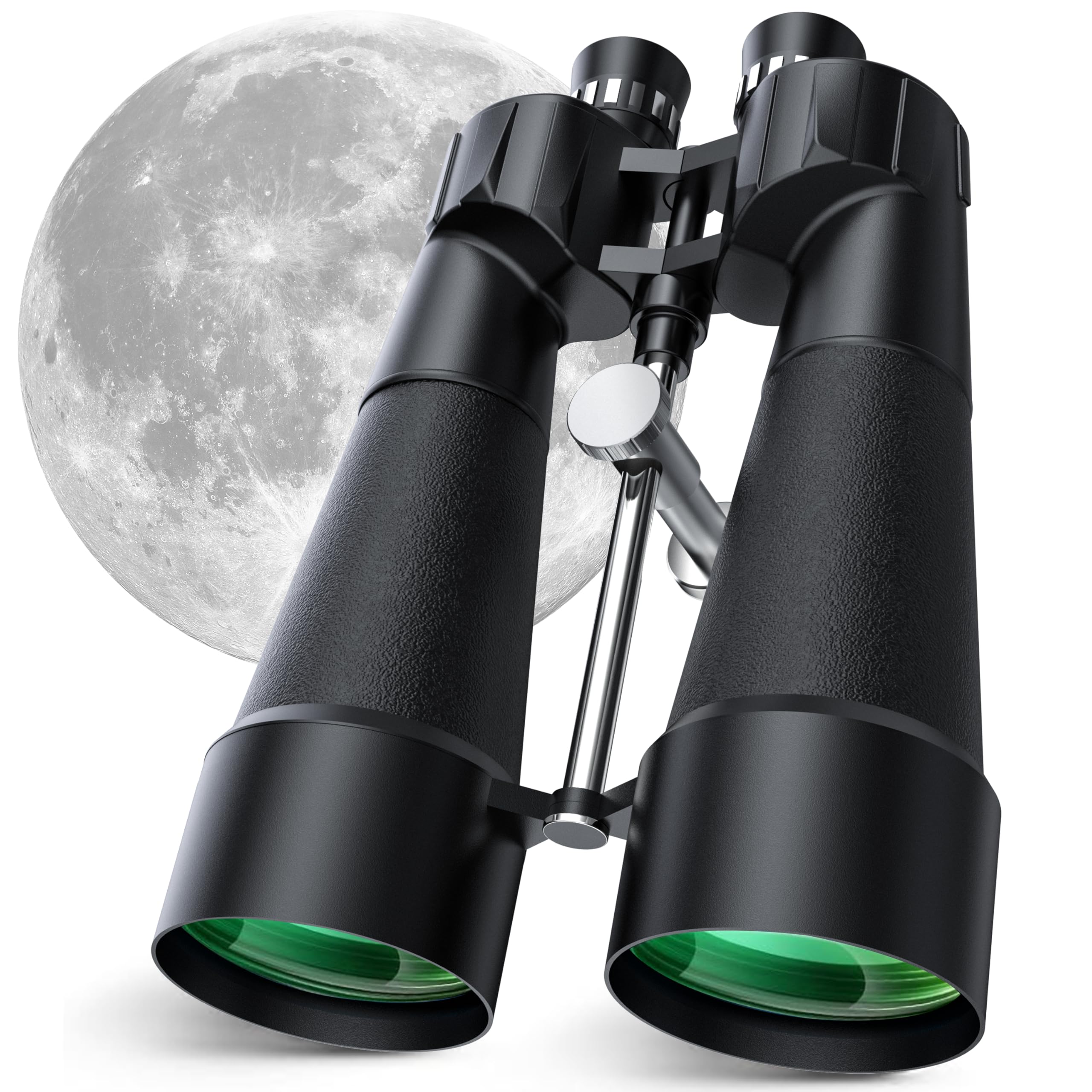
Best Astronomy Binoculars of 2026

Astronomy binoculars are a study in tradeoffs: bigger front lenses gather more light and want a tripod instead of your hands. A 7x50 rides your eyes all night; a 25x100 will split double stars and then remind you, in about a minute, that arms make poor mounts. Where you land on that line is most of the buying decision.

Magnification gets top billing on the box, but aperture and exit pupil decide how faint a star you can actually pull out of the sky, and a wide field of view matters more than most first-time buyers expect once you're sweeping the Milky Way rather than picking off one target. My team and I spent eight months with nine pairs, from handheld wide-field models to giants bolted to tripods, in backyards, on a driveway, and over one long weekend at a dark-sky site.

What decided it was the small stuff: how a focuser turns in cold air, whether the eyecups adjust far enough for glasses, whether a pair holds collimation after a bumpy car ride. None of that is on the spec sheet. The picks below are the ones that held up.

1

Best Overall

Celestron SkyMaster 15x70

89 /100
LBD Score Excellent

Key details

Weight
3.3 lb
Field Of View
4.4 degrees
Magnification
15x
Objective Lens
70 mm
View on Amazon

The 15x70 designation is the whole argument for the SkyMaster: 70mm objective lenses gather enough light to pull star clusters and the Orion Nebula out of the sky, while 15x is enough magnification to make the moon's craters look like terrain rather than smudges. We think it is the best first serious astronomy binocular for most people because it delivers that combination without moving into the large, heavy classes.

The 4.4-degree field is a useful middle ground. It is wide enough to scan along the Milky Way and locate constellations, but not so wide that everything collapses into a tiny, cluttered view. We also appreciated the 18mm eye relief, which gives glasses wearers a reasonable chance of seeing the full field without pressing into the lenses. The center focus is smooth and easy to settle, and the rubber-armored body feels secure in the hand.

At 3.3 pounds, the SkyMaster is not a binocular for a long hike or a quick look out the window. Handheld, the view swims after a few seconds at 15x, especially when you are trying to study a small target. Mount it on a sturdy tripod and the instrument makes sense: the built-in 1/4-inch-20 adapter is there, but the tripod is not. A lightweight photo tripod will fight you; use something with a rated load well above the binoculars.

The glass is multi-coated BaK-4, and the housing is water-resistant rather than waterproof. For a backyard astronomy pair, that is a sensible place to save. We kept coming back to the same conclusion: this is the pair that makes the night sky accessible without a telescope, as long as you give it a proper mount.

Pros

  • 70mm aperture for bright deep-sky views
  • 15x magnification reveals lunar detail
  • 18mm eye relief suits glasses
  • Good value for the aperture

Cons

  • Tripod required but not included
  • Heavy for handheld use
Our verdict

We recommend the SkyMaster 15x70 as the best all-around astronomy binocular for its balance of light grasp, lunar detail, and price.

Check Latest Price
2

Best for Beginners

Celestron Cometron 7x50

91 /100
LBD Score Outstanding

Key details

Weight
1.71 lb
Field Of View
6.8 degrees
Magnification
7x
Objective Lens
50 mm
View on Amazon

The Cometron 7x50 is the pair we hand to someone who wants to start stargazing without buying a mount on day one. Seven power is low enough to hold steady, and the 50mm objectives give a 7.1mm exit pupil that keeps the view bright when you are sweeping the Milky Way or picking out constellations. We think that combination makes it the best beginner astronomy binocular here.

The 6.8-degree field is the real pleasure. It turns the sky into something you can navigate rather than a series of tiny targets, and it makes the moon feel close without filling the whole view. At 774 grams, the Cometron is light enough to hold for a long scan, and the included neck strap and case are useful rather than decorative. The individual focus takes a moment to set, but once you have both eyepieces dialed in, it stays put.

This is not a planet-killer. At 7x, Jupiter is a bright dot with its moons, and Saturn is a small oval at best; you are buying wide-field context, not high-power detail. The optics are multi-coated Porro prisms, and the body is water-resistant rather than fogproof, so a damp night can eventually cloud the view. For a first pair, though, the trade-offs are easy to live with. We liked that it works as a daytime binocular too, which is more than some dedicated astronomy giants can say.

Pros

  • Wide 6.8-degree field
  • Light 774 g body
  • 7x magnification stays steady
  • Bright 7.1mm exit pupil

Cons

  • Individual focus can be finicky
  • Not fogproof
Our verdict

We think the Cometron 7x50 is the beginner pair to buy when you want wide, steady views without a tripod.

Check Latest Price
3

Best 80Mm Value

Sogries 20x80

82 /100
LBD Score Excellent

Key details

Weight
4.59 lb
Field Of View
173 feet
Magnification
20x
Objective Lens
80 mm
View on Amazon

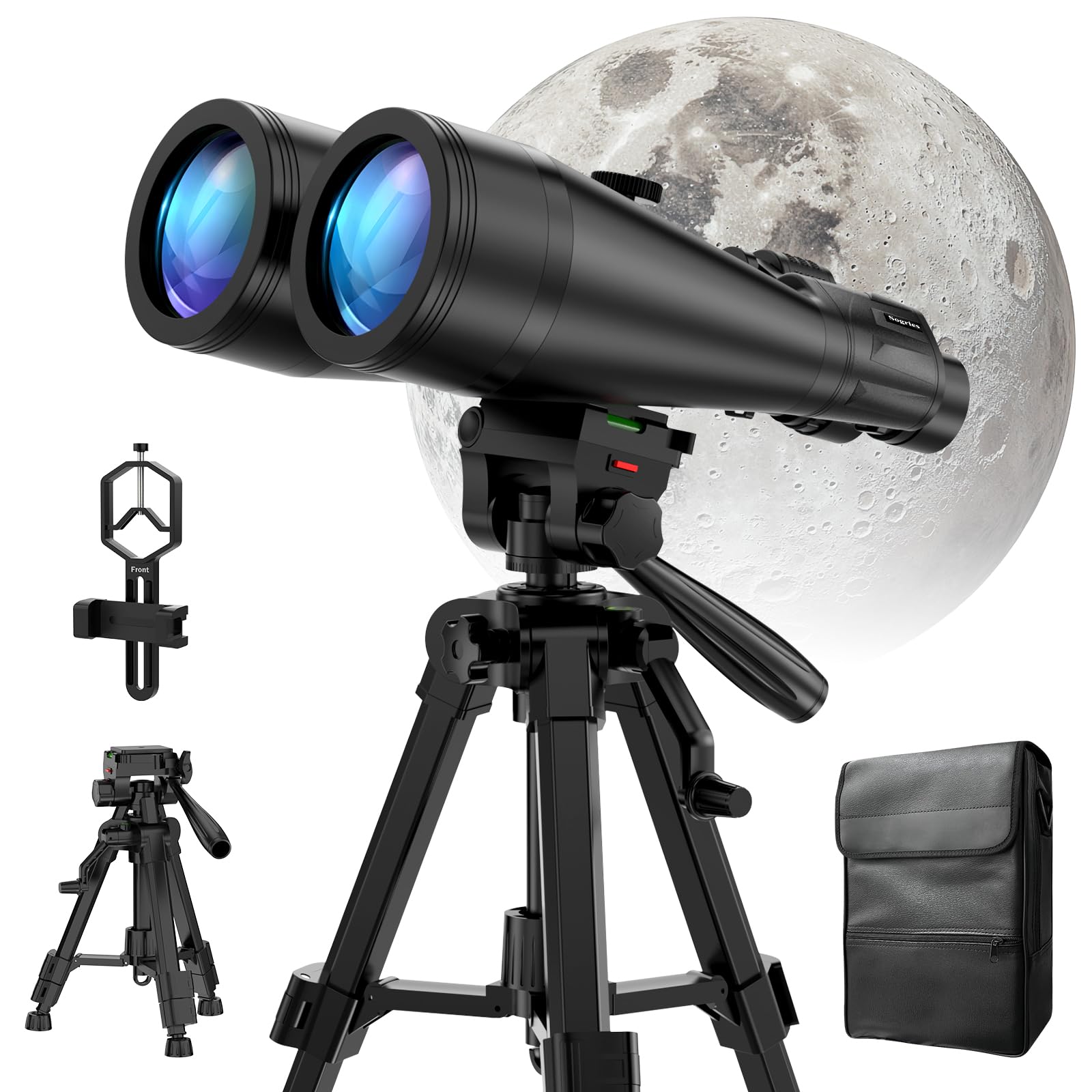
Twenty power and 80mm objectives are a real step up from a 15x70, and the Sogries 20x80 gets there without the near-nine-pound heft of a 100mm giant. The 4mm exit pupil is a sensible compromise: it gives up some low-light brightness to a 7x50, but the extra magnification and aperture pull more detail out of the moon and larger clusters. The 17mm eye relief makes it easier to use with glasses than the compact astronomy binoculars we tried.

At 20x, a tripod is not optional. We used it on a solid mount, and the difference between that and hand-holding was immediate. The 173-foot field is narrow enough that star-hopping takes patience, so start with the moon or a bright planet and work outward. The center focus is usable, but fine adjustments at this power need a light touch. The waterproof body and included phone adapter are practical extras for recording what you see.

What we like most is the role it fills: more reach than a 15x70 for someone who is not ready to haul a 100mm binocular. The trade-off is a narrower view and a tripod requirement, so buy from a seller with a clear return policy and check collimation as soon as it arrives. If you already have a heavy tripod and a dark site, the 25x100 is the more serious deep-sky tool. If you want one large pair that stays manageable, this is the one.

Pros

  • 20x80 reach without 100mm weight
  • Waterproof body
  • 17mm eye relief
  • Phone adapter adds convenience

Cons

  • Narrow 173-foot field
  • Tripod required at 20x
Our verdict

We like the Sogries 20x80 for buyers who want more reach than a 15x70 without moving to a 100mm giant.

Check Latest Price
4

Best for Deep-Sky Reach

Sogries 25x100

85 /100
LBD Score Excellent

Key details

Weight
8.8 lb
Field Of View
147 feet
Magnification
25x
Objective Lens
100 mm
View on Amazon

At 8.8 pounds, the Sogries 25x100 is less a binocular you carry than a small telescope you point with two hands. What the weight buys is 100mm of light grasp and 25x magnification, which is enough to make globular clusters resolve into grainy balls and to show Jupiter's moons as distinct points rather than a smudge.

We think it is the best choice here for a dedicated dark-sky setup. The 147-foot field is narrow, and the individual-focus eyepieces add another step to every target change. That is the cost of this much magnification. On a heavy tripod, the payoff is a view that feels more telescope-like than the smaller binoculars, especially on compact targets. The rubber-armored metal body and waterproof, fogproof construction are reassuring for a permanent backyard station. The included backpack is useful for storage, though this is not a pair to carry far.

This is not a beginner's first pair. It needs a substantial tripod, and the 8.8-pound body limits who can handle it comfortably. The size is the point, though: if you have a fixed observing spot and want the most aperture in this group, the 25x100 delivers. For everyone else, the 15x70 or 20x80 is easier to live with and still shows plenty.

Pros

  • 100mm objectives for faint targets
  • 25x magnification for lunar detail
  • Waterproof and fogproof
  • Backpack for storage

Cons

  • Heavy 8.8-pound body
  • Tripod not included
Our verdict

Our pick for a permanent dark-sky setup is the Sogries 25x100, where aperture matters more than portability.

Check Latest Price
5

Budget Moon Views

ESSLNB 25x70

79 /100
LBD Score Very Good

Key details

Weight
2.8 lb
Field Of View
129 feet
Magnification
25x
Objective Lens
70 mm
View on Amazon

The ESSLNB 25x70 is the odd one out: it promises 25x magnification in a 2.8-pound body that costs less than the other 70mm binoculars here. That combination is appealing if you want a high-power view without a heavy mount, but the numbers hide a trade-off. The 70mm objective divided by 25x gives a 2.8mm exit pupil, which is small for astronomy.

In practice, that means the ESSLNB is at its best on the moon and bright planets, not on faint nebulae or the outer reaches of the Milky Way. The 129-foot field is narrow, the 12mm eye relief is tight for glasses, and the center focus is simple but not especially refined. We did appreciate the light weight for quick sessions, and the waterproof body and tripod mount make it easy to set up on a modest mount.

We think it earns a place as a budget moon-and-planets binocular, not as an all-purpose stargazing pick. If you already have a 7x50 or 15x70 for wide-field sweeping, the 25x70 adds a cheap high-power option for lunar detail. If you are buying your only astronomy binocular, spend the money on a brighter 50mm or 70mm model instead.

Pros

  • 25x in a light 2.8-pound body
  • Waterproof construction
  • Tripod mount built in
  • Inexpensive high-power option

Cons

  • Dim 2.8mm exit pupil
  • Tight 12mm eye relief
Our verdict

We see the ESSLNB 25x70 as a budget moon-and-planets binocular, not a deep-sky replacement.

Check Latest Price

How We Tested Astronomy Binoculars

We built the shortlist from spec sheets, manufacturer documentation, and a long read through owner reviews, then filtered for the things that decide a night under the stars: aperture and prism glass, listed weight, whether there's a tripod mount, eye relief, and how far the eyecups adjust for people who wear glasses. That left nine pairs, from compact wide-field models up to 100mm giants. Each one got months, not minutes.

Over eight months we used them the way buyers actually will — on clear weeknights in a suburban backyard, in a driveway under a streetlight, and across one long weekend at a dark-sky site, packed in the trunk between sessions. We weighed each pair, then timed how long we could hold it steady before the view started swimming, which is where weight and stability stop being specs and become the whole experience. Every model with a tripod mount went on one, and we tapped the barrels and turned the focuser while watching whether the image jumped.

On clarity, we split Albireo, chased the moons of Jupiter, and looked along the moon's bright limb for color fringing. Field of view we judged by panning the Pleiades and counting how much of the cluster fit in a single look. Focus got tested in cold air, racking between near and far targets to feel for stiffness or backlash, and we rechecked collimation after every car trip. On dew-heavy nights we watched for fogging on the outside and, worse, inside. Value came last and was the simplest question of all: how much sky does this pair actually show for what it asks.

How to Choose Astronomy Binoculars

Match Magnification to Your Mount

A 7x or 10x binocular is the handheld range. At 7x, the view stays steady enough to scan the Milky Way, and a 50mm objective gives a bright 7.1mm exit pupil. Once you move to 15x, hand shake becomes obvious, and 20x or 25x really needs a tripod. The Celestron SkyMaster 15x70 is a good example of the crossover: it is manageable on a solid mount but frustrating to hold freehand for long. If you want to start without a tripod, choose the Cometron 7x50 and learn the sky first.

Aperture and Exit Pupil

Aperture gathers light, but exit pupil tells you how bright the view will feel. Divide the objective diameter by the magnification: a 7x50 gives 7.1mm, a 15x70 gives 4.7mm, and a 25x100 gives 4mm. Bigger aperture helps you see fainter objects, while a larger exit pupil makes the view easier for your eye to take in. That is why a 25x70 with a 2.8mm exit pupil is a moon-and-planets tool, not a faint-nebula specialist.

Plan for Weight and a Real Tripod

Astronomy binoculars get heavy fast. A 3.3-pound 15x70 is already a two-hand instrument, and an 8.8-pound 25x100 is a permanent setup. Check that the tripod is rated for more than the binoculars weigh, and budget for a mount before you spend up on glass. Eye relief matters too: 18mm is comfortable with glasses, while 12mm is tight. Center focus is quicker for changing targets; individual focus stays put once set but slows you down.

Check the Glass and the Sealing

BaK-4 prisms and multi-coated lenses are the baseline for a serious astronomy binocular; fully multi-coated optics are better if the price is reasonable. Waterproof and fogproof construction matters if you observe in damp air or leave the binoculars outside during temperature swings. Collimation is the quiet deal-breaker: a misaligned pair gives a double image that no amount of focusing fixes. Buy from a seller with a return window, and check the view in daylight before your first clear night.

Frequently Asked Questions

Final Verdict

We recommend the Celestron SkyMaster 15x70 as the best all-around astronomy binocular. It has enough aperture and magnification to make the moon and brighter deep-sky objects rewarding, and it costs less than the big 80mm and 100mm models here. Pair it with a sturdy tripod and it will show you more than a small telescope for a fraction of the bulk.

If you want to stargaze without a mount, choose the Cometron 7x50; if you have a permanent dark site and a heavy tripod, the Sogries 25x100 gives you the most light grasp.