Best Cameras for Food Photography of 2026

Every food photo I've ruined, I've ruined the same way: a gorgeous plate, a dim restaurant, a phone that turns the whole thing beige. A real camera fixes that. Bigger sensor, a lens you can open wide, enough control to hold the shutter a beat longer without smearing the sauce — it's the difference between a picture of dinner and a picture that makes someone hungry.

My team and I spent seven months shooting with seven cameras, from a pocket-size compact to a mirrorless kit, and what separated them wasn't megapixels. It was autofocus that holds a lock in candlelight, a screen that flips so you can shoot straight down into a bowl, and Wi-Fi that gets the shot to your phone before the ice cream melts. All seven are forgiving enough for a beginner to shoot on auto for a week. The picks below are the ones where what came in the box justified the price — and the ones we kept reaching for after testing ended.

1

Best Overall

Canon EOS R50

90 /100
LBD Score Outstanding

Key details

Screen
3-inch articulating touchscreen
Sensor
24.2MP APS-C CMOS
Lens Mount
Canon RF
File Formats
RAW, C-RAW, HEIF, JPEG
View on Amazon

A food photo is mostly a framing problem. You are standing over a plate, the light is coming from one side, and the angle that makes the dish look good is usually one you cannot see through a viewfinder pressed to your eye. The R50 solves that with a 3-inch screen that swings out and rotates, so you can hold the camera low over the table and still watch the frame. We leaned on the subject-detection autofocus too, which covers 651 zones and holds a plate or a moving hand while you nudge the garnish into place.

What earns it the top spot is the sensor behind that screen. At 24.2 megapixels on an APS-C chip it matches the Rebel T7 for the largest sensor in this guide, and size is what buys the look most food photos are after: a sharp plate against a background that falls softly out of focus. The small-sensor cameras here cannot produce that at any resolution. It also writes RAW, C-RAW, HEIF, and JPEG, which matters more for food than for almost anything else, since a white-balance mistake under tungsten light is a two-second fix in RAW and a lost shot in JPEG.

The feature we did not expect to use is Canon's close-up demo movie mode, which records a short clip that racks focus from soft to sharp across the dish, the exact move behind most food reels, done for you. The RF mount means a macro lens goes on later without replacing the body. Two caveats: it is the most expensive camera we are recommending, and the compact body puts the controls close together, so larger hands will want to handle one before committing.

Pros

  • Articulating screen makes low and overhead angles easy
  • 24.2MP APS-C sensor with RAW and C-RAW
  • 651-zone autofocus with automatic subject detection
  • Close-up demo mode shoots focus-rack clips

Cons

  • Most expensive camera in this guide
  • Compact body crowds the controls for large hands
Our verdict

We recommend the R50 to most people shopping for a food camera: a large sensor, a screen that rotates over the plate, and autofocus that holds while you work.

Check Latest Price
2

Best Budget DSLR

Canon EOS Rebel T7

95 /100
LBD Score Outstanding

Key details

Sensor
24.1MP APS-C CMOS
Lens Mount
Canon EF
Body Weight
1 lb
File Formats
JPEG and RAW
View on Amazon

Canon put a food setting on the T7's mode dial, and it does what it says, warming and saturating the image instead of leaving you to rescue a plate's color afterward. That dial position summarizes the camera well, because this is a DSLR that walks a beginner through the settings rather than drowning them in them. It is also the least expensive way in this guide to get an APS-C sensor, RAW files, and an optical viewfinder in one body, which is why we point budget buyers here first.

The 24.1-megapixel sensor is the same size class as the R50's, so the shallow depth of field that separates a dish from its background is available, and RAW capture means color and exposure stay yours to correct. What you trade for the price is speed: nine autofocus points, slow enough to hunt in a dim dining room, and video that turns into a manual-focus job in practice. For food that is survivable, since you are focusing on something that does not move, though it is the reason we do not push this body toward anyone shooting action.

Two things we liked more than expected. The optical viewfinder draws almost nothing from the battery, so a dinner-through-dessert shoot does not need a spare in your pocket. And the body is big enough to hold steady at a low angle, which the compacts here cannot claim. The Wi-Fi transfer is the weak link in the package; treat a card reader as your default and it stops mattering.

Pros

  • Dedicated food scene mode on the mode dial
  • 24.1MP APS-C sensor with RAW capture
  • Optical viewfinder barely touches the battery
  • Lowest price here for a large sensor and RAW

Cons

  • Nine-point autofocus hunts in dim light
  • Wi-Fi transfer is unreliable
Our verdict

For a first food camera on a tight budget, the Rebel T7 earns its place: a food mode, an APS-C sensor, and a viewfinder that will not quit mid-shoot.

Check Latest Price
3

Best for Handheld Shots

Olympus OM-D E-M10

85 /100
LBD Score Excellent

Key details

Screen
3-inch tilting touchscreen
Sensor
16.1MP Micro Four Thirds
Body Weight
14 oz
Stabilization
Sensor-shift
View on Amazon

Dim rooms and food want opposite things. To get a whole plate sharp you stop the lens down, which costs light, which pushes the shutter speed below what hands can hold steady. The E-M10 answers with stabilization built into the body rather than into the lens, so it works with whatever glass you mount, and that is the one thing no other camera in this guide does.

That makes it our choice for shooting hand-held in available light, which is the situation at most restaurant meals, where a tripod is not happening and a flash would flatten the food. The 16.1-megapixel Micro Four Thirds sensor is the smallest here and has a second effect worth understanding: at the same aperture a smaller sensor keeps more of the frame in focus, so a whole plate stays sharp around f/5.6 where the Canons want f/8. What you give up in exchange is some of that creamy falloff behind the dish.

At 396 grams the body is the lightest camera here, and the tilting screen covers the low angle over a plate even though it will not swing forward for a full overhead. The menus are deep and take a while to learn, video stops at 1080p, and this is an older body with thin stock, so confirm availability before you commit to it.

Pros

  • Sensor-shift stabilization works with any lens
  • Lightest body of any camera here
  • More of the plate stays sharp at wider apertures
  • RAW capture and a tilting touchscreen

Cons

  • Deep menu system takes time to learn
  • Video tops out at 1080p
Our verdict

The E-M10 is our pick when the light is bad and a tripod is out of the question: stabilization in the body, at the lightest weight here.

Check Latest Price
4

First Camera

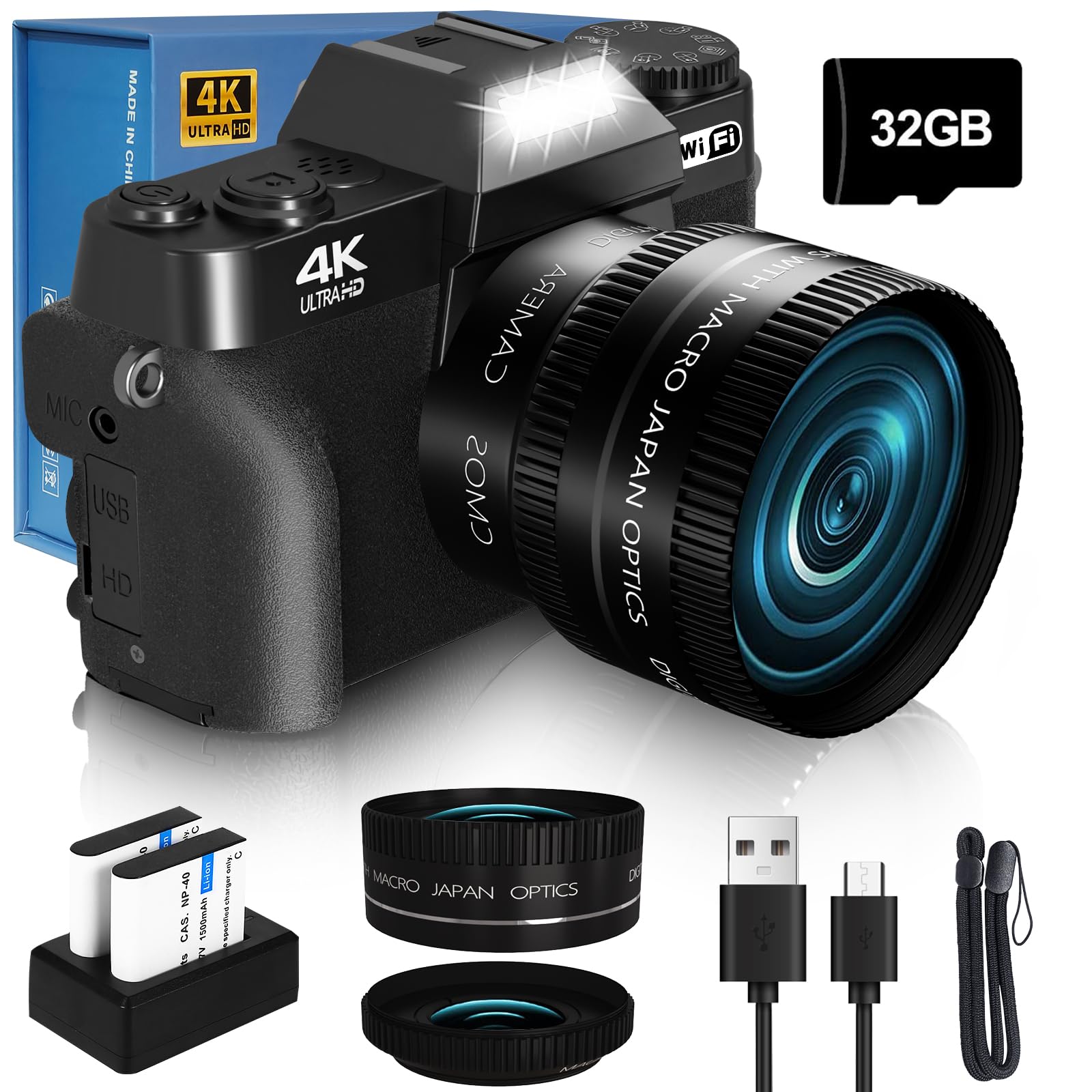
VJIANGER W02

86 /100
LBD Score Excellent

Key details

Focus
Manual and automatic
Lenses
52mm wide-angle and macro
Screen
3-inch tilting
Included
32GB card and two batteries
View on Amazon

The box says 64 megapixels; the sensor behind the lens is 1/2.5-inch, and that second number is the one that decides how much detail actually survives. We are not telling you to skip the W02. We are telling you to buy it for a different job than the Canons above, because at the bottom of the price range it still gives you things the interchangeable-lens bodies make you pay for separately.

The 52mm wide lens comes with a screw-on macro attachment, and that is the piece that matters for food. Fit it and you can fill the frame with the char on a crust, close enough that the texture is the subject rather than the plate. Manual focus is available too, and for a stationary dish that is often more dependable than letting the camera decide where to lock.

Wi-Fi transfer, two batteries, a 32GB card, and a tilting screen round it out, and each of those is something you would otherwise add to the cart. What you will not get is the shallow depth of field that makes a subject pop, because a sensor this small keeps nearly everything sharp, so a plate on a busy table stays a plate on a busy table. Buy it to find out whether food photography is for you. Buy one of the interchangeable-lens cameras to get good at it.

Pros

  • Screw-on macro lens for close detail
  • Manual focus available for still subjects
  • Two batteries and a 32GB card in the box
  • Least expensive camera in this guide

Cons

  • Small sensor keeps backgrounds sharp
  • Resolution figure outruns actual detail
Our verdict

Buy the W02 to find out whether you love food photography: the cheapest camera here with a real macro attachment and manual focus.

Check Latest Price
5

Starter Video Kit

Yatao YT01-A

79 /100
LBD Score Very Good

Key details

Lenses
Wide-angle and macro
Screen
3-inch flip
Battery
Two cells with charging stand
Included
Fill light, mic, and 64GB card
View on Amazon

The box is the pitch: a bi-color fill light, a microphone, a 64GB card, two batteries with a charging stand, and a lens hood, all bundled with the camera. For food, the light is the interesting part. A small continuous source you can angle across a plate is how you get texture instead of a flat, flash-lit rectangle, and it is the accessory most people buy after the camera arrives.

The body underneath is a 1/2.7-inch sensor with a wide-angle lens and a screw-on macro, so close-ups are possible and background blur mostly is not. Treat the 6K video and 64MP still figures as packaging rather than performance; nothing about this chip competes with the APS-C bodies here on detail, particularly in the shadowed side of a plate.

Where it earns a place is as a complete starter kit, for a reader who wants to begin posting food clips without assembling the pieces one at a time. Two things to plan around. Battery life runs short enough that both cells need charging before a shoot, and the fill light works alongside window light rather than replacing it. Go in expecting a first kit and it delivers exactly that.

Pros

  • Fill light, microphone, and 64GB card included
  • Screw-on macro lens for close-ups
  • Wi-Fi transfer and a flip screen
  • One purchase covers light, sound, and storage

Cons

  • Small sensor limits background blur
  • Battery life runs short
Our verdict

The Yatao kit is what we point at readers who want to shoot food video from day one without buying a light and a microphone separately.

Check Latest Price

How We Tested the Best Cameras for Food Photography

We started with about 30 cameras and narrowed by price, sensor size, and whether a usable lens came in the box — a cheap body with no lens isn't cheap. That left seven: APS-C and Micro Four Thirds mirrorless bodies, one DSLR, and a compact or two small enough for a tote. Each had to be something a first-timer could pick up and get a decent photo out of on day one.

For seven months those cameras went everywhere my meals went: Sunday brunch by the window, a dim restaurant table on a Friday, takeout on the kitchen counter, a holiday baking marathon, a farmers market where the light changed every five minutes. We shot the same three dishes — a salad, a seared steak, a slice of layer cake — in each setting and compared the files side by side for white balance, how the sauce read, and blown highlights.

Autofocus got the hardest test we could devise: half-pressing on a glossy sauce or a glass of wine and watching whether the camera locked or hunted. We handed each one to two people who'd never shot on anything but a phone and timed how long it took them to get a photo worth posting, then noted how deep white balance sat in the menu and whether the dials made sense without the manual.

We judged size by where the camera actually ended up — a coat pocket, the bottom of a tote, or left at home because it needed its own bag. For Wi-Fi we paired each to a phone, sent ten photos, and counted the dropouts. At the end we compared what came in the box against the price, and which ones we were still reaching for on a Saturday because they were fun.

How to Choose a Camera for Food Photography

Sensor Size Before Megapixel Count

A 64MP badge on a 1/2.5-inch sensor buys you bigger files, not more detail, because those pixels sit too close together to gather much light. The APS-C chips in the R50 and the Rebel T7, or the Micro Four Thirds sensor in the E-M10, are several times the area, and area is what gives a food photo its two signatures: clean detail on the shadowed side of a plate, and a background that falls out of focus on cue. Find the sensor size in the spec list and read it before anything else.

Check How Close the Lens Actually Focuses

Food photography happens in the last few inches, and the kit lens on every interchangeable-lens camera here stops well short of true macro. The figure to hunt for is minimum focus distance: a zoom that only focuses from a couple of feet away cannot fill the frame with a single fig. Two ways around it. The budget compacts here ship with screw-on macro attachments that get closer than the bare lens, and any body with a mount can take a dedicated macro later, which the R50, T7, and E-M10 all allow.

The Screen Matters More Than You Think

Most plates get shot from slightly above, and a fixed rear screen turns that into guesswork. An articulating screen like the R50's swings out so you can see it from any angle, including over the top of a table. A tilting screen, as on the E-M10 and the W02, handles low and high angles but will not flip forward. For flat-lays on a tripod at home a tilting screen is plenty; for video of your own hands plating, you want the full articulation.

Plan for Light and Color, Not Just the Camera

Food is a color subject before it is anything else, and two settings decide whether it looks appetizing: white balance and exposure. RAW capture lets you pull a warm tungsten cast back to neutral in editing, while JPEG bakes the cast in. Window light at an angle is still the best free light there is, which is why the budget kits here bundle a small continuous fill light. Use it as a supplement. Skip the pop-up flash: fired straight at a plate, it flattens texture and blows out every highlight on a sauce.

Decide What You Will Actually Carry

The camera that gets used is the one that comes along. A 396-gram body and compact zoom, like the E-M10, disappears into a tote, while a full DSLR the size of the Rebel T7 tends to stay home. The trade is steadiness, since a heavier body is easier to hold still at a low angle. If nearly all your shooting happens at your own kitchen table, weight stops mattering and the money is better spent on a lens.

Frequently Asked Questions

Final Verdict

The R50 is the camera we recommend to most people who ask: an APS-C sensor for the shallow-background look, a screen that gets you over the plate, and autofocus that holds while you rearrange the garnish. It is the most expensive pick here, and it is the one that keeps up as you get better.

Two situations change the answer. If the budget is firm, the Rebel T7 delivers a large sensor, RAW files, and a food scene mode for less. If you shoot in dim rooms without a tripod, the E-M10's in-body stabilization and 396-gram body are worth the trade in resolution.