Best Canon RF Lenses of 2026

Every lens purchase is a tradeoff you feel in your shoulder by day's end: the faster the glass, the heavier the bag. A zoom that opens to f/2.8 rescues a dim birthday dinner, then reminds you about it on the third mile of a hike. What a good lens actually fixes is simpler than any spec chart — it's the shot you stop missing because the right focal length was already mounted when the moment arrived.

I shoot portraits and my kid's soccer games, and the lens I reach for is rarely the sharpest one on paper. My team and I have spent nine months shooting with eight RF lenses, from a compact 50mm prime to a super-telephoto zoom, and what separated them had little to do with the marketing copy. The spec new buyers underestimate is the focus motor: a stepping motor glides quietly and deliberately, while a ring-type USM snaps into place when a player breaks toward the goal.

Weight, value, and versatility pull against each other here more than in most gear categories, and low light is where the budget picks show their seams. Every lens below earned its spot in the bag — start with the focal length you keep reaching for.

1

Best Overall

Canon RF 24-70mm f/2.8 L IS USM

94 /100
LBD Score Outstanding

Key details

Weight
1.98 lb
Focal Length
24-70mm
Stabilization
Up to 5 stops
Maximum Aperture
f/2.8
View on Amazon

A 24-70mm f/2.8 is the lens we build a full-frame R kit around, and this is the version that earns the spot. The 24mm end takes in tight rooms and wide landscapes; 70mm tightens onto faces and details. The constant f/2.8 aperture is the part that matters after dark, and it keeps background blur available at every focal length.

In use, the Nano USM autofocus is quick and quiet, which makes it as useful for video as for stills. The 5-stop optical stabilization helps at slow shutter speeds, and the control ring gives your right hand a job without leaving the viewfinder. We also appreciate the L-series sealing and fluorine coating when the weather turns.

Sharpness holds across the frame, and the coatings help control flare in backlit portraits and window light. The lens balances nicely on an R5 or R6 body, which matters because a standard zoom is the lens that stays mounted longest. If you mostly shoot in good light and want a smaller kit, the 24-105mm f/4 is the more sensible travel lens.

The 24-70mm range is not long enough for field sports or birds, and 70mm is modest for tight portraits. That is why it works as the center of a kit rather than the whole kit: add a telephoto or a fast prime when your subjects demand it.

Pros

  • Constant f/2.8 through 24-70mm
  • Sharp edge-to-edge image quality
  • Fast, quiet Nano USM autofocus
  • Five-stop optical stabilization

Cons

  • Heavy at 898 g for all-day carry
Our verdict

We recommend this as the default RF zoom for full-frame R bodies: the 24-70mm range and constant f/2.8 aperture cover interiors, events, and portraits without a lens change.

Check Latest Price
2

Best Value

Canon RF 28-70mm f/2.8 IS STM

90 /100
LBD Score Outstanding

Key details

Focal Length
28-70mm
Maximum Aperture
f/2.8
Weather Resistance
Yes
View on Amazon

The price gap between this lens and the 24-70mm f/2.8 L is the first thing you notice, but the more interesting difference is how little the images give up. The 28-70mm range covers portraits, events, and general walk-around shooting, and the constant f/2.8 aperture keeps low-light work and background blur on the table. It is a sensible step up from a kit zoom without the full L-series commitment.

We found the lens sharp through the zoom range, with the kind of contrast that makes files look finished before editing. The STM autofocus is quick enough for everyday stills and smooth enough for video, and the weather-resistant build means you do not have to baby it. Two UD elements and two aspherical elements do the optical work, but the practical story is simpler: this is the standard zoom we reach for when we want to travel light without dropping to an f/4 lens.

The lens pairs naturally with a 70-200mm for events or a 35mm prime for low light, and it leaves room in the bag for either. That flexibility is why it earns a place beside the L zoom rather than as a consolation prize.

Pros

  • Constant f/2.8 aperture
  • Weather-resistant build
  • Lighter and less expensive than the L zoom

Cons

  • Narrower 28mm wide end
Our verdict

If the L standard zoom is more than you want to carry or spend, we point you here: a fast, sealed f/2.8 zoom that covers most everyday work.

Check Latest Price
3

Best All-Purpose

Canon RF 24-105mm f/4 L IS USM

92 /100
LBD Score Outstanding

Key details

Weight
1.5 lb
Focal Length
24-105mm
Stabilization
Up to 5 stops
Maximum Aperture
f/4
View on Amazon

The 24-105mm range is the closest thing to a one-lens answer in this set. It goes from tight interiors and street scenes at 24mm to head-and-shoulders portraits at 105mm without a change, and the constant f/4 aperture keeps exposure consistent as you zoom. That makes it a natural travel lens and a sensible upgrade from a kit zoom.

We found the image quality consistently sharp, and the 5-stop stabilization lets you handhold in dimmer conditions than the aperture suggests. Autofocus is fast enough for moving subjects, though this is not the lens for indoor sports. The lighter build is welcome on a long day, and the extra reach over a 24-70mm means you crop less often.

The f/4 aperture is the line between this lens and the 24-70mm f/2.8 L. In low light you will lean on stabilization and higher ISO, and subject separation is less pronounced. If most of your work happens indoors or after dark, pay for the faster lens; if you shoot in good light and value range, this one is the easier carry.

Pros

  • Versatile 24-105mm range
  • Constant f/4 aperture
  • Five-stop image stabilization
  • Lighter than the f/2.8 standard zoom

Cons

  • Not weather-sealed
Our verdict

For travel and everyday documenting, this is the lens we reach for: the 24-105mm range and lighter build matter more than the f/2.8 aperture you give up.

Check Latest Price
4

Best for Events

Canon RF 70-200mm f/2.8 L IS USM

93 /100
LBD Score Outstanding

Key details

Weight
2.6 lb
Focal Length
70-200mm
Stabilization
Up to 5 stops
Maximum Aperture
f/2.8
View on Amazon

A dim event floor is where a 70-200mm f/2.8 proves itself. The fast aperture keeps shutter speeds up and pulls subjects away from busy backgrounds, and the 70-200mm range covers everything from full-length frames to tight heads without moving your feet. The RF version is also notably compact for an f/2.8 telephoto, which makes it easier to carry than the spec suggests.

We found the dual Nano USM autofocus quick and decisive, and the 5-stop stabilization helps when the light drops further. Images are sharp wide open, with the contrast and color that make the L-series label meaningful. For portraits, the compression and background separation are exactly what you want; for sports, the focus tracking keeps up.

This is a specialist lens, and the f/4 version covers the same range for travel and daylight work. The difference is the aperture and the subject separation it buys. If you shoot available-light events or indoor sports, the extra speed is worth the carry; if not, the f/4 version is the better fit.

Pros

  • Constant f/2.8 aperture
  • Fast dual Nano USM autofocus
  • Five-stop stabilization
  • Compact for an f/2.8 telephoto

Cons

  • Heavy at 2.6 lb for handheld events
Our verdict

We choose this for weddings, indoor sports, and portraits where the f/2.8 aperture earns its keep; it is the strongest event telephoto in this group.

Check Latest Price
5

Best Lightweight Telephoto

Canon RF 70-200mm f/4 L IS USM

93 /100
LBD Score Outstanding

Key details

Weight
1.53 lb
Focal Length
70-200mm
Stabilization
Up to 7.5 stops with IBIS
Maximum Aperture
f/4
View on Amazon

At 695 grams, this is a telephoto you can leave on the camera and forget about. The 70-200mm range covers portraits, compressed landscapes, and outdoor sports, and the constant f/4 aperture keeps the lens compact without turning it into a slow kit zoom. For travel and hiking, that combination is hard to beat here.

We were impressed by the sharpness: the lens holds detail across the frame, and the dual Nano USM autofocus is fast and quiet. The 5-stop optical stabilization is useful, and it stretches to a claimed 7.5 stops with a coordinated IBIS body. That makes handheld shooting in shade much more practical.

Compared with the f/2.8 version, this is the one that fits in a small shoulder bag and stays there. It is also the more sensible choice for landscape and hiking, where you are stopping down anyway. The f/2.8 version is the one for shallow-depth portraits and dim venues.

Pros

  • Light 695 g build
  • Sharp across the frame
  • Up to 7.5 stops with IBIS
  • Fast, quiet dual Nano USM

Cons

  • f/4 aperture limits indoor action
Our verdict

This is the telephoto we pack when the bag has to stay light: sharp, stabilized, and easy to carry all day.

Check Latest Price
6

Best Budget Wildlife

Canon RF 100-400mm f/5.6-8 IS USM

90 /100
LBD Score Outstanding

Key details

Weight
1.8 lb
Focal Length
100-400mm
Stabilization
Up to 5.5 stops
Maximum Aperture
f/5.6-8
View on Amazon

The 100-400mm range is the practical entry point for wildlife, field sports, and backyard birds. At the long end you get 400mm of reach in a lens that weighs 816 grams, which is light enough to carry on a hike and handhold for a while. The 0.41x maximum magnification at 400mm also lets you treat it like a close-focus lens when a subject presents itself.

We found the Nano USM autofocus quick and quiet, and the 5.5-stop stabilization helps keep the long end steady. Images are sharp in good light, and the lens is at its best when you can stop down a little or keep the sun behind you. The plastic build keeps the weight down, but it does not feel disposable.

The f/5.6-8 aperture is the catch. In shade, at dusk, or indoors, the lens pushes ISO up and the autofocus has less to work with. We treat it as a daylight lens and plan around the light; if you need f/2.8 or f/4 at 200mm, the 70-200mm is the better tool. For the money, it is still the most accessible long reach in this group.

Pros

  • 400mm reach at a budget price
  • Light 816 g for a telephoto
  • 5.5-stop stabilization
  • 0.41x close focus at 400mm

Cons

  • Not weather-sealed
Our verdict

We recommend this for anyone who wants their first long lens without a pro budget: it is light, stabilized, and best outdoors in good light.

Check Latest Price
7

Best Budget Prime

Canon RF 50mm f/1.8 STM

94 /100
LBD Score Outstanding

Key details

Weight
5.6 oz
Focal Length
50mm
Maximum Aperture
f/1.8
View on Amazon

A 50mm f/1.8 is the simplest way to make an R-series camera feel more capable. The focal length is close to how you see, the f/1.8 aperture opens up low light and background blur, and the lens is small enough to leave on the camera all day. For portraits, details, and available-light street shots, it does most of what an expensive prime does at a fraction of the size.

We found the image quality genuinely good wide open, with sharp detail in the center and pleasing falloff toward the edges. The STM autofocus is smooth and quiet enough for video, and the control ring is a useful addition on a lens this small. It is not an L-series prime, so do not expect the same optical correction, but the results hold up.

The 50mm focal length is not wide enough for tight interiors and not long enough for sports, so it works best as a second lens. Pair it with a standard zoom and you have a low-light option that weighs almost nothing.

That is the role we keep coming back to: the lens that turns an ordinary walk into a portrait session. It is the least intimidating way to learn how aperture changes a picture, and it stays useful after you upgrade.

Pros

  • Compact 5.6 oz build
  • Bright f/1.8 aperture
  • Smooth STM autofocus for video
  • Affordable entry prime

Cons

  • No weather sealing
Our verdict

This is the first RF prime we tell most people to add: small, bright, and affordable enough to keep in the bag without a second thought.

Check Latest Price
8

Street and Macro

Canon RF 35mm f/1.8 IS Macro STM

0 /100
LBD Score Fair

Key details

Weight
10.9 oz
Focal Length
35mm
Maximum Aperture
f/1.8
Maximum Magnification
0.5x
View on Amazon

The 35mm focal length is the heart of this lens: wide enough for street scenes and interiors, normal enough for portraits, and small enough to carry without thinking. Then there is the 0.5x magnification and 0.56-foot minimum focus, which turn the same lens into a close-up tool for flowers, food, and details. That combination is rare in this group.

We found the image quality sharp and the f/1.8 aperture useful in low light, with the 5-stop stabilization helping in dimmer rooms. The lens is lightweight and balances well on smaller R bodies, and the control ring is easy to reach. For travel, it is a strong one-prime kit.

Autofocus is the caveat. It can be slow and audible at times, especially when it hunts in low contrast, so it is not the lens for fast action or silent video in every situation. For street, portraits, and close-ups, we did not mind the trade.

What keeps it in our bag is the flexibility: you can shoot a street scene, move closer for a detail, and never change lenses. It is not a replacement for a dedicated macro or a fast 50mm, but it covers more ground than its size suggests.

Pros

  • Versatile 35mm focal length
  • 0.5x close-up magnification
  • Five-stop image stabilization
  • Light 10.88 oz build

Cons

  • No weather sealing
Our verdict

We like this as a compact walk-around prime that also does close-up work; it is the lens we grab for street, food, and travel when one small lens has to cover a lot.

Check Latest Price
9

Ultra-Wide Interiors

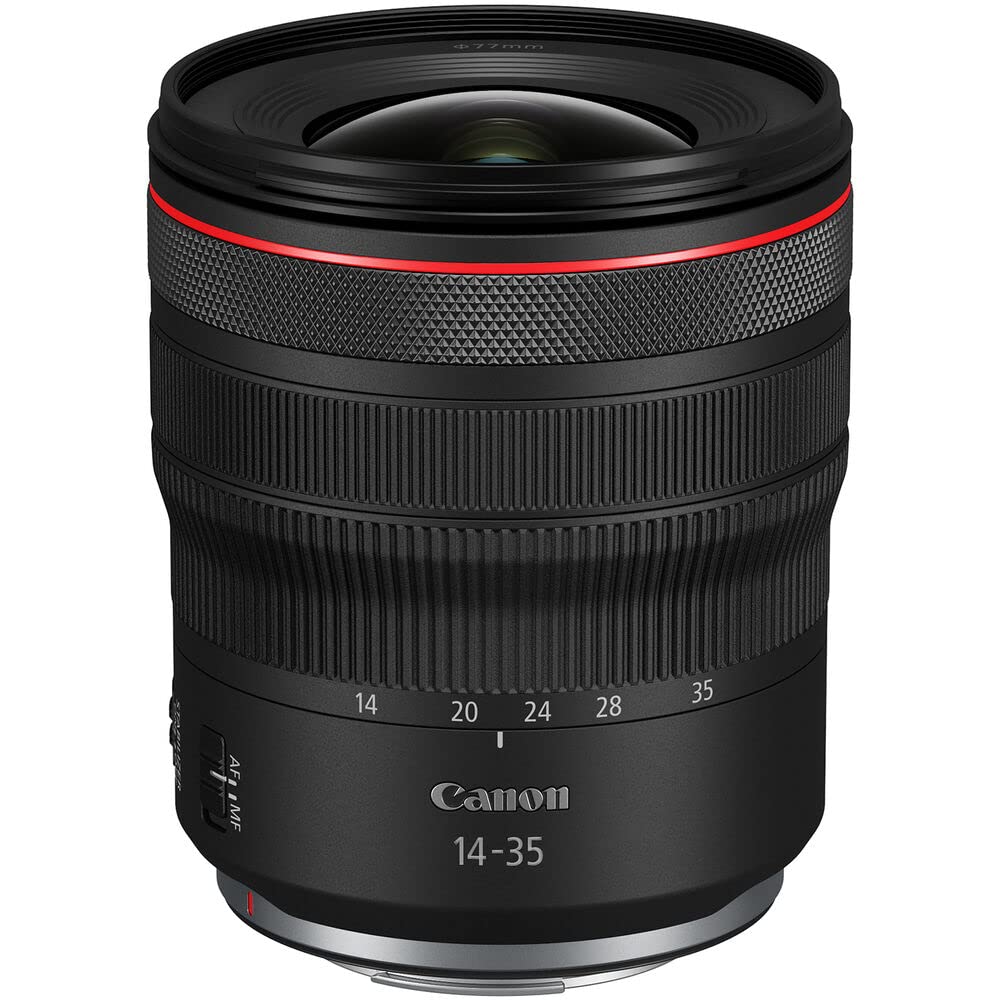
Canon RF 14-35mm f/4 L IS USM

88 /100
LBD Score Excellent

Key details

Weight
1.2 lb
Close Focus
7.9 in
Focal Length
14-35mm
Maximum Aperture
f/4
View on Amazon

The 14mm end is what makes this lens worth owning. It pulls a whole room, a tight street, or a dramatic sky into the frame, and the 14-35mm range gives you room to compose without swapping to a normal zoom. For real estate, architecture, and travel, that width changes what you can capture.

We found the lens easy to carry at 544 grams, which is light for an L-series ultra-wide. The constant f/4 aperture keeps exposure consistent through the zoom, and the optical stabilization helps when you are working in dim interiors without a tripod. The close-focus distance of 7.9 inches adds a useful near-far composition option.

The 14-35mm range is specialist. It is not the lens for portraits or general walk-around shooting, and at the wide end you need to watch your composition so edges do not feel stretched. That is the nature of ultra-wide work, not a flaw in the lens.

Autofocus is quick, and the L-series coatings help control flare when the sun is in the frame. We also appreciate that the lens takes standard 77mm filters, which keeps a polarizer or ND kit simple.

If your work needs the widest view, this is the ultra-wide in this group that delivers it without the bulk of a faster lens. It is the lens we pack for tight interiors and big landscapes, and it earns its place even though it will not be the only lens in the bag.

Pros

  • Ultra-wide 14mm coverage
  • Light 544 g L-series build
  • Close focus to 7.9 in
  • Optical image stabilization

Cons

No notable drawbacks to flag.

Our verdict

For interiors, architecture, and landscapes, this is the ultra-wide zoom we choose: it goes to 14mm, stays light, and focuses close.

Check Latest Price
10

Wildlife Reach

Canon RF 100-500mm f/4.5-7.1 L IS USM

90 /100
LBD Score Outstanding

Key details

Weight
3 lb
Focal Length
100-500mm
Stabilization
Up to 5 stops
Maximum Aperture
f/4.5-7.1
View on Amazon

The 500mm end is the reason this lens exists. It gives you the reach for distant wildlife, field sports, and birds without adding a teleconverter, and the 100-500mm range keeps a shorter option available when an animal moves closer. For a dedicated wildlife kit, that flexibility is the point.

We found the dual Nano USM autofocus fast and quiet, and the 5-stop stabilization with three modes covers static subjects, panning, and exposure-only work. Images are sharp across the range, and the L-series build holds up in weather that would send a budget zoom back to the bag.

Three pounds is the cost of the reach. It balances on a larger R body, but on a long hike you feel it, and a monopod makes sense for long sessions. This is a lens you carry with intent, not a walk-around telephoto.

The 100-500mm range is also more specialized than a 70-200mm: it starts too long for portraits and close action, so it works best as part of a two-lens wildlife kit. Pair it with a standard zoom and you can cover the close shots as well.

If you need 500mm and the reach is the priority, this is the super-telephoto we reach for. It is a specialist's lens, and it rewards planning.

Pros

  • Long 500mm reach
  • Three stabilization modes
  • Fast dual Nano USM autofocus
  • L-series weather resistance

Cons

  • Slow f/4.5-7.1 aperture at 500mm
Our verdict

For dedicated wildlife shooters who need 500mm and L-series sealing, this earns its place; it is a specialist lens, not a casual carry.

Check Latest Price

How We Tested the Best RF Lenses

We began by mapping the RF-mount lineup by focal range, maximum aperture, and image stabilization, then cross-checked owner reviews for the complaints that surface after the honeymoon: soft corners wide open, focusing that hunts in a dim room, a zoom ring that stiffens in the cold. Eight lenses made the cut — primes, standard zooms, and telephotos running from ultra-wide to super-telephoto — and each one stayed in rotation for the full nine months.

Every lens went to the same four kinds of shoots: a low-light birthday dinner in a living room with the lamps turned down, an afternoon soccer game with kids sprinting toward the camera, a dawn hike for backlit landscapes, and a full day of walking with the bag on one shoulder. We weighed each lens on a kitchen scale before its first shoot and rated how it felt at hour six.

In low light we shot the identical scene at every aperture, then compared 100 percent crops for corner sharpness, color, and how quickly the files fell apart at high ISO. To judge stability, we shot handheld at 1/8 second with stabilization on and then off, counting how many frames came back clean. Autofocus got a keeper count per 100 frames at the soccer game plus a recording of the motor in a silent room, and versatility was measured by what we left at home — a zoom that covered an entire day without a swap earned real credit.

Value had the last word: after nine months we asked which lenses had paid for themselves in usable photographs rather than in day-one excitement.

How to Choose a Canon Rf Lens

Match the Focal Length to the Job

A 24-70mm f/2.8 is the closest thing to a default for full-frame R bodies: wide enough for interiors, long enough for portraits, and fast enough for most events. If you want one lens for travel, the 24-105mm f/4 trades aperture for reach. For wildlife and field sports, start at 100-400mm or 100-500mm. Ultra-wide work calls for the 14-35mm f/4, and a 35mm or 50mm prime is the low-light companion. We like a two-lens kit more than one enormous zoom because you carry only what the day needs.

Aperture Is a Working Tool, Not a Badge

The difference between f/2.8 and f/4 is not just blur; it is the shutter speed and ISO you can live with indoors. A fast standard zoom such as the 24-70mm f/2.8 L is the easier choice for weddings and available-light events, while the 24-105mm f/4 is the better travel lens when you mostly shoot outdoors. At the long end, f/5.6-8 lenses like the 100-400mm need daylight. We prioritize one faster lens for the work that pays, and accept a slower zoom for hiking and daylight.

Stabilization and Autofocus Change the Hit Rate

Optical stabilization helps you handhold slow shutter speeds, and it works even better when the camera body adds IBIS; the 70-200mm f/4 L is rated to 7.5 stops with a coordinated body. For moving subjects, autofocus speed and quietness matter more than stabilization. Nano USM and dual Nano USM lenses snap into focus quickly, while STM designs favor smooth, quiet video focus. If you shoot both stills and video, look for a lens that does both without distracting noise.

Weather Sealing and the L-Series Premium

L-series lenses bring tougher build, better coatings, and usually weather sealing, which matters if you shoot in rain, dust, or salt spray. But the red ring is not the only path: the RF 28-70mm f/2.8 IS STM is built to L-series-equivalent weather resistance and costs far less. We pay for sealing when the lens will live outdoors; for a studio or indoor portrait kit, that money can go toward a faster aperture or a second focal length.

Build a Kit, Not a Collection

The most useful RF kit is usually one zoom that covers your main work and one lens that solves a specific problem: a 50mm f/1.8 for low light, a 35mm macro for close-ups, or a 100-400mm for reach. A fast prime can replace a heavy f/2.8 zoom for a night out, and a macro adds a way of seeing without taking bag space. Buy the second lens after you know which shots you keep missing, not before.

Frequently Asked Questions

Final Verdict

We recommend the Canon RF 24-70mm f/2.8 L IS USM as the default because it covers the widest range of paid and personal work without forcing a lens change. If you want most of that speed in a lighter, less expensive package, the RF 28-70mm f/2.8 IS STM is the better daily carry. And if your real subject is wildlife, skip the standard-zoom debate and put the money into the RF 100-400mm or 100-500mm instead.