Best Carbon Fiber Tripods of 2026

Carbon fiber is the reason your shoulders don't ache after a day of shooting—and also the reason a tripod can cost as much as a lens. The trick is finding one that trims grams without turning into a tuning fork in the wind. A good one holds your camera steady in a gust, packs down to the size of a water bottle, and adjusts without pinching fingers. The wrong one wobbles at the slightest breeze, and you end up leaving it in the car.

We've spent the past seven months with eight carbon fiber tripods—compact travel models, full-size stands, and a couple of heavy-duty options—and the differences come down to leg locks, ball-head feel, and how much wind they actually tolerate. The spec sheet won't tell you this, but a center column you can invert or remove often matters more than a few ounces of weight savings, especially for low-angle shots. Flip locks are faster to set up but can snag on branches; twist locks are slower but more secure over years of use.

Below are the ones that earned a permanent spot in my trunk—and the ones I'd hand to a friend without a caveat. I'd start with the compact models for hiking and the heavier stands for studio work.

1

Best Overall

K&F Concept X-Series Tripod

86 /100
LBD Score Excellent

Key details

Weight
3.88 lb
Leg Diameter
28 mm
Load Capacity
35.2 lb
Maximum Height
68 in
View on Amazon

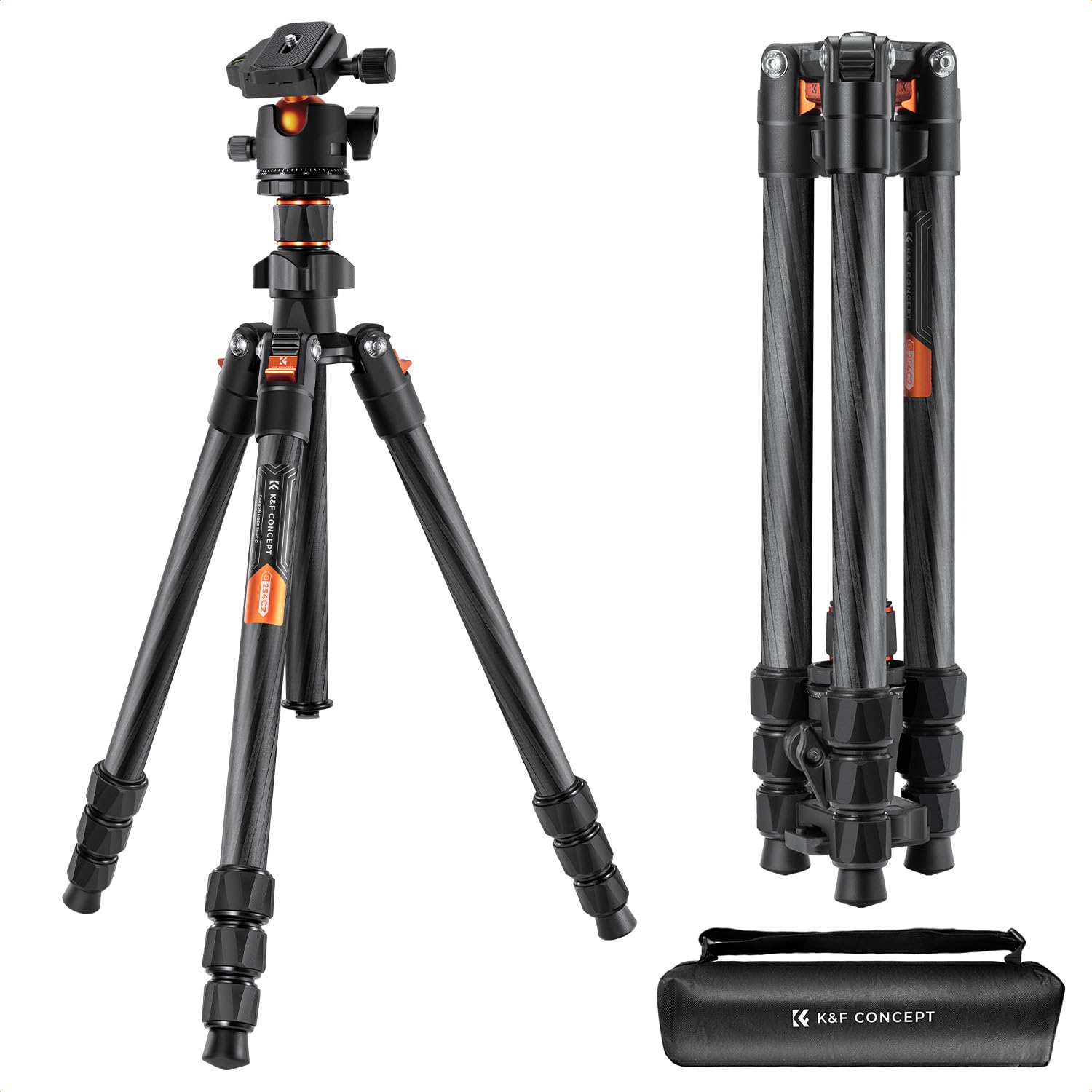
A 35.2-pound load rating on a tripod that weighs under four pounds is the number that settled this one for us. The X-Series gets there with 28 mm carbon tubes and a 36 mm CNC-machined ball head, and that pairing is why it is the tripod we point people toward when they want one carbon set of legs for everything from a mirrorless body to a DSLR with a long zoom. Four sections, twist locks, 68 inches at full height, and a 58.5 cm minimum cover most of what a stills shooter does in a day.

The head is the part we expected to be the compromise, and it isn't. A 36 mm ball with a 360-degree panning base holds a heavy zoom where you leave it, and the Arca-Swiss foot means plates from a gimbal or another tripod swap straight across. That matters more than the rating on paper, because a tripod is only as steady as the joint between the plate and the ball, and the head is where cheap tripods usually give themselves away.

Where it asks something of you is wind. At 1.76 kg it is light for its rating but not heavy enough to ignore a gust on an exposed ridge, so budget for ballast on the center hook during landscape work and keep the column down unless you need the last few inches. That is not a fault unique to this tripod — every carbon leg set here has the same conversation with the weather — it is simply the trade you make for a tripod you will actually carry to the location.

Set against the alternatives on this page the case is straightforward. Sirui's AM-324S buys more rigidity for a premium and a longer fold; NEEWER's N55C saves money and asks you to watch its leg locks. The X-Series is the one in the middle that gives up the least, and it is the tripod we would hand to someone who does not want to own two.

Pros

  • 35.2 lb rating on 28 mm carbon legs
  • 36 mm CNC ball head with Arca-Swiss plate
  • 68-inch reach with a 58.5 cm minimum

Cons

  • One-year warranty trails Sirui's coverage
Our verdict

The best all-round carbon tripod here for a photographer who wants one set of legs — buy it if your kit ranges from mirrorless to a DSLR with a long zoom.
Check Latest Price
2

Best for Heavy Telephoto Rigs

Sirui AM-324S+G1

87 /100
LBD Score Excellent

Key details

Weight
3.75 lb (1.7 kg)
Load Capacity
44 lb
Maximum Height
59.8 in
Ball Head Diameter
56 mm
View on Amazon

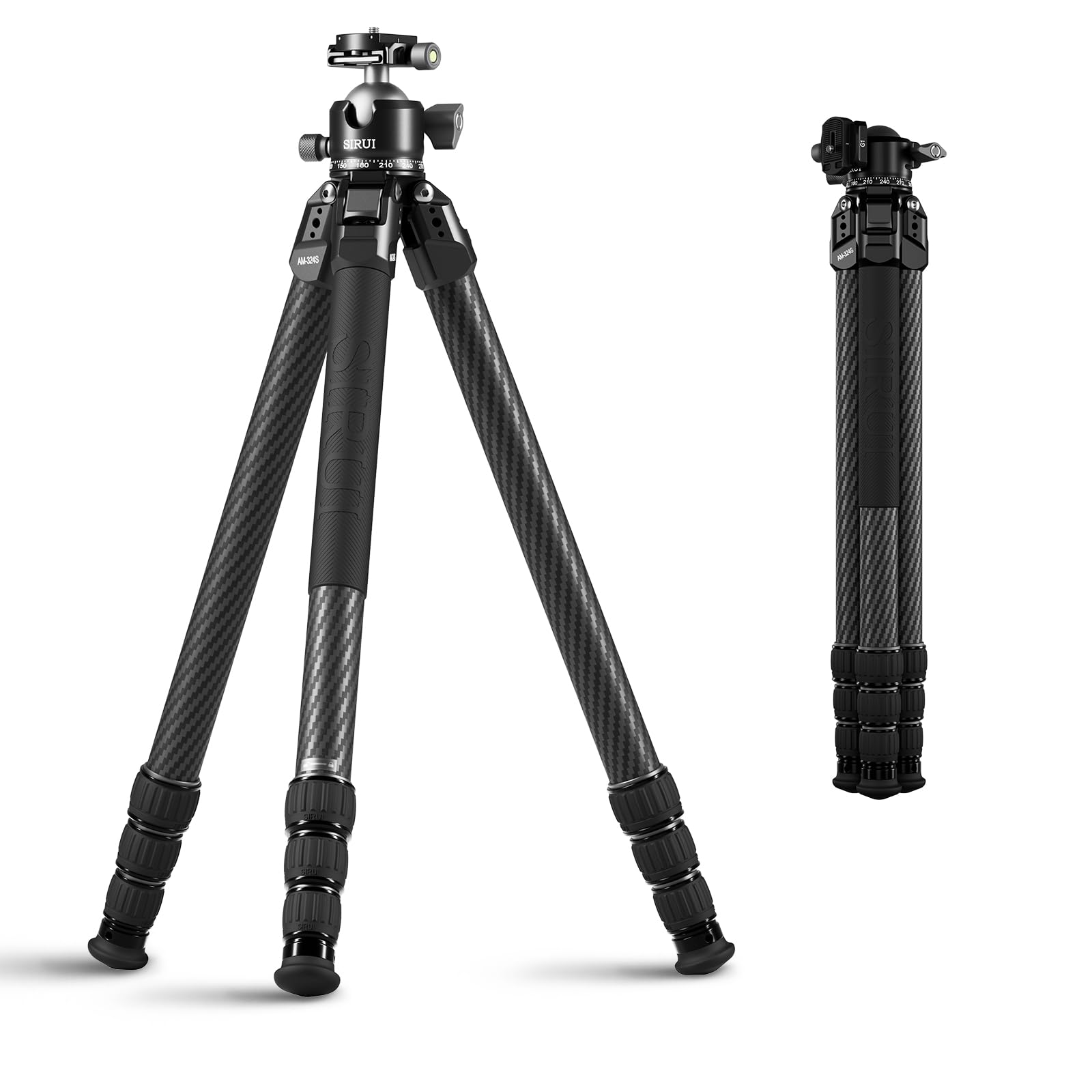
No center column, and that is the point. The AM-324S is the tripod here we reach for when the payload is a full-frame body with a long telephoto or a rig with a monitor bolted on, and the missing column is a large part of why: with nothing sliding above the spider, the top of the tripod is as rigid as the legs underneath it. Sirui backs that up with 32 mm tubes, four sections reaching just under 60 inches, and a 56 mm G1 ball head built with a lower center of gravity.

Our take is that this is the most support you can put under a camera in this group short of the INNOREL, and it is the better-finished of the two. The 44 lb rating is the number to hold onto if you are mounting a 200-500 or a cine rig, because at that weight the limiting factor is nearly always the joint between head and legs. The six quarter-inch ports around the spider are genuinely useful once you are running a monitor and a mic off one support, since you are not clamping a magic arm to a leg and hoping it stays.

What you give up is convenience. Without a column, small height changes mean adjusting three legs and re-leveling, and the low-profile head asks for a firm hand when you are making fine adjustments under a heavy lens. Neither will bother a wildlife or architecture shooter who sets up once per location; both will bother someone raising and lowering the tripod a dozen times an afternoon. The two-year warranty is a reasonable middle ground for the money.

Pros

  • 44 lb rating for long lenses and cine rigs
  • 32 mm carbon legs and a 56 mm ball head
  • Six accessory ports for monitors and mics
  • Rigid at the top with no center column

Cons

  • No center column means leveling three legs
  • 22-inch fold is long for a small pack
Our verdict

The pick for a long telephoto or a built-out video rig — it trades a center column and a compact fold for the stiffest top end in this guide.

Check Latest Price
3

Best for Maximum Height

INNOREL KT324C

91 /100
LBD Score Outstanding

Key details

Weight
3.35 lb
Head Included
No
Load Capacity
55 lb
Maximum Height
180.5 cm
View on Amazon

Seventy-one inches of maximum height and a 55-pound load rating on a tripod that weighs 1.52 kg is a combination that shouldn't hold together, and it is the reason the KT324C earns a place. The trick is in the tubes: 32.5 mm, four-section legs with three locking angles, CNC-machined and anodized fittings, and a two-section center column that screws in when you want another 41 cm. At full height it puts a viewfinder at the eye of a six-footer with room to spare.

What arrives in the box is legs, column, hook, three stainless spikes, three Allen keys, and a bag. No head. That is the trade for putting the money into the legs, and it is the right one if you already own a ball head or a gimbal you trust — screw it on and you have more support than anything else here for tall shooting, at about what the midrange picks cost with a head included. If you don't own a head, price one in before you compare.

In the field it behaves like a tall tripod: with 71 inches of leg under the camera and only 1.52 kg of its own weight, it is top-heavy once the column is up and a long lens is on, so use the hook and a ballast bag rather than trusting the footprint. The feet are worth a look too — they can work loose over a hike, and a drop of threadlocker on the studs before the season saves you hunting for one in the grass. A 9.5 cm minimum gets you to ground level without swapping anything.

Pros

  • 71-inch maximum height
  • 55 lb capacity on 32.5 mm legs
  • 1.52 kg for that much capacity
  • Three leg angles and stainless spikes included

Cons

  • No head included, so add one to the budget
  • Four twist-lock sections take time to raise
Our verdict

The most height and capacity per kilogram here — buy it as legs and put your own head on top, especially if you shoot tall.

Check Latest Price
4

Best Value

NEEWER N55C

90 /100
LBD Score Outstanding

Key details

Weight
3.53 lb
Monopod Leg
Yes
Folded Length
22.6 in
Maximum Height
172 cm
View on Amazon

One leg unscrews into a monopod, and that is the trick that keeps the N55C in the bag when a lighter tripod might have stayed home. It is also a full-size tripod rather than a travel compromise: 172 cm at the top, four leg sections, 1.6 kg, and a 22.6-inch fold that lies across the bottom of a daypack.

The head is a two-lock ball with a 360-degree panning dial and an Arca-type plate, and it does what a stills shooter needs without asking anything of you. What makes it worth the money is the middle of the range: enough height to stand up straight behind the camera, enough capacity for a DSLR and a standard zoom, and a bag and strap in the box so nothing else is on the shopping list.

The leg locks are the part we keep an eye on. Quick-release collars are the fastest way to set up a tripod and the first thing to stop biting on a budget model, and a leg that slips under load costs you a frame and possibly a camera. Check every collar before the camera goes on, don't force one past its stop, and the N55C stays a lot of tripod for what you spend.

What settles it for us is the height-to-weight trade. Standing eye level with a modest kit and a monopod in the same bag is a combination that covers events, travel, and family shoots without a second tripod. Put a heavy zoom on it and keep the bottom sections down — true of every light tripod here, and no reason to skip this one.

Pros

  • 172 cm height on a 1.6 kg frame
  • One leg converts to a monopod
  • Arca-type plate and panning ball head

Cons

  • Leg locks are the wear point over time
  • 22.6-inch fold is long for a small pack
Our verdict

The value pick for a full-size tripod with a monopod leg — worth buying if you check the collars before every shoot and keep the column low.

Check Latest Price
5

Best for Video

NEEWER LITETRIP LT32

88 /100
LBD Score Excellent

Key details

Weight
2.6 lb/1.18 kg
Leg Locks
Flip buckles
Load Capacity
22 lb
Maximum Height
62 in
View on Amazon

Spring-loaded flip buckles and a leveling base are the two details that make the LT32 the tripod we point video shooters toward. Half-open a buckle and the leg section releases; let it snap shut and you can see at a glance that it is locked. Flip locks rather than twist collars turn a four-section setup into something you do without thinking, which matters when the light is going and the shot is not framed yet.

At 2.6 lb with a 62-inch reach and a 22 lb rating, it sits in the middle of this group — far lighter than the heavy-duty picks, more support than the ultralights, and the only one here with a leveling base built into the head. For handheld-style video and quick pans on a level horizon, that base earns its keep: the ball handles the tilts while the base trims the horizon without you touching a leg. We rate it the most pleasant tripod here to adjust in a hurry.

Two things to know. The leveling base corrects a few degrees, not a dramatic tilt, so treat it as a fine adjustment rather than a second head. And the buckles can release under light pressure, so check each one is fully closed before the camera goes on — a sensible habit with any flip lock, and essential when a monitor is hanging off the rig. Arca-type plates including Peak Design clip straight in, and the detachable center axis gets you low.

Pros

  • Flip buckles speed up setup
  • Built-in leveling base for video
  • 2.6 lb with a 62-inch reach
  • Takes Arca and Peak Design plates

Cons

  • Leveling base corrects only a few degrees
  • Costs more than higher-rated tripods here
Our verdict

The video shooter's pick — flip locks and a leveling base make it the fastest tripod here to set up on uneven ground.

Check Latest Price
6

Best Ultralight

Sirui Traveler 5C

83 /100
LBD Score Excellent

Key details

Weight
1.87 lb
Folded Length
13 in
Load Capacity
8.8 lb
Maximum Height
54.3 in
View on Amazon

A tripod that folds to 13 inches and weighs 0.85 kg changes the arithmetic on whether to bring one at all. The Traveler 5C goes inside a daypack instead of riding strapped to the outside, and at 54.3 inches fully extended it is tall enough for most standing work — five carbon sections and an invertible column get it there from a 6.3-inch minimum.

The head is where the compromises show. The ball is fine for a mirrorless body, but the panning base is not the smooth, damped motion a panorama wants, and if you already own a better head, swapping it is the first upgrade worth making. Five sections of twist lock are also slower to raise than a four-section leg set, and the bottom tube is thin enough that a full-frame body with a zoom will feel the flex once everything is extended.

Where it earns its place is as a second tripod or a one-tripod travel kit for light gear: a mirrorless body, a small prime, a phone clamp, an action cam. The six-year warranty is the longest in this guide and is worth weighing against the lighter-duty legs — on a tripod this small, knowing the maker stands behind it that long is a real part of the value. It is the one we take when bag space, not capability, is the limit.

Pros

  • Folds to 13 inches and weighs 0.85 kg
  • Six-year warranty
  • Invertible column for low angles

Cons

  • 8.8 lb rating limits it to light kits
  • Five twist-lock sections slow setup
Our verdict

The one to buy when the tripod has to disappear into a daypack — ideal for mirrorless kits, and backed by the longest warranty here.

Check Latest Price
7

Budget Travel Kit

K&F Concept O254C2+BH-36

88 /100
LBD Score Excellent

Key details

Weight
2.51 lb
Folded Length
16.3 in
Load Capacity
17.6 lb
Maximum Height
64 in
View on Amazon

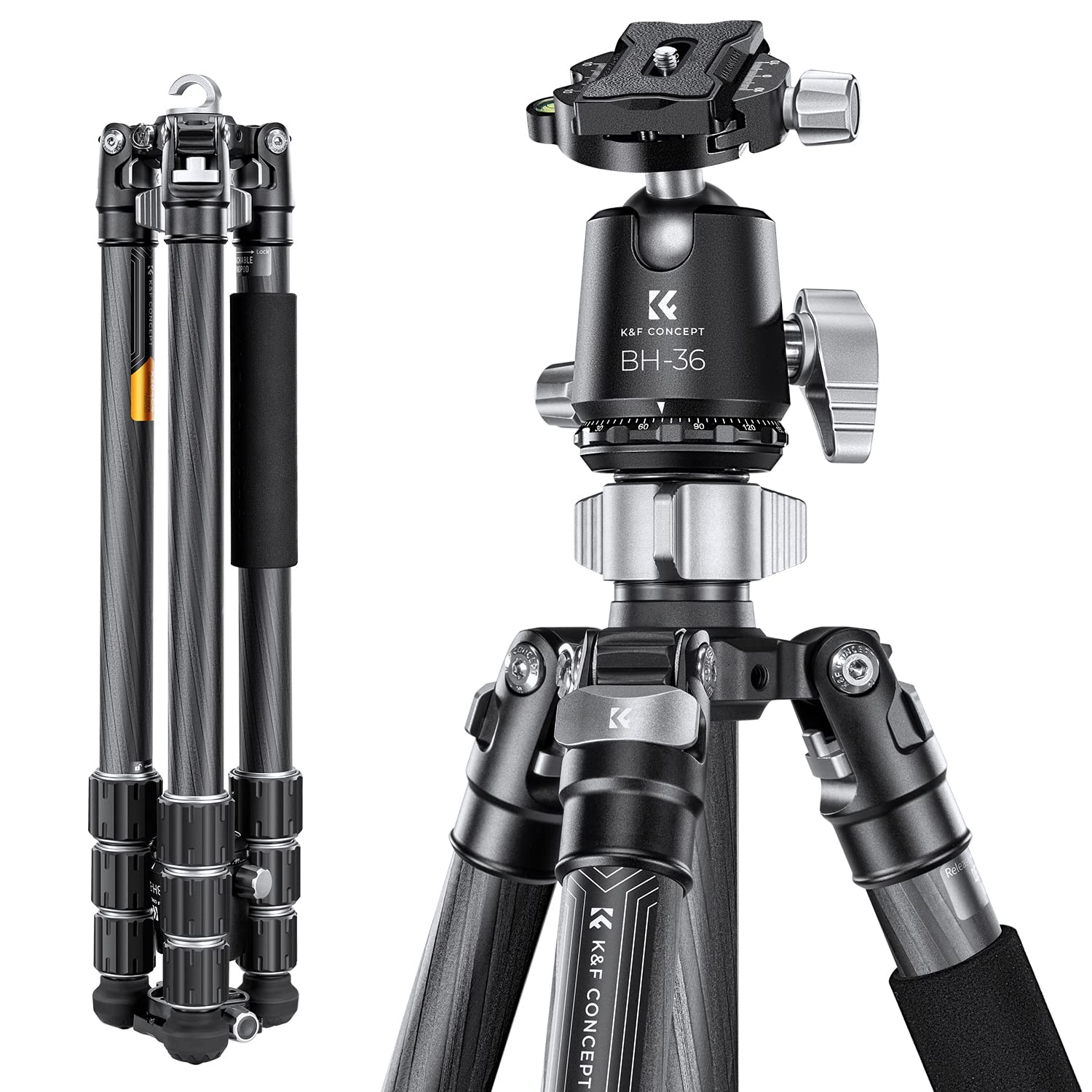
The O254C2 is the least expensive way into a carbon tripod with a proper ball head in this guide, and the spec sheet does not obviously show where the savings came from. Four sections, a 64-inch top height, a 16.3-inch fold, and 1.14 kg — numbers that sit within a whisker of tripods here that cost considerably more.

The 36 mm ball head is the same size class as the one on our top pick, and it pans and locks with a positivity we did not expect at this end of the range. The center column inverts, and a short column is included for ground-level work, which is more than most budget tripods bother with. Folded, it is 16 inches of tube that will slide into the bottom of a normal backpack.

Where a budget tripod shows itself is in the fittings. Whether the head housing feels like machined metal or molded plastic is the thing to check in your hands on arrival, because that is the part that decides whether a heavy lens stays where you put it. Nothing in the specification says it won't; the low price is just worth verifying before a shoot depends on it.

For a first carbon tripod, a second set that lives in the car, or travel with a light kit, it is a straightforward recommendation — we point people here when the choice is between this and a heavier aluminum tripod of the same size. It won't be the tripod you hand down to anyone, and at this level it does not need to be.

Pros

  • 64-inch height at 1.14 kg
  • 36 mm ball head with Arca compatibility
  • Folds to 16.3 inches
  • Invertible column with a short column

Cons

  • Head housing is the part to inspect on arrival
  • 17.6 lb ceiling rules out big telephotos
Our verdict

The budget travel tripod to buy when you want carbon and a real ball head without paying midrange money — for light to midweight kits.

Check Latest Price
8

Casual Travel Use

Fotopro X-go Carbon E2

80 /100
LBD Score Excellent

Key details

Weight
2 lb (0.98 kg)
Folded Length
14.17 in
Load Capacity
17.6 lb
Maximum Height
157 cm
View on Amazon

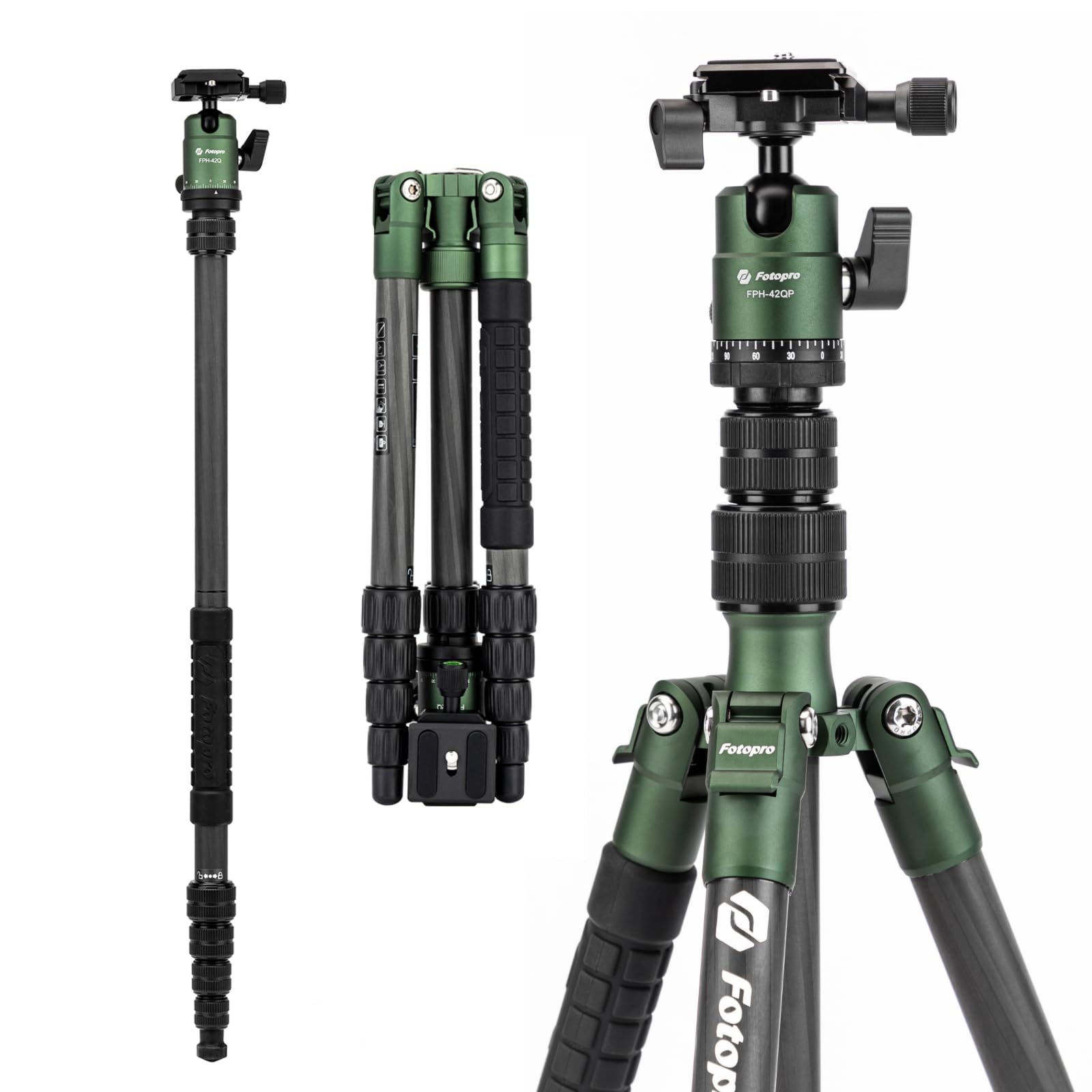
The X-go Carbon E2 is the lightest tripod here after the Traveler 5C, and it is the one where our recommendation comes with the most conditions. At 2 lb it will disappear into a pack; whether it suits you depends on what you hang on it and where you set it up.

The feature list is generous for the end of the market it sits in: leg angles from 25 to 80 degrees for uneven ground, a monopod conversion that takes seconds and no tools, a genuine Arca-Swiss plate rather than a lookalike, a carry bag, and a 157 cm top height. For a spotting scope, a small mirrorless kit, or a phone rig on a hike, that is a useful package that folds to 14.17 inches and weighs about as much as a filled water bottle.

Steadiness is the question mark. A 2 lb tripod rated to 17.6 lb is asking a lot of its lower sections, and the answer depends on the day: on a calm morning with a light kit it is fine, and in a crosswind with a long lens it won't be. Weight the center hook, keep the column down, and treat the rating as a ceiling rather than a target. That is the honest boundary of what this one is for.

We rate it as a specialist rather than a default. If your gear is heavier than a compact body and a short lens, the K&F O254C2 folds slightly larger but reaches about four inches higher for roughly the same money. If two pounds is what decides whether the tripod comes along at all, this one is easy to justify.

Pros

  • 2 lb frame folds to 14.17 inches
  • Tool-free monopod conversion
  • True Arca-Swiss plate included
  • Three leg angles for uneven ground

Cons

  • 157 cm top height is short for tall shooters
  • Steady only with light gear in calm air
Our verdict

A specialist for scopes and small kits — buy it if two pounds matters more than headroom, and check the legs before you load them.

Check Latest Price

How We Tested Carbon Fiber Tripods

We started by reading through specs and customer reviews for more than 30 carbon fiber tripods, then narrowed the field to eight that covered the range of prices, heights, and folded sizes. Over seven months, we used them the way a photographer actually would: on a windy rooftop, on a weekend hike to a waterfall, in a dim studio for long exposures, and packed into a carry-on bag for a flight.

Each tripod got the same workout. We timed setup solo with a stopwatch, then twisted or flipped every leg lock a few hundred times to check for slip, finger pinch, and how quickly the locks engaged. We mounted a heavy telephoto lens and tapped the center column to see how fast vibrations settled. We inverted or removed the center column for low-angle shots, and swept each ball head through its full range to feel for smoothness, creep, and how well it held a heavy lens off-axis.

For portability, we weighed each tripod with and without its carry bag, then strapped it to a daypack to see how it rode. We checked folded length against a water bottle and a laptop sleeve. Durability meant leaving one in a hot car and another in a damp garage for a few weeks, then inspecting leg sections for cracks, resin chips, and any wobble at the joints. We also noted which models felt solid enough to trust in a gust—and which ones we'd only use on a calm day.

How to Choose a Carbon Fiber Tripod

Match the Load Rating to Your Heaviest Lens

Load ratings are static figures, and the camera body is usually the lightest part of a serious kit. A full-frame body with a 200-500 mm zoom and its collar weighs several times what the body does, before you add a gimbal or a quick-release plate. Read the number next to the leg diameter: the 32 mm tubes on Sirui's AM-324S and INNOREL's KT324C are what make their 40-plus-pound ratings useful, while an 8.8 lb rating on a thin leg set is telling you it is for a small camera. If your loaded rig comes close to the rating, move up a class.

Decide the Height You Need With the Column Down

A headline height usually assumes a raised center column, and a raised column is the least rigid part of any tripod. A six-footer on a 54-inch tripod is either stooping or cranking the column; a 68- or 71-inch tripod lets you stand up with the column collapsed. Work that out before you fall for a folded length, because the tripods that pack smallest are also the ones that top out around chest height. Buy the height you shoot at with the column down, and treat the inches above that as a bonus for odd angles.

Weigh Folded Length Against How You'll Carry It

Folded length decides whether a tripod rides inside your pack or strapped to the outside of it. Under about 15 inches it disappears into a daypack; 20 inches and up is a strap-and-carry or checked-bag item. Section count is the mechanism behind the number — five sections pack shorter but add two more locks to undo every time and leave the bottom tube thin. If you set up and break down a dozen times a day, four sections are the better trade. If the tripod lives in a pack for a week and comes out twice, take the shorter fold.

Pick a Lock Style You'll Be Happy With

Twist locks seal against grit and stay quiet; flip locks are faster and show you at a glance that a leg is clamped. Neither design is inherently more reliable — what varies is the material in the mechanism and how it wears across a season. On a budget tripod the locks are usually where the savings show first, which is why the lock hardware is the part we inspect before anything else. If you shoot in sand or surf, sealed collars are worth more than speed.

Decide What the Head Has to Do

A ball head is the right default for stills, and it is not a substitute for a fluid head when you are panning video. Ball diameter matters as much as the load rating: a 36 mm ball and up holds a long lens where you leave it, while a small head sags under the same rig. Stick to Arca-Swiss plates so a gimbal, a monopod, and your tripod swap without adapters, and check whether a head is included at all — INNOREL's KT324C arrives as legs only, which is a good deal if you already own a head and a false economy if you don't.

Frequently Asked Questions

Final Verdict

If you want one carbon tripod for stills and the occasional clip, the K&F Concept X-Series is the one we point you to: 35.2 lb of rated capacity, a 36 mm ball head, and 68 inches of reach at a weight you will carry without complaining. It is the least compromised balance of height, capacity, and packability in this group.

Go to Sirui's AM-324S if your everyday kit is a long telephoto and you want rigidity ahead of a center column, or to NEEWER's LITETRIP LT32 if you shoot video and would rather have flip locks and a leveling base than another 10 pounds of rating.