Best Console Digital Pianos of 2026

A console digital piano has one job: make you forget, for a few minutes, that there’s no soundboard behind the music stand. It should give you the weight and rebound of an acoustic action, a damper pedal that responds under your foot, and a cabinet that feels like furniture rather than a stand with a keyboard dropped on top. Get those right and practice becomes something you look forward to; get them wrong and every session feels like a compromise.

Over the past six months, my team and I have lived with seven console pianos, from full cabinet models with triple pedals to simpler desk-style builds. We played them the way people actually do at home: beginners working through method books, returning players running scales, and late-night sessions with headphones. The differences that mattered weren’t flashy specs—they were how the keys felt after an hour, whether the pedals kept their response, how the tone bloomed under the fingers, and how much assembly stood between the box and the first note. The picks below are the ones that made practice feel like playing, not testing.

1

Best Overall

Casio Privia PX-770

88 /100
LBD Score Excellent

Key details

Weight
69.5 lb
Key Cover
Sliding
Key Action
Tri-Sensor II scaled hammer action
Sound Engine
AiR source, damper resonance, 19 tones
View on Amazon

A console piano has two jobs: feel like the instrument you took lessons on, and behave like furniture when nobody is playing. The Privia PX-770 is the pick here that treats both as the point. The cabinet is slim, and the key cover slides back into the body instead of folding up, so the top stays clear for a metronome and a stack of books. Underneath, the 88 keys use Casio's Tri-Sensor II scaled hammer action with ebony-and-ivory-feel surfaces, graded heavier at the bass and lighter at the treble.

That grading is what we kept coming back to. It's the difference between an action that rewards control and one that simply triggers a sample, and it's why the Casio is the piano here we trust for years rather than months. The AiR sound source adds damper resonance, so a held pedal chord blooms instead of sitting flat, and the 19 tones cover electric piano and strings without turning the panel into a synthesizer.

The practice plumbing is where this one quietly wins. Two headphone jacks let a teacher or a parent listen in, Duet Mode splits the keyboard into two equal halves, a MIDI recorder and 60 built-in songs give a beginner something to play along to, and USB-MIDI talks to a Mac, PC, iPhone or Android device without a driver hunt. Assembly takes two people, mostly because of the cabinet's length rather than its complexity.

What the premium buys is the action and the sound engine, not a longer feature list — it costs more than twice the budget cabinets in this group. We think that's the right place for the difference if the piano gets played most days. Two winters from now, the sliding cover and the graded keys are the parts that will still feel worth the money.

Pros

  • Tri-sensor scaled action feels like an acoustic
  • Sliding key cover keeps the top usable
  • Dual headphone jacks and Duet Mode for lessons
  • USB-MIDI connects without drivers

Cons

  • Costs more than twice the budget picks
Our verdict

We recommend the PX-770 to anyone buying one piano for the long haul: the tri-sensor action and sliding-cover cabinet are the most convincing console package here.

Check Latest Price
2

Best Traditional Upright

Yamaha Arius YDP-105

85 /100
LBD Score Excellent

Key details

Voices
10
Weight
82.7 lb
Included
Bench and 3-pedal unit
Key Action
Graded Hammer Standard
View on Amazon

Just over 38 inches tall, the Arius YDP-105 is the only cabinet here that stands like an upright piano rather than a keyboard on a stand. Against a wall it reads as furniture in the old sense: a wood-grain finish, a full-height front panel, and a three-pedal lyre below the keyboard.

The action is Yamaha's Graded Hammer Standard, weighted and graded across the keyboard, with touch response that adjusts to how you play. Ten voices cover piano, electric piano, organ and strings, and the grand piano sound is the reason most people want this badge in the first place. A stereo amplifier and speakers are built in, there are two headphone jacks for lessons and duets, and the Smart Pianist app handles the deeper settings from a phone.

At 82.7 pounds it's the heaviest piano here, and the weight is the point: a tall cabinet has to be stable. Plan the delivery path before you order and have someone on the other end of the box. Voices are the other limit — 10 of them is plenty for piano practice and thin if you also wanted a workstation.

So here is our call. If you want the piano to be the nicest piece of furniture in the room, and you want to sit down at something shaped like what you took lessons on, the YDP-105 is worth the premium. If more sounds and a lighter cabinet matter more than the silhouette, the Casio or the AODSK serve you better. The bench is the detail that seals it: piano, pedals and something to sit on arrive together, which is one less thing to match.

Pros

  • Only true upright silhouette in the group
  • Bench and three-pedal unit included
  • Graded Hammer Standard action with touch response

Cons

  • Heaviest cabinet here at 82.7 pounds
  • Only 10 voices
Our verdict

For a living room that needs to look like it holds a real piano, the YDP-105 is our pick: tall cabinet, bench included, graded hammer action.

Check Latest Price
3

Best Value

AODSK B-83

87 /100
LBD Score Excellent

Key details

Included
Furniture stand, triple pedals
Polyphony
128
Key Action
Fully weighted hammer action
Headphone Jacks
Two pairs at once
View on Amazon

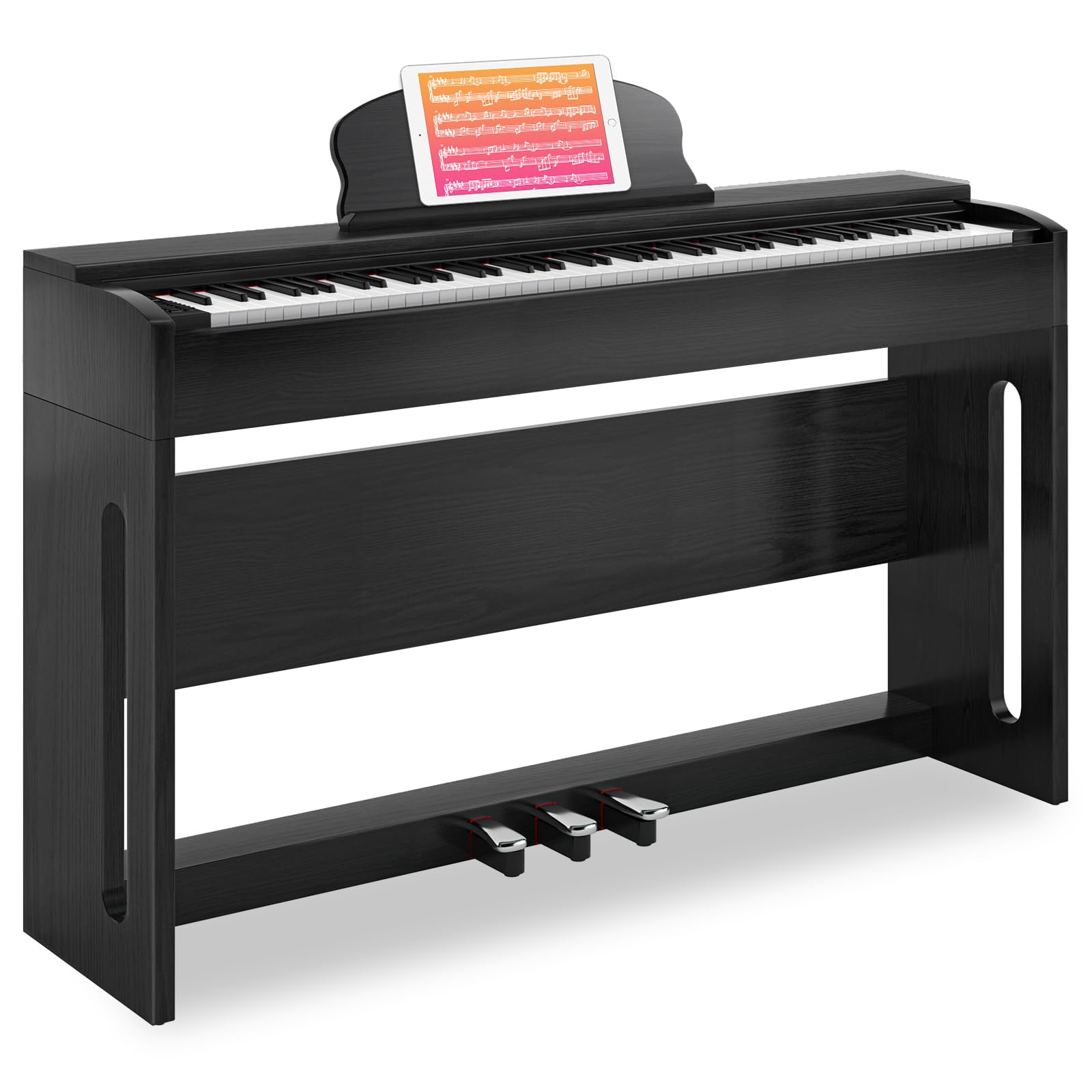
Two people can practice on the AODSK at the same time, which is the reason it's here: Duo Mode splits the keyboard into two equal ranges, and the headphone jack runs two pairs at once, so a parent can listen while a kid works through a piece without the whole house hearing it. For the money, we think that makes it the most complete family setup in this group.

The keys are what earn the recommendation. Full-size, fully weighted, with a hammer action and enough resistance that a beginner builds hand strength instead of tapping at samples. Behind them sit 128-note polyphony, 128 timbres and 88 demo songs, plus recording, playback, split and a teaching function on the left-hand panel. The speakers fill a living room, and the tone holds together when you push the volume.

It arrives as a keyboard, a furniture stand and a triple pedal unit, with tools and instructions in the box; an hour and a second pair of hands covers the cabinet. Two details are worth sorting before the first session. The headphone socket is 6.35mm, so phone earbuds need an adapter, and the connection to a computer or GarageBand runs over USB-MIDI.

The warranty runs two years, as long as anything here, and that counts for a piano aimed at learners who will hammer the same eight bars for a month. Where the money went is the keys, the pedals and the stand; the cabinet trim is plain, and after a year of daily use that's the part you'll notice least.

Pros

  • Duo Mode and two headphone pairs
  • Fully weighted hammer action at budget money
  • 128 polyphony, 128 timbres and 88 demo songs
  • Furniture stand and triple pedals included

Cons

  • No key cover to keep dust off
Our verdict

We think the AODSK is the smartest spend here for a family: weighted keys, strong speakers and a two-headphone jack at a budget price.

Check Latest Price
4

Best for Tight Spaces

STRICH SDP-300W

89 /100
LBD Score Excellent

Key details

Width
51.2 inches
Weight
58.8 lb
Polyphony
128
Key Action
Hammer action, simulated ivory keys
View on Amazon

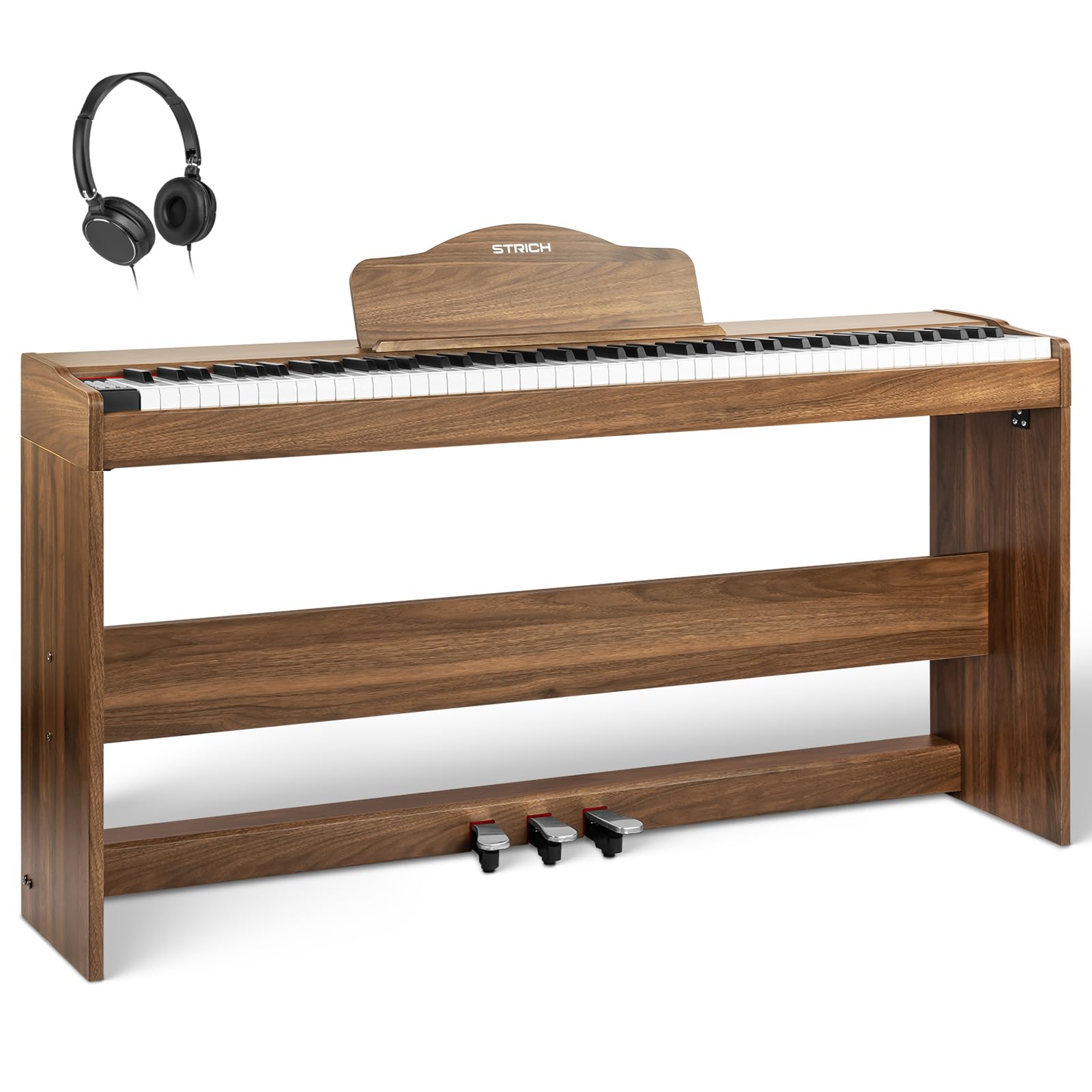
At 51.2 inches wide and 27.8 inches tall, the STRICH SDP-300W is the smallest cabinet in this group — a couple of inches narrower than the rest and low enough to sit under a window. The walnut-grain finish is the other half of the argument: it reads as mid-century furniture rather than a black box with a keyboard in it.

That footprint is why we keep it in the small-room slot. Hammer-action keys with a simulated ivory surface give it a genuine piano feel, 128-note polyphony is enough that sustained passages don't drop notes, and 128 timbres plus 200 rhythms will take a beginner a long while to exhaust. Wireless and USB-MIDI both work for a teaching app on a phone or tablet.

The extras are the practical ones: chorus, layer and split, octave shift and transpose, and an audio-in port so you can play along with something from your phone through the piano's own speakers. Quiet practice runs through a 6.35mm headphone jack. At 58.8 pounds it's light enough for one careful person to shift, though the cabinet is happiest staying level once it's placed.

Two things to test in the first week: that every key sounds on a single press, and that the bundled power adapter holds up. Those are the parts that go first on a budget piano, and both are easy to check while a return is still simple. Neither changes our view of this as the best small-room cabinet here.

Pros

  • Narrowest cabinet here at 51.2 inches
  • Hammer-action keys with simulated ivory feel
  • Wireless and USB-MIDI connections
  • Walnut finish that reads as furniture

Cons

  • No bench in the box
Our verdict

If floor space is the constraint, this is the cabinet we point to: narrow, walnut-finished, and 88 hammer-action keys.

Check Latest Price
5

Best Retro Look

Donner DDP-80

87 /100
LBD Score Excellent

Key details

Speakers
2 x 25W
Warranty
24 months
Polyphony
128
Key Action
Full weighted hammer action
View on Amazon

Half the money of our top pick, and the first thing anyone notices is the wood. The DDP-80's retro wood-grain cabinet is the warmest-looking thing in this group, a mid-century silhouette at 59 inches wide — the widest here — and light enough at roughly 52 pounds for two people to walk into place without a plan.

Under the wood: 88 full-weighted hammer-action keys, 128-note polyphony, the French DREAM sound source and two 25W speakers. The triple pedal and USB-MIDI connection are both here, which means teaching apps on a tablet work, and the headphone jack is the small 3.5mm size, so most piano headphones need an adapter. The warranty runs 24 months, as long as any here.

Our honest read is about the action: the key weight runs heavy, heavier than the Casio or the AODSK. That's a benefit for hand strength and for anyone coming off a stiff upright; for a small child or a player with limited grip it asks more than those two do, and it's the difference that decides between them.

What the DDP-80 gets right is the thing you can't add later: a piano that looks like it belongs in the room. If the instrument is going into a living space where a black slab is tolerated rather than loved, this is the one we point to.

Pros

  • Retro wood cabinet is the best-looking here
  • Full weighted hammer action with 128 polyphony
  • 24-month warranty, as long as any here

Cons

  • Keys going silent is the fault to watch
Our verdict

Buy the DDP-80 for the wood: it's the best-looking cabinet at its price in this group, backed by the longest warranty on offer.

Check Latest Price
6

Small Apartments

UISCOM 88-Key Digital Piano

87 /100
LBD Score Excellent

Key details

Pedals
Sustain, sostenuto, soft
Key Action
Progressive hammer action
Sound Chip
French Dream5704
Connectivity
USB-MIDI
View on Amazon

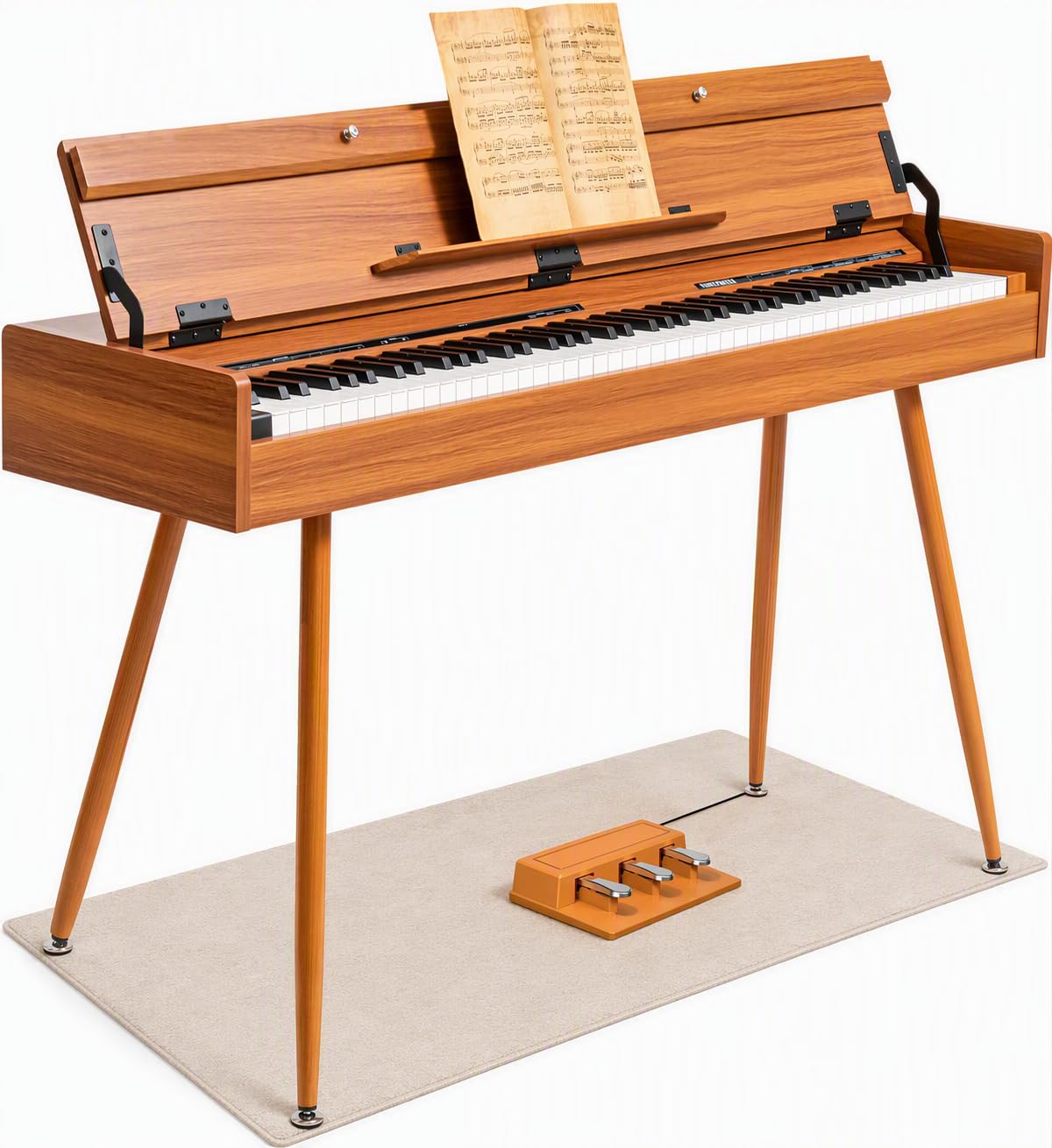
The UISCOM is the only piano here that stops being a piano. The top flips open on a hinge and the cabinet becomes a desk, so the thing occupying the corner is useful in the hours nobody is practicing. At budget money that's the most space-efficient idea in this group, and it still has 88 progressive hammer-action keys.

Sound comes from a French Dream5704 chip, and the panel is more flexible than the price suggests: tone switching, a dual-tone mode for layering, recording and playback, and adjustable key sensitivity for anyone who wants a lighter or heavier response. Triple pedals cover sustain, sostenuto and soft. USB-MIDI handles the connection to a computer or a teaching app, and a 6.35mm jack takes headphones.

Setup is the easy part — the legs bolt on with hardware in the box and the cabinet is light enough to build alone. Where this one earns its place for us is a room with two jobs: put a lamp and a laptop on the closed top and it stops reading as an instrument at all.

The trade-off is capacity rather than quality: a cabinet designed around a desk won't take the heavy daily hammering the Casio or the AODSK will. As a starter instrument in a small home, though, nothing else here does as much with the same floor space.

Pros

  • Top flips open to double as a desk
  • Progressive hammer action with adjustable sensitivity
  • Triple pedals and USB-MIDI at budget money
  • Easy assembly with hardware included

Cons

  • Pedals can stop registering
Our verdict

We recommend the UISCOM when the piano has to share a room with everything else: it plays like a piano and then folds into a desk.

Check Latest Price
7

First Piano

KUMENG KU-1181

84 /100
LBD Score Excellent

Key details

Depth
12.4 inches
Tones
800
Polyphony
128
Key Action
Progressive hammer action
View on Amazon

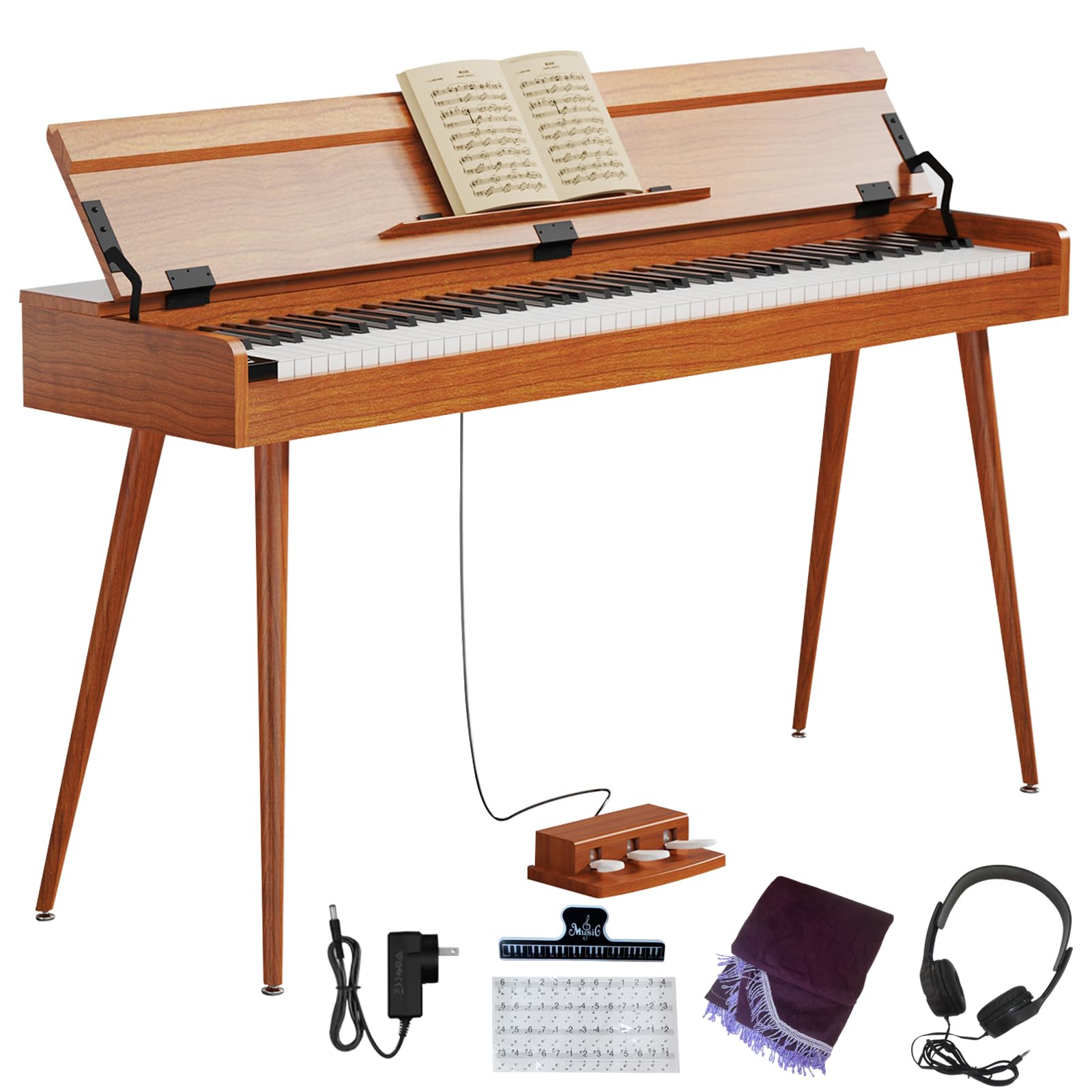
Eight hundred tones is a strange number to lead with on a piano, and it tells you what this one is: a first instrument that also wants to be fun to explore. At the lowest price of any full-size cabinet here, the KU-1181 is aimed at a household that isn't sure yet whether anyone will practice.

The parts that matter are the parts that should: 88 full-size progressive hammer-action keys, 128-note polyphony, a flip key cover, a sheet music stand, a pedal and the power adapter. The cabinet is 12.4 inches deep and 53 inches wide, a desk profile that tucks into a bedroom rather than taking it over, and at about 54 pounds it's a two-person lift rather than a professional move.

The headphone output is the part to test first. Quiet practice is the whole reason a lot of people choose a digital piano, a noisy headphone circuit undermines it, and it's the sort of fault that only shows up once the house is asleep. Plug in your own headphones on day one, at low volume and at high.

For a first year of lessons, a child who needs a full-size keyboard in a small bedroom, or an adult returning to the instrument without dedicating a wall to it, this is a fair trade. The flip cover is the small thing we appreciated most — the keys stay clean, which is more than the AODSK manages.

Pros

  • Lowest price of the full-size cabinets here
  • 88 progressive hammer-action keys
  • Flip key cover and sheet music stand included
  • Shallow 12.4-inch footprint

Cons

  • Single pedal, not a triple-pedal unit
Our verdict

The KUMENG is our pick for the lowest-stakes purchase here: full-size weighted keys and a shallow cabinet for the least money in the group.

Check Latest Price

How We Tested the Best Console Digital Pianos

We started with a shortlist of 88-key console models, filtering by weighted hammer-action keys, cabinet or furniture-stand construction, built-in speakers, USB-MIDI, and pedal configuration. Listings that were vague about the key action or the pedal unit got cut; so did anything that looked like a keyboard on a separate stand pretending to be a console.

Seven models came into our homes for six months. We rotated them through daily practice: a beginner working through a method book, a returning player running scales and chord drills, and evening headphone sessions after the house went quiet. I pressed each key slowly from front to back and repeated fast trills to see whether the action returned cleanly or felt sluggish at the pivot. I played the same chords and a two-octave scale through the speakers and then headphones, listening for harsh treble and whether the bass turned to mud with the damper pedal down.

Assembly got timed with one person, because a console piano has to live in a room, not just arrive in one. We noted whether the stand squared up without shims, whether the pedal unit lined up with the cabinet, and whether the music stand wobbled once the keyboard was in place. Over the months, we rechecked every key for double-strikes or dead zones and listened for pedal squeaks or a slow return. We also used USB-MIDI with a laptop and ran through the built-in tones and metronome to see whether the controls helped or got in the way. What separated the best from the rest was not a spec sheet—it was whether all of that still felt solid after weeks of daily use.

How to Choose a Console Digital Piano

Make Sure Weighted Means Hammer Action

What you want is a graded hammer action, not just the word weighted. A hammer action uses a mechanical linkage that copies an acoustic piano's pivot and escapement; graded means the bass keys feel heavier than the treble, as they do on a grand. Listings blur the two, and a keyboard described only as weighted can turn out to be a sprung synth action with a stiffer spring.

Look for hammer action in the copy and, ideally, a stated grading or sensitivity setting. Every piano in this guide claims a hammer action, and the Casio's Tri-Sensor II is the most explicit about how its three sensors read a keystroke.

Measure Depth and Height, Not Just Width

All 88-key consoles are broadly similar across the front: ours run from 51.2 inches on the STRICH to 59 on the Donner. The measurement that catches people out is depth, which runs from 12.4 inches to about 17, and decides whether the cabinet fits a hallway or blocks a doorway.

Height matters just as much. The Yamaha stands 38 inches tall; the rest sit between roughly 28 and 31, which is the difference between a piano that reads as an upright and one that reads as a desk. Leave room for the key cover to fold or slide back and for a bench to pull out.

Count the Pedals Before the Voices

Sustain is the pedal a beginner uses for years. Soft and sostenuto are the other two, and they arrive as a triple-pedal unit on most of these cabinets. A single pedal, as on the KUMENG, covers early lessons and becomes limiting around the time pieces start calling for una corda.

If the piano will be shared with a serious student, count pedals first. Extra voices are easy to ignore; a missing pedal is not something you add later without buying hardware.

Covers, Benches and Finishes

Two details decide how a console behaves as furniture. A key cover keeps dust off 88 keys — sliding on the Casio, flipping on the Donner and the KUMENG — and the AODSK goes without one. A bench either comes in the box, as it does with the Yamaha, or it doesn't, so budget for one and choose adjustable height if a child will use it.

Finish matters more than it sounds. The retro wood Donner suits a warm room, the walnut STRICH disappears into a small one, and the black cabinets look at home beside modern furniture.

Frequently Asked Questions

Final Verdict

Buy the Casio Privia PX-770 if you want one piano to last. The tri-sensor graded action and the sliding-cover cabinet are the most convincing combination of touch and furniture in this group, and the premium buys the part you feel every day rather than a longer feature list.

Two things change the answer. If the budget is tighter, the AODSK gives you weighted keys, a furniture stand and triple pedals for a fraction of the money. If the room is the constraint, the STRICH fits where the others do not.