Best Digital Pianos Under $500

The word "weighted" does a lot of heavy lifting in this price range. Nearly every 88-key piano under $500 claims it, but what your fingers actually meet ranges from a genuinely graded hammer action to keys with a little lead taped inside. Touch is the whole decision, because it's what determines whether you practice for ten minutes or an hour — and whether a beginner makes it past the third month of lessons.

We've spent seven months with eight of these pianos, and the differences show up where spec sheets don't: how the keys clack when you're practicing at 11 p.m., whether the sustain pedal slides out from under your heel, and how much room a pair of built-in speakers actually fills. Wattage is a poor proxy for tone, and a triple-pedal unit isn't automatically sturdier than a single sustain pedal.

All of these are living-room instruments: a bedroom corner, a bench in the hallway, a desk you clear off at night. I looked for pianos that feel solid under the hands and are genuinely enjoyable to sit down at, rather than ones padded with hundreds of voices nobody touches. The list below is built around exactly that.

1

Best Overall

Yamaha P71

95 /100
LBD Score Outstanding

Key details

Voices
10
Weight
25 lb
In The Box
Sustain pedal, power supply
Key Action
88 weighted hammer action
View on Amazon

Eighty-eight weighted keys, a sustain pedal in the box, and 25 pounds is most of the argument. The P71 is the piano we point to for someone taking lessons at home who does not want to think about the purchase again: the hammer action has enough resistance to build finger strength, the touch response carries the difference between soft and loud, and the body is light enough that one person can carry it to a stand and back.

The tone is the other half of why it wins. Ten voices is the whole library, and the grand piano is the one you'll live in, so there's no screen and no menu between you and playing. The sound holds up under headphones, dual mode layers a second voice when you want strings behind the piano, and USB lets you run it into a laptop once you start recording.

One practical note before you order: the headphone jack is 3.5mm rather than the 1/4-inch socket most pianos here use, so a pair of studio headphones needs a cheap adapter. Everything else that's missing is missing on purpose — no Bluetooth, no app, no accompaniment — and for home practice that's a clean trade rather than a hole in the package.

Pros

  • Weighted hammer action with real resistance
  • Grand piano tone that holds up on headphones
  • 25 pounds
  • Sustain pedal and power supply included

Cons

  • Only 10 voices, no rhythms or accompaniment
Our verdict

One piano to learn on and keep: we recommend the P71 for its genuinely weighted action, convincing grand tone, and 25-pound body you can shift on your own.

Check Latest Price
2

Best Key Action

Roland FP-10

90 /100
LBD Score Outstanding

Key details

Weight
27 lb
Key Action
88-note acoustic-feel keyboard
Connectivity
Bluetooth, USB
Sound Engine
SuperNATURAL
View on Amazon

The FP-10 costs more than the Yamaha and gives you less in the box, so it has to earn the difference at the keyboard. It does: the SuperNATURAL engine and the acoustic-feel keys with their ivory-feel surface are the two things Roland put the money into, and both show up the moment you play.

We came away thinking the action is the best of anything here. There's real resistance under the fingers and a clear relationship between how hard you press and how loud the note comes out, which is exactly what a beginner needs in order to develop touch rather than just hit notes. At the top of the budget, that is what you are paying for.

The rest of the package is compact: 27 pounds, a low profile that sits on a table or an X-stand, a headphone output for late practice, and Bluetooth MIDI that pairs with a phone or tablet so a learning app works without a cable. That last part is the one convenience the Yamaha doesn't offer, and for a beginner working alone it counts for more than another hundred voices would.

Pros

  • Most convincing key action in this set
  • SuperNATURAL piano tone
  • Bluetooth MIDI for apps and recording
  • Compact 27-pound body

Cons

  • Onboard speakers are the weak link
Our verdict

If touch is the thing you care about most, we point you to the FP-10 — the most convincing keyboard here, with Bluetooth MIDI on top.

Check Latest Price
3

Best Budget

STRICH SDP-120

84 /100
LBD Score Excellent

Key details

Weight
20.5 lb
Speakers
2 x 15W
Key Action
88 fully weighted
Connectivity
Wireless MIDI, USB
View on Amazon

A fully weighted action at the bottom of the price range is a claim worth doubting, so the SDP-120 went into testing with the lowest expectations of anything here. The weighting is real: the keys have heft, they push back, and they return with the weight of a hammer rather than the snap of a spring, which is the difference between building finger strength and simply pressing buttons.

Sound is better than the price suggests too. Fifteen watts per side is more than most of the budget group, and the piano voices at the front of the library are the strongest — the electric pianos and organs further in are there for variety rather than for playing. Wireless MIDI and USB both work, and the LCD makes the 128 tones and 200 rhythms navigable once you've read the manual.

What you give up is polish. The control panel is busier than a practice piano needs, the assembly paperwork is skimpy, and there's no furniture here — the SDP-120 is a slab that wants a stand. At 20.5 pounds it tucks into a closet between sessions, and the sustain pedal comes with it. For the money, the action is the reason to buy.

Pros

  • Fully weighted hammer action at the lowest fully weighted price
  • 2 x 15W speakers with real headroom
  • 20.5 pounds, easy to tuck away
  • Wireless MIDI and USB

Cons

  • Assembly instructions are skimpy
  • Control panel is busier than practice needs
Our verdict

The cheapest fully weighted piano here, and the one we recommend to anyone who wants hammer-action feel without paying for polish they don't need.

Check Latest Price
4

Best for Living Rooms

Donner DDP-80

87 /100
LBD Score Excellent

Key details

Finish
Retro wood
Pedals
Three-pedal unit
Speakers
2 x 25W
Key Action
88 weighted hammer action
View on Amazon

Most of the pianos here are slabs that need a stand and a corner nobody looks at. The DDP-80 is a console in a retro wood finish with a music stand and a triple pedal built into the cabinet, and that changes where it can live: 59 inches wide, close to 30 tall, and heavy enough at 52 pounds that you decide the spot before you start assembling.

Inside, Donner has been generous. Two 25-watt speakers give it the most volume of the console models, the Dream sound source produces a warm, room-filling piano, and 128-note polyphony means a held sustain pedal doesn't start stealing notes. We especially appreciate the three pedals sitting on the cabinet — soft and sostenuto are what a method book asks for in the second year, and here they aren't an upgrade.

The thing to check is the keys. A dead or intermittent key is the fault that comes up on this model, so play every one, top to bottom, on the day it arrives, and keep the packaging until you have. Donner's two-year warranty covers it, and assembly itself is quick. There's no Bluetooth either; USB-MIDI is how you connect to a laptop.

Pros

  • Wood console that reads as furniture
  • Triple pedal with soft and sostenuto
  • 2 x 25W speakers fill a room
  • Straightforward assembly

Cons

  • USB-MIDI only, no Bluetooth
Our verdict

If the piano has to pass as furniture, we recommend the DDP-80: a wood console with three pedals and enough speaker for a living room.

Check Latest Price
5

Small Apartments

UISCOM 88-Key Digital Piano

87 /100
LBD Score Excellent

Key details

Design
Flip-top desk and vanity
Pedals
Three-pedal unit
Key Action
88 progressive hammer action
Connectivity
USB-MIDI
View on Amazon

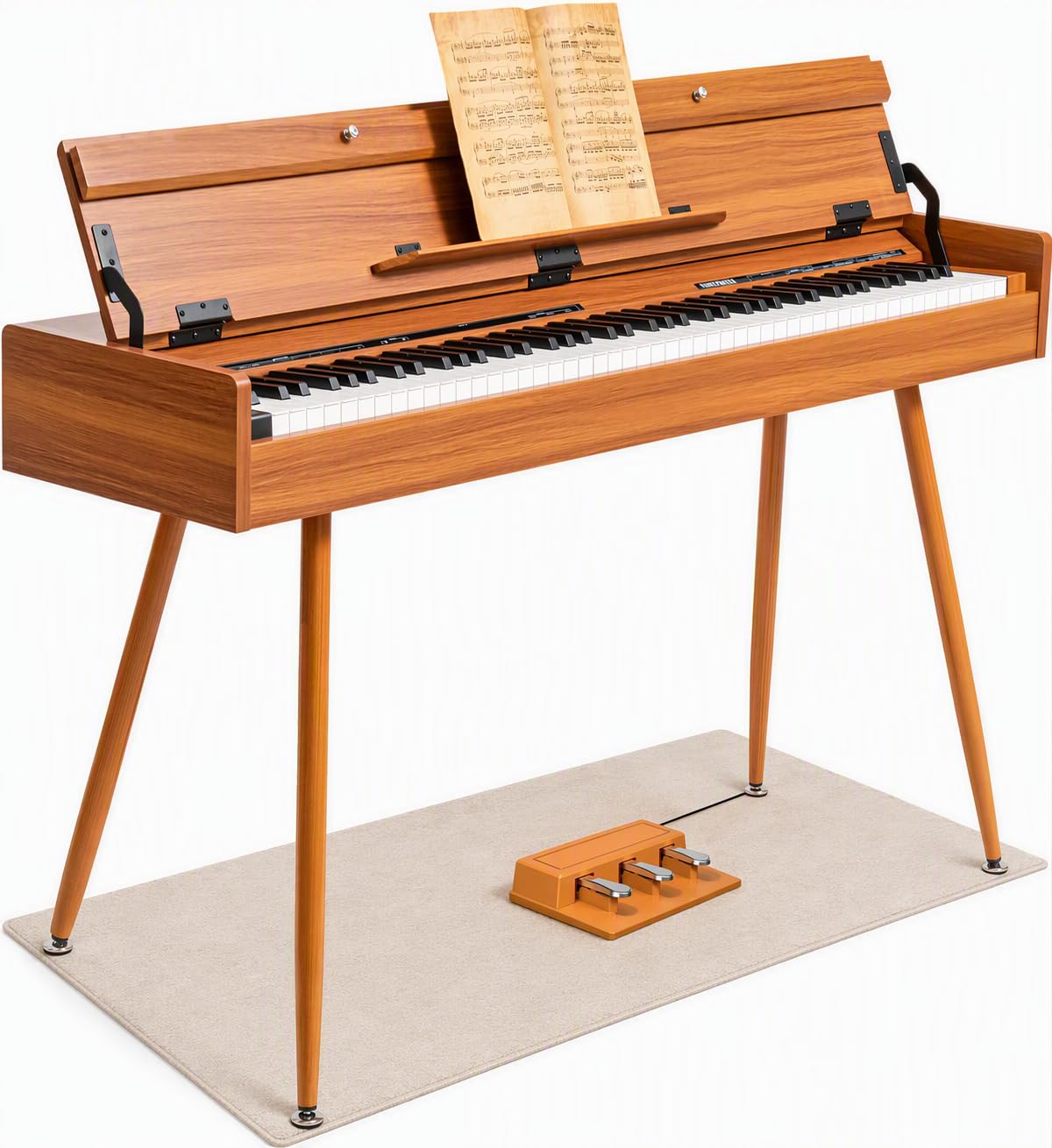
The lid is the whole idea. The UISCOM's top folds down over the keys and the cabinet reads as a small desk or vanity rather than a piano, which is the difference between owning an instrument in a studio apartment and not owning one at all.

Underneath it's a real instrument: 88 progressive hammer-action keys with adjustable sensitivity, a three-pedal unit with sustain, sostenuto and soft, a 6.35mm headphone jack, and USB-MIDI for a laptop. Volume is a knob rather than a menu, which we appreciate on a piano that gets switched on for ten minutes at a time.

Two things to weigh before you buy. The pedals are the part to test — a pedal that stops responding is the fault that comes up on this model, so work all three before you settle the piano into place. And the brown finish is paint rather than veneer, which you notice up close and forget from across the room. Neither changes what the design buys you: a piano in a room that had no space for one.

Pros

  • Closes into a desk-sized footprint
  • Progressive hammer-action keys
  • Triple pedal with sustain, sostenuto and soft
  • Simple knob-and-switch controls

Cons

  • Painted finish, not real wood veneer
Our verdict

For a small apartment, the UISCOM earns its floor space: weighted keys and a triple pedal in a cabinet that closes into a desk.

Check Latest Price
6

Quiet Headphone Practice

Alesis Recital

93 /100
LBD Score Outstanding

Key details

Power
AC or 6 D batteries
Weight
15.7 lb
Speakers
2 x 20W
Key Action
88 semi-weighted
View on Amazon

Fifteen and a half pounds and three and a half inches thick is the case for the Recital. It's the only piano here that runs on six D cells as well as mains power, so the porch, the basement and the back seat of a car are all fair game, and it stores on a shelf instead of claiming a wall.

The action is semi-weighted with adjustable touch response, and that's the trade you're making. The keys are full size and respond to how hard you play, so dynamics work from the first lesson, but there's no hammer resistance, and a student who moves to an acoustic will feel the difference in their hands. Five voices, split and layer modes, and a three-month Skoove subscription cover the beginner years.

The 20-watt speakers are the weak spot: at full volume the Recital is quiet enough that a room with a television in it wins. Headphones, or powered speakers through the stereo RCA outputs, are how it does its best work — and since the headphone jack is a proper 1/4-inch socket, any pair you already own plugs straight in.

So this is a headphones-first piano, and a good one for a small home where the instrument comes out for half an hour at a time. It's the lightest way here to get full-size, touch-sensitive keys in something you can carry with one hand, and the batteries make it the only one that doesn't need to live near an outlet.

Pros

  • 15.7 pounds
  • Runs on batteries or AC
  • Adjustable touch response
  • Lesson mode and a Skoove subscription

Cons

  • Semi-weighted keys, no hammer resistance
  • No sustain pedal in the box
Our verdict

We recommend the Recital for quiet, portable practice: 15.7 pounds, battery power, and a headphone jack that keeps the household undisturbed.

Check Latest Price
7

First-Time Beginners

KUMENG 88-Key Digital Piano

85 /100
LBD Score Excellent

Key details

Tones
800
Warranty
2 years
In The Box
Stand, pedal, power adapter
Key Action
88 semi-weighted
View on Amazon

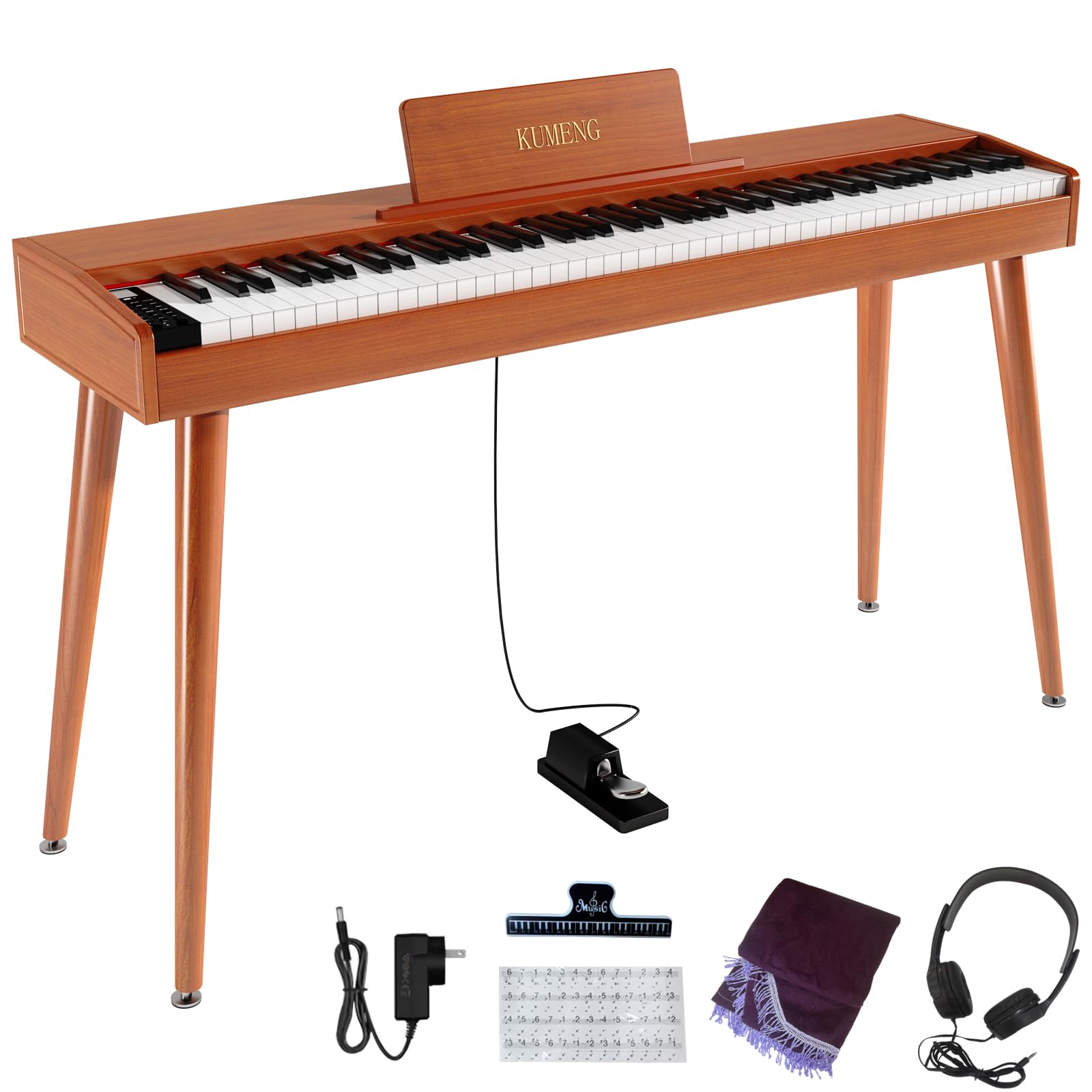
Semi-weighted is the honest description, and it's the first thing to understand here: the keys are full size and respond to how hard you play, but they don't carry the hammer resistance of the Yamaha or the STRICH. For a child's first two years, or an adult finding out whether piano is going to stick, that's a fair place to start — the full 88 keys mean the repertoire doesn't run out before the keyboard does.

What arrives in the box is generous at this end of the market: the stand, a sustain pedal, the power adapter, a sheet music stand, and 800 tones with 128-note polyphony. USB-MIDI connects it to a phone or laptop for an app-based course, there's a 3.5mm headphone jack for evening practice, and setup takes minutes.

The compromises show up over time. Individual keys can stop responding, so register the two-year warranty the day it lands and keep the receipt where you'll find it. The tone library is wide rather than deep — a handful of the 800 are worth playing and the rest are there to be counted. As a first piano that has to justify its place in a small budget, it still earns the recommendation, and the warranty is the longest of anything here.

Pros

  • Full 88 keys at the lowest price here
  • Stand, pedal and adapter included
  • USB-MIDI for app-based lessons
  • Two-year warranty

Cons

  • Semi-weighted action, no hammer feel
Our verdict

Buy it as a first instrument for a kid or a curious adult: 88 full-size keys, a stand and a pedal for less than any other piano here.

Check Latest Price

How We Tested the Best Digital Pianos Under $500

We started by pulling every 88-key digital piano under $500 we could find from the big-name manufacturers and the direct-to-consumer brands, then filtered on what actually matters: a graded hammer or authentic-feeling action rather than a spring, full-size keys, at least one pedal in the box, and whether the thing is in stock. That left eight pianos, which we bought outright and set up in living rooms, bedrooms, and one very small home office.

For seven months, each piano lived where a piano actually lives. We played the same warm-up scales, the same chord voicings, and a beginner method-book piece on all eight, noting where the action pushed back and where it just felt heavy. We played with eyes closed to catch key clack and lateral wobble, pressed keys slowly to feel the graded weighting, and spent evenings on headphones so we could judge tone without the speakers covering for it. Volume got tested the honest way: half, then full, in a carpeted room.

Pedals took the most abuse, because they're the first thing to fail. We noted whether a sustain pedal crept across hardwood, whether it registered a light half-press, and how a triple-pedal unit held up when we leaned on it. Every few weeks we ran chromatic scales to catch dead notes, double-triggering, or keys that had developed a rattle; we nudged and bumped each piano the way a vacuum cleaner does to check for wobble; and we clocked whether hooking up USB-MIDI to a laptop took minutes or an afternoon.

A beginner with about four months of lessons worked through the same book on each, which is where weighted keys prove themselves or don't. Nothing here matches a $2,000 console, but a few of these I kept playing after the notes were filed — the only reliability test that really counts.

How to Choose a Digital Piano for Home Practice

Start with the action, because that's what you're buying

A hammer action uses weighted levers to imitate an acoustic piano, and it builds the finger strength a real piano expects. Semi-weighted keys add some heft to a spring, which is fine for a convenience instrument but won't train the same hands. Listings blur the line, so look for the words 'hammer action' or 'fully weighted' rather than trusting a badge, and check whether touch response is adjustable.

If lessons on an acoustic are the goal, this is the last place to compromise. The Yamaha P71 and Roland FP-10 get the feel right, and the STRICH SDP-120 gets close for a lot less.

Decide between a slab and a console before you measure anything

A slab is a keyboard with speakers in a flat case; it needs a stand, a wall, and somewhere to park the music. A console such as the Donner DDP-80 or the UISCOM arrives as furniture and hides the pedals and the stand inside the cabinet.

Nearly everything here runs 50 to 54 inches wide, so width rarely settles it. The real question is whether the piano has to look like an object in the room or can disappear into a closet. Answer that first, then measure the wall.

Watts per side are a rough guide, not a volume rating

Speaker power figures don't translate neatly into loudness. The Alesis Recital runs 20 watts per side and still gets lost in a room with a television going, which is the clearest reminder in this set to listen for output rather than read it off a spec line.

If most practice happens on headphones, put the budget there instead and check the jack. The Yamaha P71 uses a 3.5mm socket, so a 1/4-inch headphone cable needs an adapter; the Alesis and most consoles here use the full-size jack.

Count what's in the box, including the pedals

A sustain pedal stops being optional within weeks, and soft and sostenuto pedals are what method books start asking for in the second year. The Donner DDP-80 and the UISCOM build three pedals into the cabinet, the STRICH and KUMENG include one, and the Alesis ships without — its 1/4-inch input is waiting for a pedal you buy.

Add the stand, the bench, and the pedal before comparing prices. A cheaper piano with an empty box often isn't cheaper once the gaps are filled.

Spend on polyphony, not on the tone count

Polyphony is how many notes the piano can sound at once, and it matters most with the sustain pedal down: 64 notes runs out in a big chord passage, while 128 stays comfortable through practice. Everything worth buying here clears 128.

Tone counts go the other way. Eight hundred voices sounds like value until you audition the fifth one. A handful of well-sampled pianos and generous polyphony is the better instrument.

Frequently Asked Questions

Final Verdict

The Yamaha P71 is the piano we keep coming back to. It gets the two things that decide whether practice actually happens — a weighted action that feels like an instrument and a grand piano tone you want to hear — and it does it at 25 pounds, with a pedal in the box and no screen in the way.

Spend more on the Roland FP-10 if touch is your priority and Bluetooth MIDI would genuinely get used. Go cheaper with the STRICH SDP-120 and you still get a fully weighted action. And if the piano has to sit in a living room and look like it belongs there, the Donner DDP-80 is the one to measure the wall for.