Best Electric Bass Guitars of 2026

Nobody quits bass because it sounded wrong. They quit because the strings sat too high, the neck felt like a fence post, and the thing drifted out of tune every time they set it down between songs. A beginner bass has one real job: to get out of the way of the person learning on it.

Price and a handsome finish are what sell a bass online, but action, neck profile and tuning stability decide whether it's still leaning against the bedroom wall in six months. I've spent the past six months with 12 of them — short-scales, full 34-inch models, and a handful of starter kits that arrived with their own small amps — playing through cheap practice combos, at a weekly rehearsal with a live drummer, and unplugged on the couch.

Two things I'd pass on to any first-time buyer: a short scale is a genuine advantage if your hands are small or you're coming over from guitar, and the bundled amp in a kit is almost always the first thing you'll outgrow. The picks below cover both paths, including a couple of finishes worth a second look.

1

Best Overall

Ibanez GSR200

92 /100
LBD Score Outstanding

Key details

Neck
One-piece maple
Weight
9 lb
Fretboard
Rosewood
View on Amazon

If you want one bass that covers practice, recording, and a first gig without asking you to learn its quirks, start here. The GSR200 is a standard 4-string with a 9-pound body, a one-piece maple neck, and a rosewood fretboard. That combination is not flashy, but it is the right starting point for most players: light enough to hold through a long practice, familiar enough to feel normal after a few minutes, and simple enough that you spend your time playing rather than adjusting.

The tone is warm and round rather than aggressive, and the neck is easy to move around on. The setup is the variable: some GSR200s arrive ready to play, while others need the truss rod, action, and intonation checked. That is normal for a bass at this price, and it is not a reason to skip it — just budget a little time, or ask a shop to do it, before you judge the instrument. The pearl dot inlays and black finish are a tidy bonus.

What keeps the GSR200 at the top is the balance of cost and risk. It is not the cheapest bass here, and it does not have the PJ flexibility of the Yamaha or the short-scale fit of the MiKro. But it is the one we are most comfortable recommending without a long list of caveats. It looks tidy on a stand and does not advertise its price, which is more than you can say for every budget bass.

Pros

  • Comfortable 4-string neck for long practice
  • Warm, round tone with a simple layout
  • 9-pound body is manageable for most players

Cons

  • No bag or cable included
Our verdict

This is the bass we recommend first: a comfortable 4-string with a 9-pound body, a maple neck, and a long record of easy playability.

Check Latest Price
2

Best Short-Scale

Ibanez MiKro

92 /100
LBD Score Outstanding

Key details

Body
Poplar
Frets
22
Weight
6.9 lb
Scale Length
28.6 inches
View on Amazon

The MiKro's 28.6-inch scale and 6.9-pound body are the first things you notice. It feels closer to a guitar than a full-size bass, which is exactly the point: shorter reaches, less weight on your shoulder, and a body that tucks into a small practice space. The walnut flat finish is understated, and the poplar body and maple neck keep the build simple.

We like it most for players who have struggled with a full-size bass. The shorter scale makes fretting easier, and the light body is kind over a long session. The trade-off is tonal: a short-scale bass does not have the same deep, round low end as a full-size P-bass, and the low E can feel a little soft. That is a fair exchange for comfort, not a flaw. The setup is worth checking — nut height, neck relief, and pickup height can all need a tweak to clear fret buzz.

The MiKro is also a smart choice for a guitar player adding bass to a home studio, because the smaller body leaves more room for a desk and a keyboard. The included strap is a small convenience, and the 22 frets and jatoba board are standard fare. The reason to buy this one is the fit, not the feature count.

Pros

  • Short 28.6-inch scale suits smaller hands
  • Light 6.9-pound body is easy to carry
  • Beginner-friendly feel with a strap included

Cons

  • No gig bag included
Our verdict

The MiKro is the short-scale bass we point to for smaller hands, guitar players, and anyone who wants a lighter bass that still sounds like a bass.

Check Latest Price
3

Best Budget Precision

Squier Debut Precision Bass

91 /100
LBD Score Outstanding

Key details

Neck
C-shaped
Pickup
Split-coil
Weight
9.9 lb
Warranty
2 years
View on Amazon

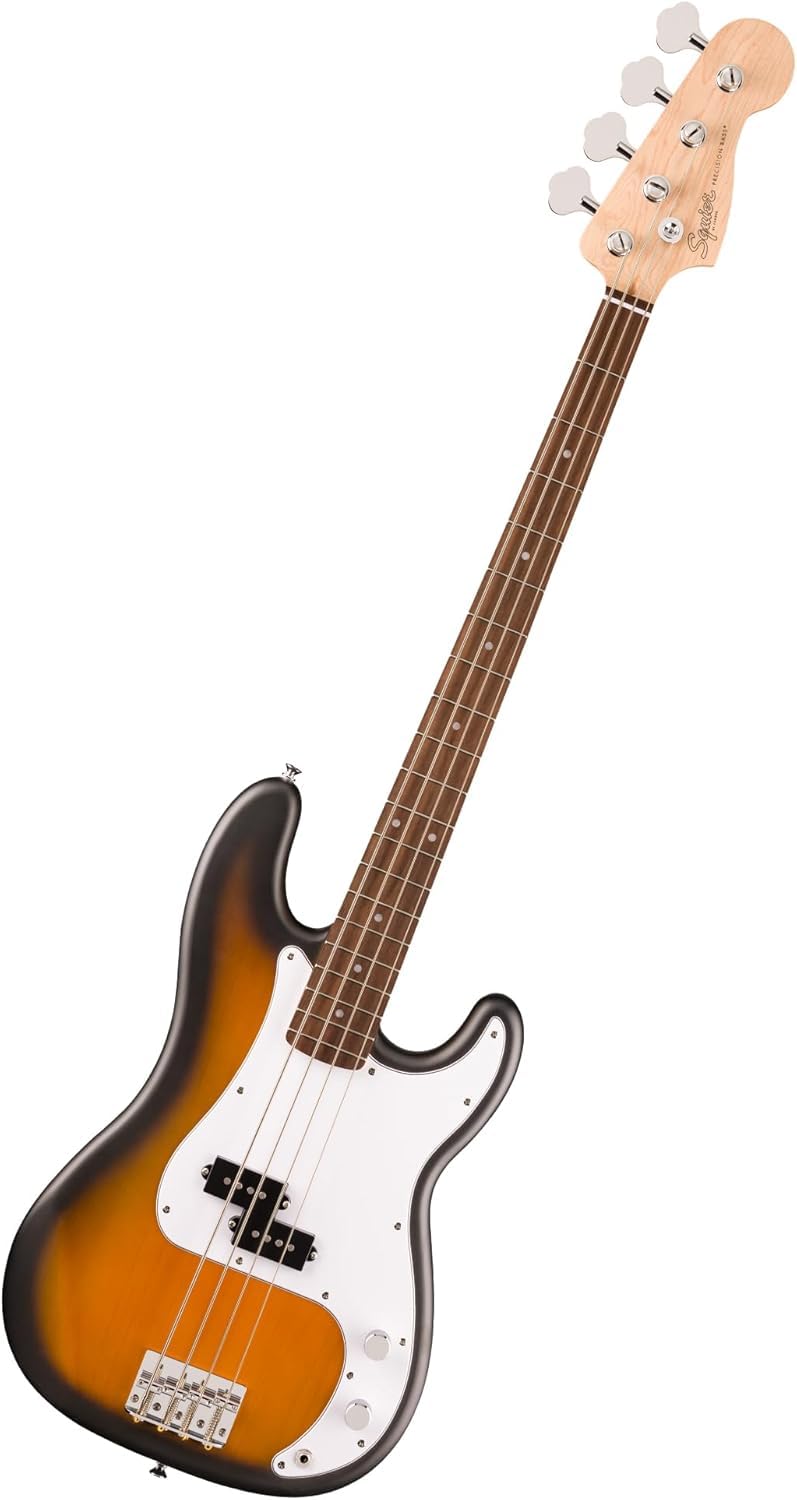
A two-year warranty and a 30-day Fender Play subscription are the kind of extras that matter more than another knob on a beginner bass. The Debut Precision pairs them with a poplar body, a C-shaped neck, a laurel fingerboard, and a split-coil pickup with volume and tone controls. The matte 2-color sunburst finish looks purposeful, and the vintage-style open-gear tuners are simple to live with.

We recommend it for a beginner who wants the Precision Bass look and a neck that feels familiar right away. The C shape is comfortable, and the split-coil gives you that thick, focused P-bass tone without a lot of fuss. The caveat is the neck: a bent or twisted example can show up, and that is not something a truss-rod tweak fixes. Check the neck as soon as it arrives, and use the warranty if it will not straighten. At this price, the two-year coverage is a real safety net, and the Fender Play lessons give a new player something to do beyond noodling. The strings can feel rough at first, so a fresh set is a cheap upgrade.

Pros

  • Two-year warranty backs a budget bass
  • Comfortable C-shaped neck
  • Split-coil pickup delivers punchy P-bass tone
  • Fender Play subscription included

Cons

  • No bag or cable included
Our verdict

We like the Squier Debut for a beginner who wants a Precision Bass: it brings a two-year warranty and Fender Play lessons, though the neck is the part to inspect first.

Check Latest Price
4

Best Step-Up Tone

Yamaha TRBX174

92 /100
LBD Score Outstanding

Key details

Neck
Bolt-on maple
Weight
11.8 lb
Pickups
PJ
Fingerboard
Sonokeling
View on Amazon

At 11.75 pounds, the TRBX174 is the heaviest bass in this group. We still recommend it, because the weight is doing something: the body feels solid, the pronounced upper bout provides balance, and the bass does not feel like it is going to tip away from you. If you have back or shoulder issues, this is the one to try before you buy; otherwise, the extra mass is a fair trade for the stability.

The PJ pickup setup is the reason to step up. You get the split-coil's thick low end plus a bridge single-coil for bite, so the bass can move from warm, rounded thump to a brighter rock tone without swapping instruments. That flexibility is the difference between a bass that does one thing well and one that follows you into a second band.

The deep cutaway also makes the upper frets easier to reach than on a traditional slab body. The neck is a fast, bolt-on maple piece with a sonokeling fingerboard, and the overall feel is closer to a more expensive bass than the price suggests. The black finish is clean and understated, and the hardware feels sorted rather than stripped-down.

The bass is not as forgiving to new hands as the short-scale MiKro, and it costs more than the other 4-strings here. If you want a full-size bass that can cover more tonal ground and you are comfortable with a heavier instrument, this is the one we point to. A wide strap is worth adding if you plan long standing sets.

Pros

  • PJ pickups cover a wide tonal range
  • Deep cutaway opens upper-fret access
  • Solid, balanced feel
  • Comfortable bolt-on maple neck

Cons

No notable drawbacks to flag.

Our verdict

We pick the TRBX174 as the step-up 4-string here: PJ pickups, a comfortable neck, and a solid feel, as long as you can live with the weight.

Check Latest Price
5

Best All-In-One Starter Kit

GLARRY Beginner Bass Kit

91 /100
LBD Score Outstanding

Key details

Amp
20W included
Size
Full-size 39 inches
Pickup
Split single-coil
Warranty
1 year
View on Amazon

The box arrives with a full-size 39-inch bass, a 20-watt amp, a gig bag, a strap, a cable, and a pick. That is the appeal: no second order, no matching amp to research, no excuse to leave it in the case. The bass itself uses a basswood body, a rosewood fingerboard, and a split single-coil pickup with two volume knobs.

The bass is the better part of the package. It plays well out of the box and has a warm, straightforward tone that suits practice and simple recording. The amp has volume, treble, mid, and bass controls plus a headphone jack, so you can play without bothering anyone. The hardware is basic, but it does the job.

We recommend the kit for a true beginner who wants to plug in the day it arrives, or for a parent buying a first bass without assembling a rig. If you already own a bass amp or an audio interface, put the money into the instrument instead. The one-year warranty is a point in its favor over the shorter coverage on some budget kits, and the included bag makes it easy to take to a lesson.

Pros

  • Complete kit with amp, bag, strap, and cable
  • Full-size 39-inch bass
  • 20-watt amp has a headphone jack

Cons

  • Amp is practice-only, not band-ready
  • No tuner included
Our verdict

The Glarry kit is our simplest start: a full-size bass, a 20-watt amp, and the accessories you need in one box.

Check Latest Price
6

PJ Kit Value

Ktaxon Electric Bass Kit

90 /100
LBD Score Outstanding

Key details

Amp
20W included
Pickups
PJ
Controls
2 volume, 2 tone
Warranty
30 days
View on Amazon

Two volume knobs and two tone knobs set the Ktaxon kit apart from the simpler single-pickup bundles. The bass uses a PJ pickup set — a split-coil plus a single-coil — so you can dial in a thick foundation or a brighter, more aggressive tone. The body is basswood, the neck is maple, and the fingerboard is rosewood. It is a full-size 4-string, and the kit includes a 20-watt amp, a strap, picks, and a cable.

The bass plays well out of the box and sounds good for the money. The controls are more flexible than the Glarry kit's two-knob setup, which is the reason to pick this one if you want to shape your tone early. The 20-watt amp is included and covers the basics for home practice.

We recommend it as an also-consider for a beginner who wants PJ pickups and more control without spending much. The bass is the part worth keeping; the amp is the part you will replace first. The extra knobs take a little more getting used to than a single volume and tone, but that is the point of choosing this kit.

Pros

  • PJ pickups add tonal flexibility
  • Separate volume and tone controls
  • 20-watt amp included

Cons

  • 30-day warranty is short
Our verdict

The Ktaxon kit earns our also-consider spot for a beginner who wants PJ pickups and separate tone controls without spending much.

Check Latest Price

How We Tested 12 Electric Basses

We started with a couple of dozen beginner basses and cut hard: anything priced past what a first instrument should cost, anything with no realistic path to replacement tuners or a new output jack, and anything whose only argument was its finish. That left 12 — a deliberate mix of short-scale and full 34-inch models, split-coil and PJ pickup configurations, and a few kits that ship with their own amplifier.

Every bass got the same first hour. I tuned it with a clip-on tuner, checked string height at the 12th fret, ran a thumb down both edges of the fretboard looking for sharp ends, played two octaves up the neck and noted exactly where it buzzed. I also turned each truss rod a quarter turn to confirm it actually moved. Nothing was set up beforehand — the question was what shows up at your door, not what a tech can make of it later.

Then came six months of ordinary use: 20 minutes of daily practice, a weekly rehearsal with a live drummer, and sessions plugged into each kit's bundled 20-watt amp as well as a small practice combo. I retuned at the start of every sitting and logged how far each string had drifted, which is how you learn whether the tuners hold or the neck moves with the weather. Each bass also went straight into a recording interface so I could compare low-end response side by side instead of from memory.

Finally, the survivors got knocked around a little — carried in a gig bag in the back of a car, left on a stand, jack cables plugged and unplugged a few hundred times — and I watched how the finish took buckle rash and fingerprints. Each one also went to a friend who had never held a bass, to see which let a total beginner make a clean note in the first fifteen minutes.

How to Choose an Electric Bass Guitar

Start With Scale and Body Size

Scale length decides how far your fretting hand has to reach. A short-scale bass such as the Ibanez MiKro uses a 28.6-inch scale and a 6.9-pound body, which suits smaller hands, younger players, and guitarists adding bass to a home studio. Full-size basses have longer reaches and more low-end authority, but they are not automatically harder to play. The Glarry kit is a full-size 39-inch instrument; the Ktaxon kit is also full-size. If reach is the limiting factor, choose short-scale; if you want the familiar feel of a full-size bass, stay full-size.

Weigh Comfort, Not Just Pounds

A bass that weighs 11.75 pounds, like the Yamaha TRBX174, can feel fine for ten minutes and less fine after an hour. The MiKro is the lightest here at 6.9 pounds; the GSR200 is 9 pounds. But balance matters as much as the number on the scale. A bass with a heavy neck will dive toward the floor, and no strap fixes that completely. Try it seated and standing, and use a wide strap if you stand for long sets.

Check the Neck, Action, and Setup

Budget basses often need a little setup, and that is not a defect. Check the neck relief, the string height at the nut and bridge, and the intonation at the 12th fret. A straight neck with a working truss rod can be adjusted; a twisted neck cannot. If a bass arrives with a bent or twisted neck, use the return window or warranty rather than trying to fix it. A fresh set of strings and a proper setup make a bigger difference than most upgrades at this level.

Choose Pickups and Controls for Your Sound

A split-coil P pickup gives you a thick, focused tone that sits well in rock, pop, and Motown-style lines. A PJ setup adds a bridge single-coil for more bite and flexibility, which is why we like it on the Yamaha TRBX174 and the Ktaxon kit. More knobs do not make a bass better, but separate volume and tone controls can help you shape a practice tone. For a first bass, a simple volume and tone layout is easier to live with than a preamp you do not understand yet.

Decide Whether You Want a Kit or a Bass Alone

A kit makes sense if you have nothing to plug into. The Glarry kit includes a 20-watt amp, a bag, a strap, a cable, and a pick; the Ktaxon kit adds PJ pickups and separate tone controls. The included amps are for solo practice, not band rehearsal. If you already own a bass amp or an audio interface, spend the money on the instrument instead. Warranty support varies too: the Squier Debut carries two years, the Glarry kit one year, and the Ktaxon kit 30 days.

Frequently Asked Questions

Final Verdict

Most players should start with the Ibanez GSR200. It has the combination that matters: a comfortable 4-string neck, a 9-pound body that will not wear you out, and a long record of playing and sounding better than its price suggests. It is not the cheapest or the most flexible bass here, but it is the one we are most comfortable recommending without a long list of caveats.

If your hands are smaller, the MiKro's 28.6-inch scale is the better fit. If you want PJ pickups and a step-up feel and do not mind the weight, the Yamaha TRBX174 is the upgrade. And if you need an amp in the box, the Glarry kit is the simplest start.