Best Eyepieces for Dobsonian Telescopes of 2026

A Dobsonian is the best bargain in amateur astronomy: real aperture, a simple rocker box, nothing to charge. What lets it down is usually the eyepiece in the box, a basic Plössl that makes a good mirror look ordinary. I've hauled an 8-inch Dob into my backyard for years, and over the past six months my team and I ran 15 eyepieces through it.

Magnification is the least interesting thing to shop for. What you notice at the eyepiece is how wide the view feels, how comfortably your eye settles in, and whether stars stay sharp at the edge, which is where cheap glass falls apart on a fast Dobsonian mirror. Eye relief matters just as much: a short focal length with tight relief means blinking and losing the image.

Weight and fit sneak up on people too. A heavy wide-angle can tip a small Dob forward, and a sloppy barrel wobbles in the focuser. A zoom that replaces four eyepieces is only a bargain if the field doesn't pinch shut at the long end. The picks below survived all of it.

1

Best Overall

Celestron 8-24mm Zoom

92 /100
LBD Score Outstanding

Key details

Barrel
1.25-inch
Zoom Ratio
3:1
Focal Length
8-24mm
Apparent Field
55°
View on Amazon

If we want one eyepiece to do the work of several, the Celestron 8-24mm zoom is the one that earns the focuser. Twist from 24mm down to 8mm and you cover the middle and high powers without swapping lenses, which matters when the scope is already balanced and the object is drifting. On a 1,200mm Dob, that range works out to roughly 50x to 150x, a practical spread for the Moon, planets, and brighter deep-sky targets.

The zoom action is the part we appreciate most: it turns smoothly and needs only a touch of refocusing between powers, so we can follow a planet as the seeing shifts. The 55-degree apparent field is enough for lunar and planetary work, and the 8mm end is where it earns its keep. We noticed the 0.36 kg weight on a small Dob, especially when the tube points high, so balance the scope before you lock the altitude bearing. The two-year warranty is a nice cushion for a moving part.

If you already own a wide low-power eyepiece, the zoom is a strong mid-to-high-power companion; if you are starting from stock lenses, it replaces several of them at once. We reach for it first on nights when we want to observe rather than fiddle.

Pros

  • One eyepiece covers 8-24mm
  • Smooth zoom with little refocusing
  • 55-degree field suits lunar and planetary work
  • Two-year warranty

Cons

  • Narrower at 24mm than a wide-field fixed eyepiece
Our verdict

We recommend the Celestron 8-24mm zoom as the default Dobsonian eyepiece for anyone who wants one smooth, versatile 1.25-inch unit instead of a case of fixed lenses.
Check Latest Price
2

Best High-Power Planetary

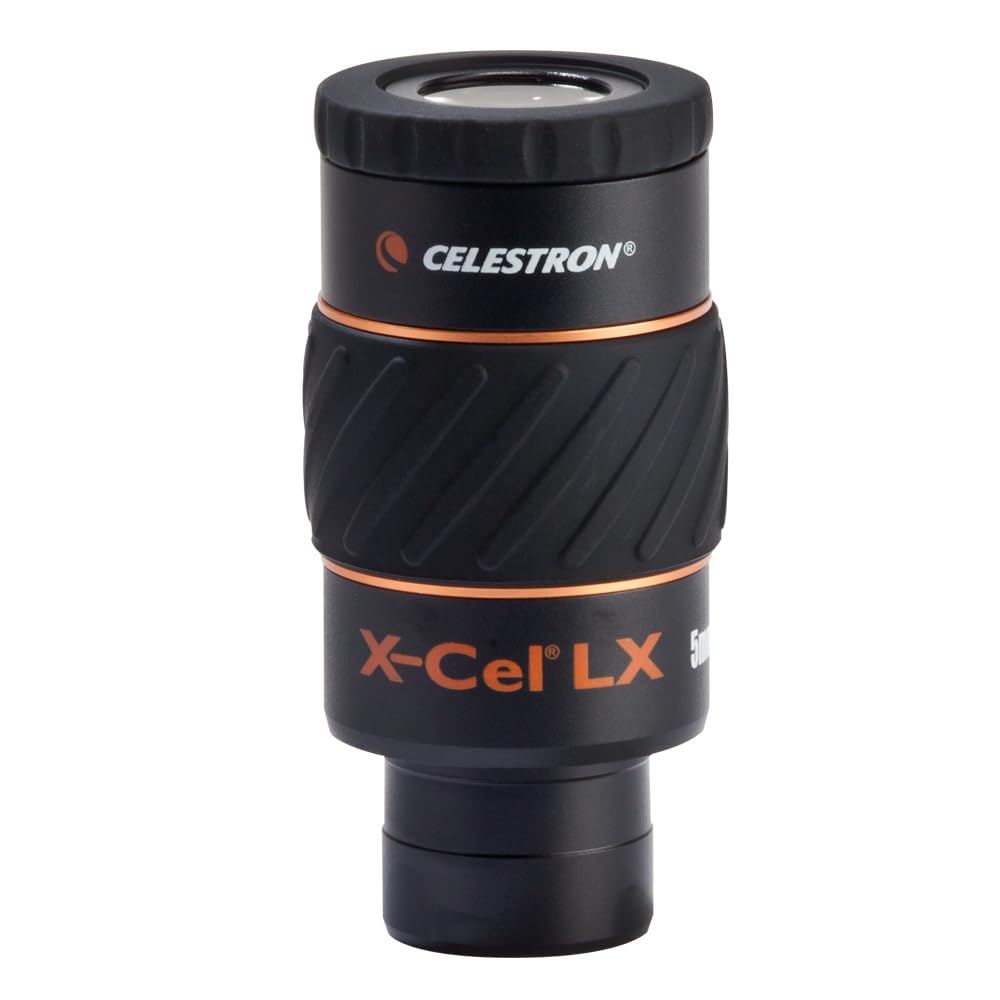
Celestron X-Cel LX 5mm

85 /100
LBD Score Excellent

Key details

Barrel
1.25-inch
Eyecup
Twist-up
Focal Length
5mm
Apparent Field
60°
View on Amazon

A 5mm eyepiece is a specialty tool, and the Celestron X-Cel LX is the one that makes that specialty comfortable. On a 1,200mm Dob it gives about 240x, which is a steady-night power for the Moon and planets rather than an everyday low-power view. The 60-degree apparent field is the reason we keep it: it gives you more drift time before you nudge the tube, and the six-element fully multi-coated optics hold a crisp center on bright targets.

The long eye relief is the other half of the appeal. Unlike a short Plossl, the X-Cel LX lets you keep your glasses on, and the twist-up eyecup blocks stray light without pressing into your face. We also like the threaded 1.25-inch barrel, which takes standard filters for lunar viewing. The 7.2-ounce body is light enough that it does not throw off a medium Dob, and the rubber grip helps when your hands are cold.

The X-Cel LX is not the lens for wide star fields, but it is the one we choose when the planets are up. It feels purpose-built for a Dobsonian rather than adapted from a general-purpose line, and the twist-up eyecup is a small detail that makes long sessions easier.

Pros

  • 60-degree field for manual tracking
  • Long eye relief and twist-up eyecup
  • Six-element fully multi-coated optics
  • Threaded barrel accepts filters

Cons

  • Interior dust can appear on some units
Our verdict

We keep the X-Cel LX 5mm for the nights when the atmosphere cooperates: it turns a Dobsonian into a planetary scope without the usual short-eye-relief penalty.

Check Latest Price
3

Best Wide-Field Planetary Value

SVBONY 6mm 68°

87 /100
LBD Score Excellent

Key details

Barrel
1.25-inch
Eye Relief
17mm
Focal Length
6mm
Apparent Field
68°
View on Amazon

The first thing we noticed about the SVBONY 6mm is how much sky it gives you at high power. A 68-degree apparent field is unusually generous for a 6mm eyepiece, and on a 1,200mm Dob it turns 200x into a view you can follow without constantly repositioning the tube. The 17mm eye relief is the other surprise: it is comfortable enough for glasses, which is rare at this focal length.

The center of the field is sharp on the Moon and planets, and the fully multi-coated optics keep the image bright enough to show cloud bands and ring detail when the atmosphere settles. The 5.6-ounce body also stays out of the way of balance, so it is an easy eyepiece to add to a small scope. It is a simple-looking lens, but the blackened interior and fold-down eyecup are the right details for long planetary sessions.

This is not a wide-field sweeper. A 6mm eyepiece is for the Moon, planets, and tight double stars, and it will make large nebulae look dim and oversized. If that matches the way you observe, it is one of the most comfortable high-power views in this group.

Pros

  • 68-degree field at high power
  • 17mm eye relief suits glasses
  • Fully multi-coated optics
  • Light 5.6-ounce body

Cons

  • Edge softens in fast Dobsonians
Our verdict

We recommend the SVBONY 6mm 68° for Dobsonian users who want a comfortable, wide high-power view of the Moon and planets without spending a lot.

Check Latest Price
4

Best Low-Power Finder

SVBONY 40mm Plossl

91 /100
LBD Score Outstanding

Key details

Barrel
1.25-inch
Weight
3.39 oz
Focal Length
40mm
Apparent Field
40°
View on Amazon

Before you chase magnification, a Dobsonian needs a way to find things, and the SVBONY 40mm Plossl is a simple answer. On a 1,200mm Dob it gives about 30x, a bright view with a large exit pupil that makes star-hopping easier than starting at high power. The fully multi-coated optics and blackened interior keep the field clean, and the 96-gram metal body is light enough to disappear in the focuser.

The fold-down rubber eyecup helps if you wear glasses, and the M28.5 thread takes standard 1.25-inch filters. The metal barrel feels solid, and the blackened interior keeps stray light down. It is a simple eyepiece, but the details are right for a low-power finder.

We keep it as a finder eyepiece, not as the one eyepiece for deep-sky touring. Center a cluster or a bright star, then switch to the 20mm or 12.5mm for a closer look. For a 1.25-inch Dob, it is a useful, comfortable low-power tool.

Pros

  • Bright low-power view for finding objects
  • Long eye relief and fold-down eyecup
  • Metal build at 96 grams
  • Threaded for 1.25-inch filters

Cons

  • Narrow 40-degree apparent field
Our verdict

We recommend the SVBONY 40mm Plossl as a low-power finder eyepiece for Dobsonian users who want a bright, comfortable view for star-hopping, not a wide-field panorama.

Check Latest Price
5

Best Complete Kit

Celticbird 13-Piece Kit

91 /100
LBD Score Outstanding

Key details

Barrel
1.25-inch
Pieces
13
Included
2x Barlow, 7 filters
Eyepieces
40, 20, 12.5, 8, 6mm
View on Amazon

The case does a lot of work here: open it and you have five focal lengths, a Barlow, filters, and a place for everything. The Celticbird kit covers 40mm, 20mm, 12.5mm, 8mm, and 6mm Plossls, plus a 2x Barlow and seven filters, all in a foam-lined metal case. For someone starting with a Dob and one or two stock eyepieces, that is a lot of observing range in one box.

We like the organization as much as the optics. The 40mm is a useful finder, the 20mm and 12.5mm are the workhorses, and the 8mm and 6mm are for the Moon and planets. The case has spare cutouts, so you can add a favorite eyepiece without carrying a second bag. The Plossl design keeps the cost down, but the apparent field is narrower than the wide-angle singles here.

The 2x Barlow doubles the range, though stacking it with the 6mm asks a lot of a small Dob and a steady sky. For a first upgrade, the appeal is the completeness: you can try different powers and filters without buying blind. If you already know you love wide fields, spend the money on one good wide-angle eyepiece instead; if you are still learning what your Dob can do, this kit is a practical way to find out.

Pros

  • Five focal lengths from 40mm to 6mm
  • Includes 2x Barlow and seven filters
  • Foam-lined metal case with spare space
  • Fits 1.25-inch Dob focusers

Cons

  • Short eye relief on the 6mm
Our verdict

We recommend the Celticbird 13-piece kit as the most complete kit here for a Dobsonian user who wants one case to cover low, medium, and high power.

Check Latest Price
6

Budget Starter Kit

Celticbird 8-Piece Kit

88 /100
LBD Score Excellent

Key details

Barrel
1.25-inch
Pieces
8
Included
2x Barlow, 4 filters
Eyepieces
6, 12.5, 20mm
View on Amazon

If the 13-piece kit feels like more case than you need, the 8-piece version trims the focal lengths without dropping the essentials. It includes 6mm, 12.5mm, and 20mm Plossls, a 2x Barlow, four filters, and a small aluminum case. The 20mm is the finder-ish view, the 12.5mm is the general-purpose lens, and the 6mm is the planetary end.

The smaller case is the practical advantage. It fits into a gear bag with room for a couple of extra eyepieces, and the foam holds everything without rattling around. We appreciate that the kit does not pretend to be a wide-field set: the Plossls are simple, the field is narrow, and the 6mm is a short-eye-relief lens. What you get is a compact range that covers the basics.

For a budget-minded Dob user, the 8-piece kit makes sense if you want to sample several powers and do not mind the Plossl view. The 2x Barlow adds flexibility, though stacking it with the 6mm is a steady-sky trick rather than an everyday setting. If you already know you want a wide low-power view, the 13-piece kit or a dedicated 40mm makes more sense.

Pros

  • Compact three-eyepiece range
  • Includes 2x Barlow and four filters
  • Small aluminum case fits in a gear bag
  • Budget-friendly way to upgrade stock eyepieces

Cons

  • No 40mm low-power option
Our verdict

We recommend the Celticbird 8-piece kit for a budget-minded Dobsonian user who wants a compact set of useful focal lengths and a Barlow in one small case.

Check Latest Price

How We Tested: 15 Eyepieces, Six Months, One Backyard Dobsonian

We started by pulling roughly 60 eyepieces and accessory kits sold for 1.25-inch focusers and sorting them by focal length, so the final 15 covered the usable range for a Dobsonian, from a 5mm planetary eyepiece to a 40mm wide-field, plus two zoom eyepieces and two kits that promise to replace a whole case.

Every eyepiece went into the same 8-inch Dobsonian on clear nights in my backyard, then into a smaller reflector at a darker site an hour out of town. We ran them in pairs on the same targets: the moon and Jupiter early in the evening, then the Pleiades, the Double Cluster, and a few bright double stars once the sky settled.

Field of view we judged by timing how long a star took to drift from one edge to the other with the mount undriven, then checked how much of that width stayed sharp and whether the moon threw up ghosting or color fringing, a quick way to tell real multi-coatings from a claim on the box. Eye relief we judged by whether a glasses-wearer could see the whole field without mashing the eyecup into their brow.

Zoom models got their own handling test: I turned each through its full range one-handed, noted where it needed refocusing, and watched how much the apparent field narrowed at the long end. We weighed each eyepiece and checked whether it forced a rebalance, seated it in the focuser to see if it wobbled or needed the set screw cranked down, and cranked the eyecups up and down between observers. The dust caps stayed on the eyepieces for six months, which showed which ones stayed snug.

How to Choose Eyepieces for a Dobsonian Telescope

Match the Barrel and the Magnification Range

Start with the focuser. Every eyepiece in this guide uses a 1.25-inch barrel; a 2-inch Dob focuser accepts them through its 1.25-inch adapter, but a dedicated 2-inch eyepiece gives a wider true field if that is your priority. Then think in focal lengths rather than labels. A Dob usually comes alive with a low-power eyepiece for finding, a medium power for general viewing, and one high-power eyepiece for the Moon and planets. If you already have a 25mm stock lens, adding a 6mm or 5mm high-power eyepiece changes your viewing more than buying another middle focal length.

Prioritize Apparent Field on a Manual Mount

A Dobsonian mount does not track, so the object drifts out of view while you watch. A wider apparent field gives you more drift time and makes high power less frantic. The difference between a 40-degree Plossl and a 68-degree wide-angle eyepiece is obvious at 200x: the wide-angle keeps the planet in the same view while you nudge the tube. Wider is not automatically better for every target, but for manual tracking it is one of the most useful upgrades you can buy. The SVBONY 6mm 68° is the clearest example here; the 40mm Plossl is the opposite trade-off.

Check Eye Relief Before You Buy High Power

Eye relief is the distance your eye sits from the glass. Short focal-length Plossls often force you close, which is uncomfortable with glasses and tiring without them. A 5mm or 6mm eyepiece with 17mm or more of eye relief is a different experience: you can relax, blink, and keep the whole field. If you wear glasses, look for a fold-down or twist-up eyecup and a stated eye relief figure. The Celestron X-Cel LX 5mm and SVBONY 6mm 68° are the two picks here that make high power comfortable rather than a test of patience.

Choose Fixed, Zoom, or Kit by How You Observe

A fixed eyepiece usually gives the cleanest view for its focal length and the widest field for the money. A zoom replaces several lenses with one and is ideal when you want to follow changing seeing without swapping in the dark; the Celestron 8-24mm is the most versatile example here. A kit gives you the widest range and a case, but the Plossl lenses inside are narrower and less comfortable at the short end. Buy a kit when you are still learning what powers your Dob likes; buy one good fixed eyepiece when you already know the focal length you use most.

Plan for Weight, Balance, and Care

Eyepieces are small, but a heavy zoom or a long eyepiece can change the balance of a Dob, especially when the tube points high. Check the altitude bearing after you swap lenses, and do not overtighten the focuser thumbscrew on a metal barrel. A light 96-gram Plossl is easy to live with; a 0.36 kg zoom may need the tube rebalanced. Keep the glass clean with a blower first, and inspect a new eyepiece for dust or scratches before the return window closes. A hard case is not a luxury if you observe away from home.

Frequently Asked Questions

Final Verdict

For most Dobsonian users, the Celestron 8-24mm zoom is the eyepiece we recommend first. It covers the useful middle and high powers, works in any 1.25-inch focuser, and lets you follow changing seeing without swapping lenses. If you already have a wide low-power view, the SVBONY 6mm 68° is the high-power pick we reach for when the Moon and planets are the goal; the Celestron X-Cel LX 5mm is the better choice if long eye relief matters most. The Celticbird 13-piece kit is the one to choose when you want a full case rather than a single lens.