Best Dobsonian Telescopes of 2026

Every Dobsonian is the same bargain: the most mirror your money will buy, in the simplest tube that holds it, on a box that swivels. No motors, no alignment routine, no tripod to level. What you trade away is portability — and that's the part you'll actually feel.

I've spent eight months with 11 of them, from palm-sized tabletops to a full solid tube, and the pattern had less to do with aperture than I expected. Beginners stall on the same things: whether the mount moves smoothly enough to follow Jupiter at high power, whether the scope comes out in one trip, and whether what's visible from a street-lit backyard is worth the trouble.

Nobody mentions that a tabletop needs something sturdy to sit on, or that a solid tube wants collimating before it gives its best. Still, these are the scopes that make the hobby stick — judged on what you see, what it takes to get outside, and what it weighs at nine at night.

1

Best Overall

Celestron StarSense Explorer 150mm

83 /100
LBD Score Excellent

Key details

Mount
Alt-azimuth tabletop Dobsonian
Weight
25 lb
Aperture
150 mm
Focal Length
650 mm
View on Amazon

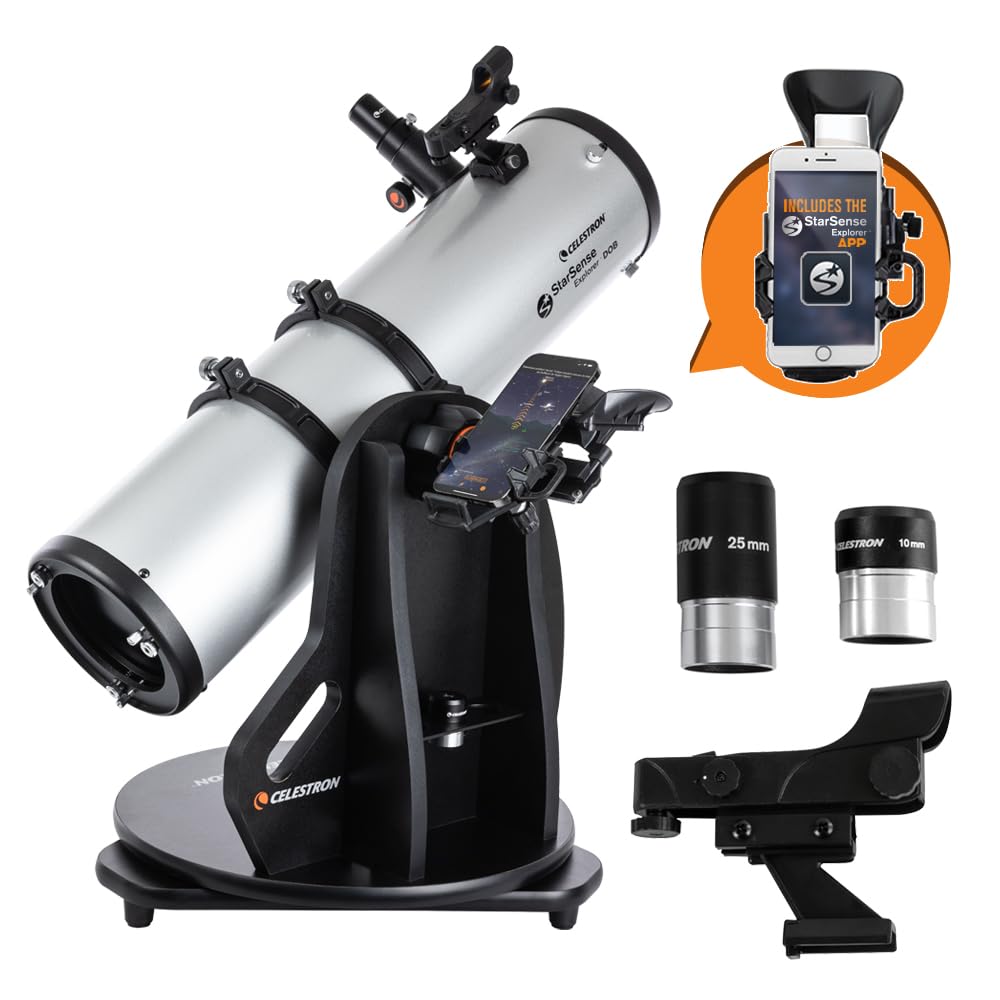
The phone dock on top of the StarSense Explorer 150mm is what earns this telescope our top recommendation. Drop in a phone, open the StarSense app, and the screen becomes a guide: arrows point toward a target, and a bullseye turns green when you arrive. For a first Dobsonian, that changes the evening. Instead of star-hopping with a chart and hoping, you spend the time looking. The app uses sky recognition rather than a simple compass, and the follow-the-arrows routine is the feature we came back to session after session.

The 150mm mirror gives the app something worth finding. It is enough to show the Moon's craters, Jupiter and its moons, Saturn, and brighter nebulae and clusters, while the 650mm focal length keeps the tube short enough for a tabletop base. The 25mm and 10mm Kellner eyepieces cover a wide view and a closer look; the 25mm does most of the work. The red-dot finder is a useful backup when the app is slow to catch, and the whole scope weighs 25 pounds—manageable, but not something to carry one-handed up a ladder.

The StarSense is a tabletop design, and that shapes ownership: it wants a solid table or a permanent stand at a comfortable height, and the fixed tube takes more shelf space than a collapsible one. In exchange, the app and the 150mm mirror make the first few nights productive. We recommend it to the beginner who wants to see objects, not hunt for them; the Heritage 150 is the alternative for someone who already knows the sky and wants the same aperture with a smaller packed footprint.

Pros

  • Phone-guided finding is beginner-friendly
  • 150mm aperture shows planets and bright deep-sky objects
  • Stable tabletop Dobsonian base
  • Includes two eyepieces and a red-dot finder

Cons

  • Kellner eyepieces are basic
  • No tracking for long-exposure imaging
Our verdict

We recommend the StarSense Explorer 150mm to first-time Dobsonian buyers who want help finding targets and a scope that stays portable; the app is the difference-maker.

Check Latest Price
2

Best Value

Sky-Watcher Heritage 150

80 /100
LBD Score Excellent

Key details

Weight
23 lb
Aperture
150 mm
Focal Ratio
f/5
Focal Length
750 mm
View on Amazon

The Heritage 150 is the value play here: the same 150mm aperture as our top pick, in a collapsible tube that packs down smaller and weighs 23 pounds. Sky-Watcher gives it a 750mm focal length and an f/5 ratio, with a parabolic mirror and RAQ coating for contrast. The collapsible design is meant to hold collimation when you extend it, which is the detail that makes the space saving practical rather than a chore.

What we noticed first is how much easier it is to store than a fixed-tube Dobsonian. The tube slides down, the base is compact, and the whole thing is light enough to move in one trip. The trade is a 1.25-inch helical focuser, which is simpler than a Crayford and limits you to 1.25-inch eyepieces. The reflex finder is basic, and there is no app to point the way; you star-hop with a chart or a phone app of your choosing. For a patient beginner, that is part of the hobby. For someone who wants the scope to do the finding, it is the reason to pay for the StarSense.

Optically, the 150mm aperture is the same class as the Celestron, and the 750mm focal length gives a little more magnification with the same eyepiece. The 23-pound weight and collapsible tube make it the better choice for a small apartment or a car trunk. We recommend it to the buyer who wants 6 inches of aperture and a packable package without app-assisted finding; the savings can go toward a better eyepiece.

Pros

  • Collapsible tube packs down small
  • 150mm aperture at a budget price
  • Light enough for one-trip carrying
  • Parabolic mirror with RAQ coating

Cons

  • Manual target-finding takes practice
  • 1.25-inch focuser limits eyepiece choice
  • Needs a wide, sturdy table
Our verdict

Our value pick is the Heritage 150 for buyers who want 6 inches of aperture and a packable tube without app-assisted finding.

Check Latest Price
3

Best Full-Size

Sky-Watcher Classic 200

78 /100
LBD Score Very Good

Key details

Mount
Alt-azimuth Dobsonian
Focuser
2-inch Crayford
Aperture
203 mm (8 in.)
Focal Length
1,200 mm
View on Amazon

An 8-inch mirror is the classic step up from a 6-inch scope, and the Sky-Watcher Classic 200 delivers it in a traditional solid-tube Dobsonian. The 1,200mm focal length, 94% reflective coatings, and 2-inch Crayford focuser are aimed at deep-sky work: galaxies, globular clusters, and the kind of detail on Jupiter and Saturn that a smaller scope strains to show. The 25mm and 10mm super wide-angle eyepieces get you started, and the 1.25-inch adapter lets you use the smaller eyepieces you may already own.

What we appreciate most is the lack of fuss. There is no app, no battery, and no alignment routine—just carry it out, point it, and look. The patented tension handles hold the tube without perfect balance, and the Teflon bearings are meant to keep the azimuth motion smooth. In practice, the base is the part to watch: it can need tuning to move without stiffness, and the altitude tension adjustment does not always hold as cleanly as the handles suggest. That is a setup task, not a reason to avoid the scope, but it is worth knowing before you buy.

The 8-inch aperture is the reason to choose this over the 6-inch tabletop models. Under a dark sky, it shows brighter, more detailed views of faint objects, and the solid tube is simple and sturdy. It is a stay-at-home scope: it rewards a permanent spot or a short trip to the yard. We recommend it to the deep-sky viewer with a garage, a shed, or a vehicle that can carry it.

Pros

  • 8-inch aperture for deep-sky views
  • 2-inch Crayford focuser and two eyepieces
  • Tension handles and Teflon bearings
  • Solid, simple traditional build

Cons

  • Heavy, bulky two-piece package
Our verdict

We see the Classic 200 as the deep-sky choice for someone with a nearby observing spot and room for a traditional 8-inch Dob.

Check Latest Price
4

Kids and Moon

Celestron FirstScope Moon

84 /100
LBD Score Excellent

Key details

Mount
Manual tabletop Dobsonian
Weight
4.3 lb
Aperture
76 mm
Focal Length
300 mm
View on Amazon

The FirstScope is the smallest Dobsonian here, and the only one with a Moon map wrapped around its tube. At 4.3 pounds and 18 inches tall, it can live on a shelf and come out for a quick look. The 76mm mirror and 300mm focal length are built for the Moon and the brightest planets rather than faint galaxies. That is a narrow job, but it is one a lot of families actually want.

We found the 20mm eyepiece does the useful work, giving a bright, easy view of the lunar surface, while the 4mm eyepiece is a tighter squeeze. The tabletop Dobsonian base is simple and stable on a solid surface, and the whole thing is light enough for a child to help carry. The Moon map is more than decoration: it gives a new observer something to look for and a reason to come back the next night.

The 76mm aperture runs out of light on faint nebulae and galaxies, so this is a Moon-first scope, not an all-round Dobsonian. Aiming the tube by eye takes patience, and a red-dot finder is the first accessory to add. For the Moon, bright planets, and a child's first sessions, those limits are easy to accept. It is a starter scope in the truest sense: enough to spark interest, not enough to carry the whole hobby.

Pros

  • Very light and easy to store
  • Moon map gives beginners a guide
  • Simple, stable tabletop mount
  • Low-cost way to start lunar viewing

Cons

  • No finderscope included
  • 4mm eyepiece is cramped to use
Our verdict

We think the FirstScope makes sense as a low-cost Moon scope for kids and casual lunar viewing, not as an all-round deep-sky Dob.

Check Latest Price

How We Tested 11 Dobsonian Telescopes

We started by pulling every Dobsonian a beginner might realistically buy, then cut the ones with plastic focusers, altitude bearings that couldn't be tensioned, or a base that wouldn't come apart for the car. That left 11 telescopes over eight months, from palm-sized tabletops to a full solid tube. Each one got assembled on a kitchen table using only the tools in the box; I timed it solo and noted which steps in the manual were wrong. We also compared what came in the box — eyepieces, finder, anything else — because that's usually where the value argument lives.

Then the hauling. I carried each scope from the house to a driveway before sunset, counting trips, weighing tube and base separately, and loading them into a car beside a weekend bag to see what actually fit. After dark I let each mirror cool, collimated it with a Cheshire eyepiece, and star-tested on Polaris, then pushed magnification on the Moon and Jupiter to watch how the mount behaved — whether it moved in small smooth increments or jumped, whether the tube drifted after I let go, and whether a heavier eyepiece tipped it out of balance.

The view itself we logged against the same short list of targets — the Pleiades, Andromeda, the Ring Nebula, Saturn — from a street-lit backyard and again from a darker field, writing down what was obvious, what was a faint smudge, and what never showed at all. Durability got a few dewy nights, a bump in the trunk, and a base left in a humid garage for a week; we checked for swollen particleboard, screws that had worked loose, and focusers that had developed play.

How to Choose a Dobsonian Telescope

Aperture and the carry

Every extra inch of aperture gathers more light and resolves finer detail, which is why an 8-inch Dobsonian shows more of a galaxy's shape than a 6-inch. The catch is that the bigger scope is also longer, heavier, and more demanding to move. We prioritise a 6-inch tabletop for a scope that comes out every clear night, and an 8-inch for a dedicated yard or dark-site trip. If the scope stays in a closet because it is a chore to carry, the extra aperture is wasted.

Tabletop or full-size?

Tabletop Dobsonians sit on a picnic table, a deck rail, or a sturdy bench; full-size models sit on the ground. Tabletop saves storage and keeps the eyepiece at a convenient height, but you need a solid surface and enough room to walk around it. Full-size is more stable and can use larger tubes, but the base and tube are two pieces to carry. Measure your table and your storage space before choosing; a wobbly table makes a good scope frustrating.

How you find objects

A red-dot or reflex finder is the minimum: you align it with the main tube, then use it to point at bright stars. From there, star-hopping with a chart or an astronomy app takes practice. The StarSense Explorer models add a phone dock and a sky-recognition app that points you with arrows and confirms the target with a bullseye. That is a real help for beginners, but it depends on a reasonably dark sky and a charged phone. A manual finder is the fallback, so learn it even if you buy the app-assisted scope.

Mount motion and balance

A Dobsonian mount should move smoothly in two axes: up-down altitude and side-to-side azimuth. Tension handles or bearings hold the tube where you leave it, but they need adjustment when you change eyepieces or add a finder. Check that the base turns without stiffness or rocking. A little tuning is normal; a mount that binds or slips constantly will spoil the view. Balance the tube before you tighten anything, and test the motion with the eyepiece you plan to use most.

Eyepieces and focuser

Most Dobsonians come with one or two eyepieces, and the low-power one gets the most use. A 2-inch focuser gives wider true fields and accepts larger eyepieces; a 1.25-inch focuser is fine to start. We treat the included eyepieces as a starter set: a better low-power eyepiece often makes a bigger difference than a high-power one. Check the focuser size before buying an eyepiece, and do not assume a 2-inch eyepiece fits a 1.25-inch drawtube.

Frequently Asked Questions

Final Verdict

For most first-time Dobsonian buyers, the Celestron StarSense Explorer 150mm is the one we recommend. It pairs a useful 150mm mirror with an app that turns finding targets into a follow-the-arrows exercise, and it stays small enough for a tabletop.

The Sky-Watcher Heritage 150 is the alternative when you want the same aperture and a collapsible tube without app-assisted finding. If you have a dark spot close by and can handle a full-size scope, the Classic 200's 8 inches are worth the extra bulk.