Best Overall
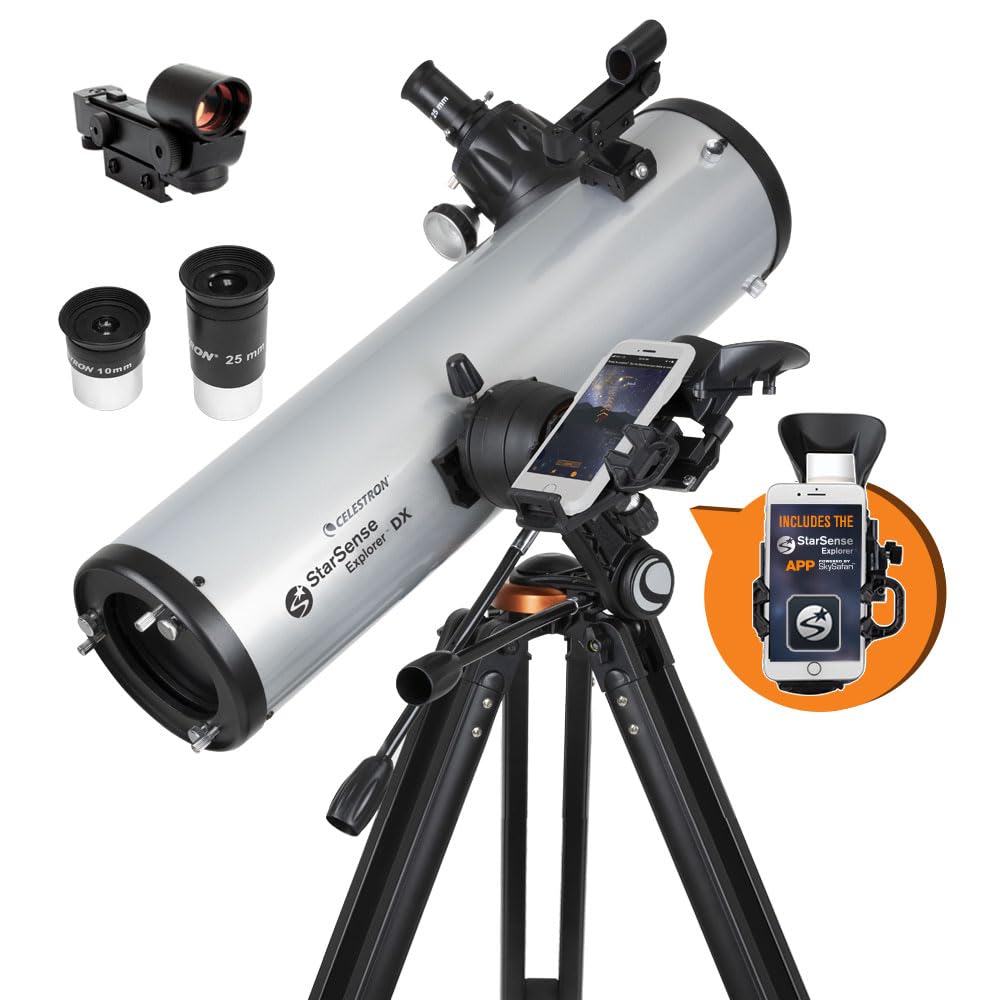
Celestron StarSense DX 130AZ
Key details
- Mount
- Altazimuth
- Weight
- 18 lb
- Aperture
- 130 mm
- Focal Length
- 650 mm
Setting a telescope up takes ten minutes. Finding something to look at with it is the part that defeats people, and it is the part the DX 130AZ is built around. Dock your phone on the mount, open the StarSense app, and the camera reads the star field overhead; arrows on the screen then walk you toward a target until the bullseye turns green.
We think that combination is worth the money. A 130 mm mirror with a 650 mm focal length is the most light-gathering instrument in this group, and that is what separates a telescope that shows the Moon from one that shows the Orion Nebula as a shape rather than a smudge. The app also builds a list of what is worth seeing tonight from where you are standing, so the answer to "what now?" is already on the screen.
The mount is a manual altazimuth with slow-motion controls on both axes, which makes centering a target at 26x or 65x far less fiddly than nudging a bare tripod head. It also takes a moment to stop shaking after you touch the focuser, so the trick is to find a target at low power and step up to the short eyepiece afterward. Collimation — lining the mirrors up — may need a tweak after a car ride, and a Cheshire cap costs little and takes a few minutes.
Two things to know before ordering. The Newtonian design shows everything upside down and mirror-reversed, which is fine for astronomy and hopeless for birdwatching. And the app needs an unlock code that ships in the box: register it the day the telescope arrives, because a misplaced slip is the one snag that stops the whole system working.
Pros
- Largest aperture in this group
- App-guided finding takes the guesswork out
- Shows nebulae and galaxies, not just the Moon
- Slow-motion controls on both axes
Cons
- Upside-down mirrored image rules out daytime use
- Finding targets depends on a charged phone
We recommend it to anyone who wants the most aperture here plus a phone that does the hunting, provided they can live with a mount that needs a settling second.