Best Floodlight Cameras of 2026

The moment a floodlight camera earns its money isn't the afternoon you install it — it's 2 a.m., when something crosses the driveway and your phone lights up before you've found your slippers. What you need in that moment is a clear picture, light that actually reaches the far fence, and an alert that means something. Getting all three in one unit is harder than the listings make it look.

I mounted 12 floodlight cameras around my house over six months, on the garage, the side gate, and the back deck, and moved a few out to a barn to see how they handled a long dark run. The ones I kept came down to the basics: how readable faces and license plates were in the footage, whether the light was bright enough or just blinding, and how long the whole install took me on a ladder with nobody holding it steady.

Two numbers tell you more than the marketing does — the beam's actual spread across your driveway and whether the camera stores clips without a monthly fee. Both are things you only learn by living with one. Below are the ones that held up.

1

Best Overall

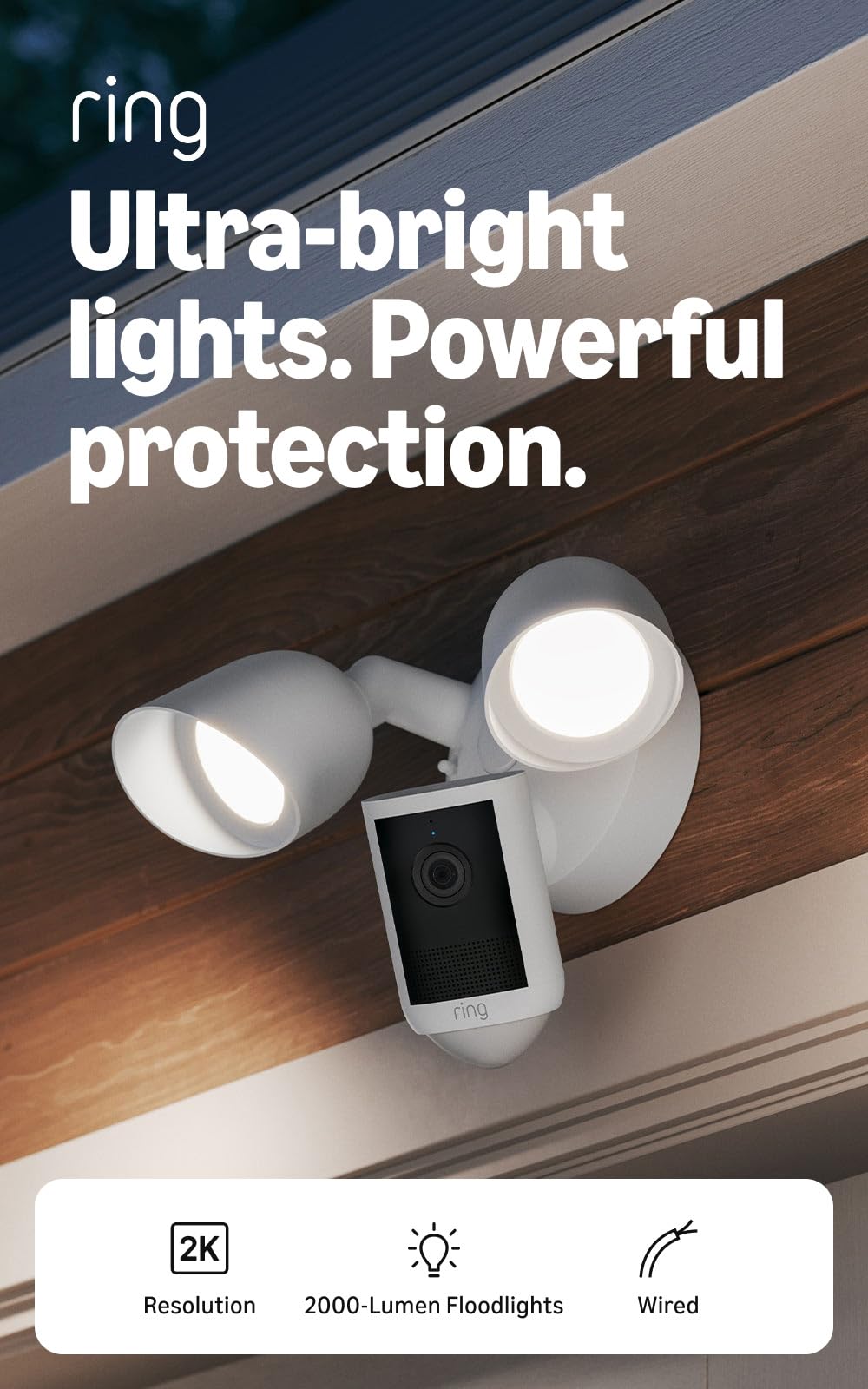
Ring Floodlight Cam 2K

88 /100
LBD Score Excellent

Key details

Zoom
Up to 6x enhanced
Power
Wired, DIY or pro install
Video
Retinal 2K, wide-angle
Lighting
Motion-activated floodlights
View on Amazon

Ring's wired Floodlight Cam 2K assumes there's already a floodlight on the wall, and it's a better camera for the assumption. You take the old fixture down, put this on the same wiring, follow the app, and you're finished — no electrician, no battery to remember, no solar panel waiting on the weather. That head start is why we send most people here first: the hardest part of outdoor security is everything that happens before you open the app.

The Retinal 2K sensor gives a wide frame that covers a two-car driveway, and up to 6x enhanced zoom crops into a face or a plate without the mush that cheap digital zoom produces. We watched it after dark more than in daylight, because that's the shift when a floodlight camera either works or doesn't, and the picture stays readable once the lights fire.

The floodlights are bright enough that we stopped using the porch light on the same stretch of driveway, and the siren, which you trip with a tap in the app, is the part nobody expects from a camera this size. Neither is a gimmick — light and noise are still the two things that move somebody off a property. Where it earns the top slot, though, is the fourth week: same alerts, same speed, nothing to reset.

Pros

  • Reuses existing floodlight wiring
  • Wide 2K video with 6x zoom
  • Bright motion-activated lights and an app siren
  • Holds alerts and connection week after week

Cons

  • Lights can't be re-aimed on horizontal mounts
Our verdict

Our default recommendation: it reuses the wiring of the floodlight you're replacing, throws wide 2K video and bright light across a driveway, and gets the alerts and siren right.
Check Latest Price
2

Best Without a Subscription

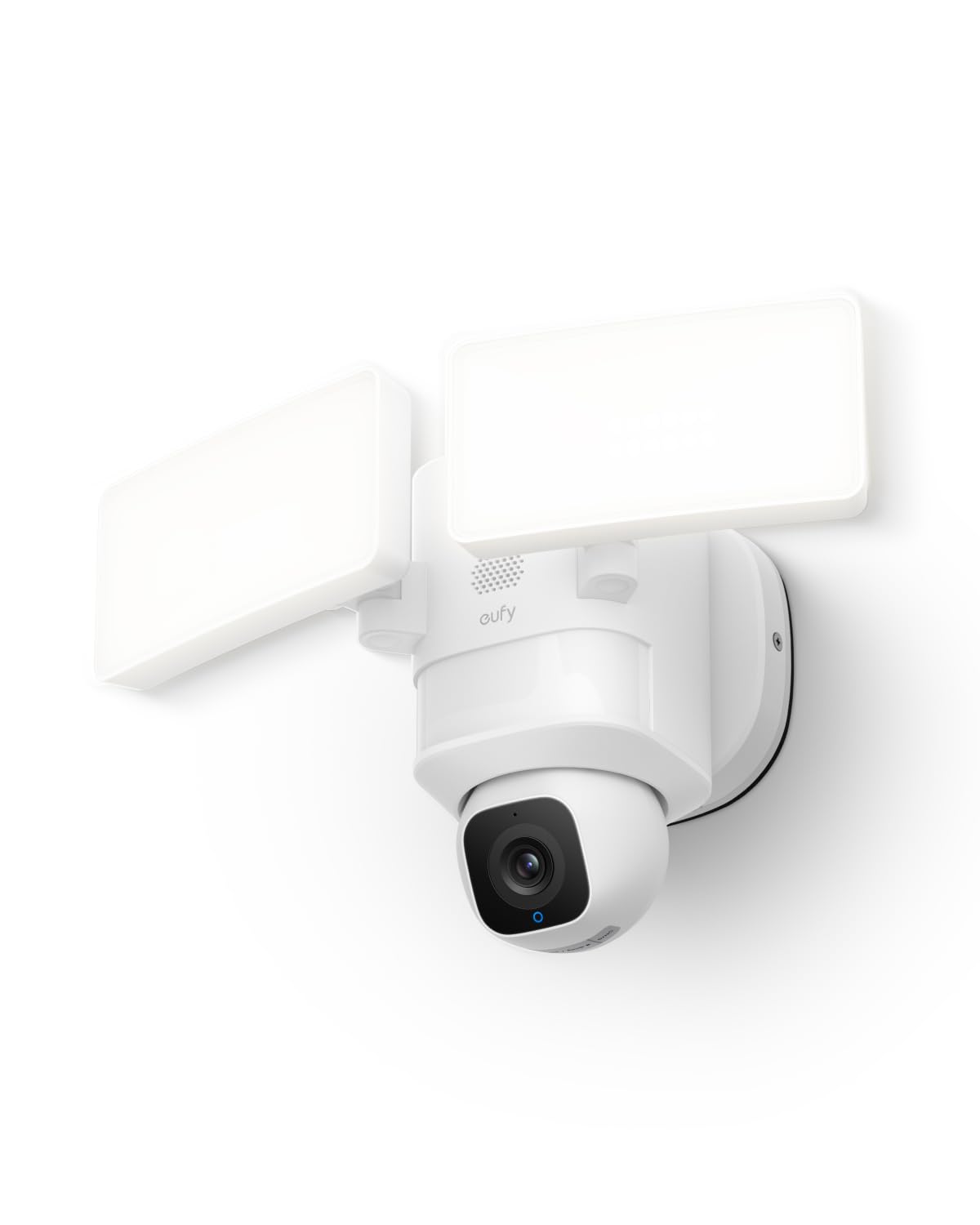
eufy Floodlight Cam E30

87 /100
LBD Score Excellent

Key details

Video
2K, color night vision
Storage
24/7 local, no monthly fee
Coverage
360° pan and tilt
Lighting
2,000 lumens, dimmable
View on Amazon

The E30's head swivels, and after a couple of weeks we stopped thinking of it as a fixed camera. Instead of one stare at whatever you aimed at on install day, you get full 360-degree pan and tilt, and the built-in AI drives the head to follow a person or a vehicle across the frame. Put it on a patrol schedule and one unit covers ground that would take two fixed floodlight cameras here.

The 2K picture is what we came away trusting: sharp in daylight, full color at night once the 2,000-lumen panel fires, and the brightness slider runs from 1 to 100 rather than offering three presets. The no-fee part is what makes it the pick for a lot of people, though — recording to a microSD card means 24/7 coverage without a monthly bill, which is where the plan-based cameras here quietly cost you again every year.

The AI isn't perfect. It follows people and vehicles well and is less reliable on a cat crossing the lawn or a branch moving in wind; at default sensitivity the light fires for both, so plan on an evening spent drawing motion zones and dropping sensitivity rather than trusting the box settings. Do that and the tracking earns its keep.

Pros

  • 360-degree pan and tilt with auto-tracking
  • 2,000-lumen light, adjustable 1 to 100
  • Local 24/7 recording, no monthly fee
  • Crisp 2K color footage day and night

Cons

  • 2.4GHz Wi-Fi only, no 5GHz band
  • Four-pound head needs a solid mounting surface
Our verdict

Our pick if you don't want another subscription: a swiveling 2K camera that tracks people and cars, records to a card, and costs nothing after you buy it.

Check Latest Price
3

Best Video Quality

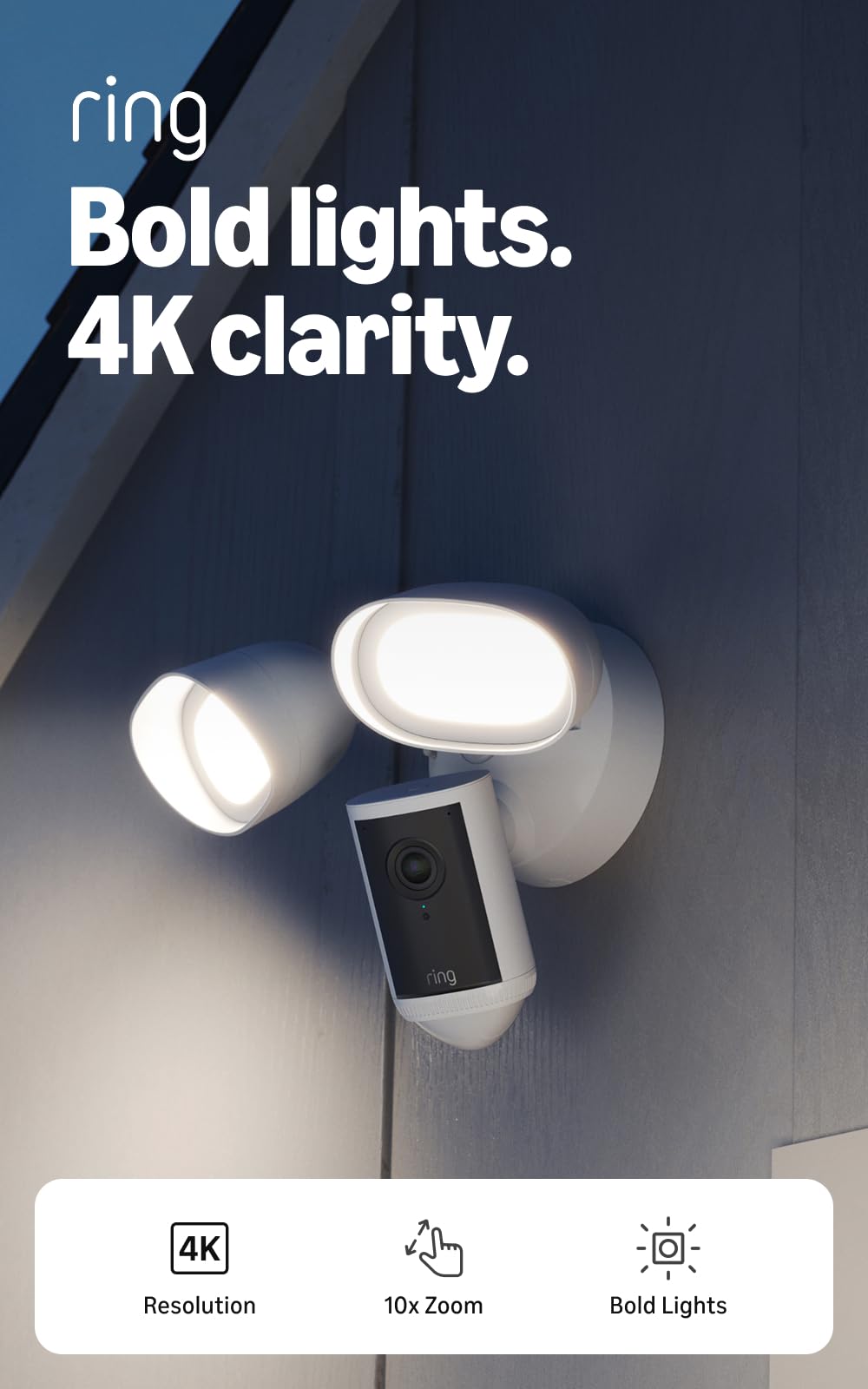
Ring Floodlight Cam 4K Pro

89 /100
LBD Score Excellent

Key details

Zoom
Up to 10x enhanced
Video
Retinal 4K, wide-angle
Lighting
2,000 lumens
Detection
3D Motion Detection
View on Amazon

Everything we like about the cheaper Ring is here, plus the one upgrade that changes what you can do with the footage. The 4K Pro shoots Retinal 4K instead of 2K and pushes enhanced zoom to 10x — the difference between a shape at the end of a driveway and a face.

We spent our time on the two things that make 4K worth paying for: distance and low light. Low-Light Sight holds a full-color image with the floodlights off, as long as there's street lighting around, and the 2,000-lumen panels take over the moment something moves. Down a long drive, that combination buys you more than another few degrees of field of view.

3D Motion Detection is the other reason to move up. It pinpoints where in the frame movement starts, so the alerts shift from the road to the porch — fewer notifications about traffic, more about someone actually walking up. That's the part you notice daily; the resolution is what you notice the one night you need it.

Pros

  • Retinal 4K video with 10x zoom
  • 2,000-lumen motion floodlights
  • 3D Motion Detection cuts road traffic alerts
  • Full-color view with the lights off

Cons

  • Premium price tier of the two Rings
  • 4K needs strong Wi-Fi at the camera
Our verdict

The upgrade if your camera looks down a long driveway: 4K and 10x zoom make a plate or a face readable, and 3D motion detection keeps the alerts on your property.

Check Latest Price
4

Best for Wide Coverage

eufy Floodlight Cam E340

86 /100
LBD Score Excellent

Key details

Zoom
8x hybrid
Video
3K wide + 2K telephoto
Storage
microSD up to 128GB, no fee
Coverage
360° pan and tilt
View on Amazon

At 12.6 inches across and just over three pounds, the E340 is the biggest camera in this group, and it looks it. On a garage gable that's fine; under a porch soffit it takes over. What the housing is carrying is a second lens.

A 3K wide-angle sensor handles the overview while a 2K telephoto grabs the close-up, and 8x hybrid zoom stitches between them instead of just cropping a wide shot. In practice the telephoto is the part we used: reading a plate two houses down isn't something the single-lens cameras here can do, and the pan-and-tilt base swings the whole assembly to follow a car up the street rather than watching it leave the frame.

The 2,000-lumen light and 95dB alarm cover the deterrence half, and both adjust far enough to be useful rather than annoying. Recording is where it splits from the Ring cameras: a microSD card up to 128GB or a HomeBase 3 gives you continuous 24/7 recording with no monthly fee. That combination — a lens you can zoom into and footage you keep — is why it's the one to buy when your property is measured in acres rather than feet.

Pros

  • Wide 3K lens plus 2K telephoto
  • 8x hybrid zoom and 360-degree tracking
  • 2,000-lumen light and 95dB alarm
  • Local 24/7 recording, no monthly fee

Cons

  • Large housing, conspicuous on a porch
  • Tracking and connection falter on weak Wi-Fi
Our verdict

The pick for a property with real distance in it: a 3K wide lens for the overview, a 2K telephoto for the detail, and a head that follows a car up the street.

Check Latest Price
5

Best Without Wiring

Tapo C615F Kit

86 /100
LBD Score Excellent

Key details

Power
Solar panel + 10,400mAh battery
Video
2K 3MP
Coverage
360° pan, 130° tilt
Lighting
800 lumens, dimmable
View on Amazon

If there's no junction box on the wall you want to watch, the C615F ends the conversation about hiring an electrician. A solar panel tops up a 10,400mAh battery — 45 minutes of direct sun is quoted as a full day of use, with up to 140 days per charge as the fallback — and the whole thing hangs on screws and a bracket.

The trade is light. At 800 lumens it's the dimmest output in this group by a wide margin, closer to a bright porch light than a floodlight, and on a wide driveway you'll notice the difference. What balances it is the head: 360 degrees of pan with 130 degrees of tilt means one camera covers ground that would take two fixed units, and the 2K image holds up after dark.

Local storage is the other argument. Add a microSD card and you're recording without a monthly bill, which over a couple of years is real money against the plan-based cameras here. It's the pick for the shed, the back gate, the rental you can't rewire — the porch with a junction box still belongs to a wired camera.

Pros

  • Solar and battery, no wiring needed
  • 360-degree pan with 130-degree tilt
  • Local recording with no monthly fee
  • 2K color video day and night

Cons

  • 2.4GHz Wi-Fi only
  • Charging depends on a sunny mounting spot
Our verdict

The one to buy when there's no wiring to reuse: solar keeps it charged, the head turns through 360 degrees, and local recording skips the monthly bill.

Check Latest Price
6

Best Budget Wired

Arlo Wired Floodlight Camera

87 /100
LBD Score Excellent

Key details

Plan
Paid plan after trial
Power
Wired
Video
2K HDR, 160° view
Lighting
Up to 2,000 lumens
View on Amazon

The Arlo is the best-specified camera in the bottom price tier here: 2K HDR at 160 degrees, up to 2,000 lumens from two heads that pivot independently, and color night vision instead of the usual grey. On paper it outguns the top pick in almost every line that isn't connection stability.

The picture is where that shows. HDR holds detail in a lit doorway that a flatter image blows out, and the articulating lights mean you can put one beam down a path and the other across a gate — a small thing that decides a lot of installs, because a fixed housing only lights what the bracket allows. It also slots into an existing Arlo setup if you already run one.

Then there's the part that isn't on the box. AI detection, 60-day video history and the in-app emergency response all sit behind an Arlo Secure plan once the trial ends; without it you get live view, alerts, and the light. Whether that's a dealbreaker depends on what you want from it — as a bright, sharp wired camera you watch yourself, it's excellent value; as a camera that tells you a person is on the walkway, you're renting the intelligence.

Pros

  • 2K HDR with color night vision
  • Two light heads that aim separately
  • Simple swap onto an existing box
  • Works with an existing Arlo system

Cons

  • Single-band 2.4GHz Wi-Fi
  • Wired installation only
Our verdict

The best-specified camera in the bottom price tier: 2K HDR, 2,000 lumens, and two heads that aim separately — just know the smart alerts need a paid plan.

Check Latest Price
7

Best Two-Camera Kit

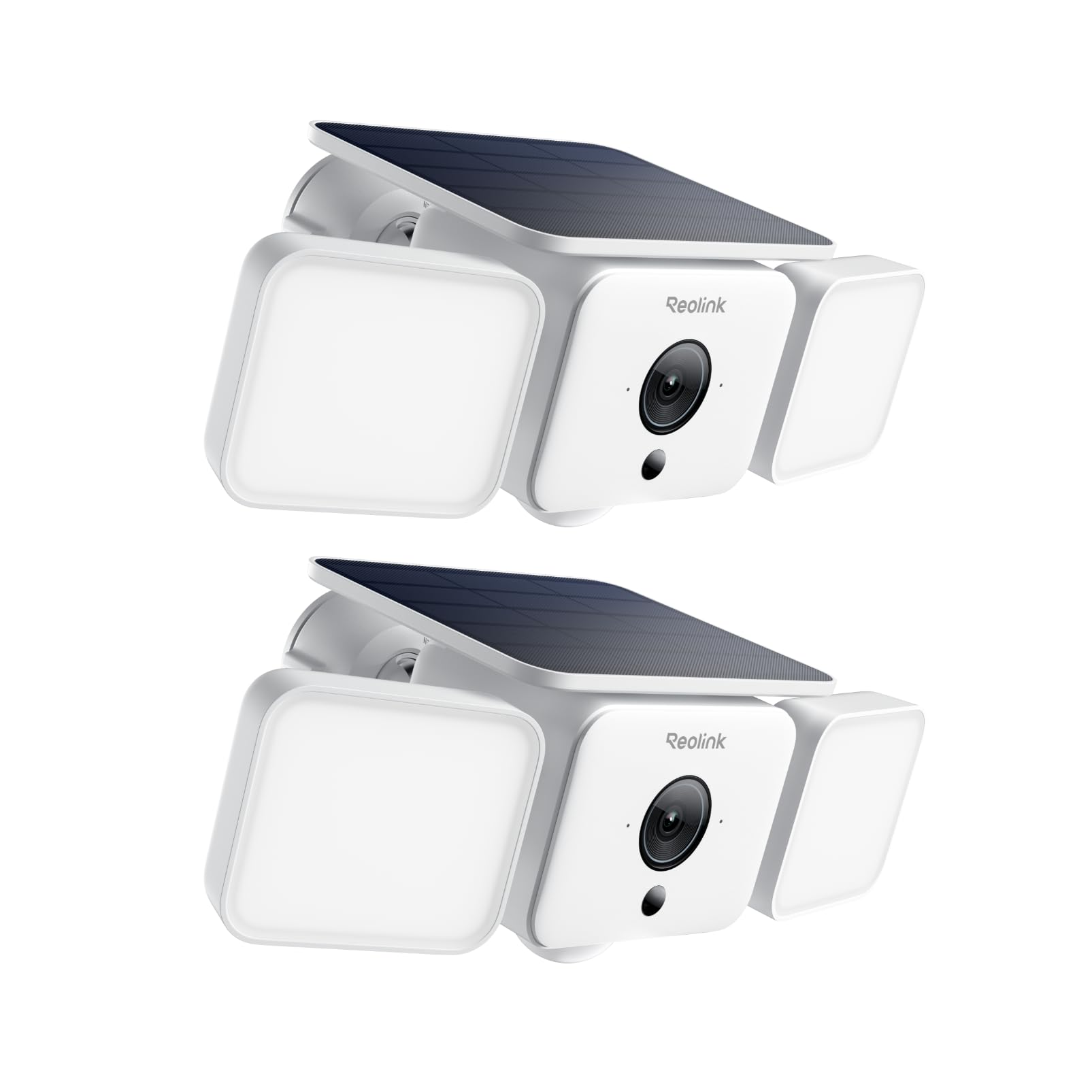
Reolink Solar Floodlight Cam 2-Pack

81 /100
LBD Score Excellent

Key details

Pack
2 cameras
Power
3W solar + rechargeable battery
Video
2K 4MP, 150° view
Lighting
Up to 1,000 lumens
View on Amazon

Two cameras, two solar panels, one box. For a back gate and a side yard that both need watching and neither of which has power within reach, the arithmetic is hard to argue with: you're covering two spots for roughly what one of the premium picks here costs on its own.

Per camera you get 2K color night vision at 150 degrees, an IP66 housing, and Wi-Fi 6 on both bands — which matters more than lumens when the unit is at the far end of a yard and the router is in the house. The 1,000-lumen panel is a strong security light rather than a floodlight that turns a driveway into daylight, and the flashing mode plus a 110dB siren covers the deterrence the brightness doesn't.

Recording goes to a microSD card up to 512GB, so there's no subscription, and the battery carries both units through a grey week when the panels can't keep up. It's the kit for awkward corners and long property lines rather than one dramatic camera over the front door.

Pros

  • Two cameras and two solar panels
  • No wiring and no subscription
  • 2K color night vision at 150 degrees
  • IP66 housing and dual-band Wi-Fi 6

Cons

  • Sold only as a two-pack
Our verdict

The kit that solves two dark corners at once: solar panels keep both cameras charged, 2K color video covers 150 degrees each, and nothing needs an electrician or a subscription.

Check Latest Price
8

4K Panoramic Views

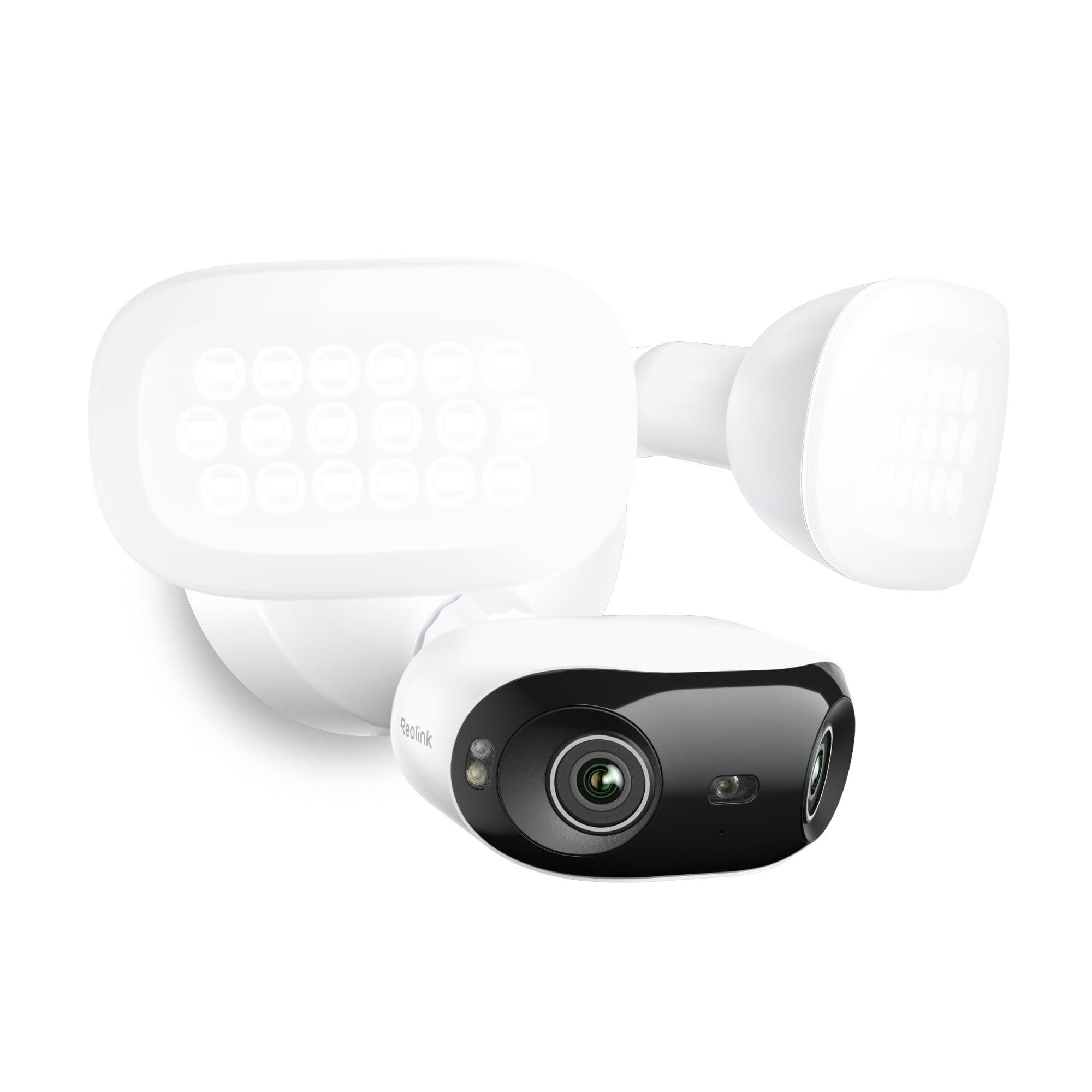
Reolink Elite Floodlight WiFi

79 /100
LBD Score Very Good

Key details

Video
4K 8MP, 180° panoramic
Storage
microSD up to 512GB
Lighting
3,000 lumens, dimmable
Connectivity
Dual-band Wi-Fi 6
View on Amazon

The Elite has the lowest buyer rating of anything we're recommending here, and it has the best picture. Both are true. Two stitched lenses give a 4K, 180-degree panorama with no seam we could find, and 3,000 lumens of dimmable light throws about 40 feet — nothing else in this group matches that pair of numbers.

What holds it back is motion handling. The floodlights don't always fire when something crosses the frame, and at night the 4K image is harder for the camera to read motion in than a 2K one: the panorama sees more, and more of what it sees is noise. When it does trigger, the footage is the most useful here — a whole driveway in one frame, at a resolution that survives zooming.

The compensation is cost of ownership. microSD up to 512GB, NVR and Home Hub support, and no subscription at all, which over a few years is real money against the plan-based cameras. It hardwires to 100-240V where a floodlight already was, and one person can hang it. If you want the widest, sharpest view of a property it delivers; if you want to stop thinking about alerts, it will give you something to think about.

Pros

  • 4K panoramic view across 180 degrees
  • 3,000 lumens, dimmable, 40-foot throw
  • No subscription; microSD up to 512GB
  • Hardwires to 100-240V supply

Cons

  • 4K needs a strong, close Wi-Fi signal
  • Over five pounds on the wall
Our verdict

The most capable camera here on paper — 4K, 180 degrees, 3,000 lumens, no subscription — as long as you're willing to double-check the alerts it sends you.

Check Latest Price
9

Bright on a Budget

Wyze Floodlight Camera v2

85 /100
LBD Score Excellent

Key details

Siren
105dB built-in
Video
2K, 160° view
Lighting
2,800 lumens, dimmable
Night Vision
Color night vision
View on Amazon

2,800 lumens for the least money in this group is the whole pitch, and it holds up. The two LED panels are dimmable, the 160-degree view is wide enough for the side of a house, and 2K color night vision means you can tell a raccoon from a person without turning on the porch light.

It's also the least fussy wired install of the bunch: the app pairs by scanning a QR code, so you're not standing on a ladder typing a password into a camera. The 105dB siren is genuinely unpleasant, and the 270-degree PIR coverage catches movement at the edge of the light's reach rather than only dead center.

Give it a strong signal — it's fussier about distance from the router than the Ring is — and the value is hard to beat. Where it's thinner is the app: settings sit a couple of menus deeper, and the motion zones take longer to get right than they should. Do that work once and you have a very bright camera for very little.

Pros

  • 2,800-lumen dimmable light
  • 2K color night vision at 160 degrees
  • QR-code pairing from the ground
  • 105dB siren and 270-degree sensing

Cons

  • 2.4GHz Wi-Fi only, no 5GHz
  • Connection drops need a reset
Our verdict

The brightest light per dollar here: 2,800 dimmable lumens, 2K color video, and a siren that carries — provided you can give it a solid 2.4GHz signal.

Check Latest Price
10

Google Home Setups

Google Nest Cam with Floodlight

88 /100
LBD Score Excellent

Key details

Power
Wired
Video
1080p HDR
Storage
3 hours free history
Detection
Person, animal, vehicle
View on Amazon

1080p, at the top of the price range, in a group where 2K is the floor. On paper the Nest Cam with Floodlight is the odd one out, and it's still the camera we point Google households toward, because it's the only one here that lives natively in the Home app with everything else they own.

The video is better than the number suggests. HDR holds detail in a lit doorway that a flatter 2K image blows out, and the camera sorts people, animals and vehicles itself before the alert reaches your phone. Where 1080p runs out is distance — at the end of a long driveway there simply aren't the pixels to read a plate, and that's a job for the 4K Ring instead.

Two details we appreciated: it keeps up to an hour of recorded events in its own memory when the Wi-Fi or the power drops, and the floodlight responds to what the camera decides is worth seeing rather than to a schedule. Neither is headline material, and both are the kind of thing you're grateful for on the one night something happens.

Pros

  • Lives natively in the Google Home app
  • Person, animal and vehicle sorting on-camera
  • An hour of events stored during outages
  • HDR detail holds in bright doorways

Cons

  • 1080p resolution limits detail at distance
  • Nest Aware needed past three free hours
Our verdict

Worth it if your home already runs on Google: native Home app control, on-camera person and vehicle alerts, and an hour of backup footage — at 1080p and a premium price.

Check Latest Price

How We Chose and Tested Floodlight Cameras

I started by pulling everything on the market with a real floodlight attached — wired units, battery-and-solar models, and pan-and-tilt cameras that swing to follow movement — then cut anything that couldn't hit 2K or better, and separated the ones that charge a subscription for basic recording from the ones that don't. That left 12 units, which I ran for six months across a full summer into fall.

Every camera got the same install test: I timed myself wiring and mounting each one solo, noted where the bracket forced a second pair of hands, and logged how many minutes passed between screwing it to the wall and seeing a live picture in the app. Then I stood at the far edge of each beam at 10 p.m. and again before dawn to see what the light actually illuminated, not just how bright it claimed to be.

For footage quality, I had a family member pull into the driveway and walk to the door, then reviewed the clips the next morning to see whether I could make out a face or a plate. I jogged past each camera at an angle to check how far the motion tracking lagged behind, and left them running through two rainstorms to see if the picture held or the feed dropped. Over a week I counted false alerts from a neighbor's cat versus real ones from the mail carrier, and I checked live view from the far end of the house on both Wi-Fi bands to see which units stuttered. Monthly cost, app clutter, and how loud the siren was from thirty feet away came last.

How to Choose a Floodlight Camera

Power First: Wired, Battery, or Solar

A floodlight camera draws far more current than a doorbell cam, so the first question is what's already on the wall. Replacing an existing floodlight, or finding a junction box under the eave, opens up the hardwired models — the Ring Floodlight Cam 2K and the eufy E30 both go straight onto that wiring. With nothing there, running a new circuit costs more than the camera, and solar like the Tapo C615F or the Reolink two-pack is the sensible answer.

Expect the trade to show up in light. The battery and solar units here top out around 1,000 lumens, and the Tapo sits at 800, while the wired cameras run 2,000 to 3,000. Most battery models also record on motion rather than continuously, so the wiring decision is really a decision about how much coverage you get.

Lumens, and Where the Light Lands

Two thousand lumens is the practical floor for a real floodlight — enough to light a two-car driveway in color and give the camera something to work with. Below that, as with the Tapo, you're buying a security light with a camera attached, which is fine for a gate or a path and disappointing over a driveway.

Where the beams point matters as much as how many there are. Heads fixed into a housing can't be re-aimed once the bracket is up, so the mount orientation decides where the light goes. Independently pivoting heads, as on the Arlo, let you put one beam down a path and the other across a gate.

Resolution, Field of View, and Zoom

2K is the sensible default: enough to identify a face at porch distance and light enough to stream over ordinary Wi-Fi. 4K earns its money in one specific situation — a long drive or a gate at the far edge of the property, where the extra pixels are the only way to read a plate. That's the case the Ring 4K Pro and the Reolink Elite are built for.

Wider isn't automatically better. A 160-degree lens covers most of a front yard; a 180-degree panorama takes in a whole driveway but pushes more of the frame into the distorted edges. A 360-degree pan-tilt head, like the eufy E30's, trades one wide view for the ability to follow.

Alerts Worth Answering

Motion detection is where these cameras separate in daily use. A plain PIR sensor triggers on heat and movement, which means rain, branches, and passing cars. Person-and-vehicle filtering on the eufy, Ring, and Reolink models cuts most of that, and zone or 3D detection goes further by only alerting inside an area you draw. Budget an evening for zones and sensitivity — the defaults on every camera here are too eager.

Subscription or Local Storage

This is the cost that doesn't show up in the box. Arlo and Nest both push you toward a paid plan for longer history and smart alerts; Nest gives you three hours free, and Arlo's AI detection goes when the trial does. The eufy and Reolink cameras record to a microSD card instead, so you buy the card once and skip the monthly bill. Order it with the camera — 128GB covers weeks of event clips, and the Reolink Elite takes up to 512GB.

Frequently Asked Questions

Final Verdict

For most homes the Ring Floodlight Cam 2K is the answer: it replaces the floodlight you already have, lights the driveway properly, and is still sending the same alerts in week four. If there's no wiring to reuse, the Tapo C615F does the job on solar with a dimmer light. And if your camera looks a long way down a driveway, the Ring 4K Pro is the one that makes a plate readable.