Best GPS Trackers of 2026

Strip away the packaging and a GPS tracker is three parts: a radio that listens for satellites, a battery that decides how long it stays hidden and useful, and a magnet or a wire that decides whether it's still attached when you go looking for it. What you're actually buying is quieter than that — the ability to glance at your phone and know where the car is, or that it hasn't moved since Tuesday.

The piece first-time buyers underestimate is the subscription. Plenty of trackers cost less than a tank of gas and then charge monthly for the cellular data that makes real-time tracking work, while a few genuinely don't. The rest of the trade-off is battery: a unit that reports every few seconds drains in days, and one that sleeps can stretch for weeks but tells you less. We've spent eight months with 11 of them riding in cars, bolted to a motorcycle, and strapped to a boat trailer, and the picks below are the ones that kept answering the same question the same way.

1

Best Overall

Bouncie GPS Tracker

93 /100
LBD Score Outstanding

Key details

Coverage
US, Canada, Mexico
Connectivity
4G LTE cellular
Power Source
OBD2 port, no battery
Service Plan
Monthly subscription required
View on Amazon

A tracker you never have to charge is a tracker you never forget to charge. The Bouncie takes its power from the OBD2 port under the dash, the same socket a mechanic plugs into, so installation is one push and no wiring at all. On anything built since 1996 that port is there, and the whole job takes less time than pairing a phone to the stereo.

The format only matters because of what the app does with it. Bouncie reports trips as they happen and keeps the history, then layers speed, hard braking, idle time and accident notifications on top, so one device answers both where the car is and how it was driven. That combination is what makes it our top pick: the plug-in design removes the upkeep, and the reporting is detailed enough to change what you do with it — a parent can read a week of trips and know exactly where the conversation should start.

Two limits are worth knowing before you order. Coverage is North America, which is fine for a US buyer and not something to plan around if you drive in Europe, and the port requirement rules out older trucks, trailers, boats and classic cars. For any of those, a battery unit like the Tracki Pro is the answer instead.

Everywhere else it is generous: geofence and speed alerts, unlimited data retention, a lifetime-limited warranty, and apps for both iOS and Android plus a desktop browser. Nothing about it is exciting, and that is the point — it goes in once and quietly does the job.

Pros

  • Runs off the OBD2 port, so nothing to charge
  • Live trips, route history and driving detail in one app
  • Geofence, speeding and accident alerts built in
  • Works on most vehicles from 1996 onward

Cons

  • Requires a paid subscription to function
  • Sits visibly in the footwell
Our verdict

For keeping tabs on a car in real time — a teenager's first year of driving, a small work fleet — we recommend the Bouncie: plug it in once and it reports every trip.

Check Latest Price
2

Best for Long Battery Life

Tracki Pro GPS Tracker

89 /100
LBD Score Excellent

Key details

Battery
10,000 mAh, 2 to 7 months active
Coverage
185+ countries
Update Rate
15 seconds to 1 minute
Connectivity
4G LTE Cat1 with global SIM
View on Amazon

The number that decides this one is 10,000 mAh, which the listing puts at two to seven months of active use. We read that as the honest version of the claim: seven months is a tracker you check on a schedule, two months is one set to frequent updates, and most people land somewhere in between. Either way it is the longest-running device here, and it is the reason this goes on a trailer, a boat or a collar rather than into a car's diagnostic port.

In the box you get a strong magnet, a screw mount and two collar attachments, which is a fairly clear statement about who this is for. The housing is weatherproof, the built-in global SIM keeps it reporting across more than 185 countries, and updates run from 15 seconds to a minute on the plan. Fifteen seconds is close to live; a minute is a trail you read after the fact. Neither will flatten the battery in a week.

The upkeep is the catch. It charges over a magnetic USB cable, so eventually you have to remember it, even if eventually is months away. Longevity is the other risk — a unit that quits within a few months is the failure to plan around, so buy where the one-year warranty is easy to use. If your target has a diagnostic port and you want zero maintenance, the Bouncie is the safer call. If it doesn't, this is the pick.

Pros

  • 10,000 mAh battery rated for two to seven months
  • Magnet, screw mount and two collar attachments included
  • Updates every 15 seconds to a minute
  • Global SIM covering 185+ countries

Cons

  • Recharging is on you, months or not
  • Longevity is uneven; some units quit early
Our verdict

We point trailer, boat and pet owners to the Tracki Pro: its 10,000 mAh battery reports for months between charges, and it mounts with a magnet, a screw or a collar.

Check Latest Price
3

Best Budget

LandAirSea 54 GPS Tracker

84 /100
LBD Score Excellent

Key details

Battery
Up to 30 days
Mounting
Built-in magnet
Update Rate
As fast as 3 seconds
Water Resistance
Waterproof housing
View on Amazon

The LandAirSea 54 is the least expensive hardware in this roundup, and it is worth being clear about what that means: the device is cheap, the service isn't. A plan is mandatory, and the month-to-month rate is the highest of the subscriptions here — switch to annual billing and it drops to roughly the level of the rest. Read the purchase price as an entry fee rather than the cost of ownership.

As hardware there is a lot to like. It measures 2.25 inches square, weighs under five ounces, and the internal magnet is the standout — it grips a frame rail or a mower deck without a bracket. The case is sealed against weather and updates can arrive as often as every three seconds, the fastest interval in this group. Motion-activated sleep means a parked vehicle stops burning battery until something actually moves.

Two things hold it back. Battery life is rated at 30 days, a figure that shrinks toward single digits as you shorten the update interval, and the short interval is exactly what you want when something is missing. Longevity is the other risk; a unit that goes silent after a couple of months is what the lifetime warranty is for, so keep the paperwork. We still rate it the budget pick, because no other device here gets you into real cellular tracking for less, and for a second vehicle or a trailer that is often all you need.

Pros

  • Cheapest hardware here for real cellular tracking
  • Internal magnet grips without a bracket
  • Waterproof case and updates as fast as 3 seconds

Cons

  • Plan required; month-to-month rate is the highest here
  • Battery life collapses at the fastest update setting
Our verdict

The LandAirSea 54 is our budget pick — the least expensive way into real cellular tracking here, with a strong magnet and a waterproof shell, as long as you accept the plan.

Check Latest Price
4

Best for Theft Alerts

CarLock Anti-Theft Tracker

86 /100
LBD Score Excellent

Key details

Alerts
Movement, vibration, engine start
Connectivity
4G LTE
Power Source
OBD2 plug-and-play
Service Plan
Subscription required
View on Amazon

A car that moves while you are asleep is the scenario CarLock is built for. It plugs into the same OBD2 port as the Bouncie, but it behaves like an alarm: vibration, an engine starting, the device being unplugged or a car that has rolled off the driveway all push an alert to your phone. On a street where catalytic converters walk away, that is a different job from logging where the car went.

It covers the family-driver ground too. Harsh acceleration, hard braking, cornering, a driving score, geofenced zones and trip tagging for business versus personal miles all sit in the same app, and coverage runs across the US and Canada. Installation is a genuine plug-in — no wiring and no fitter — which is the part that makes it easy to say yes to.

The catch is timing. Alerts can arrive minutes after the event they describe, which is fine for where did my teenager go and much less fine for someone is taking the car right now, and a vehicle sitting idle can trigger a vibration alert. None of that ruins the family-monitoring job, since a delayed hard-braking notice still tells you what you wanted to know, but it does mean the theft alarm works as a deterrent and a record rather than a live guard.

So we recommend it for a specific buyer: someone who wants theft alerts and teen-driver reporting from one plug-in device and does not need to watch the car move in real time. If live pursuit is the point, the Bouncie's location feed is the more dependable version of it. If you want your phone to buzz the moment a door opens, this is the device here that tries hardest to do that.

Pros

  • Movement, vibration and engine-start alerts
  • Driving behaviour, trip tagging and geofences in one app
  • Plug-in OBD2 install with no wiring

Cons

  • Alerts can lag minutes behind the event
  • Idle cars can trip false vibration alarms
Our verdict

For a car parked where theft is a real worry, CarLock earns our recommendation: it buzzes your phone when the vehicle moves, starts or gets nudged.

Check Latest Price
5

Best Without a Subscription

Moto Watchdog Wired Tracker

85 /100
LBD Score Excellent

Key details

SIM
Pre-installed
Alerts
Geofence, speeding, movement
Power Source
Hardwired, no battery
Service Plan
No subscription
View on Amazon

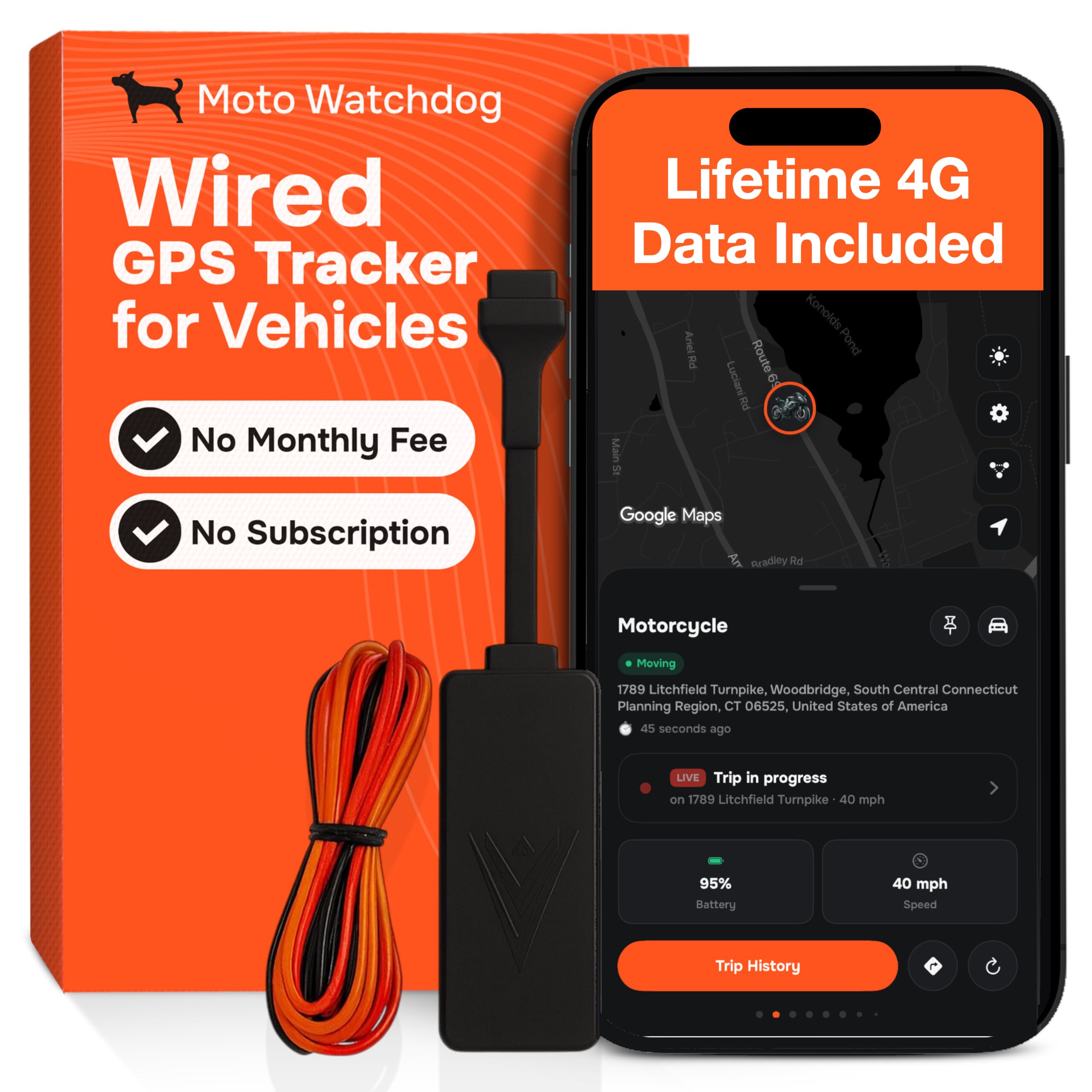
Two wires, or three if you want ignition sensing. The Moto Watchdog draws its power from the vehicle rather than a battery, and that one decision shapes everything else: no charging, no cell to go flat in a cold snap, no sleep schedule to preserve. It runs when the car runs, and it wakes when the ignition turns.

It ships with a pre-installed SIM that needs no subscription, which removes the recurring bill entirely. Live location, route history, speeding alerts and geofences all come through the app, and several vehicles can be managed on one screen, which is what turns it from a gadget into a fleet tool. Notification settings are configurable per vehicle, so a new driver's car can be watched without watching everyone.

The honest trade-off is the install. This is not a dongle: it needs a fused connection to the vehicle's wiring in a two- or three-wire configuration, and if you are not comfortable under a dash, add the cost of someone who is. We think it earns its keep in a work van or a small fleet that will hold the device for years, where not paying a plan every month adds up. For one car and one driver, the plug-in ease of the Bouncie is simpler to live with.

Pros

  • No subscription and no activation fee
  • Runs on vehicle power; no battery to charge
  • Live location, geofences and speeding alerts
  • Several vehicles manageable from one screen

Cons

  • Needs a fused hardwired install
  • Notifications can arrive late
Our verdict

If a monthly bill is the dealbreaker, this is our pick: the Moto Watchdog runs off the vehicle's own power and reports in real time with no plan at all.

Check Latest Price
6

Motorcycles and ATVs

Monimoto 9 GPS Tracker

86 /100
LBD Score Excellent

Key details

Battery
900 mAh, USB-C rechargeable
Alert Type
Motion-triggered phone call
Connectivity
International eSIM
Water Resistance
IP68
View on Amazon

A key fob comes in the box, along with zip ties for mounting the unit out of sight, and that sets the tone: this is an alarm with a tracker inside rather than a map you watch all day. The moment it detects suspicious movement it calls your phone — an actual voice call, not a notification you can swipe away half-asleep at two in the morning. That design choice is why it earns a place here for bikes and powersports, where the risk is not where did it go but is it still there.

Physically it is built for the job: IP68 sealing, a USB-C rechargeable battery that doesn't tap the bike's own, an international eSIM for tracking across borders, and a two-year warranty. What it won't do is give you a continuous trail to follow — it reports when something happens, not every thirty seconds — and at the top of the price range here, we think it is money well spent on a motorcycle and hard to justify on a car that could take a plug-in tracker instead.

Pros

  • Calls your phone when it detects movement
  • IP68 sealed against rain, mud and dust
  • USB-C rechargeable without touching bike power
  • International eSIM for cross-border tracking

Cons

  • No continuous tracking between alerts
Our verdict

For a motorcycle or ATV parked out of sight, the Monimoto 9 is the one we trust: it calls your phone when the bike moves, and it survives the weather.

Check Latest Price
7

Wireless, No Fees

TuTrackAI M501N Tracker

77 /100
LBD Score Very Good

Key details

Mounting
Built-in magnet
Connectivity
4G LTE with GPS and LBS
Service Plan
No subscription; SIM and data included
Route History
180 days
View on Amazon

No subscription is the promise, and here it looks like a real one: the M501N ships with a 4G SIM and data service built in, so there is nothing to activate and nothing to cancel. That combination — cellular tracking, a magnet mount, no recurring bill — is unusual in this group, where the only other no-fee pick has to be wired into the vehicle. What we cannot do is vouch for it the way we can the Bouncie, because the record behind this model is thin and not all of it is enthusiastic. We treat it as promising rather than proven.

The specification is generous. Three tracking modes let you trade update frequency against runtime, the built-in magnet needs no wiring or bracket, and the app keeps up to 180 days of route history with geofence and speed alerts and multi-user access for a family or small fleet. At 2.17 by 1.69 by 0.69 inches it is small enough to tuck under a seat or inside a trailer frame. Put it on a low-stakes asset first, watch how it behaves for a month, and scale up only if it holds.

Pros

  • No subscription; SIM and data included
  • Built-in magnet needs no wiring or bracket
  • 180 days of route history
  • Three modes trade update rate for runtime

Cons

  • Short reliability record so far
Our verdict

If you want a magnetic tracker with no monthly fee, the TuTrackAI is worth trying on a low-stakes asset — we can't yet vouch for it the way we can the Bouncie.

Check Latest Price

How We Tested GPS Trackers

We started with roughly 40 trackers pulled from retailer listings and owner forums, then cut anything that duplicated a mounting type, a subscription model, or a price bracket already covered. Eleven survived: magnetic pucks, OBD plug-ins, hardwired units, and an alarm-style tracker built for bikes and boats. They spent eight months in a commuter sedan, a weekend car, a motorcycle parked on a street, and a boat trailer, rotating between vehicles so no device got a permanently easy assignment.

Accuracy got checked the low-tech way. At a dozen addresses we already knew, we compared the app's pin against where the vehicle was actually sitting, and noted whether a cold start landed on the right block or wandered a street over. Magnetic units were stuck under seat frames and left through a week of speed bumps, potholes, and one car wash, then pulled off to see whether they'd held and whether they'd marked the upholstery. We drew geofences around a school lot and a driveway to time how fast a boundary alert arrived, and ran one unit through a rainstorm and a curb-deep puddle.

Setup was timed from unboxing to the first usable ping, working alone, and we logged every low-battery notification against the days of service we actually got. Value meant adding the device price to a full year of subscription fees, since a cheap tracker with a monthly bill can outrun an expensive one without. We also wrote down the disappointments: alerts that arrived minutes late, a unit that went silent in a parking garage, app crashes mid-check, and the false alarms that make you stop trusting a notification. What separated the top of the list from the bottom wasn't the feature count — it was whether the thing was still telling the truth in month seven.

How to Choose a Gps Tracker

Cellular or Bluetooth: Know Which One You're Buying

Plenty of cheap listings call themselves GPS trackers without carrying a GPS receiver at all. If the page names Apple Find My or Google Find Hub and lists Bluetooth as the connection, the device has no radio of its own and no idea where it is — it borrows the position of nearby phones. That works for keys and a backpack and fails completely for a trailer in a field with nobody around.

A real tracker has a cellular modem and its own SIM, which is why it costs more and usually charges monthly. Check the connectivity line before anything else: 4G LTE or cellular means it reports itself; Bluetooth means it depends on strangers.

The Plan Is the Real Price

Almost everything here needs a data plan, and the plan decides what the device actually costs you. Annual billing often halves the monthly rate, so the unit that looks twice as expensive can be the cheaper one over two years, and the cheap unit with a pricey month-to-month rate is the expensive one.

Work out a two-year total — hardware plus service — before comparing anything else, and read the cancellation terms, because a tracker on a contract is a commitment rather than a purchase. The no-subscription models trade that recurring bill for a higher upfront price, and sometimes for a shorter record to judge them by.

Match the Power Source to What You're Tracking

A car built after 1996 has an OBD2 port, and a dongle that plugs into it needs no charging and no installer, which is why it is the easiest answer for a family vehicle. A trailer, a boat, a mower or a bike has no such port, so a battery unit with a magnet or a bracket is the only option.

Two traps live here. A magnet only holds on steel, so an aluminium trailer frame needs the screw mount or a zip tie, and a hardwired unit is a wiring job you may not want to do yourself. If the device lives outdoors, check the IP rating rather than trusting the word waterproof.

Update Rate and Battery Life Pull Against Each Other

A tracker reporting every ten seconds can empty a battery in days; the same device on a five-minute interval runs for weeks. That is the entire trade, and it is why a published battery figure means little without the interval it was measured at.

Set the slowest interval that still tells you what you need, and if following a vehicle live is the point, accept that the unit will run on vehicle power. The long-runtime picks here quote their best case, so read the range and not the headline.

Frequently Asked Questions

Final Verdict

The Bouncie is the tracker we recommend to most people: a car that reports every trip, no battery to charge, and an app that turns location into driving history you can act on. It isn't the cheapest way in and the plan is ongoing, but nothing else here matches that combination of low effort and useful detail.

Change one requirement and the answer changes. No diagnostic port involved, take the Tracki Pro. A monthly bill is the dealbreaker, go to the Moto Watchdog. A motorcycle parked on a street, the Monimoto 9.