Best Ham Radios for Beginners of 2026

A ham radio isn't a walkie-talkie with extra buttons, and that's exactly what scares people off. The license, the jargon, the wall of numbers on the spec sheet — it reads like homework. But a decent starter handheld will have you listening to local repeaters and pulling in weather broadcasts within an hour of opening the box.

I've been the person squinting at a manual at 11 p.m., so I understand the hesitation. Over four months, we put a dozen radios through hikes, commutes, and plenty of evenings scanning channels at the kitchen table. Price barely predicted how a radio sounded; the stock antenna and the programming method almost always did. Insist on dual band, too — a single-band radio runs out of conversations fast.

What separates a good first radio from a frustrating one isn't raw power. It's whether you can program a repeater without wanting to throw the thing across the room, whether the battery lasts a day outdoors, and whether the audio is clear enough that you keep talking. Every pick below is one I'd hand to a friend who's never keyed a mic.

1

Best Overall

Baofeng UV-5R Mini

89 /100
LBD Score Excellent

Key details

Channels
999
Charging
USB-C port on the battery
Output Power
5W
Weather Bands
NOAA, AM, FM receive
View on Amazon

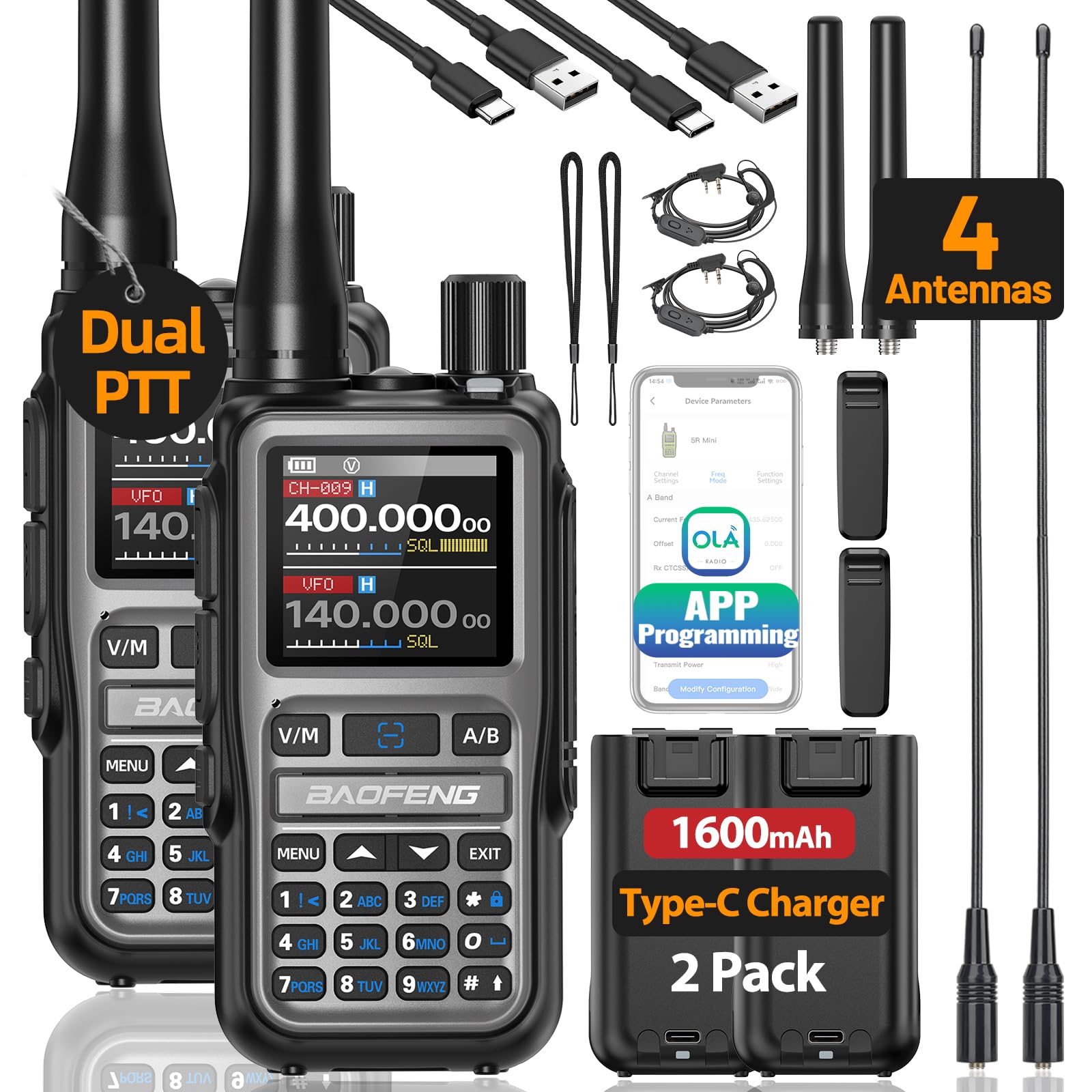
The UV-5R Mini earns the top spot with a phone. Pair it with Baofeng's app and you type a repeater's frequency and tone onto a screen with a keyboard instead of walking the keypad through nested menus, and a side-key shortcut copies a frequency off another radio in about two seconds. Programming is the chore that keeps a new radio in its box, and this is the one that deletes it.

Charging is the other chore it deletes. The USB-C port sits on the back of the battery, so a phone charger, a power bank, or a car outlet all work and there's no cradle to lose. It isn't quick — we top it up overnight rather than expecting a coffee-break refill.

The receiver reaches past the ham bands to NOAA weather, AM, and FM, and we kept coming back to the weather channel during a storm watch. Each radio in the set ships with a stubby 9 cm antenna and a 38 cm whip. The long one goes on outdoors or in a vehicle; the stub keeps the radio pocketable around town.

Two things to know before you order. The display shows a channel name or a frequency, not both at once, so scanning means switching views. And this is a two-radio set — ideal if someone is on the other end, unnecessary if you're buying for one. Five watts is enough either way; the extra power in a mobile rig matters mostly at the edge of coverage.

Pros

  • Programs from a phone app, not menus
  • USB-C charging on the battery itself
  • NOAA weather plus AM and FM receive
  • Two radios with long and stub antennas

Cons

  • Shows channel name or frequency, not both
  • Sold only as a two-radio set
Our verdict

Our pick for a first ham radio: it programs from your phone, charges over USB-C, and pulls in weather, and it arrives as a pair so someone can answer you.

Check Latest Price
2

Best Budget

Baofeng UV-5R

91 /100
LBD Score Outstanding

Key details

Battery
1800mAh Li-ion
Channels
128
Charging
Desktop cradle
TX Range
144-148 MHz / 420-450 MHz
View on Amazon

The UV-5R is the radio every beginner hears about first, and the arithmetic still works. It is the least expensive way here onto 2m and 70cm, and it's a real transceiver rather than a toy: 128 channels, dual watch, a keypad lock, and an antenna connector you can unscrew and upgrade. The five-mile maximum on the listing is a line-of-sight figure for two radios with nothing in between — a repeater on a hill does more for your range than wattage does.

What keeps it in the roundup is that antenna connector and the price. Nothing sits between you and the band. Programming is the tax: frequencies go in from the keypad a step at a time, or over a computer with CHIRP and a cable that isn't in the box, so budget for the cable and an evening with a repeater list. The Mini is what we hand people who don't want that evening.

Two more things sit on the ownership side. It charges in a desktop cradle rather than over USB, so set the dock up the day it arrives and confirm it's taking a charge, because a dead or misplaced charger takes the radio off the air. And it talks only to other hams — FRS and GMRS walkie-talkies are outside its range by design, not behind a setting you can unlock. Neither has stopped us from keeping one around as a spare.

Pros

  • Lowest-cost route onto 2m and 70cm here
  • 128 channels with dual watch and lock
  • Removable antenna, clip, and earpiece included

Cons

  • No programming cable included
  • No weather or airband reception
Our verdict

Still the cheapest way onto the 2m and 70cm bands, and a sound first radio if you accept keypad programming, a cradle charger, and a ham-only receiver.

Check Latest Price
3

Best for the Car

Retevis RT95

89 /100
LBD Score Excellent

Key details

Display
180° rotating LCD
Channels
200
Supply Voltage
13.8V DC
Frequency Range
144-148 MHz / 420-450 MHz
View on Amazon

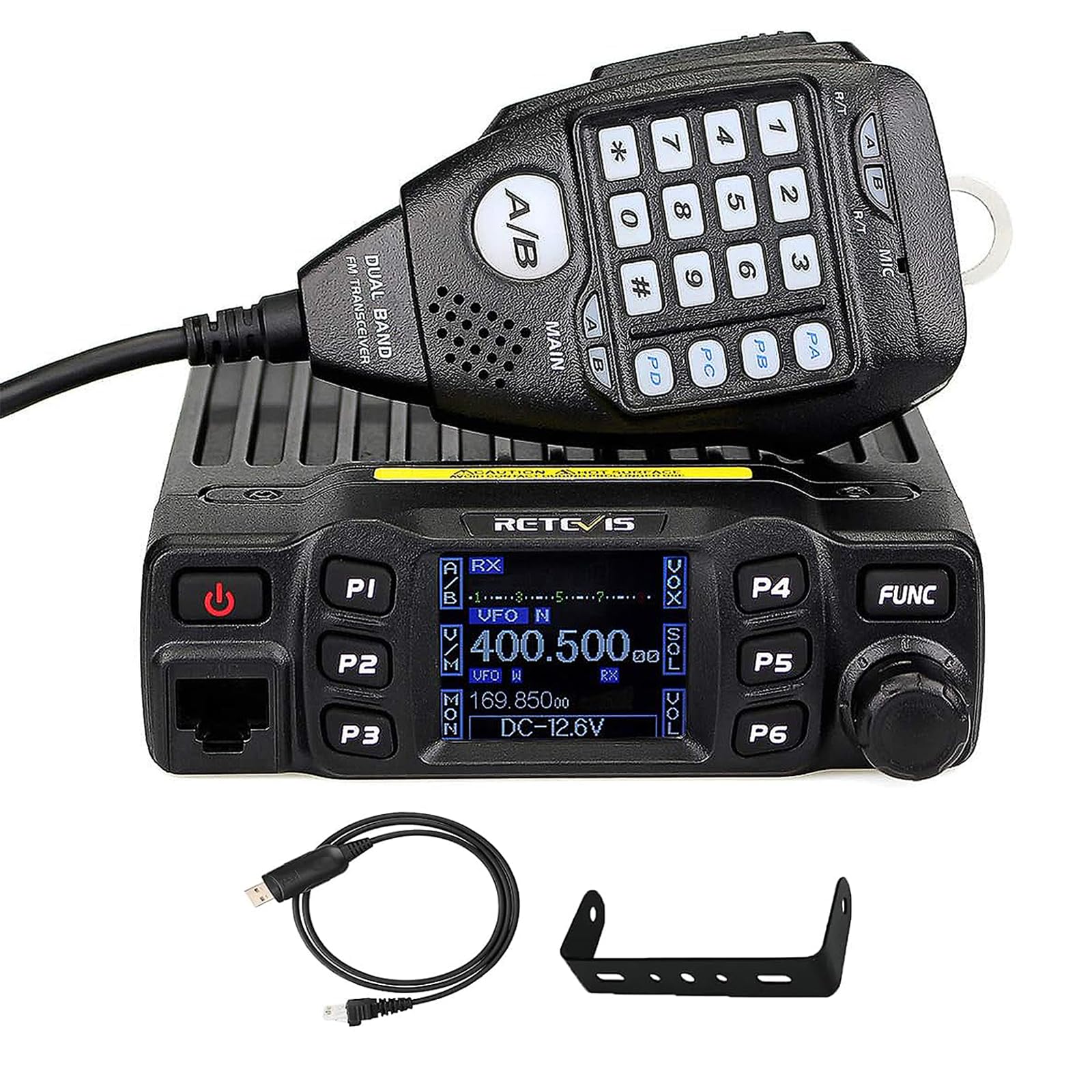
The RT95's display rotates through 180 degrees, which sounds like a gimmick until you're fitting a radio under a dash where the only flat surface is upside down. Mount it that way, flip the screen, and the readout still reads right side up. That detail is why we reach for this one when someone wants a radio in a truck instead of a pocket.

Underneath it's a 13.8-volt mobile transceiver with 200 channels on 2m and 70cm, and it behaves like a proper rig rather than a handheld in a bracket. The microphone carries its own speaker, so audio reaches you from two places, and the sound is the clearest of the three here. Front-panel VFO operation covers frequency, offset, and tone without a computer or a cable, which is the part of a mobile install you appreciate at a trailhead.

The install is the real cost. It wants a regulated 13.8V supply and an external antenna, so plan on a mount, a feed line, and an antenna alongside the radio. Do it once in one vehicle and it's an afternoon's work rather than an ongoing project.

Coverage is the quiet advantage: three years on the radio body is the longest warranty of anything here, and it counts for a box that bakes in a cab all summer. The compact front panel is the trade — buttons and menus sit close together, and you'll learn the function keys instead of browsing them.

Pros

  • Screen rotates for upside-down mounting
  • Speaker built into the microphone
  • Front-panel VFO plus CHIRP support
  • Three-year warranty on the radio body

Cons

  • Needs a 13.8V supply and external antenna
  • Compact front panel crowds the controls
Our verdict

For a vehicle install this is the one: the screen rotates to mount upside down, the mic carries a speaker, and most setup happens from the front panel.

Check Latest Price

How We Tested a Dozen Beginner Ham Radios

We started with a list of two dozen radios sold as beginner-friendly, then cut anything that skipped dual band, cost more than a first-timer should reasonably spend, or needed software we couldn't get running on an ordinary laptop. Size and weight mattered too — a handheld that doesn't fit in a jacket pocket tends to stay in a drawer. That left a dozen units, which we ran for four months.

Each radio got the same first hour: I unboxed it, ignored the quick-start card, and timed how long it took to reach a working channel and a clear weather broadcast, then did it again with the manual in hand. We programmed the same six local repeaters by hand on every unit — and through computer software wherever a cable was involved — noting where the menus fought back. Then we handed each radio to someone who'd never used one and watched without helping.

The radios went where beginners actually take them: clipped to a pack on day hikes, in a cupholder on the commute, on a windowsill during evening nets, in a glovebox for a week at a stretch. We charged each to full and left it scanning at moderate volume to see how long the battery truly lasted, and we checked range in a wooded park and across town instead of trusting the number on the box. Sound quality got a second opinion from whoever was on the other end; durability meant a waist-high drop onto concrete, a week in a bag with keys, and whether the antenna connection still felt tight.

Compatibility was tested with the things a beginner actually buys — an external mic, a magnetic car antenna, a spare battery — and we noted which ones needed an adapter. The radios that came through all of it cleanly are the ones below.

How to Choose a Ham Radio for Beginners

License and Bands Come First

In the U.S., keying up on 144-148 or 420-450 MHz requires an FCC amateur license, and the Technician class is the entry exam. Every radio here transmits on those amateur bands and nothing else, which is why none of them will talk to the FRS or GMRS walkie-talkies in your camping bin. No menu setting changes that.

If your group is on GMRS, buy a GMRS radio and skip the exam. If you're willing to study, the Technician ticket opens repeater networks, satellites, and far quieter frequencies. You can listen on any of these radios while you prepare for the test.

How You Program It Decides How Much You'll Use It

A new ham radio arrives with a blank or arbitrary channel list, and a repeater needs a frequency, an offset, and a tone before it does anything useful. There are three ways in: the front keypad, which is slow and easy to get wrong; a computer running CHIRP over a cable, which is fast but needs the cable; and a phone app, the newest route and the one the UV-5R Mini uses.

Pick the path you'll actually sit down and finish. And don't assume a cable is in the box — on the UV-5R it isn't.

Watts Don't Buy Range; Antennas and Repeaters Do

VHF and UHF are line of sight, so the five-mile talk range printed on these listings describes two radios with nothing between them. Going from 5 watts to 10 adds a little headroom at the edge of coverage; raising the antenna or reaching a hilltop repeater does far more.

That's why the cheapest handheld here with a better antenna can outperform a pricier radio with a stub. Before you pay for watts, find out which repeaters cover your address.

Handheld, Mobile, or Both

A handheld carries its own battery and antenna, which is what you want on a hike and what you don't want on a dashboard. A mobile rig runs from the vehicle at 13.8 volts, drives an external antenna, and reaches repeaters a handheld can only hear. The RT95's rotating display exists for exactly that install.

Mobile radios ship in regional band versions, so confirm the one you order covers 144-148 and 420-450 MHz before it ships, and plan on a mount, a feed line, and an antenna as part of the purchase.

Frequently Asked Questions

Final Verdict

For a first radio we point beginners at the UV-5R Mini. It programs from a phone, charges over USB-C, picks up weather, and arrives as a pair, which is one more radio than most people start with.

If budget is the deciding factor, the UV-5R still puts you on 2m and 70cm for the least money here — budget for a programming cable and accept that weather bands aren't part of the deal. Once you want to talk from a vehicle with an antenna that isn't a rubber duck, the RT95 is the step up, and its rotating screen makes the install easier than most.