Best Hand Crank Radios of 2026

A hand crank radio is the one piece of gear you buy hoping it stays in a drawer — which is exactly why the kind that's dead when you finally reach for it stings so much. The whole promise is that it works when the power doesn't: no outlet, no signal, no fresh batteries at two in the morning. What you're actually buying is a battery that holds its charge through months of neglect, a crank you can turn with cold hands, and a speaker loud enough to hear a weather alert over the rain on a window.

My team has put 12 of these through eight months of blackouts, camping trips, and long stretches of being ignored on a shelf. The pattern held: the radios that earn their keep have a crank that feels geared rather than gritty, and they treat the little solar panel as a trickle top-up instead of a real charger. Sound quality matters more than most shoppers expect, too — a tinny speaker you have to hold to your ear is useless with the whole family in one room, and a power bank that can't meaningfully charge a phone is a missed opportunity in an outage.

Every radio below earned its place by working in the dark, not on a spec sheet. Some are built for a go-bag, others for the kitchen counter; the right one depends on where it will live and who's cranking it.

1

Best Overall

OnLyee CR1030

92 /100
LBD Score Outstanding

Key details

Bands
AM/FM plus 7 NOAA channels
Weight
1.6 lb
Battery
12,000 mAh
Power Sources
Hand crank, solar, USB-C, 3 AAA backup
View on Amazon

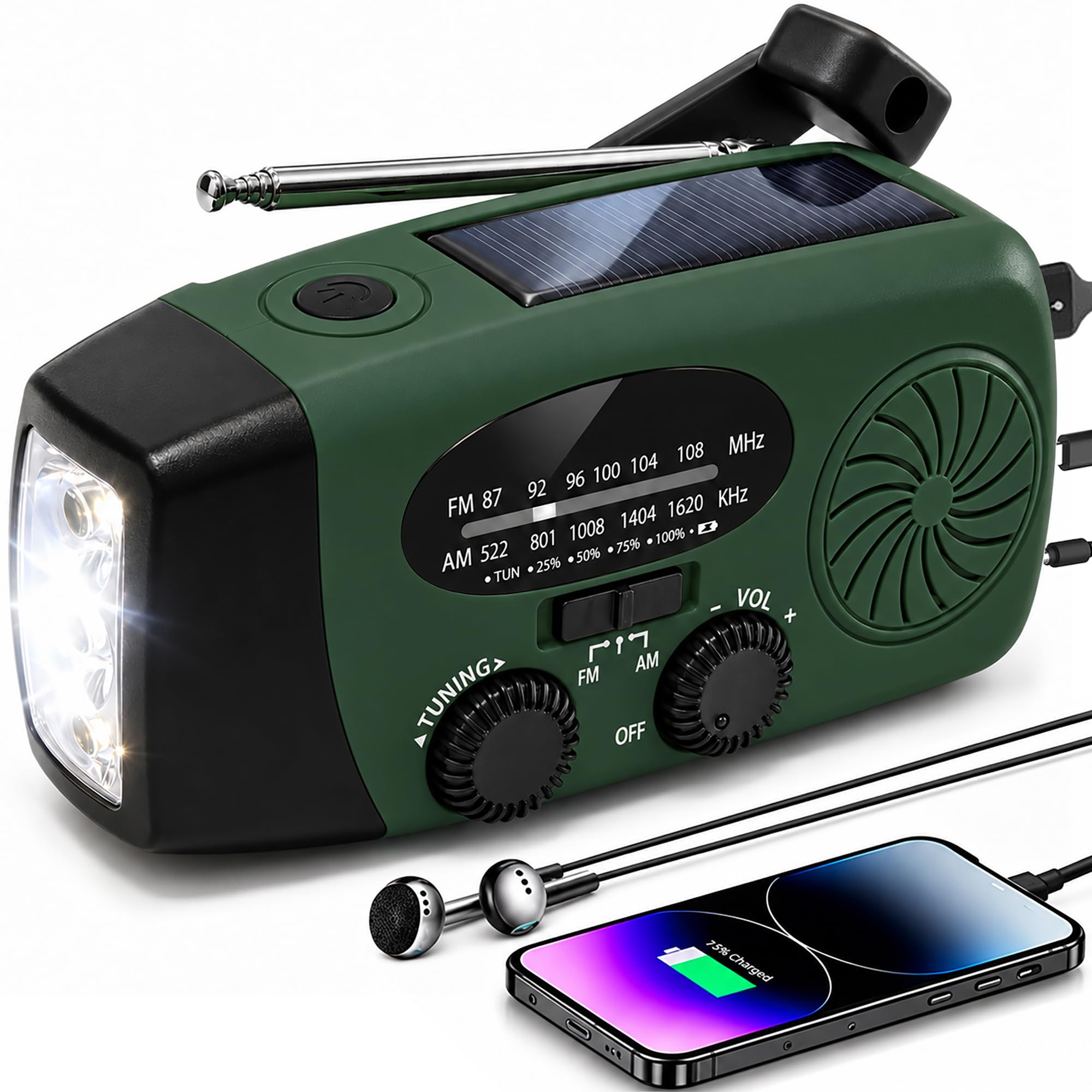
An 8,500-square-millimeter solar panel is an odd thing to lead with, but it explains why the CR1030 is our top pick. Panels on radios this size usually just slow the drain; this one is paired with a 12,000mAh battery, the largest in this group, so a day on a windowsill counts for more than it does anywhere else here. In an emergency radio, that's the trait that matters: it should need the crank least.

The rest of the hardware holds up. Seven NOAA weather channels join AM and FM, tuning runs through a proper dial and buttons rather than one multifunction rocker, and the 57mm speaker is genuinely listenable — we left FM on for an afternoon without wanting to switch it off, which isn't true of every radio in this group. A 5W flashlight and a separate reading light cover the lighting side, and the SOS alarm is rated at 120dB, loud enough to be unpleasant indoors.

It measures 6.81 by 2.91 by 4.76 inches and comes with a woven strap for moving it between rooms, and it's sealed to IPX6, so a wet porch or a tipped glass isn't a crisis. Behind that sit a three-year warranty and a compartment that takes three AAA cells when the built-in pack eventually ages. For a radio that will sit on a shelf for two years and then be asked to work, that last part is worth more than any spec.

Pros

  • Largest battery and solar panel in this set
  • Seven NOAA channels alongside AM and FM
  • IPX6 shell and a three-year warranty
  • AAA compartment as a last-resort backup

Cons

  • 1.6 lb is heavy for a pack
Our verdict

We think the CR1030 is the best all-round choice here: the largest battery and solar panel in this group, seven weather channels, and sound you'll keep using after the storm.
Check Latest Price
2

Best for Long Outages

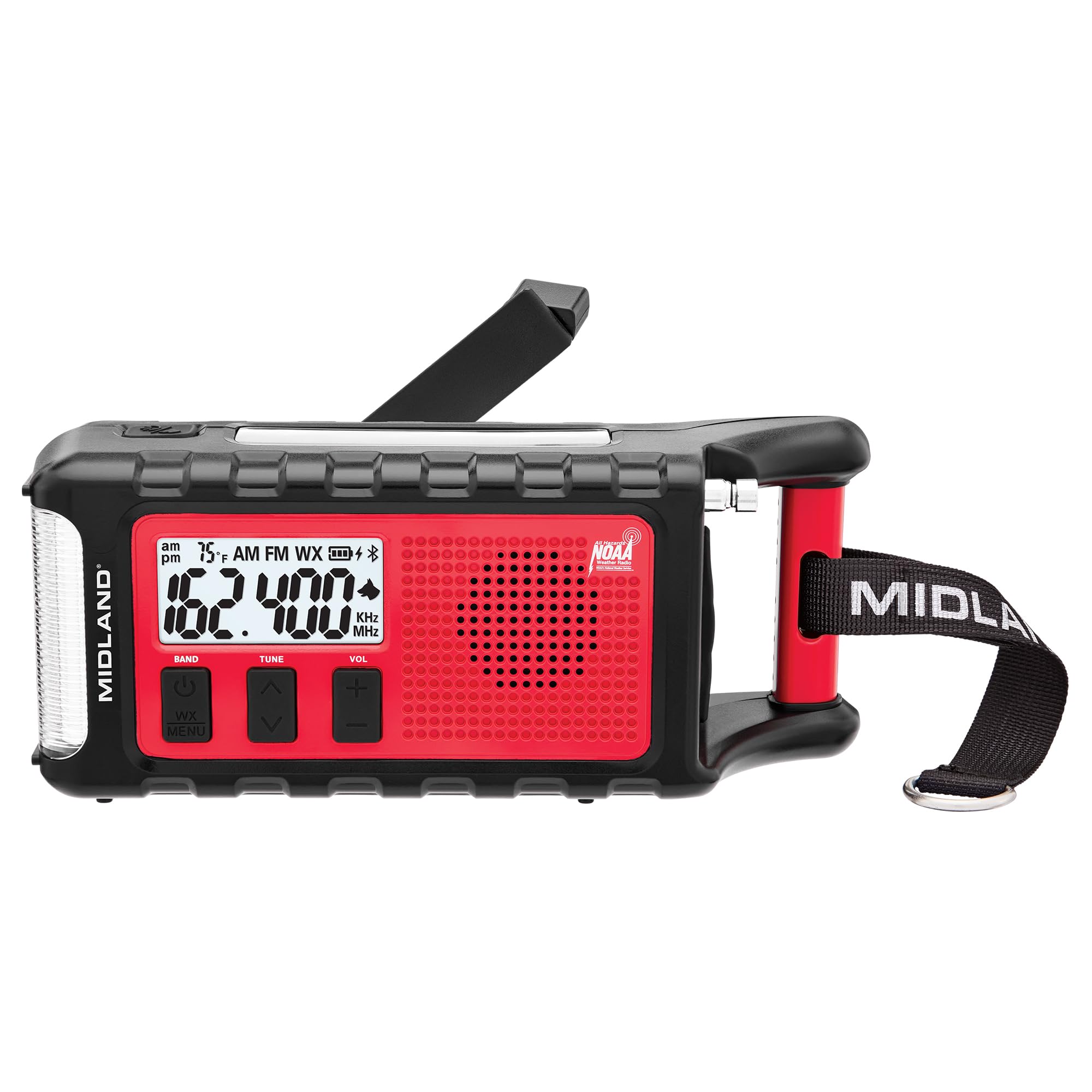
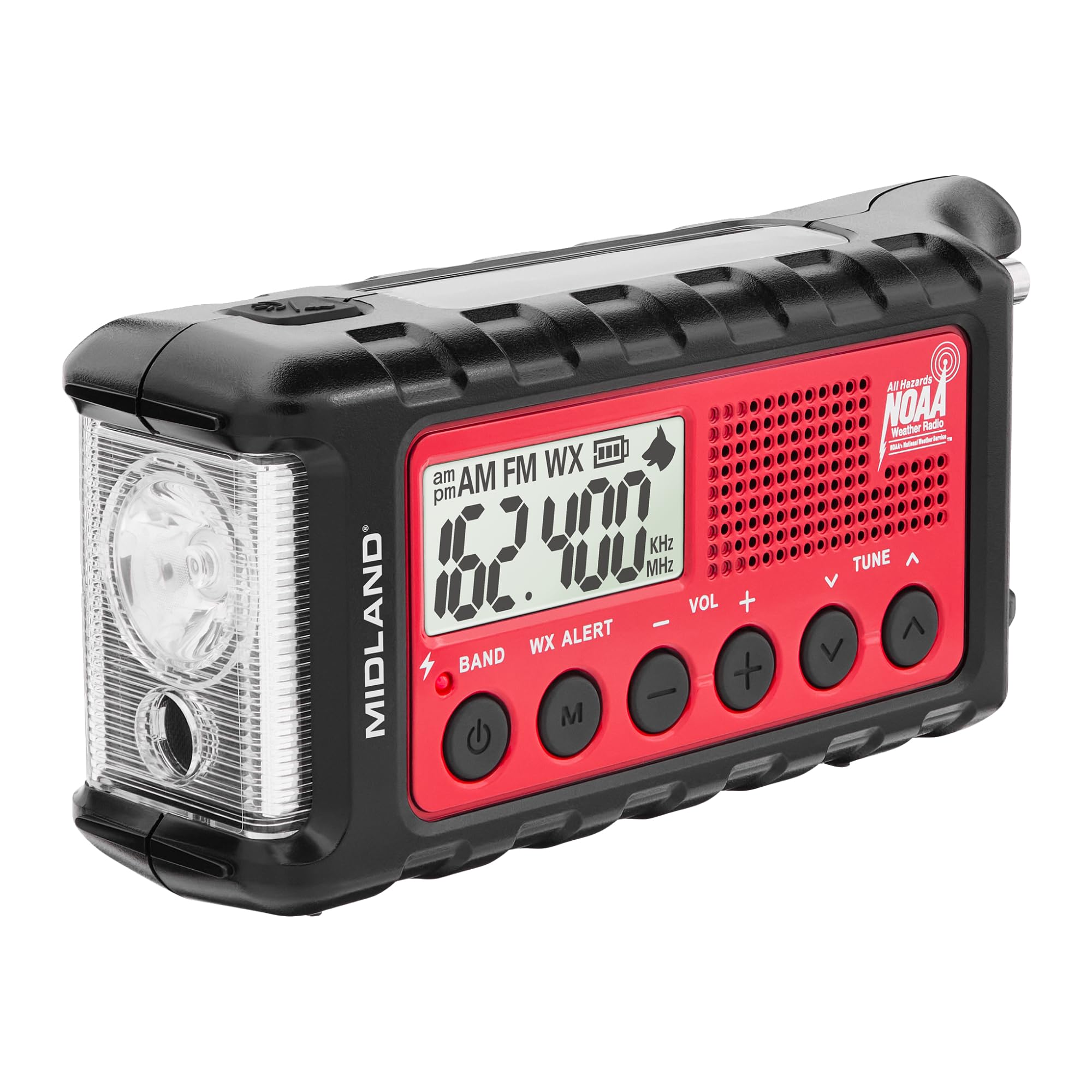
Midland ER310

93 /100
LBD Score Outstanding

Key details

Bands
AM/FM plus NOAA scan and alert
Weight
16 oz
Flashlight
Built-in SOS beacon
Power Sources
Hand crank, solar, USB, 6 AA
View on Amazon

Six AA batteries live alongside the rechargeable pack in the ER310, and a switch lets you choose which source feeds the radio. It's a small design decision that answers the real failure of every emergency radio: not that it breaks, but that the battery inside has quietly gone flat since the last time you looked at it. Alkalines have their own shelf life, but you can see them, test them and replace them at a gas station.

The alert side is equally thorough. NOAA weather scan runs the seven channels and locks onto the strongest one, and the alert circuit brings the radio up when a warning is issued. The flashlight flashes an SOS pattern in Morse code, and an ultrasonic dog whistle is built in for search-and-rescue work — a niche feature, but a legitimate one on a radio that lives in a disaster kit.

Day to day it's an easy thing to own. The volume dial and tuning knob are the kind you find by feel in the dark, which sounds trivial until you're doing it, and voices come through clearly with enough headroom that the alert tone genuinely startles. Music is a small-speaker experience, which is the wrong reason to pick or reject any of these radios.

At 9.61 inches tall and 16 ounces it takes up real shelf space. What we keep coming back to is that switch: a radio you can feed with six AA cells from a drugstore is one you can keep alive for weeks, and no other radio here takes AA batteries at all.

Pros

  • Six AA batteries back up the rechargeable pack
  • NOAA scan and alert lock onto the strongest channel
  • Controls you can work by feel in the dark
  • SOS flashlight and ultrasonic dog whistle

Cons

  • No water-resistance rating
Our verdict

Buy the ER310 if you want a radio that lives in the house and can fall back on six AA batteries when the built-in pack runs down.

Check Latest Price
3

Best for a Go Bag

FosPower A1

93 /100
LBD Score Outstanding

Key details

Bands
AM, FM, WB
Weight
14.8 oz
Battery
7400mWh (2000mAh)
Power Sources
Hand crank, solar, USB-C, 4 AAA
View on Amazon

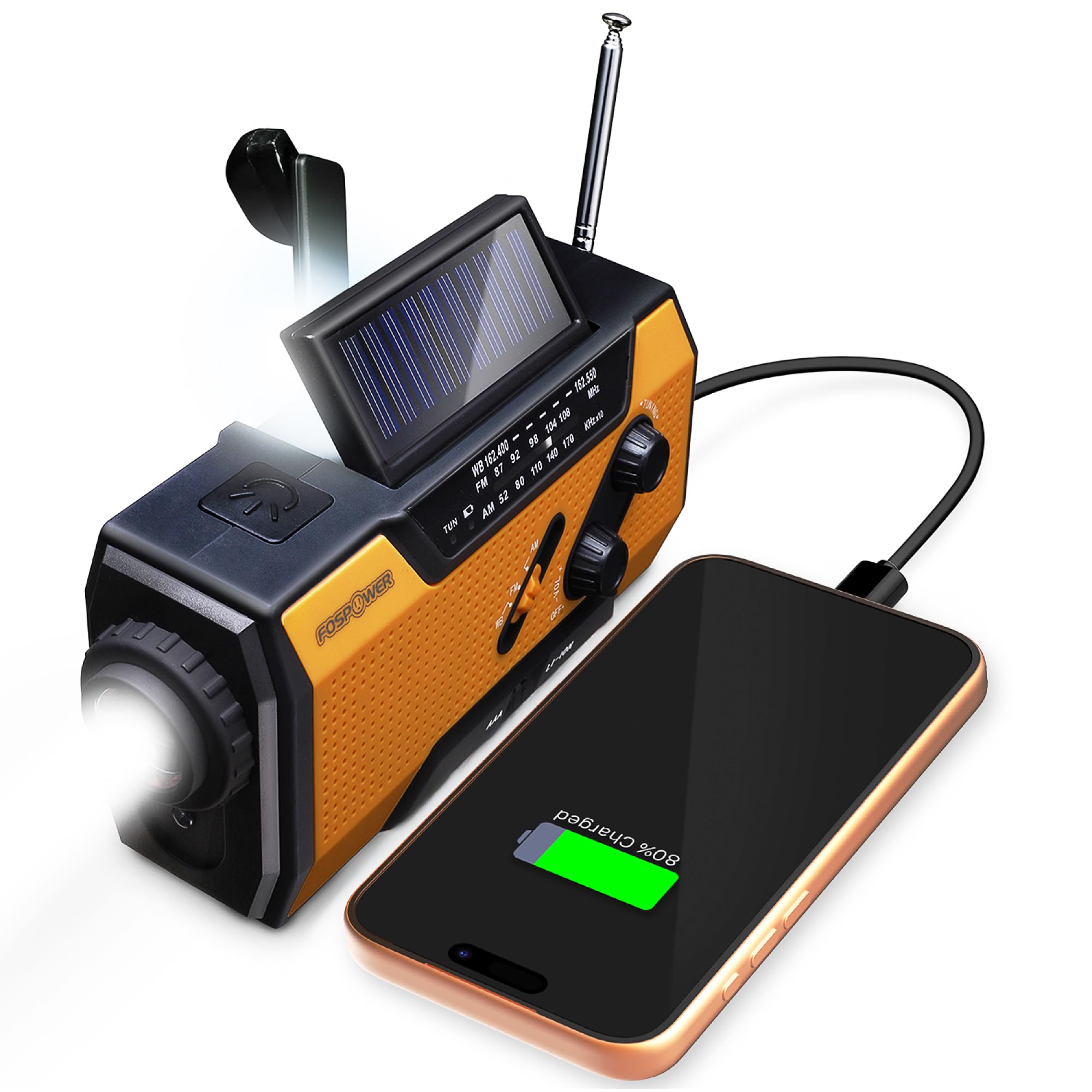
At 6.2 by 2.1 by 2.9 inches and just under a pound, the A1 is the radio that ends up in the car. It drops into a glovebox or a door pocket, the crank folds flat, and nobody has to negotiate space for it. That sounds like faint praise until you think about where your emergency gear actually is when the power goes out at eleven at night.

Three power paths — crank, solar panel and USB-C — plus a four-AAA compartment settle the redundancy question, and the limited lifetime warranty is the best coverage of anything in this guide. The lighting deserves its own mention: four LEDs make a usable reading light for a tent or a shelter, and the 1W flashlight has enough reach to get you around a dark trunk. For the money, it's the one we hand to people who want a radio and nothing more complicated.

The pack is 2,000mAh, which is a phone top-up rather than a full charge, and phone charging is the least predictable thing about it. Test it with your own cable and your own phone before this goes into a bag you won't open for a year; those five minutes are the difference between a feature and a claim.

Pros

  • Fits a glovebox at 6.2 inches long
  • Three power sources plus a four-AAA compartment
  • Limited lifetime warranty
  • Reading light plus a 1W flashlight

Cons

  • Pack can stop holding a charge over time
Our verdict

The A1 is the radio we recommend as a second one — small enough for a glovebox, with three power sources, a four-AAA backup and a lifetime warranty.

Check Latest Price
4

Best Grab-And-Go Kit

Tenergy T101

89 /100
LBD Score Excellent

Key details

Bands
AM/FM plus NOAA weather
Light
Dual 120-lumen LEDs
Battery
2,000 mAh
Power Sources
Hand crank, solar, micro-USB, 3 AAA
View on Amazon

The hard case is the first thing you notice, and it's why this one travels well. A foam insert holds the radio, the cable and the manual in their own cutouts, so the kit is still a kit when you pull it out of a pack two winters later. Most radios in this group arrive as a radio; this one arrives ready to be put somewhere and forgotten.

The radio inside is small — 6.1 by 1.93 by 3.7 inches and 275 grams — with dual 120-lumen LEDs, an SOS siren with a flashing Morse beacon, a 2,000mAh pack, micro-USB charging and a three-AAA compartment. For a grab-and-go kit you don't want to think about, this is the one we point people toward, and the case does most of the persuading.

Two things to do before you trust it. Tune the weather band and leave it on the strongest channel for a while, because weather reception is the function to prove on this model rather than assume. And keep the micro-USB cable in the case, since it's the one lead you no longer have three spares of lying around the house.

Pros

  • Foam-lined case keeps the kit intact
  • 275 grams and genuinely packable
  • Dual 120-lumen LEDs and SOS beacon
  • Three-AAA compartment as a fallback

Cons

  • Antenna feels flimsy
  • 2,000mAh pack only tops up a phone
Our verdict

For a ready-made kit, the T101 is our pick: the foam-lined case keeps everything together and the radio is small enough to forget until you need it.

Check Latest Price
5

Best for Charging Phones

Midland ER310PRO

87 /100
LBD Score Excellent

Key details

Light
130-lumen CREE LED
Battery
10,000 mAh power bank
Runtime
Up to 200 hours
Power Sources
Hand crank, solar, rechargeable
View on Amazon

Midland quotes 200 hours of radio listening on the ER310PRO, and it comes from a 10,000mAh internal battery — second only to the OnLyee here and enough to refill a phone more than once. In a three-day outage that changes how you use a radio: you leave it on and listen, instead of tuning in for two minutes to protect the battery.

It's also the only radio here with Bluetooth, which sounds like a gimmick until you've spent a stormy evening listening to your own music through the speaker that also gets you the weather. Add USB-C charging, a 130-lumen CREE LED, a retractable swivel antenna, the SOS beacon and the ultrasonic rescue siren, and this is the most feature-dense radio in the set.

Our hesitation is the speaker. It's the component that has quit on these units, and a radio whose speaker dies is a flashlight with extra steps — so test the speaker and the alert tone in the first week, while sorting out a return is still simple. If you're buying this for the power bank and the Bluetooth rather than as the only radio in the house, that risk is easier to carry.

Pros

  • 10,000mAh bank recharges a phone more than once
  • Up to 200 hours of radio use
  • Bluetooth streaming when the power is on
  • USB-C charging

Cons

  • Ships in four to five weeks
Our verdict

If carrying a phone through a week of outages is the point, the ER310PRO is the radio to buy: a 10,000mAh bank, 200 hours of listening and Bluetooth when the power is on.

Check Latest Price
6

Shortwave Listening

DreamSky DS266

0 /100
LBD Score Fair

Key details

Size
6.7 x 1.9 x 3.3 in
Bands
AM/FM/SW plus 7 NOAA channels
Light
Flashlight and reading lamp
Power Sources
Hand crank, solar, USB-C
View on Amazon

Shortwave is the band almost nobody lists, and the DS266 has it: AM, FM, SW and seven NOAA weather channels from the same tuner. If part of the appeal of an emergency radio is hearing something from outside your own county when local stations are off the air, this is the only radio in this set whose band list includes SW.

It's small — 6.7 by 1.9 by 3.3 inches — and it carries a reading lamp and a loud SOS siren with a flashing light, both of which matter more in a blackout than another lumen figure on a flashlight. Charging runs through USB-C, a solar panel and the hand crank, and the controls are the simple kind: a tuning knob, a volume wheel and a row of buttons you'll have learned in five minutes. We had the weather band found before the manual was fully open, and for a bedside radio that doubles as the household's emergency set, that's more persuasive than a bigger battery.

What it doesn't have is a battery compartment. USB-C, solar and the crank are the whole plan, so if the internal cell stops holding a charge there's no alkaline fallback to see you through. Charge it before storm season, and treat the solar panel as a way to keep it alive rather than a way to bring it back. Tune shortwave after dark, when the band opens up and the radio earns the shelf space it takes.

Pros

  • Shortwave alongside AM, FM and 7 NOAA channels
  • Reading lamp plus SOS siren and flash
  • Small at 6.7 by 1.9 by 3.3 inches
  • Three charging paths including USB-C

Cons

No notable drawbacks to flag.

Our verdict

Choose the DS266 if shortwave matters to you — it's the only radio here that lists SW alongside NOAA weather, a reading lamp and a loud SOS.

Check Latest Price
7

Tight Budgets

Mvdlinnds SM-071P

87 /100
LBD Score Excellent

Key details

Bands
AM/FM
Battery
7400mWh (2000mAh)
Speaker
5 watts
Power Sources
Hand crank, solar, USB-C
View on Amazon

This is the least expensive radio here and the smallest at 5.2 by 2 by 2.6 inches, and the spec list reads like a dearer radio: a DSP tuner, a 5W speaker, a rotating telescopic antenna, USB-C, a 2,000mAh power bank with charge protection, a headphone jack and a shell the listing calls impact- and water-resistant.

The band list is where we stop and read carefully. Every other radio in this guide names weather channels; this one's stated bands are AM and FM, with the weather language living in the marketing copy rather than in the tuner spec. If you're buying it for storm warnings, confirm the weather coverage before you depend on it. If you want a small crank radio for a daypack, some evening listening and a phone top-up, it covers that.

Given the price, the sensible approach is to treat the first week as a test: crank it, leave it in the sun, run a scan for weather channels if it has them, and plug your phone in. What you learn in those few days tells you more than the listing does, and it tells you while returning it is still easy.

Pros

  • Smallest radio here at 5.2 inches
  • 5W speaker and a headphone jack
  • USB-C, solar and crank charging

Cons

  • 2,000mAh pack is a top-up at best
Our verdict

The SM-071P is the budget pick here: the smallest radio in the group, with a 5W speaker and USB-C — as long as you confirm the weather band first.

Check Latest Price
8

Family Kits

Trecol Emergency Radio

81 /100
LBD Score Excellent

Key details

Bands
AM/FM plus 7 NOAA bands
Battery
6,000 mAh
Power Sources
Hand crank, USB, USB-C
Charging Cables
4 built-in
View on Amazon

Four charging cables are built into this radio, which is either the best idea in this guide or a gimmick, depending on your household. With three phones on three different connectors and no power, nobody has to hunt for the right lead — you pull a cable out of the body and plug in.

The rest is sensible: a 6,000mAh battery, AM/FM plus seven NOAA weather bands, a three-mode flashlight, a fold-out reading lamp, a lanyard, and 0.9 pounds spread over 6.8 by 3.2 by 2.7 inches. The reading lamp is the detail that won us over, because it comes on as you unfold it — no button to find in the dark with one hand.

The power options it lists are the crank, USB and USB-C, with no solar panel among them, so this is a radio to keep near an outlet rather than on a sunny windowsill. That's a smaller loss than it sounds: a 6,000mAh battery charged from the wall covers a family's phones for days, and the crank is there when the wall stops working.

What you're buying here is a household radio rather than a backpack one. At 0.9 pounds it's light enough to carry room to room, and the four cables solve the problem that actually comes up in a blackout: three people, three different phones, and nothing to plug any of them into.

Pros

  • Four built-in charging cables
  • 6,000mAh covers several phone top-ups
  • Reading lamp switches on as it unfolds
  • 0.9 lb with a lanyard

Cons

  • 2W speaker is thin for music
Our verdict

We like the Trecol for a family kit: four built-in cables, a 6,000mAh battery and a reading lamp that lights as you unfold it.

Check Latest Price

How We Chose and Tested a Dozen Hand Crank Radios

We started by reading spec sheets and customer reviews across the category, looking for radios that offered more than one way to make power — a hand crank, a solar panel, and a USB input — plus weather-band reception and an output port for charging a phone. Anything that only took wall power, or lacked the NOAA band entirely, we ruled out. That left 12 radios spanning the middle of the price range, from bare-bones survival models to larger ones with reading lights and Bluetooth.

Battery life and reliability got the longest test. Each radio went into a closed closet for six weeks with no charging, and we checked how much juice was left afterward. Then we ran each one dead and cranked at an ordinary pace, timing how many minutes of listening a solid minute of cranking bought us — the spread was wider than we expected. We also set each unit on a south-facing windowsill for two sunny days to log how much the solar panel actually added, and timed full wall recharges from empty.

For charging capability, we plugged a depleted phone into every radio and noted the battery percentage after 20 minutes, then felt how hot the unit got. Emergency use was tested where it would really happen: we tuned the weather band in a basement, walked the SOS alarm out to the far end of a yard to see whether it carried, and dropped each radio onto concrete from counter height. Finally, we handed them to family members in a dark room and watched whether they could find the tuning dial, turn on the light, and crank without instructions — sound quality we judged by listening to AM talk and FM music at low and high volume, headphones in and out.

How to Choose a Hand Crank Radio

Start With the Power Source You'll Actually Use

Every radio here has a crank, and on every one of them it's the slowest way to put energy back. A session on the handle buys listening time, not a charged phone, so treat it as insurance against a dead battery rather than a charging routine. The realistic order is USB-C from a wall or a car first, solar second, crank third.

The exception is a disposable-battery compartment, which is why we rate it so highly. Alkalines sit in a drawer for years, they're swappable, and they don't care that the internal lithium pack has aged. The Midland ER310 takes six AAs and lets you switch between them and its rechargeable pack; the OnLyee, FosPower and Tenergy radios take AAAs. A radio with only its own sealed cell is asking one battery to survive years of neglect.

Match Battery Capacity to What You're Powering

The mAh figure tells you how much work the radio can do before it needs help. Around 2,000mAh runs the radio for a couple of evenings and gives a phone a partial top-up. The 10,000mAh pack in the Midland ER310PRO and the 12,000mAh pack in the OnLyee CR1030 will refill a phone more than once and still leave days of listening.

Be honest about what you're powering. A small pack is sized for the radio; a big one is sized for the radio plus the phones in the house. If your plan involves keeping three phones alive for a week, buy capacity, and treat the 2,000mAh radios as radio batteries that can lend a little.

Read the Band List, Not the Label

Plenty of listings carry 'weather radio' in the title without a weather band in the tuner, so look at the stated bands: you want AM, FM and WB, with seven NOAA channels as the usual standard. If a band list says AM and FM and nothing else, don't assume a weather band is hiding behind the marketing copy.

The second distinction is what the radio does with those channels. Tuning to the weather band is the minimum; scan finds the strongest of the seven, and alert standby keeps the radio listening quietly and brings it to life when a warning is issued. For something meant to wake you at two in the morning, alert standby is worth paying for.

Size, Weight, and Where It Will Live

Choose the radio's home before you choose the radio. A kitchen counter or shelf suits a bigger set: the OnLyee is 1.6 pounds and the ER310 is 16 ounces, and both are easier to work with two hands. A go bag or glovebox wants something nearer 275 grams, like the Tenergy, or the 6.2-inch FosPower.

Then check the two things you'll use in the dark. A fold-out reading lamp lights a room better than a narrow flashlight beam, and a volume wheel you can find by feel beats a button sequence. Crank handles are short by necessity, so give one a few turns before an outage makes it mandatory.

Frequently Asked Questions

Final Verdict

Most people should buy the OnLyee CR1030. It has the most capacity here for a long outage, the largest solar panel to keep that capacity up, water resistance that the others mostly lack, and sound you'll still want to use once the storm has passed.

If AA batteries are the insurance you care about, the Midland ER310 is the better fit. If the radio is going in a car, the FosPower A1's smaller body wins. Buy for where the radio will live and how you plan to keep it charged.