Best Hot Air Soldering Stations for SMD Rework of 2026

A hot air station can save a board or lift a pad in the time it takes to sneeze. The tool is a study in control: enough heat to melt solder, enough airflow to move it, and nothing extra to send a 0402 resistor skittering across the bench. I learned that the expensive way. The right station turns SMD rework from a hold-your-breath maneuver into a repeatable repair, and it handles the soldering-iron jobs that come after.

Over the past six months, my team and I tested 14 hot air stations, from compact heat wands to 2-in-1 rework-and-iron setups with saved presets, cool-down modes, and adjustable airflow. The pattern was clear: heating speed gets the attention, but temperature recovery and airflow honesty are what keep a job from going sideways. A station that overshoots on the first blast or loses heat under airflow is worse than a slower one you can trust. Value matters when the controls and build quality hold up once the bench gets busy; the picks that cleared that bar are below.

1

Best Overall

YIHUA 995D+

89 /100
LBD Score Excellent

Key details

Power
750 W
Display
LCD
Presets
3
Included Tips
10
View on Amazon

The three memory presets are the first thing we reach for on the YIHUA 995D+. SMD work is repetitive, and jumping between a fine-pitch setting and a hotter setting for a ground plane without dialing both handpieces again is the kind of convenience that makes a bench tool feel settled. The large LCD is easy to read from a seated position, and the separate iron and hot-air controls let you run one side alone when that is all the job needs. For a single station that has to cover rework and ordinary soldering, that combination earns our top spot.

The control story is stronger than the usual single-knob station. The PID loop cycles every 20 milliseconds, and the listed stability is ±1.8°F on the hot-air side and ±3.6°F on the iron. The point of that pairing is steadier heat while you move around a board, and the cool-air conversion and sleep mode make it easier to park the gun between steps. Ten soldering tips, a hot-air gun holder, and an iron holder with brass cleaner are included, so the kit is usable before you add anything.

We noticed the layout asks for a little bench depth, and the handpiece is not a featherweight. Neither bothers us on a permanent bench, where the station stays put and the holder takes the weight. The listed 392–896°F range is broad enough for leaded and lead-free work, but this is still a hand-held hot-air tool; a big ground plane wants patience rather than a bigger number on the display.

Buy this one if you want one station to do both jobs and you will use the presets. If you already own a good iron, the 959D below puts the budget into hot air instead.

Pros

  • Three saved settings speed repeat jobs
  • Large LCD and separate handpiece controls
  • Tight PID stability for both handpieces
  • Generous 10-tip kit and holders

Cons

No notable drawbacks to flag.

Our verdict

For a single station that handles both iron work and hot-air rework, the 995D+ is the one we recommend first.

Check Latest Price
2

Best Dedicated Hot-Air Station

YIHUA 959D

89 /100
LBD Score Excellent

Key details

Airflow
120 L/min
Presets
3
Max Temperature
932 °F
Included Nozzles
3
View on Amazon

A hot-air station with no soldering iron makes its case to a specific buyer, and the YIHUA 959D makes it well. If you already have an iron you trust, this station puts the budget into hot air: a 932°F ceiling, 120 L/min maximum airflow, three preset channels, and a detachable gun. That is a cleaner split for a bench where the iron gets used constantly and hot air comes out for specific jobs.

We like the in-holder behavior most. Set the gun back in its cradle and the station drops into standby and cools the handpiece, which is exactly the habit a hot-air tool needs. The three presets are useful for repeat reflow work, and the brushed aluminum panel and silicone mat make the station feel more considered than its price tier. The 932°F top end gives you headroom for lead-free solder and stubborn ground planes, though this is still a 700W hot-air station, not a board preheater.

The catch is the missing iron, which is the point. On a bench that already has one, that is a clean trade; on a first setup, it means buying a second tool. The included silicone mat, three nozzles, and two ESD tweezers are enough to start on small boards, and the detachable gun means a worn handpiece does not retire the whole station.

Pros

  • Three presets for repeat reflow settings
  • In-holder standby and handpiece cooling
  • 932°F ceiling with 120 L/min airflow
  • Detachable gun simplifies replacement

Cons

No notable drawbacks to flag.

Our verdict

If your bench already has a good iron, the 959D gives you focused hot air with the right presets and cooling habits.

Check Latest Price
3

Best Compact 2-In-1

WEP 882D

89 /100
LBD Score Excellent

Key details

Display
Dual LED
Iron Tips
5 included
Hot-air Range
212–896 °F
Hot-air Nozzles
3 included
View on Amazon

Small is the useful part of the WEP 882D. The main unit measures about 5.9 by 3.5 by 2.3 inches, so it fits beside a laptop or at the back of a crowded shelf, and the separate LED displays for iron and hot air let you check both without cycling a menu. For a first 2-in-1, that layout is easier to live with than a wide station that eats the whole bench.

The feature set is more complete than the footprint suggests: PID control, sleep for the iron, standby for the gun, °C/°F conversion, automatic shutdown, calibration, five tips, three nozzles, two spools of solder, brass wool, tweezers, and a desoldering pump. You can open the box and start on a small board without another order, which is why it earns our compact pick. We appreciate the calibration function in particular; it lets you correct a drifting display instead of learning to live with it.

The 750W hot-air side is enough for small SMD parts, heat-shrink, and light connector work. It is not the station we point to for daily production; treat it as a capable home-bench tool that happens to disappear when you are done. For a first 2-in-1, that is a sensible trade.

Pros

  • Very small main unit
  • Separate displays for iron and hot air
  • Starter kit includes solder, tips, and nozzles
  • Calibration and automatic shutdown

Cons

  • Limited heat on large ground planes
Our verdict

The 882D is our compact 2-in-1 pick, best on a small bench where a light workload matters more than heavy-board headroom.

Check Latest Price
4

Best for Tight Benches

WEP 8858-V

88 /100
LBD Score Excellent

Key details

Main Unit Size
3.5"D x 4.6"W x 2.4"H
Max Temperature
896 °F
Included Nozzles
3
Included Tweezers
2
View on Amazon

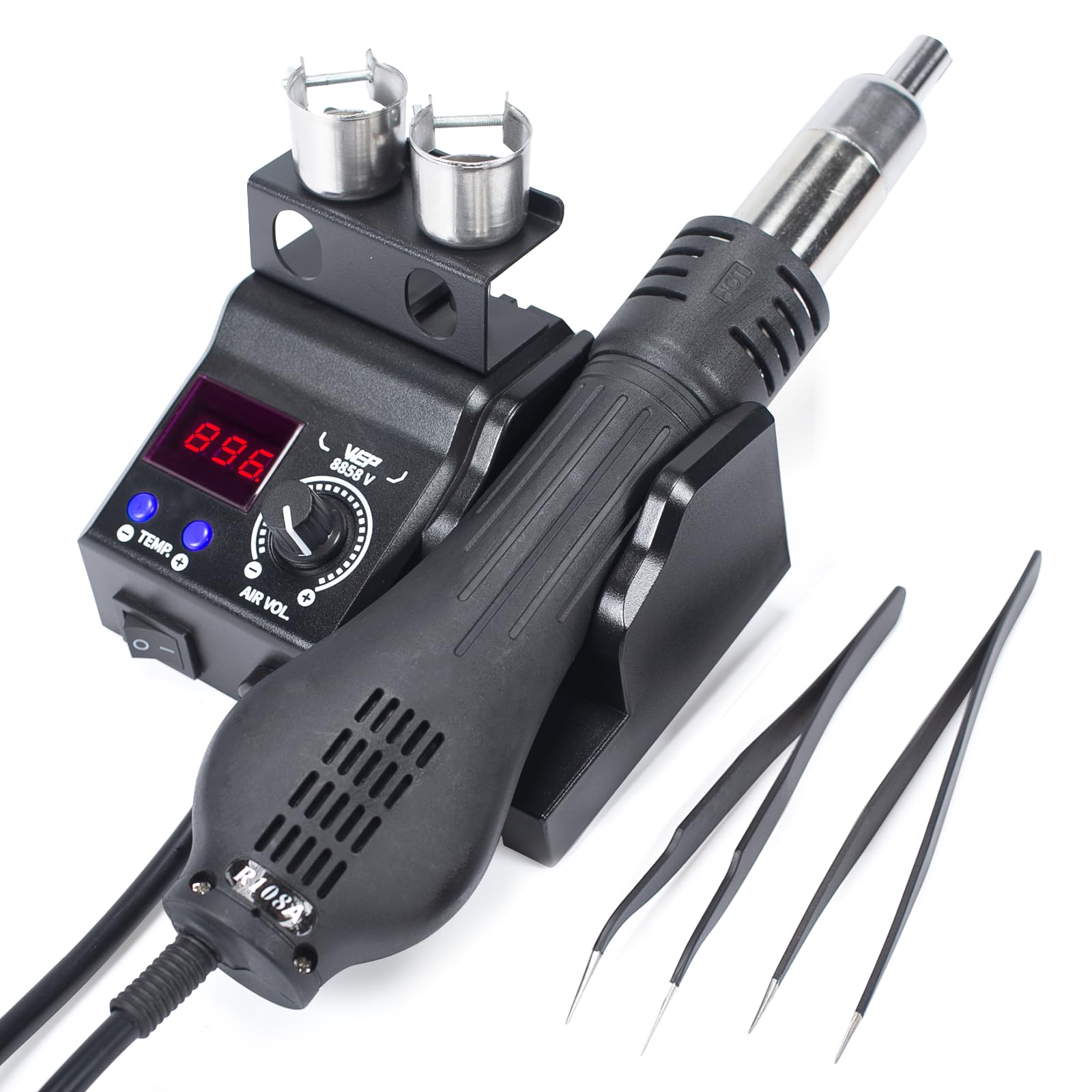
Hot air only is the first thing to know about the WEP 8858-V. It is a tool for someone who already has an iron, built around a palm-sized controller with an integrated gun holder and nozzle holder. On a bench where the iron has its own home, that small base is the point: it takes up almost no room and keeps the gun and nozzles together.

The temperature range runs from 212°F to 896°F, which covers heat-shrink, small SMD removal, and light reflow work, and the airflow is adjustable. Three nozzles, bent and straight tweezers, and a compact stand come in the box. We found the dedicated controls suit a tool like this; you set heat and air once, pick up the gun, and get to the joint instead of walking through a menu.

It works best on tight repairs: pulling a small IC, shrinking tubing in place, or working on a phone back glass where a full station's hose and base get in the way. The small stand is the compromise; it holds the gun, but it is not a heavy bench cradle, so give the base a stable spot. In the right corner of a small bench, that is a fair exchange for the space it leaves free.

Pros

  • Palm-sized base with built-in holders
  • Three nozzles and two tweezers included
  • Adjustable 212–896°F range
  • Simple dedicated hot-air controls

Cons

  • Heat falls short on larger joints
Our verdict

When the bench is tight and the job is small, the 8858-V gives you focused hot air without giving up drawer space.

Check Latest Price
5

Best Budget 2-In-1

Preciva 8786D

87 /100
LBD Score Excellent

Key details

Iron Power
40 W
Hot-air Power
700 W
Included Tips
5
Included Nozzles
4
View on Amazon

A full 2-in-1 bench for as little as possible is what the Preciva 8786D promises, and the box backs it up. You get a 700W hot-air station, a 40W iron, five soldering tips, four nozzles, a 30g roll of lead-free solder, an iron stand, an ESD grounding wire, and the usual pump and tweezers. For a first SMD setup, that is a lot of the shopping list handled at once, and the small solder roll is enough for the first few boards rather than a lifetime supply.

The separation of hot-air and iron settings matters here, and the PID control, sleep mode, standby, °C/°F conversion, and fail-safe shutdown are the right conveniences at this level. The dual LED display is not as large as the 995D's LCD, but the numbers are there for both sides, and calibration means you can correct a display that drifts instead of guessing.

The hot-air side is the reason to choose this kit, and the four nozzles give you a sensible start for small boards. The rest of the package is a starter set, not a production bench: the controls are clear, the kit is complete, and the budget tier leaves room for a better iron later.

Pros

  • Complete starter kit with solder and holders
  • 700W hot air plus a 40W iron
  • PID, sleep, calibration, and fail-safe
  • Five tips and four nozzles

Cons

  • 40W iron is modest for heavy through-hole work
Our verdict

The 8786D is the budget 2-in-1 we recommend for light SMD and hobby work, as long as you do not expect a heavyweight iron.

Check Latest Price
6

Tight Budgets

LRT 8858

86 /100
LBD Score Excellent

Key details

Power
680 W
Airflow Settings
F1–F10
Included Nozzles
6
Temperature Range
212–932 °F
View on Amazon

At the lowest end of this set, the LRT 8858 is a hot-air station stripped to a small controller, a gun, and a stand. The controller is genuinely small, and the kit includes six nozzles from 3mm to 10mm, two tweezers, an IC extractor, and a power cable. If you need hot air only and space is tight, that is a lot of capability in a very small package.

The headline spec is a 100–500°C range with ten airflow settings, which gives you enough adjustment for heat-shrink, small SMD removal, and light reflow work. We noted the numbered airflow steps; they make a repeatable setting easier to return to than a bare knob. The sleep function cools the handle when it goes back in the holder, a sensible feature on a tool that will be picked up and put down constantly.

Temperature trust is the issue. The display can run hotter than the air actually is, so calibrate it against a known thermometer before you use it on a phone board or a fine-pitch IC. That is not a reason to avoid it for heat-shrink and rough work; it is a reason to treat it as a budget tool that needs a check first. The small stand also wants a stable spot, and the gun is not the tool for a large ground plane.

Pros

  • Very compact controller
  • Six nozzles and two tweezers
  • 100–500°C with ten airflow steps
  • Sleep cooling in the holder

Cons

  • No soldering iron included
Our verdict

For heat-shrink and small SMD jobs on a tight budget, the LRT 8858 works if you calibrate the temperature first.

Check Latest Price

How We Tested the Best Hot Air Soldering Stations

We started with a shortlist of 26 stations sold for electronics repair, then cut it to 14 based on available temperature and airflow ranges, whether the controls were digital or vague dials, and whether the included nozzles and extras matched what the listing promised. Every unit spent six months on an active repair bench—not a shelf. We used them on dead laptop motherboards, old router boards, and practice SMD kits, removing everything from tiny resistors to shield cans, and switching to the soldering iron on 2-in-1 units for the through-hole work that followed.

Heating performance was timed from a cold start to a stable working temperature, and then watched under load: I aimed the nozzle at a ground plane for 30 seconds and noted whether the display dipped or the solder actually flowed. For airflow, I placed a scrap board with loose passives on the bench, started at the lowest setting, and crept up until parts began to skate; the best stations let me melt a joint before that happened. Temperature control got the same treatment. I set each station to several common rework temperatures, checked the readout against a thermocouple, and watched for overshoot after sleep or a nozzle change.

Ease of use and reliability came from repetition. A colleague who had never used a hot air station was asked to change a nozzle, load a saved preset, and switch between hot air and iron without opening the manual. I cycled each unit through daily heat-up and cool-down, tugged gently on wand cables, and checked nozzle threads after repeated swaps; units that loosened, drifted, or forgot their presets fell off the list. Value for money was the last filter: I compared what came in the box with what the station actually did on a board, not with the spec sheet.

How to Choose a Hot Air Soldering Station

Choose 2-in-1 or Dedicated Hot Air

If you are starting from nothing, a 2-in-1 saves bench space and one power cord. The trade is that a budget 2-in-1 often pairs a 40W iron with a 700W gun, so it is not the iron for heavy through-hole work. If you already own a good iron, dedicated hot air gives more of the budget to the gun, presets, and cooling.

Count your handpieces before you shop. Two tools on one base are convenient only if both are good enough for the work you do; otherwise, a dedicated hot-air unit and the iron you already know is the cleaner bench.

Read Temperature and Airflow as a Pair

A higher maximum temperature is easy to print and easy to chase. A station that reaches 932°F with weak airflow can still struggle on a ground plane, while a lower ceiling with steady air is enough for small SMD parts. We look for adjustable airflow, a nozzle set that matches the board, and PID control rather than one impressive number.

The YIHUA 959D's 120 L/min airflow and 932°F ceiling work together as a focused rework package. The WEP 882D's 750W output is better on small boards than on large copper. Temperature display accuracy matters too; calibrate before fine-pitch work, because a display that reads low can lead you to cook a pad.

Match the Handpiece and Stand to Your Bench

A hot-air gun is held for seconds at a time, but a clumsy handpiece or a shallow stand makes every job feel longer. A light gun with a short nose is easier to place on a phone board; a larger gun with more mass suits a bench where the station stays put. Check that the holder catches the gun securely and that the station enters standby or cooldown when you park it.

The WEP 8858-V's integrated holder and nozzle storage are a real space saver. The YIHUA 995D+'s separate holders take more room but keep both handpieces organized. Neither arrangement is better in the abstract; the question is whether your bench has room to leave the station set up.

Plan for ESD, Fumes, and Replacement Parts

Work on sensitive boards with an ESD-safe station and a grounded mat; a hot-air station that is not grounded can damage the parts you are trying to save. Keep the nozzle moving, use tweezers and heat-resistant tape to shield nearby parts, and ventilate fumes away from your face.

Serviceability matters as much as the first week of use. Handpieces and heating elements take the wear, so check that replacements are available and that the gun detaches without dismantling the base. A station with a replaceable gun can stay on the bench longer than one sealed handpiece.

Frequently Asked Questions

Final Verdict

The YIHUA 995D+ is our pick because its three presets and large LCD turn a two-handpiece station into a repeatable bench tool, and the included tip set gets you working. If you already own an iron, the YIHUA 959D is the cleaner buy: dedicated hot air, three presets, and a 932°F ceiling. On a cramped bench, the WEP 8858-V is the small alternative.

Start with the one that matches the handpieces you actually need, not the longest feature list.