Best microSD Cards of 2026

A microSD card is the cheapest part of a camera, phone, drone, or dash cam—and the one most likely to ruin the day if it quits. The label promises capacity and speed, but the card still has to format cleanly, keep up with 4K video, and survive being swapped between devices. We’ve spent three months rotating 16 microSD cards through action cameras, drones, phones, dash cams, and a handheld console, and the differences aren’t marketing. A good card gives you enough usable capacity, speed your device can use, and confidence that the last clip isn’t corrupted.

The trick is matching the card to the device, not buying the fastest label. A security camera cares more about reliable loop recording than a peak read rating; an action cam needs sustained write speed; a phone or handheld benefits from app-performance ratings. We also checked how each card formatted, how much capacity remained after formatting, whether it mounted cleanly in older and newer gear, and whether the cost per usable gigabyte held up. The picks below earned their place.

1

Best Overall

SanDisk Extreme 512GB

96 /100
LBD Score Outstanding

Key details

Capacity
512 GB
Durability
Temperature, water, and X-ray proof
Speed Class
U3, V30, A2
Read / Write Speed
Up to 190 MB/s read, 130 MB/s write
View on Amazon

Up to 130MB/s writes and a V30 rating are the numbers that put this card at the top of our list, and they matter far more than the 190MB/s read figure printed in larger type. Sustained write speed is what keeps a drone or an action camera recording 4K and 5K without the buffer stalling, and it is the first thing we check when a card is heading anywhere near video.

The 512GB capacity is the second reason. It is the biggest card in this roundup by a wide margin, which means fewer swaps in the field and fewer chances to lose a card at the bottom of a bag. The rest of the spec sheet aims at the same buyer: A2 app performance for handhelds, and water, temperature, and X-ray resistance for a card that spends its life in transit.

One caveat about the headline number. Reaching 190MB/s depends on SanDisk's QuickFlow technology and on pairing the card with one of the company's own readers, which is sold separately; a laptop's built-in SD slot will be noticeably slower. We don't mind, because the speed that decides whether footage records is the write speed, and that part needs no accessory.

Where this card is the wrong buy: a dash cam that overwrites yesterday's files doesn't need 512GB, and a phone will never use the headroom. Those jobs are better served by the PNY packs below. For anything that records something you would hate to lose, we have not found a reason to look past it.

Pros

  • Sustained V30/U3 writes for 4K and 5K
  • 512GB is the largest capacity here
  • Rated against water, temperature, and X-rays
  • A2 app performance for handhelds

Cons

  • The most expensive card in this roundup
Our verdict

The card we recommend first when the footage matters: sustained V30 writes, 512GB of room, and durability ratings that suit a bag that travels.

Check Latest Price
2

Best for Everyday Storage

SanDisk Ultra 128GB

95 /100
LBD Score Outstanding

Key details

Capacity
128 GB
Warranty
None stated
Read Speed
Up to 140 MB/s
Speed Class
C10, U1, A1
View on Amazon

A U1 rating is the whole story with this card, and it isn't a defect. It's a definition: the SanDisk Ultra is built to add storage to a device that already knows how to write its own files, not to sit behind a lens capturing them.

128GB and reads up to 140MB/s put it in the practical middle of this group — enough space that you stop thinking about space, quick enough that moving a folder of photos onto a laptop doesn't turn into an afternoon, and priced so a spare isn't a stretch. The A1 rating covers app data, and the Chromebook certification is the kind of detail nobody needs until the day a card won't mount.

We reach for it for the boring jobs: a handheld full of downloads, a phone that's out of room, a tablet used for streaming. It is the card we hand over without a second thought, and the one we've suggested most often to people who simply want more room than the device shipped with.

Pros

  • 128GB of storage at a low price
  • Fast reads for offloading files
  • A1 rating keeps app data responsive
  • Certified to work with Chromebooks

Cons

  • No warranty stated on the listing
Our verdict

Our pick for adding room rather than speed — a phone, tablet, or handheld card that costs little enough to buy a second one.

Check Latest Price
3

Best Value for Video

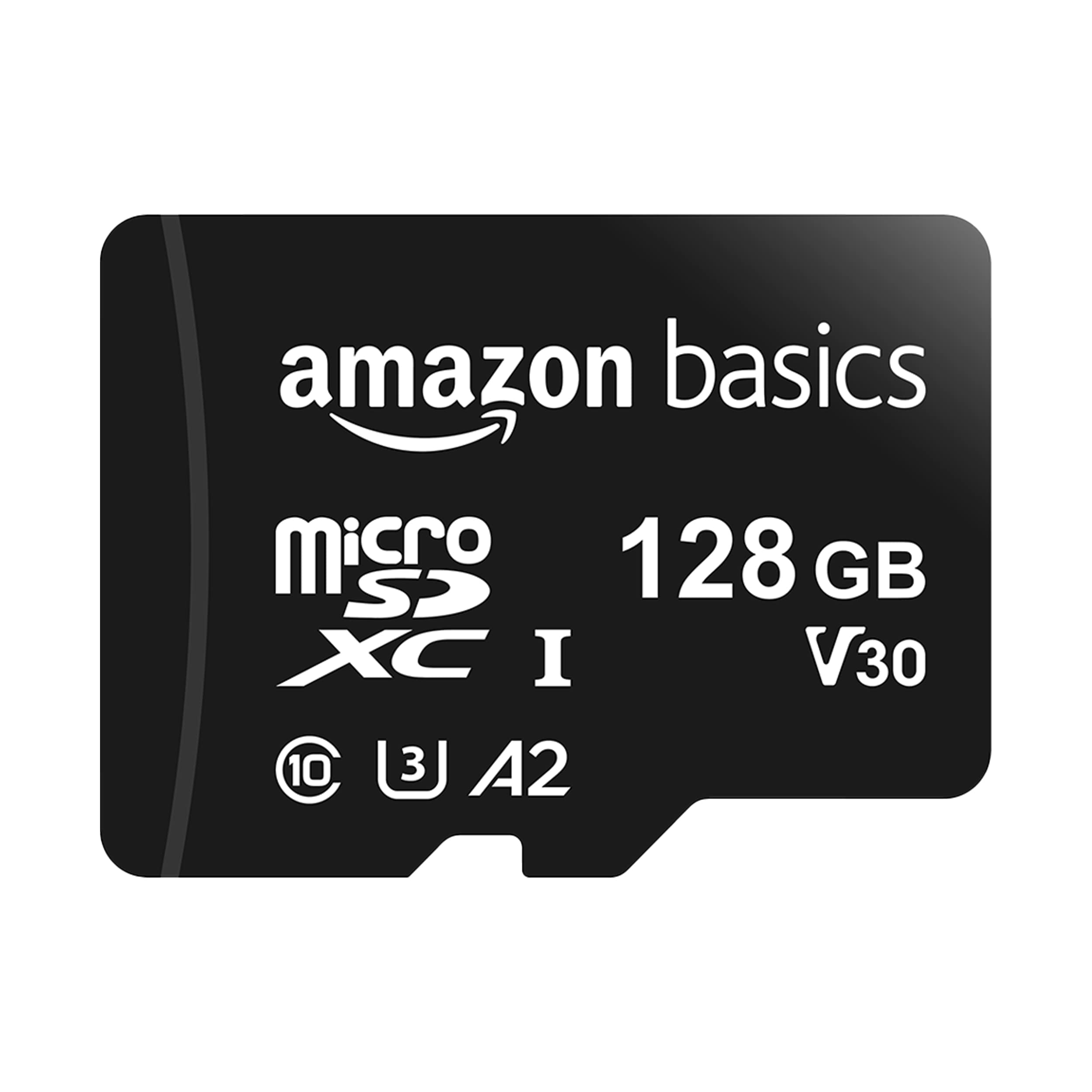
Amazon Basics 128GB

95 /100
LBD Score Outstanding

Key details

Capacity
128 GB
Speed Class
U3, V30, A2
Usable Capacity
At least 116 GB
Temperature Range
-10°C to +80°C
View on Amazon

Most memory card listings leave you to work out how much space you are really getting. Amazon prints it: a 128GB card delivers at least 116GB of usable capacity after formatting. That small piece of honesty says something about how the rest of the spec sheet was put together, and it is part of why this card ranks as high as it does.

The rest is a pleasant surprise. U3, V30, and A2 at this end of the market is more than we expect — V30 covers 4K recording, and A2 is a genuine step above the A1 cards here if you load games or apps straight off the card. Add IPX6 water resistance, a rated range of -10°C to +80°C, and X-ray and magnetic resistance, and it is better protected than the price suggests.

It is the card we point to for a Switch, a GoPro, or a phone that needs 128GB without a premium, and the one we hand to someone who wants a single do-most-things card and no further thinking. As with every card here, don't let it carry the only copy of anything.

Pros

  • Publishes its real usable capacity
  • A2 rating speeds up apps and game loads
  • V30 covers 4K recording
  • IPX6 and rated from -10°C to +80°C

Cons

  • Warranty runs only 12 months
Our verdict

We point people here when they want A2 speed and 4K-ready ratings without paying for the fastest card in the roundup.

Check Latest Price
4

Best Multi-Pack for 4K Devices

PNY Elite-X 64GB 3-Pack

93 /100
LBD Score Outstanding

Key details

Capacity
64 GB, 3-pack
Warranty
Lifetime limited
Read Speed
Up to 100 MB/s
Speed Class
U3, V30, A1
View on Amazon

Three cards in one pack answers a problem single cards don't: most of us have more than one device eating storage. One goes in the dash cam, one in the action camera, and one stays in the drawer as the spare you are glad of at the worst possible moment.

Each card is 64GB with U3 and V30 ratings, which puts write performance in the same league as our top pick, just with a fraction of the capacity. For 4K in a modest camera that is plenty. For a long shoot day it isn't, and that is the honest trade: three smaller cards are easier to keep organised than one big one, and a lost card costs you part of a shoot rather than all of it.

Lifetime limited warranty coverage on all three is the detail we appreciate most, because it runs against the disposable pricing this end of the market encourages. Each card also ships with an SD adapter for a DSLR or a laptop slot, so the pack keeps working outside microSD devices. If one dies, the warranty replaces the card and not the footage — so rotate them and keep the irreplaceable files elsewhere.

Pros

  • Three V30 cards cover several cameras at once
  • Lifetime limited warranty on each card
  • SD adapters included for DSLRs and laptops
  • 64GB is a comfortable size for 4K clips

Cons

  • A1 app rating rather than A2
Our verdict

Buy this three-pack if you have several cameras to feed: V30 writes in every card, plus a spare already sitting in the drawer.

Check Latest Price
5

Best Bulk Pack for Security Cameras

PNY Elite 32GB 5-Pack

95 /100
LBD Score Outstanding

Key details

Capacity
32 GB, 5-pack
Warranty
Limited lifetime
Read Speed
Up to 100 MB/s
Speed Class
C10, U1, V10
View on Amazon

The lowest cost per card in this roundup is the argument, and it is a strong one if you are feeding a house full of security cameras. Five cards here cost less than two of the 128GB singles, and for devices that record 1080p in loops, that is the right shape of purchase.

The spec is modest and appropriate: Class 10, U1, and V10 with reads up to 100MB/s, which is fine for the 1080p streams these devices produce. Every card ships with an SD adapter, so the same pack still works in an older point-and-shoot or a laptop slot, and lifetime limited warranty coverage is generous at this price.

Cards arrive dead sometimes, and one that formats in a laptop can still refuse to mount in a camera. That holds for every card on this page, not just this pack — but with five in a box, opening it is a small testing job.

Write a file to each card, read it back, and format it in the device it is going into rather than on a computer. The ones that will fail usually do it early, and finding that out at a desk beats finding it out three weeks into a recording schedule on a ladder. That routine is what makes buying five smarter than buying one: nothing goes into a camera untested, and there is always another card to swap in.

Pros

  • Lowest cost per card in this roundup
  • Five cards cover a fleet of cameras
  • SD adapters included
  • Lifetime limited warranty

Cons

  • 32GB and U1 rule it out for 4K recording
Our verdict

Our choice for a house full of security cameras — the lowest cost per card here, with a spare for every install.

Check Latest Price
6

Everyday Small Devices

Patriot LX 32GB

91 /100
LBD Score Outstanding

Key details

Capacity
32 GB
Durability
Magnet, shock, temperature, and water proof
Read Speed
Up to 80 MB/s
Speed Class
C10, U1, V10
View on Amazon

The oldest gadget in the house is usually the one that still needs a card, and this is the card for it: the handheld in a drawer, the budget dash cam, the point-and-shoot that takes a 32GB and nothing larger.

Class 10, U1, and V10 with reads up to 80MB/s is the most modest spec in this roundup. For Full HD recording and everyday files it is fine; for 4K it is not, and the rating says so plainly rather than leaving you to find out. Magnet, shock, temperature, and water resistance are all rated, which we like on a card more likely to live in a car or a bag than on a desk.

What earns it a place is proportion. When the device is worth less than the effort of shopping carefully, a card this inexpensive is the right amount to spend and a spare is affordable. What it is not for is anything you cannot afford to lose: 32GB fills quickly, and there is no second card in the box.

Pros

  • Lowest-priced card here
  • Rated against magnets, shock, water, and heat
  • Right size for older, capacity-capped devices

Cons

  • Slowest read speed in this roundup
Our verdict

A small, cheap card for the old devices nobody wants to spend on, and the one we keep coming back to for that job.

Check Latest Price
7

Older Fixed-Format Gear

KEXIN 32GB 3-Pack

91 /100
LBD Score Outstanding

Key details

Capacity
32 GB, 3-pack
Durability
Water, shock, magnetic, and temperature resistant
Speed Class
C10, U1
Default Format
FAT32
View on Amazon

These ship preformatted as FAT32, which reads like a footnote until you are standing in front of a dash cam, an older camera, or a 3D printer that won't acknowledge an exFAT card. If you have ever gone hunting for a formatting utility to make a brand-new card work, that default is the reason to consider this set.

Three 32GB cards, Class 10 and U1, rated for Full HD recording. This is a package aimed at devices that want small cards and predictable file systems rather than speed, and we use them exactly there: dash cams, printers, retro handhelds, older cameras, with the third card in a drawer. The limited warranty is a small comfort at the budget end of the market.

How they will be doing in three years is something no spec sheet can answer. What we can say is that three cards for less than one of the high-capacity cards here is the right shape of purchase for gear where a failure costs a reprint or a reshoot rather than a shoot. Buy them, label them, rotate them.

Pros

  • Preformatted FAT32 for older devices
  • Three cards in one pack
  • Rated water, shock, magnetic, and temperature resistant
  • Cheap enough to keep a spare on hand

Cons

  • U1 rating caps it at Full HD recording
Our verdict

Worth it for the FAT32 formatting alone if your gear is older, and three cards for this money is a low-risk way to find out.

Check Latest Price

How We Chose and Tested the MicroSD Cards

We started by building a shortlist from the cards shoppers actually cross-shop: well-known names and budget options alike, with a spread of capacities from 32GB to 512GB and a mix of speed and app-performance ratings. We filtered out listings whose claims didn’t line up with their class ratings, kept cards with common UHS-I compatibility and full-size adapters, and tracked cost per usable gigabyte so a cheap card with inflated claims didn’t get an easy pass. Brand didn’t earn a free pass, either; the final 16 cards over three months included familiar labels and smaller names.

Each card was formatted in at least three devices, then put to work where microSD cards actually live: an action camera and drone for high-bitrate video, a dash cam for loop recording, a security camera for continuous capture, a phone and handheld console for games and photos, and a laptop for file transfers through the adapter. We timed how long it took to copy a large folder of photos and video onto each card and back off again, and noted whether recording stuttered or stopped.

To check capacity and reliability, we filled cards past the halfway mark, reformatted them repeatedly, and kept a log of read/write errors, missing files, and cards that needed remounting. We also watched for durability in ordinary use—repeated insertion and removal, adapter swaps, a few inevitable drops—and whether the card still mounted cleanly afterward. The cards that rose to the top formatted without drama, held their advertised capacity after formatting, and kept recording when the cheaper cards started to hiccup.

How to Choose a Microsd Card

Read the write rating, not the big number

Nearly every card advertises its read speed in large type, because read speed is what you notice when you copy files. Recording depends on the write side, and the dependable way to judge it is the video speed class rather than the megabytes per second. V30 and U3 mark a card built for 4K; V10 and U1 are fine for Full HD and nothing more.

Our top pick pairs up to 130MB/s writes with a V30 rating, which is why we trust it in a camera body. The SanDisk Ultra stops at U1 — an excellent storage card and the wrong one for a 4K dash cam, whatever its read speed says.

Buy capacity your device can address

A card larger than your device's stated maximum is money wasted, and older cameras, dash cams, and handhelds often cap at 32GB. The formatted card always gives you less than the label too, which is why we appreciate that Amazon Basics publishes the usable figure: at least 116GB on a 128GB card. Look up the maximum in the manual before you buy big.

File systems matter as much as size on older gear. Some devices only read FAT32, which is why a preformatted card such as the KEXIN set saves a detour through a formatting utility before anything works.

One big card, or a pack of small ones

A single high-capacity card suits a device you carry and empty on a schedule: a mirrorless camera, a handheld console, a phone. A pack of smaller cards suits devices that run unattended. Five 32GB cards across a rack of security cameras means a failure costs one camera's worth of clips instead of everything, and rotating them spreads the load.

Plan for the devices that write every day

Security cameras and dash cams rewrite the same space continuously, which is the hardest life a microSD card can have. Size the card for how far back you want to look rather than for maximum capacity — 32GB in a looping camera holds days of clips, and that is usually the point. Buy cards you can afford to replace, and keep a spare per install.

Frequently Asked Questions

Final Verdict

If the card has to keep up with a camera, buy the SanDisk Extreme 512GB. It has the fastest sustained writes in this roundup, enough room that a trip no longer revolves around offloading, and the environmental ratings that suit a bag that travels.

For a phone, tablet, or handheld that just needs more room, the SanDisk Ultra 128GB does that job for far less and gives up nothing you will notice. And if you are outfitting a rack of security cameras, the PNY 32GB five-pack is the sensible purchase: the lowest cost per card here, and enough spares to keep every camera running.