Best Motion Sensor Light Switches of 2026

There's a specific juggling act that happens in a laundry room: a basket against one hip, a detergent bottle in the other hand, and a light switch that needs a finger you don't have. A motion sensor switch removes that annoyance, and it does the same for garage entries, basement stairs, and closets nobody remembers to close. What it won't fix is your wiring.

These switches fall into two wiring camps — those that need a neutral wire and those that don't — and the right one depends on what's already in your wall box. Some LED bulbs also draw so little current that a sensor never settles, so a switch that behaved with an old incandescent can flicker or drop out. We've spent five months living with 14 of them, and the wiring question decided more winners than any spec sheet did.

Sensitivity matters nearly as much: the right sensor catches you the moment you crack the door; the wrong one trips every time a cat crosses the hall. The picks below found that balance.

1

Best Overall

Lutron MS-OPS2-WH Motion Sensor Switch

93 /100
LBD Score Outstanding

Key details

Load
150W LED, 2A
Wiring
No neutral required
Bulb Types
LED, CFL, incandescent, halogen, low voltage
Compliance
Title 24, UL listed
View on Amazon

Most of the switches here ask you to check one thing before you order: is there a neutral wire in the wall box? The Lutron MS-OPS2-WH does not need one. It runs on the two wires already serving the light, works with LED, CFL, incandescent, halogen and low-voltage bulbs, and carries 150 watts of LED or 2 amps of load. That combination — no new wiring and no bulb restrictions — is why it is the switch we recommend first.

What keeps the light on is the sensing. Lutron's XCT technology is tuned to small movement, a hand on a towel bar or a page turning, so the light does not drop out while you are still in the room. That is the failure that makes people give up on motion switches, and it is the one we watched for. An optional daylight setting stops the switch firing when the room is already bright, and it is the kind of feature you set once and stop thinking about.

Programming takes a few presses on the switch face, and the settings — delay length and the daylight mode — read clearly once you have done one. Working down a hallway of these, the sequence stuck after the first switch and the rest took a couple of minutes each. The body is 2.4 ounces and shallow enough for a standard box, though one already packed with wire nuts takes a little folding.

Two things to know. The 150-watt LED ceiling is real: a garage with a row of high-output fixtures needs more headroom, and this is not the switch for it. And the sensor can be fooled — a sunny patch crossing the floor or a heat register in its line of sight can bring the light on in an empty room. Aim it away from both and it settles down. For a bathroom, closet, pantry or laundry room, this is the one we come back to.

Pros

  • Installs on existing two-wire boxes
  • Runs LED, CFL, incandescent and low-voltage bulbs
  • XCT sensing holds the light through small movement
  • Optional daylight sensor prevents needless activation

Cons

  • 150W LED ceiling limits larger fixtures
Our verdict

The switch we tell most people to buy: no neutral to hunt for, no bulb it refuses, and sensing that waits for real stillness instead of a pause.

Check Latest Price
2

Best Smart Wi-Fi

Kasa Smart KS200MP2 Motion Switch

89 /100
LBD Score Excellent

Key details

Load
600W incandescent, 300W CFL
Wiring
Neutral wire required
Network
2.4GHz Wi-Fi, no hub
Voice Control
Alexa, Google Assistant, SmartThings
View on Amazon

A motion sensor turns the light on when you walk in. The Kasa KS200MP2 also knows what time it is, which means schedules, an away mode that switches lights on and off to make an empty house look lived in, and voice control through Alexa, Google Assistant or SmartThings. It runs on 2.4GHz Wi-Fi with no hub, and it is the only switch here you can check from your phone.

We think it earns its spot for the tuning more than the tricks. Sensitivity, the delay before the light drops, and the daylight threshold are all set in the app rather than by counting presses on the wall, and that is the difference between adjusting a hallway sensor once and living with it forever. If you already run a smart home, this is the switch that fits the way you already work.

The wiring is the price of admission: a neutral wire is required, and the network is 2.4GHz only, which a mesh setup has to be told to provide. Load ratings are 600 watts incandescent or 300 watts CFL, and the two-year warranty is comfortably above average for this list. The motion adjustment itself is coarser than a dedicated sensor switch — you get sensitivity and a delay, not fine control — so if hands-free lighting is all you want, a plain PIR switch does it with less to go wrong.

Pros

  • Schedules, away mode and voice control built in
  • Sensitivity and delay tuned from the app
  • 600W incandescent or 300W CFL capacity

Cons

  • Needs a neutral wire and 2.4GHz Wi-Fi
  • Coarse motion sensitivity adjustment
Our verdict

Buy this one if you want the switch on a schedule and in your phone; the motion sensing is the bonus, not the main event.

Check Latest Price
3

Best for Tight Wall Boxes

Leviton DOS02-LW Motion Sensor Switch

90 /100
LBD Score Outstanding

Key details

Load
150W LED, 250W incandescent
Wiring
Neutral optional, ground required
Coverage
900 sq ft, 180°
Warranty
5 years limited
View on Amazon

Wall boxes fill up. Between the old switch's wire nuts, a couple of extra inches of sheathing and whatever the last person left behind, a sensor switch with a deep body can be genuinely hard to seat. The Leviton DOS02-LW is the slimmest switch in this guide at 1.38 by 1.73 by 4.13 inches, and that half inch of clearance is often the difference between a ten-minute swap and a frustrating one.

There is a catch in the wiring. It installs with or without a neutral, which is unusually flexible, but it does need a ground wire. If the box has bare copper in it, you can wire this either way; if it does not, the TOPGREENER TSOS5-HL or the RAYZEEK are the options instead.

Coverage is the strongest argument for it: 180 degrees and 900 square feet, enough for a basement or a long laundry room where a narrow sensor would only catch you at the doorway. We also like the vacancy setting, which makes the switch manual-on and automatic-off, the right choice for a closet or any room where a pet sets things off all day. Load ratings are modest at 150 watts of LED and 2 amps.

The five-year limited warranty is the longest of anything here, and Title 24 compliance matters if you are wiring in California. What holds it back is the paperwork: the instructions are thin, and the programming sequence takes a couple of readings before it clicks. Once it does, you will not touch it again.

Pros

  • Slim body fits crowded wall boxes
  • 180-degree sensor covers 900 square feet
  • Five-year limited warranty

Cons

  • Ground wire required
  • Programming instructions are thin
Our verdict

The one to want when the wall box is already stuffed, as long as there is a ground wire in it somewhere.

Check Latest Price
4

Best for Old Two-Wire Homes

TOPGREENER TSOS5-HL 4-Pack

84 /100
LBD Score Excellent

Key details

Load
150W LED, 200W incandescent
Pack
4-pack
Wiring
No neutral or ground required
Coverage
980 sq ft, 30 ft
View on Amazon

If your house was wired before grounds were standard, most of this list is closed to you: the switches either want a neutral, want a ground, or want both. The TOPGREENER TSOS5-HL is the exception. It asks for two wires, hot and load, and nothing else, which is exactly what a hallway in an older house or a garage on a legacy circuit has to offer.

The ratings are modest but honest: 200 watts incandescent or 150 watts of LED, a PIR sensor covering up to 980 square feet with roughly 30 feet of forward reach, and an ambient light sensor that learns your habits so the switch stops firing in a bright room. Four switches come in the box, which is enough for a hall, a closet, a pantry and the basement stairs.

Installation is genuinely quick. Two connections and a wall plate, no neutral to trace through the ceiling, and the plates come in the box. Spread across four locations that is an evening's work rather than a weekend's, and it is the sort of job that gets finished instead of abandoned halfway.

Two caveats, and they are why it is not higher. The delay steps run 15 seconds and then jump to five minutes, so a hallway where you want the light to linger for a minute and a half does not get that setting. And a switch that will not shut off at all is the failure worth watching for in the first week, while a return is still simple. If your box has a ground, the Lutron is the better switch; if it does not, this is the one that works.

Pros

  • No neutral or ground wire needed
  • 180-degree sensor covers 980 square feet
  • Four switches and wall plates in one box

Cons

  • No delay setting between 15 seconds and 5 minutes
Our verdict

For a house with no ground wire, this is the practical answer — four switches that need only the two conductors already in the box.

Check Latest Price
5

Best for Fans and Garages

TOPGREENER TSOS5-W 4-Pack

87 /100
LBD Score Excellent

Key details

Load
4A, 500W
Delay
15 sec, 10, 20, 30 min
Wiring
Neutral wire required
Coverage
707 sq ft, 180°
View on Amazon

The button on the face of the TSOS5-W is why we keep recommending it. Press it and the switch becomes ordinary — on until you turn it off — which is what you want while you are painting a room, working under a car, or in a bathroom long enough that no timer is going to cover it.

That override matters more than it sounds. A motion switch you cannot defeat is a switch you end up working around, and having the button costs nothing on the days you do not need it. The rest of the switch is solid: 4 amps and 500 watts, a 180-degree sensor covering about 707 square feet, and sensitivity adjustable from 30 to 100 percent, which lets you calm it down in a small room.

It also switches fans and small motors, which most of the switches here do not list. A bathroom exhaust fan on the same occupancy logic as the light is a small luxury — you walk out, and both go quiet a few minutes later. The 4-amp rating wants a neutral wire, so this is a modern-wiring product rather than a rescue for an old box.

The delay is the compromise: 15-second test mode, then 10, 20 or 30 minutes, with nothing in between. In a garage or utility room where you are in and out for a while, that is fine. In a pantry or a short hallway the light will either blink off early or burn long after you have gone, and the Lutron handles that better.

Pros

  • Front button overrides the sensor
  • Switches fans and small motors
  • Sensitivity adjustable from 30 to 100 percent
  • About 707 square feet of coverage

Cons

  • No delay setting between 15 seconds and 10 minutes
  • Needs a neutral wire
Our verdict

The pick for a garage or utility room where you sometimes stay put, because the front button lets you switch the sensor off.

Check Latest Price
6

Whole-House Packs

ELEGRP SP17OS 10-Pack

88 /100
LBD Score Excellent

Key details

Load
300W LED, 600W incandescent
Pack
10-pack
Finish
Matte white, frameless
Wiring
No neutral, ground required
View on Amazon

Ten switches, one box, and a matte frameless faceplate that looks better on a wall than the plain white plastic most of this list uses. If you are working through a whole house — every closet, laundry, pantry, hallway and basement stair — this is the arithmetic that makes a bulk buy make sense.

The wiring suits older boxes: no neutral required, though it does want a grounding wire to function, which is worth checking before you order ten of them. Load capacity is the most generous of the lighting-only switches here at 300 watts of LED or 600 watts incandescent, double what the Lutron and the Leviton will carry.

The sensor is where we push back. Detection is a fairly narrow cone in practice, and the switch wants to be mounted on the path you actually walk rather than around a corner from the doorway; where the box sits behind the door frame, you will be waving at it. In a closet or a pantry, where you stand in front of the panel anyway, it is fine.

Bought as a pack, the cost per switch undercuts everything else in this guide by a wide margin, and that changes what the sensor is worth putting up with. Use them where the switch is already on your route, and spend more on the two or three locations where the sensor has to be good.

Pros

  • Lowest cost per switch here
  • No neutral wire needed
  • 300W LED capacity
  • Matte frameless faceplate

Cons

  • Random switching and early failures on some units
Our verdict

Buy the pack if you are doing a whole house and can put each switch where you already walk; the sensor is not the part to rely on.

Check Latest Price
7

Trying One Room

RAYZEEK RZ020 Motion Switch

87 /100
LBD Score Excellent

Key details

Load
5A, 1/6 HP
Delay
15 sec to 30 min
Modes
Occupancy, vacancy, manual
Wiring
No neutral or ground required
View on Amazon

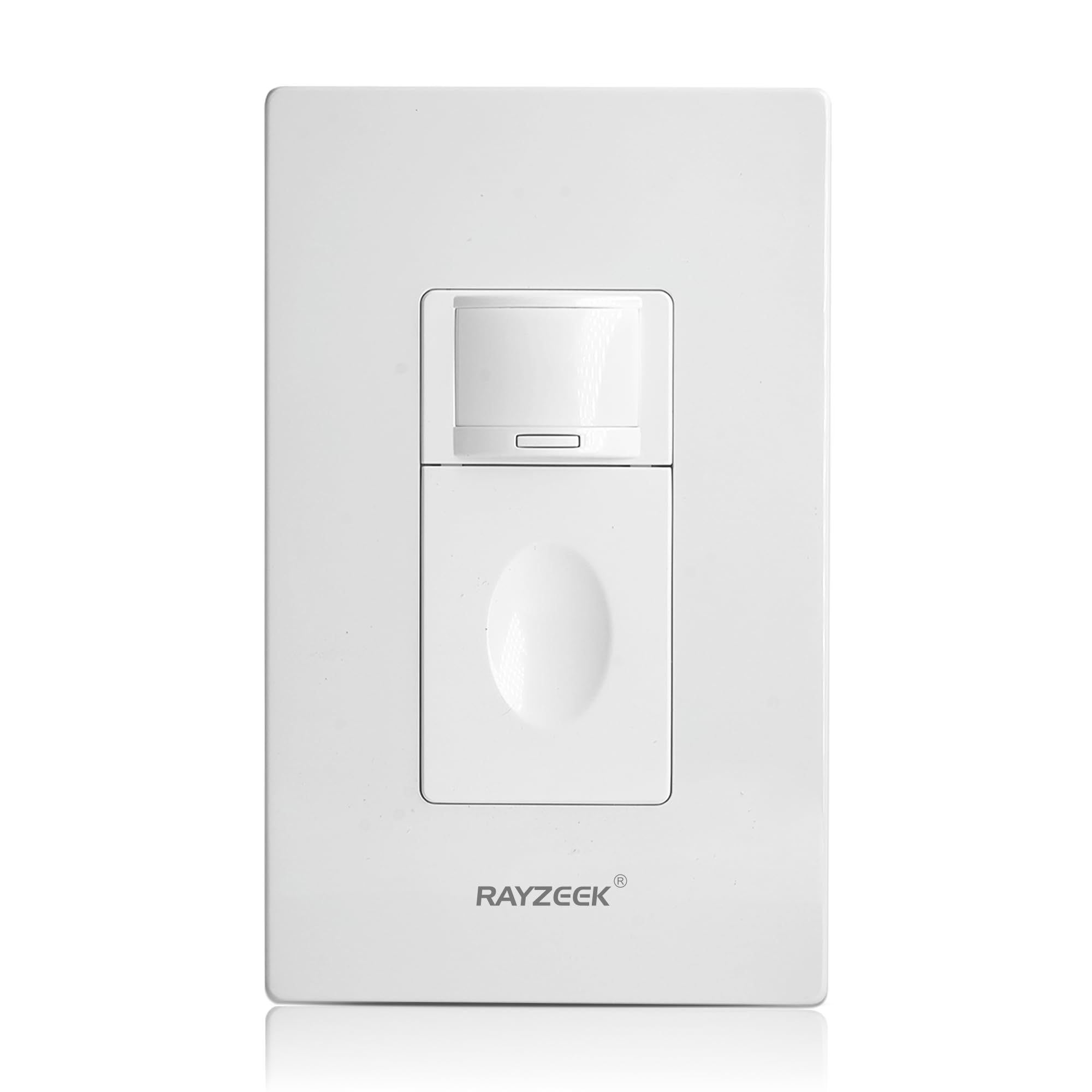
Two wires in the box and no ground is the situation the RZ020 is built for, and it handles it without a neutral, a ground, or a screwdriver — the delay, the lux threshold and the sensitivity are all set with presses on the front button. That combination, in a house where the wiring predates grounds, makes it the most useful inexpensive switch here.

The numbers hold up for a single switch: 5 amps and 1/6 horsepower, so it will carry a bathroom fan as well as a light, a delay range of 15 seconds to 30 minutes, and three modes — occupancy, vacancy and plain manual — so it can behave like an ordinary switch when you want it to.

The unknown is the long haul. This design is newer than the Lutron or the Leviton, so there is less to go on, and the sensible move is to treat the first month as the audition: if it misses you at the doorway or switches on in an empty room, return it while that is easy. What we can say is that installation is simple, movement across a room registers, and the daylight threshold does what it claims.

It is one switch per box, so it is the right buy when you want to try motion sensing in a single hallway before committing to a pack — and the wrong one if you already know you are doing six rooms, where the ELEGRP pack costs less per switch.

Pros

  • No neutral or ground wire needed
  • Settings changed from the front button
  • Delay runs 15 seconds to 30 minutes

Cons

  • Only sold as a single switch
Our verdict

A sensible first motion switch for a two-wire house: nothing to add to the box and nothing to program with a tool.

Check Latest Price
8

Fine Delay Tuning

DEWENWILS Motion Switch 2-Pack

79 /100
LBD Score Very Good

Key details

Load
5A, 1/4 HP
Delay
5 sec to 10 min
Wiring
Neutral wire required
Coverage
180°, 26 ft
View on Amazon

Most motion switches give you a menu — 15 seconds, one minute, five, ten, thirty. The DEWENWILS runs from five seconds to ten minutes, and that short end is the setting nobody advertises and everybody wants: long enough to carry a laundry basket through the door, short enough that the hallway is not lit for a quarter of an hour afterwards.

It needs a neutral wire, which puts it on the modern side of the wiring divide, and it is built for one job: single-pole indoor switching of lights and fans up to 5 amps or a quarter horsepower. The 180-degree sensor reaches about 26 feet, enough for a two-car garage, and there are occupancy and manual modes.

Two switches in the box, UL listed, with a straightforward setup and nothing extra to configure. That is not a criticism: a switch with fewer settings is a switch you finish setting up, and the ones you finish setting up are the ones that stay in the wall.

What gives us pause is how new this design is — there is less history behind it than behind the Lutron or the Leviton. But the five-second minimum is a real reason to buy: put one in the garage, where a slow light is the worst light, and you will know within a week whether the sensor reads you consistently.

Pros

  • Delay adjustable from 5 seconds to 10 minutes
  • 180-degree sensor reaches about 26 feet
  • Rated for fans up to 1/4 HP

Cons

  • Needs a neutral wire
  • No app or smart control
Our verdict

Worth it for the five-second minimum alone, which is the delay setting most of these switches cannot give you.

Check Latest Price

How We Tested Motion Sensor Light Switches

We started with a list of more than 40 switches from the major wiring-device brands and narrowed it using the things that decide whether one will work in your house: neutral wire required or not, UL listing, load rating for LED versus incandescent, single-pole only, and whether a wall plate came in the box. Since several are sold in multipacks, we compared cost per switch rather than per box. That left 14.

Each of the 14 went into at least two locations across three homes, one of them a 1950s house with two-wire boxes and no neutral at the switch. I timed every install from the moment the breaker went off, counted the trips back to the panel, and noted whether the box actually had a neutral bundle waiting inside. In the laundry room the test was whether the light came on with an armload of towels; in the garage it was whether it caught me coming through the side door with groceries; on the basement stairs, whether it lit the bottom step before my foot found it.

Then we lived with them for five months. We walked past at different speeds and angles, at night and in daylight, and logged every misfire — lights that snapped on when someone crossed the hall, lights that ignored a person standing still in a doorway, lights the household cat could trigger from two rooms away. We turned each sensitivity dial to both extremes and timed the delay-off with a stopwatch, holding still to see how long the light stayed on. We ran LED fixtures, low-wattage bulbs and CFLs through each switch and watched for flicker, hum and dropout, then pressed the override button to see how manual-on behavior felt in daily use and whether the switch recovered its settings after a power cut.

How to Choose a Motion Sensor Light Switch

Start with the wires in the box

Take the plate off and look. Two conductors plus a bare copper ground is a box that can take almost anything here. Two conductors and no ground at all narrows you to the TOPGREENER TSOS5-HL or the RAYZEEK, which need neither a neutral nor a ground. A white bundle capped off alongside the others means you have a neutral, and that is the only way the Kasa smart switch will power up.

The trap is the phrase no neutral required. It does not always mean no ground required — the ELEGRP and the Leviton both still want a ground, and a switch that is not grounded may not function. Read the wiring line twice before you order a pack.

Placement beats sensor specifications

A passive infrared sensor sees heat in a line of sight, so the square footage on the box is a best case: empty room, straight approach, nothing in the way. Mount the switch around a corner from the doorway and even a 980-square-foot sensor will miss you until you are almost on top of it.

Walk the route you actually take — into the laundry with a basket, down the basement stairs — and put the switch where your body crosses its cone first. Curtains, open doors and tall shelving all block it, and no setting fixes a bad location.

The minimum delay matters more than the maximum

Everyone checks the maximum. The number that decides whether you keep the feature switched on is the minimum: a switch that jumps from a 15-second test mode to ten minutes will leave a pantry lit long after you have gone. The DEWENWILS is the outlier here, adjustable from five seconds up to ten minutes; the Lutron and the TOPGREENER pair use fixed steps.

Then pick a mode. Occupancy means automatic on and automatic off. Vacancy means you press it and it turns itself off, which is the setting for a bedroom or a room where a pet keeps tripping the sensor.

Match the load, not just the bulb type

Every switch here is rated in watts per bulb type, and the LED number is the one that matters now. A 150-watt LED ceiling runs a typical closet or bathroom fixture and not much more; the ELEGRP's 300 watts is the most generous among the lighting-only switches we recommend.

Add up the wattage printed on the bulbs in the fixture, not the wattage of the bulb the fixture replaced, and leave headroom if two fixtures share the switch. A switch running at its ceiling is a switch that will misbehave.

Decide whether you want a smart switch at all

The Kasa adds schedules, away mode and voice control, and it is the right buy if you already run Alexa or Google at home. It also adds dependencies: a neutral wire, a 2.4GHz network, and an app that has to keep working for anything beyond plain motion.

If all you want is a light that comes on when you walk in, a PIR switch does that with two wires and no account. Buy the smart one for the room you want to check from somewhere else — the garage, the basement — and the simple one everywhere else.

Frequently Asked Questions

Final Verdict

The Lutron MS-OPS2-WH is the switch we point people to first. It goes into the wiring that is already there, it does not care what bulb you put on it, and its sensing is the most patient in this group — it waits for real stillness rather than a pause in the action. Nothing else here covers as many houses with as few caveats.

If your box has no ground wire at all, the TOPGREENER TSOS5-HL is the swap, delay gap and all. If you want the switch on a schedule and you have a neutral, the Kasa adds something none of the others can.