Best Phones for Kids of 2026

The night my nephew fished my phone out of my bag at a restaurant and started swiping, I understood why his parents keep a drawer of decoy devices. A toy phone has one job: be more interesting than the real one. Kids are ruthless about counterfeit, and a plastic brick with three buttons gets abandoned in ninety seconds — the right one buys you a calm wait for the check and a quiet hour in the backseat.

The category splits in two: pretend-play handsets with songs and buttons, and touchscreen models with working cameras, music, and learning games. Kids go straight for the camera; taking a picture of the dog and then looking back at it beats any alphabet song. We handed 16 of them to kids ages 2 to 9 over four months, on road trips and at restaurant tables, and the pattern held.

One thing to know before you buy: check whether the volume comes down. Most of these have a single loud setting and songs built to stick in your head. The picks below survived drops, sticky fingers, and sibling disputes, and they range from a few buttons to far more than you'd expect.

1

Best Overall

LeapFrog Chat and Count Emoji Phone

95 /100
LBD Score Outstanding

Key details

Weight
5.6 oz
Batteries
3 AAA (included)
Learning Focus
Counting 0 to 10, manners, music
Recommended Age
18 months to 5 years
View on Amazon

Press the seven and Scout says the number, then counts seven objects across the little screen. That's the argument for this one in a sentence: it takes what toddlers most want to do — mash a keypad and hold a slab to their ear — and quietly turns it into counting practice. Of the phones here, it's the one we can hand over with no explanation, because there's nothing a two-year-old can get wrong.

The build is honest about its audience. At 5.6 ounces it's light enough to carry one-handed, the buttons are large and lit, and the whole thing is molded plastic with a small screen set into the face — nothing that shatters when it's launched across a kitchen. Three AAA batteries come in the box, so it plays the moment the packaging comes off, and swapping them later costs a minute and no charger.

Two songs, a guessing game and a number-matching game give it a longer runway than the character phones. The first months are pure cause and effect; by three or four the matching game starts to make sense, and you've had two years out of one toy. Compare that with the Bluey or Gabby phones, which are built for a three-to-six window and depend on a child still caring about the show.

What it isn't is a screen to swipe or a camera to pose for. If your child already scrolls your camera roll with unnerving accuracy, they've outgrown this and one of the touchscreen picks is the better buy. Everyone else in that 18-month-to-five stretch gets a phone that grows with them rather than one they grow out of.

Pros

  • Turns button presses into counting practice
  • Plastic body with nothing glass to crack
  • Three AAA batteries included, ready out of the box
  • Games and songs that stretch from 18 months to five

Cons

  • Quiet speaker that struggles in a noisy room
Our verdict

It's the one we recommend first: it turns button-mashing into counting, takes a toddler's abuse, and stays interesting from 18 months to about five.
Check Latest Price
2

Best Volume Control

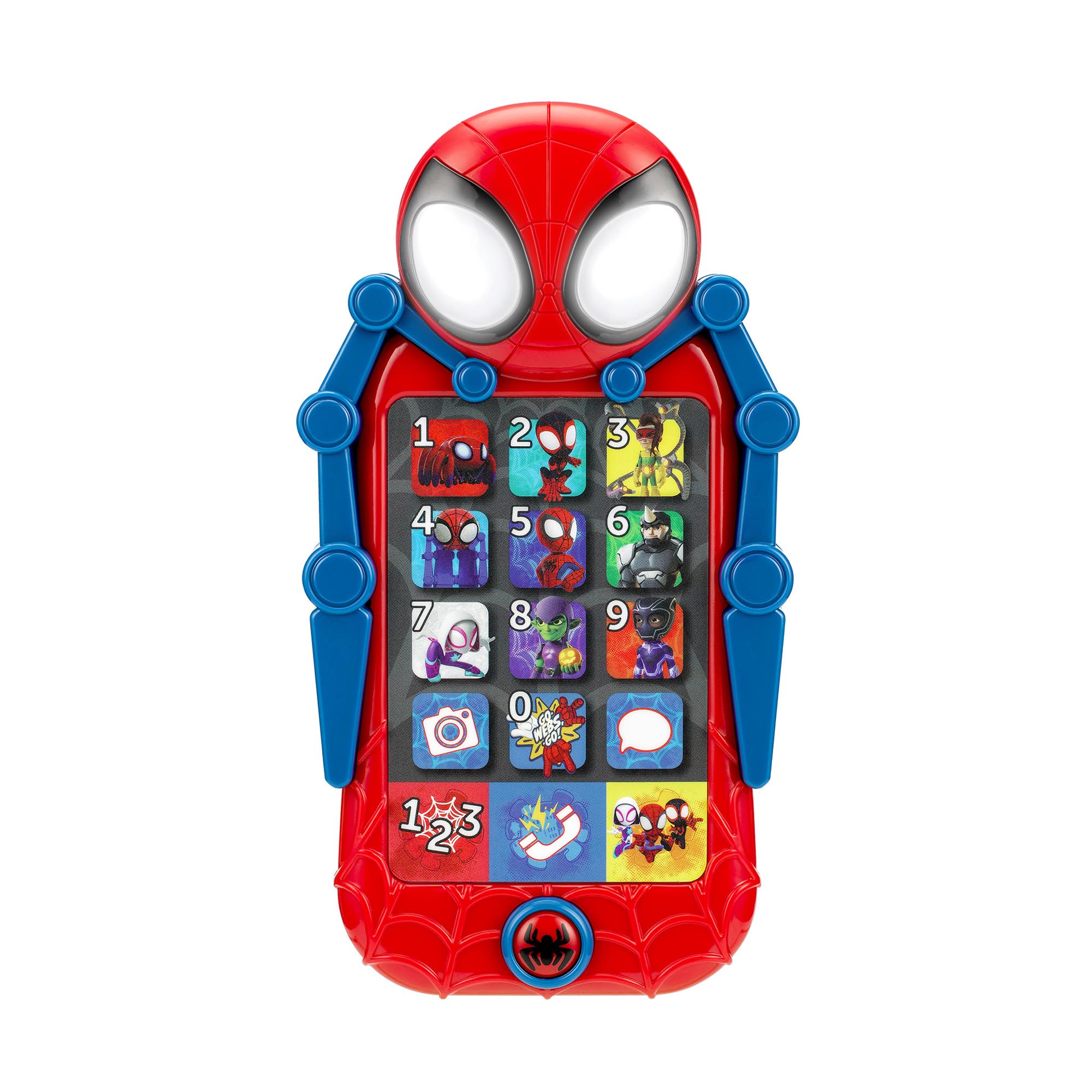
Spidey and His Amazing Friends Phone

94 /100
LBD Score Outstanding

Key details

Sounds
75+ songs and sound effects
Volume
Built-in adjustable control
Play Modes
Three
Recommended Age
3 years and up
View on Amazon

Toy phones are quiet. Small speakers, often mounted at the back, get muffled by a hand or a car seat, which is why so many of these vanish under road noise. The Spidey phone is the one here that deals with it directly, with volume controls built into the device — a small feature that decides whether the thing gets used on a drive or left in the door pocket.

Underneath the volume control it's a numbers toy, and a good one. Three play modes, more than 75 songs and sound effects, and counting and number games built around Spidey and his friends. The auto shut-off is the detail we appreciate most: it stops mid-song when it's abandoned on the floor, instead of serenading an empty room until somebody finds it.

Everything comes from one show, which is the trade. A child who doesn't know Spidey gets a counting phone with a spider on it; a child who does gets running commentary and won't put it down. At about 7 ounces with big, easy-press buttons and nothing protruding, it's also the one we're most relaxed about handing to a four-year-old.

Pros

  • Built-in adjustable volume
  • Auto shut-off when it's abandoned
  • 75+ songs and sound effects
  • Light body built to be dropped

Cons

  • No screen
Our verdict

Adjustable volume and an auto shut-off make this the phone we reach for on long drives, when everything else disappears under road noise.

Check Latest Price
3

Best for Bluey Fans

VTech Bluey Ring Ring Phone

95 /100
LBD Score Outstanding

Key details

Games
Four
Length
6.7 in
Recommended Age
3 to 6 years
Signature Feature
Voice-activated chat and reply
View on Amazon

Bluey and Bingo do the talking here, and for a preschooler who watches the show that's the whole pitch. Four games run through the characters — catch fruit with Bluey, blow bubbles, play music for Bingo, help her hold a handstand — and each comes with animation on the screen and phrases lifted straight from the episodes.

The mode that lifts it above a sound board is chat-and-reply. Your kid talks, the phone answers in character, and the exchange keeps going, which is the closest anything in this guide gets to an actual phone call. Games get abandoned; a pretend conversation doesn't.

What we like most is how much of a real phone it imitates without any of the parts that worry parents: two voice messages, a ringtone to change, a brightness setting to fiddle with. It's rated three to six, and that's honest — a five-year-old who has moved past Bluey will get a few weeks out of it, while a three-year-old who hasn't will carry it from room to room.

Pros

  • Voice-activated chat and reply
  • Four games with show phrases
  • Changeable ringtone and brightness

Cons

  • Rear speaker sounds muffled in a car seat
Our verdict

For a preschooler who already quotes the show, this is our pick: Bluey talks back, so a pretend call feels like a call.

Check Latest Price
4

Best Budget Pick

VTech Gabby's Dollhouse Phone

94 /100
LBD Score Outstanding

Key details

Games
Four mini games
Height
5.9 in
Batteries
3 AAA (demo set included)
Recommended Age
3 to 6 years
View on Amazon

This is the least expensive phone in the guide, and it doesn't feel like the cheap one. The shape is the point: it's molded like Gabby's phone from the show, complete with a meow mailbox button, and the four mini games — music with DJ Catnip, baking with Cakey Cat, hopscotch with Pandy Paws, a potion with MerCat — are short enough for a three-year-old to finish and immediately start again.

Size works in its favor: about 5.9 inches tall, 5.28 ounces, thick enough for a fist to hold and small enough for a coat pocket. It takes three AAA batteries and the set in the box is for demo only, so plan on fresh cells early. Nothing here is deep — a handful of games, some meow mail and a chat mode where Gabby answers. For a first phone, that's the right amount.

Pros

  • Least expensive phone in this guide
  • Four mini games a three-year-old can run alone
  • Small enough for a coat pocket

Cons

  • Demo batteries need replacing early
Our verdict

We point budget shoppers here — it's the least expensive phone in this guide, and the one kids run entirely on their own.

Check Latest Price
5

Best Touchscreen Pick

KOKODI Kids Smart Phone

91 /100
LBD Score Outstanding

Key details

Case
Full silicone wrap
Games
31 pre-installed
Screen
2.8-inch touchscreen
Cameras
Dual, front and rear
View on Amazon

Every touchscreen phone in this guide arrives with a case; this is the one where the case is the reason to buy. It's a full silicone wrap that covers the edge and the back, so the part that hits the floor is soft rather than plastic — and the floor is where these end up.

The 2.8-inch touchscreen carries 31 pre-installed games in three modes, and the dual camera locks onto faces and pets so a child can take a photo without hunting for a shutter button. Twenty-three stickers and a set of photo frames are what turn a camera into a habit; the games get a look, the photos get a following.

Setup is what a parent will care about: the games are loaded before it's switched on, so nothing has to be downloaded or configured before you hand it over. At 3.5 by 1.5 by 5.9 inches it's genuinely child-scale, and the icons are big enough that a four-year-old works the whole thing out without a tutorial.

So here's where we land: if the request is specifically for a phone like yours, and the child is four or older, this is the one to hand over. It takes pictures, it plays games, and it's the touchscreen here most likely to survive being owned by a preschooler.

Pros

  • Full silicone wrap for drop protection
  • Camera that locks onto faces and pets
  • 31 games pre-loaded before first power-on
  • Sized and simplified for a four-year-old

Cons

  • Battery life is the weak spot
Our verdict

Our favorite touchscreen of the group: a silicone-wrapped body, a camera that actually works, and 31 games that don't need a tutorial.

Check Latest Price
6

School-Ready 4 to 6

WEOLULI Kids Smart Phone Toy

92 /100
LBD Score Outstanding

Key details

Games
13 puzzle games
Camera
Dual cameras
Lessons
26 alphabet lessons, 10 storybooks, 24 landmarks, 5 daily activities
In The Box
8GB card, case, lanyard, charging cable
View on Amazon

Twenty-six alphabet lessons, ten storybook fables, 24 country landmarks and five daily activities are loaded before the phone is even switched on. That's a curriculum, and it's the reason this one is here: most of the touchscreen phones in this group are cameras with games attached, and this one leads with lessons.

Whether that's a feature or a chore depends entirely on the kid. A four-year-old who likes being quizzed will go back to the letters and the stories; one who wants to photograph the dog will ignore all of it and use the dual cameras and the 13 puzzle games, which are perfectly good. The habit recorder is the sleeper feature — a phone that reminds a five-year-old to brush her teeth does something a sticker chart can't. For a school-minded child this is the most interesting touchscreen in the set; for everyone else it's a camera phone with extra menus.

In the box you get a cartoon case, a lanyard and an 8GB card. The lanyard matters more than it sounds: a phone on a string doesn't end up under a car seat. It recharges over USB, so there's no battery habit to build, and the flashlight and timer are the two extras that get used away from the screen.

Pros

  • Alphabet, story and landmark lessons built in
  • 13 puzzle games plus an MP3 player
  • Case, lanyard and 8GB card included
  • Dual cameras for photos and video

Cons

  • Charging faults can end it early
Our verdict

Buy this one if you want lessons rather than games — the alphabet, stories and landmarks give it more to do than any other touchscreen here.

Check Latest Price
7

Dinosaur Fans

Luyiilo Kids Smart Phone

90 /100
LBD Score Outstanding

Key details

Case
Silicone shell
Games
16 learning games
Screen
2.8-inch touchscreen
Cameras
Dual cameras
View on Amazon

Most of the touchscreen phones in this guide arrive in pink with a unicorn on the case. This one is blue, with a dinosaur on the shell and a dinosaur theme throughout, and for the person doing the gift-buying that isn't a trivial difference — it's the reason this product has a place in the set.

Under the theme it's the same formula as its neighbors: a 2.8-inch touchscreen, 16 learning games, dual cameras, an 8GB card and a lanyard. The listing is unusually direct about what it isn't, too — no SIM card, no calling — which is the reassurance worth having before you hand a phone-shaped object to a seven-year-old.

It lands in the middle of the touchscreen group rather than at the top. The games and the camera do what they claim, the silicone shell takes a knock, and at 5.6 ounces the whole thing disappears into a coat pocket — but nothing here is done better than the KOKODI does it. The dinosaur is the reason to pick this one, and that's allowed to be enough.

The practical note is about the screen, because that's the part that fails on this class of toy. Buy it somewhere with a return window you're happy to use, and put it through a full day of play before the birthday rather than after — a dead screen turns the whole thing into a paperweight, and you want to discover that while it's still somebody else's problem.

Pros

  • Blue dinosaur theme stands out from the pink crowd
  • 16 learning games and dual cameras
  • Silicone shell takes knocks
  • 8GB card and lanyard included

Cons

  • Engages less consistently than the other touchscreen picks
Our verdict

The blue option: same camera-and-games formula as the other touchscreens, in a dinosaur shell for the kid who won't carry pink.

Check Latest Price
8

Babies and Toddlers

JOYIN Kids Learning Phone and Remote

93 /100
LBD Score Outstanding

Key details

Material
ABS plastic
Set Contents
Toy phone and TV remote
Recommended Age
6 months to 12 years
View on Amazon

The better half of this set is the remote. It has channel keys that imitate a real TV remote, animal sounds, calculator beeps and music, and it solves the actual problem in a house with a toddler: the real remote living on top of the fridge.

The phone is the simpler half — it lights up, plays music and sounds, and it's molded for a hand still working on gripping. Both pieces are ABS plastic with rounded edges, and the listed age range runs from six months to twelve years. In practice it's a six-months-to-three toy: a three-year-old will get more out of one of the character phones.

What it does better than anything else here is head off a fight. Hand over the phone and the remote together and the buttons your kid actually wanted — the ones that change the channel — are theirs, which is the whole reason this set exists.

So the case for it is narrow and clear. Buy it for a baby who is obsessed with the thing you keep on the coffee table, and expect to replace it with something that has a screen around the time they turn three.

Pros

  • Two pieces: toy phone and TV remote
  • Remote imitates channel keys and sounds
  • Suitable from six months

Cons

  • Phone runs much quieter than the remote
Our verdict

Best for a house where the TV remote lives on top of the fridge — you get two toys, and the remote is the one that matters.

Check Latest Price

How We Tested 16 Kid Phones With Kids Ages 2 to 9

We started by pulling every toy phone with a real customer base behind it, then cut anything that carried a choking-hazard warning above the age printed on the box, anything that needed an app or subscription to work, and anything priced so far above the rest that it stopped making sense as a knockaround toy. That left 16 handsets, from simple button-and-song models to touchscreen phones with dual cameras and learning games.

For four months those 16 lived where kid phones actually live: clipped to a car seat on the way to daycare, stuffed in a diaper bag, dropped on tile, and passed between siblings in the back of a grocery cart. I timed how long each one held attention before a kid moved on, and noted what brought them back — usually the camera, occasionally a song, rarely the games.

Sound got tested the unglamorous way: I held each phone at arm's length with a car radio on and listened for garbled prompts or a speaker that buzzed at the top of the range, then checked, usually in vain, for a volume control. Battery life was measured against a two-hour drive, the longest stretch most kids will sit with one of these. For reliability, I dropped each from counter height, wiped it with a damp cloth, and checked a month later whether the buttons still clicked and the screen had survived. Value came last: what each phone actually did, against what it cost.

How to Choose a Phone for a Kid

Match the phone to the age, not the character

An 18-month-old and a five-year-old want opposite things from a phone-shaped object. Under three it's cause and effect: press a button, hear a voice, watch something light up. That's why the chunky button phones start at 18 months (the LeapFrog) or six months (the JOYIN set), and why a touchscreen is wasted on that age. Between three and six, character and games take over — the Bluey and Gabby phones are built for exactly that window. From about four, a touchscreen with a camera starts earning its place, because the appeal shifts from "my phone" to "my photos."

Buy for the next twelve months rather than the next five years. A phone that's slightly too advanced gets ignored, and one that's slightly too simple gets used.

Listen for the speaker, not the song list

These phones are quiet, and the reason is usually physical: a small speaker, often mounted on the back, firing into a hand or a car seat. A rear speaker sounds muffled the moment a child holds the phone the way children hold phones, which is flat against a palm or wedged next to a hip.

The fix is adjustable volume, and it's rarer than it should be. The Spidey phone puts a volume control on the device itself; most of the others are fixed at whatever the factory chose. If the phone is going to live in a car seat or a stroller, that control is worth more than three extra games.

Decide between AAA cells and a charging cable

Button phones run on AAA batteries, and there's a lot to be said for that. A dead phone comes back in a minute, there's no cable to lose, and the toy never turns into a charging negotiation. The trade is ongoing cost, plus the demo cells that ship in the VTech boxes are partly used, so plan on fresh ones early.

Rechargeable touchscreen phones flip that. Nothing to buy, but the charging port is a moving part in the worst place, a flat battery ends play for an hour, and a phone that won't charge is a phone that's finished. Neither approach is better; pick the failure you can live with.

Test it on day one, wherever you can return it

Every electronic phone here is a small plastic device with a speaker, a battery and — on the touchscreen models — a screen a four-year-old will press hard. That's a set of parts that can arrive dead or fail in the first month, on any of these.

So buy from a retailer with a return window you'll actually use, put batteries in or charge it the day it arrives, and run every button and every game once before the birthday. On the touchscreen picks, make the case the first thing you check in the box — a full silicone wrap is the difference between a drop and a dead screen.

Frequently Asked Questions

Final Verdict

Start with the LeapFrog Chat and Count Emoji Phone. It covers the widest stretch of childhood here — 18 months to about five — and it turns the button-mashing phase into counting instead of just rewarding it with noise. It's also the pick that needs the least supervision, which matters more than any feature list when the toy is going to be dropped on a kitchen floor.

The exception is a child who already has a favorite show or wants a camera of their own. For them, the Bluey phone's chat-and-reply mode is the closest thing here to a real call, and the KOKODI is the touchscreen most likely to survive being owned by a four-year-old.