Best PLA+ Filament of 2026

The first functional part I printed in regular PLA was a bike helmet hook, and it snapped off the wall in the first cold week of October. PLA+ is what I switched to and never switched back from: same easy printing, no enclosure needed, but parts that flex before they give out. If you're printing brackets, clips, or anything that has to survive a bump, it solves the brittleness problem without dragging you into PETG tuning.

The catch is that PLA+ isn't a standard, it's a label — every manufacturer blends its own, so a profile that prints cleanly on one spool can string or under-extrude on the next. We ran 16 spools through our machines over four months, nearly all of them black so we were comparing like with like.

What separated the good ones wasn't color or a spec sheet — it was whether a spool fed through a 14-hour print without tangling, whether the diameter held steady from first meter to last, and whether the finished part survived a drop onto the shop floor. The ones that did are below.

1

Best Overall

SUNLU PLA+ 2.0

94 /100
LBD Score Outstanding

Key details

Spool Weight
2.2 lb
Max Print Speed
300 mm/s
Filament Diameter
1.75 mm
Dimensional Accuracy
±0.02 mm
View on Amazon

The 300 mm/s speed rating is the first thing that separates SUNLU's PLA+ 2.0 from the standard spools here, but the reason we make it our top pick is simpler: it has the best balance of printability and speed headroom in this set. The 1.75 mm diameter and ±0.02 mm tolerance are what you expect at this level; the 1 kg spool is easy to store and swap, and the black finish is consistent. We keep it as the default for everyday brackets, jigs, and draft parts because it prints cleanly at normal speeds and has more capacity when you want to push a faster profile.

The 2.0 formula is designed to be less brittle than standard PLA+, and that is the right trade for parts that get handled. It also doesn't demand a special profile: the listed diameter and tolerance are standard, so it slots into the same workflow as the rest of our PLA. We like that kind of compatibility—fewer variables when you're switching spools between printers.

Against the rest of the set, SUNLU is the all-rounder: ELEGOO's four-pack wins on bulk economics, OVERTURE on impact toughness, and Deeplee on entry cost. SUNLU sits in the middle and earns the spot with speed headroom and consistent printability. If you print mostly decorative models in one color, you can spend less; if you want one spool that handles functional parts and fast drafts, start here.

Pros

  • Prints cleanly at normal and fast speeds
  • ±0.02 mm dimensional accuracy
  • Less brittle than standard PLA+
  • 1 kg spool is easy to store

Cons

  • Winding can tangle on long prints
Our verdict

Our top pick for everyday printing, SUNLU PLA+ 2.0 combines 300 mm/s headroom with ±0.02 mm accuracy and enough toughness for brackets and jigs.
Check Latest Price
2

Best Bulk Value

ELEGOO PLA+ 4KG

92 /100
LBD Score Outstanding

Key details

Color
Black
Bundle
4 x 1 kg
Filament Diameter
1.75 mm
Dimensional Accuracy
±0.02 mm
View on Amazon

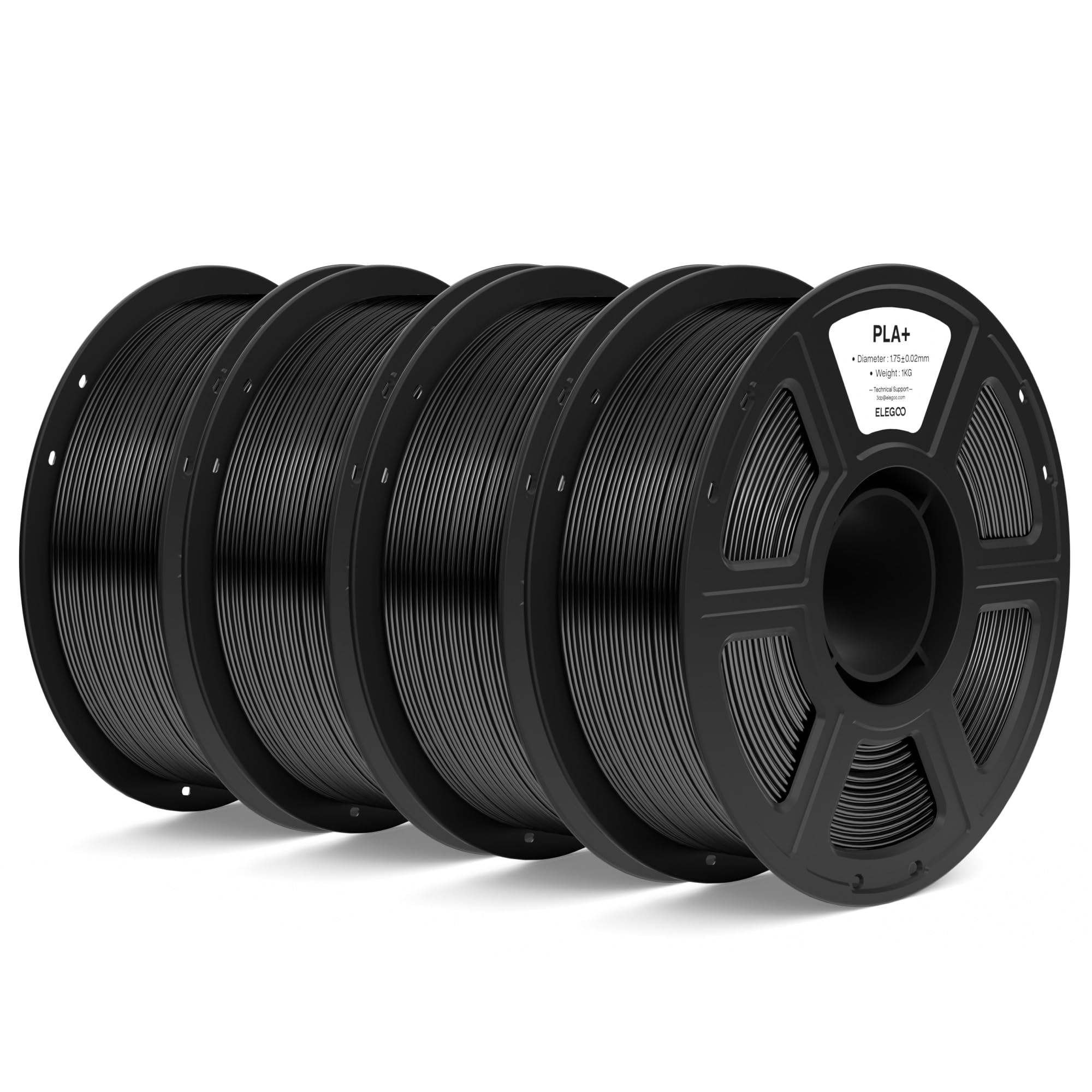
The box is four separate 1 kg reels, not one 4 kg reel, and that is the right format for a workshop that burns through black. Each spool is 1.75 mm with ±0.02 mm accuracy, so the setup is the same as any standard PLA+. We like the smaller reels for storage and swapping: you can open one, keep the other three sealed, and avoid exposing the whole lot to air.

The value is the point. A four-pack lowers the cost per spool and covers a run of brackets, jigs, or prototypes without a mid-project reorder. The finish is good enough for functional parts, and the standard PLA+ formula is easy to profile. We don't treat it as a high-speed spool; it is happiest at normal speeds, where the standard profile is easiest to dial in.

The trade-off is that you are committing to four reels of one color. If your work is mostly one color, that is a feature; if you change colors often, this is not the bundle for you. We see it as the practical bulk buy for a small shop or a heavy hobbyist, not a sampler. The fourth spool is the one that makes the format pay off.

Pros

  • Four 1 kg spools in one box
  • ±0.02 mm dimensional accuracy
  • Lower cost per spool

Cons

  • Winding and reliability can vary by spool
Our verdict

For anyone who prints the same black parts often, we think ELEGOO's four 1 kg reels are the practical bulk buy, with standard PLA+ profiles and ±0.02 mm accuracy.

Check Latest Price
3

Best for Tough Functional Parts

OVERTURE PLA Plus

91 /100
LBD Score Outstanding

Key details

Spool Weight
2.2 lb
Impact Toughness
Up to 5x standard PLA
Filament Diameter
1.75 mm
Dimensional Accuracy
±0.02 mm
View on Amazon

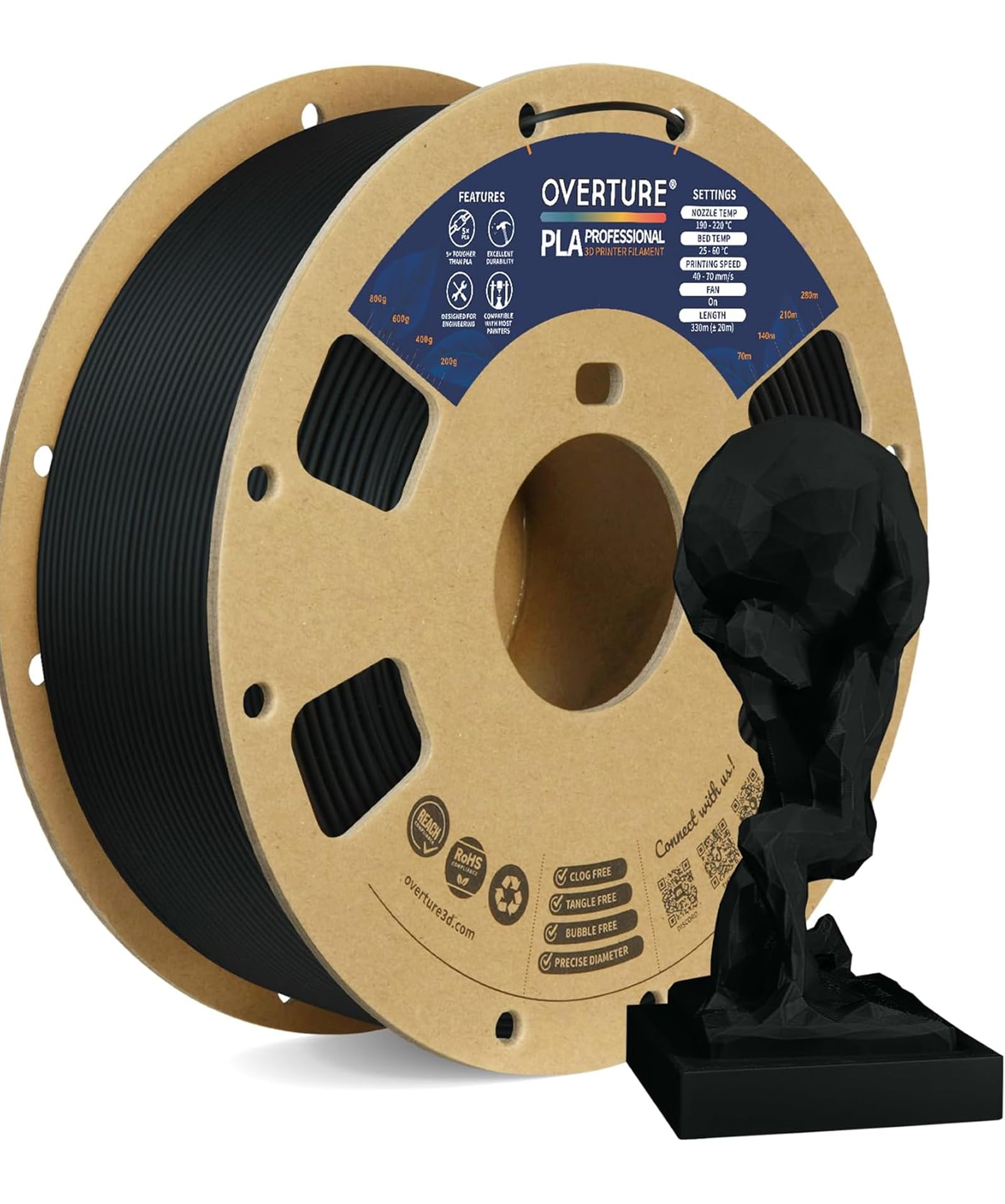
The satin finish is what you notice first on a finished print. It reflects light softly, hides layer lines better than a high-gloss PLA, and makes functional parts look less like shop scrap. We like that for brackets and replacement handles that stay visible. The 1.75 mm diameter and ±0.02 mm tolerance are standard, so it fits the same profiles as the rest of the set.

The bigger selling point is impact toughness. OVERTURE rates this filament at up to five times the impact toughness of standard PLA. We treat that as a formulation claim rather than a guarantee, but it explains why this is the spool we reach for when a part needs to flex instead of crack. The 1 kg reel is easy to store, and the filament runs on standard PLA profiles.

This is not the fastest spool here, and it is not the cheapest. What it gives you is a tougher part with a nicer surface than standard PLA, which is worth the trade when the print has to survive a drop or a clamp. For fast draft work, SUNLU is the better fit; for a part that needs to take abuse, OVERTURE is the one we load.

Pros

  • Satin finish hides layer lines
  • Up to 5x impact toughness claim
  • ±0.02 mm dimensional accuracy

Cons

  • Bed adhesion can be inconsistent
  • Unopened spool has a one-year shelf life
Our verdict

We reach for OVERTURE PLA Plus when a part needs to take a knock without looking rough, especially brackets, jigs, and replacement handles.

Check Latest Price
4

Best Budget Single Spool

Deeplee PLA+ 1KG

89 /100
LBD Score Excellent

Key details

Spool Weight
2.2 lb
Spool Material
Cardboard
Filament Diameter
1.75 mm
Dimensional Accuracy
±0.02 mm
View on Amazon

The cardboard spool is the first practical difference. It disassembles easily, which makes it simpler to recycle than a plastic reel, and it keeps the cost down. The filament itself is 1.75 mm with ±0.02 mm accuracy, and the 1 kg spool is the right size for someone testing PLA+ on a new printer or keeping a spare on the shelf.

Near the end of a reel, the cardboard gets light, and that can cause feeding hiccups. A spool weight or a holder with light drag fixes it, and we prefer that to a plastic reel that ends up in the trash. The filament prints cleanly at standard speeds; it is not a high-speed formula, and we don't push it there. For the money, it is a sensible way to keep a second color or a backup reel around.

Where it falls short is color consistency. The shade can arrive off from the listing, and that is the trade for the low entry cost. If you need a precise color match, spend more; if you need a cheap spool for prototypes, this one earns its place.

Pros

  • Cardboard spool is easy to recycle
  • ±0.02 mm dimensional accuracy
  • Lowest-cost single spool here

Cons

  • Tangling and bed adhesion vary by spool
Our verdict

Deeplee is the low-cost single spool we keep for calibration prints and everyday prototypes, as long as you can accept some color variance.

Check Latest Price
5

Color Variety

UJOY3D Elite PLA+ 10KG

83 /100
LBD Score Excellent

Key details

Bundle
10 x 1 kg
Colors
10 colors
Filament Diameter
1.75 mm
Dimensional Accuracy
±0.03 mm
View on Amazon

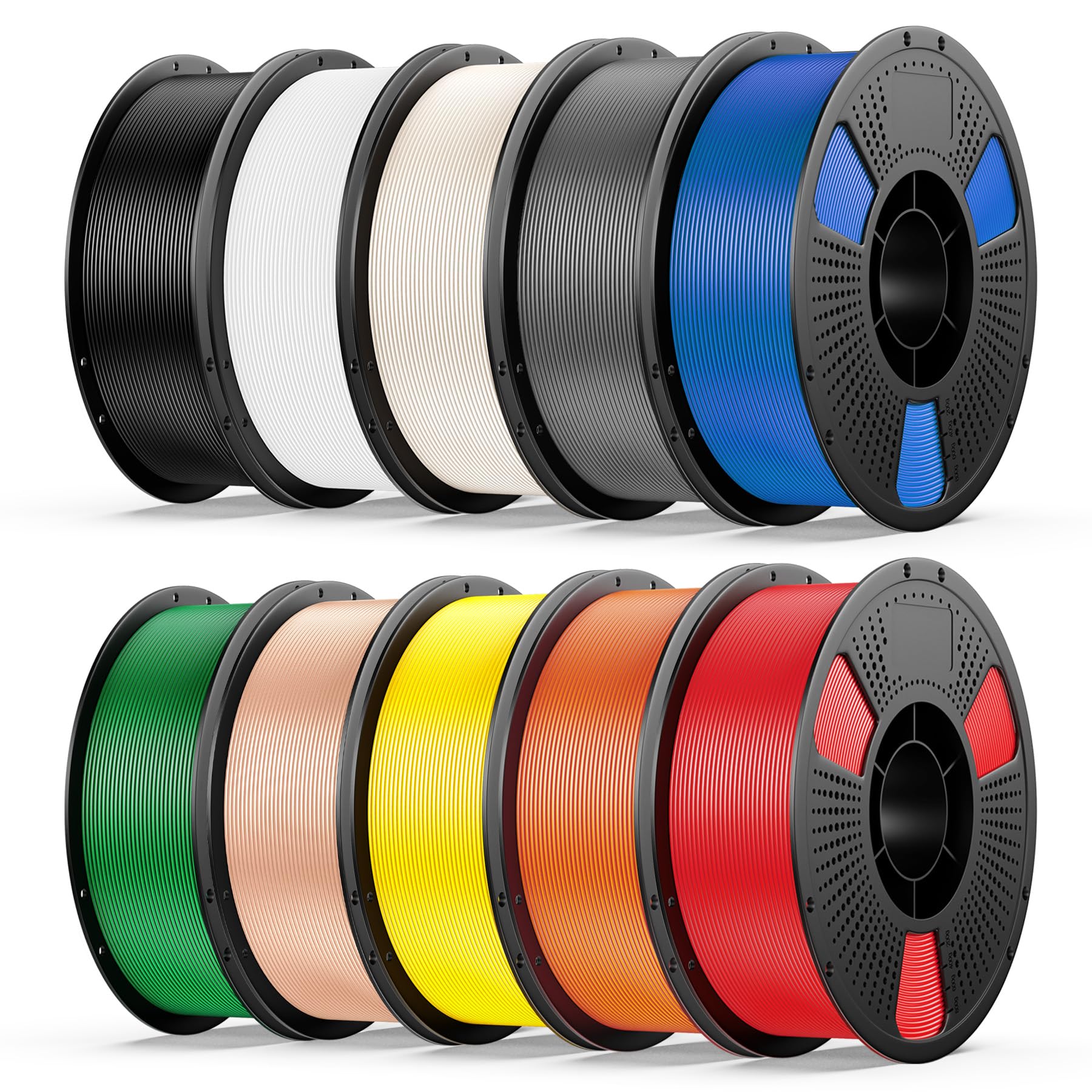
Ten 1 kg spools in ten colors is the whole idea here. The box covers black, jade white, cream white, grey, red, cobalt blue, green, orange, yellow, and beige skin, which is enough to build a sample wall or handle a class without reordering every week. The 1.75 mm diameter works on standard FDM printers, and each spool is a manageable 1 kg.

Color changes are the point for the kind of printing this bundle serves: prototypes, markers, display pieces, and small batch gifts. The finish is glossy and even, and the colors are vivid enough to read across a room. It is not the spool we choose for a structural bracket, but that is not what the bundle is for. The ten reels also make it easy to assign a color to a category and keep it consistent across a project.

The trade-off is one of purpose. This is a palette, and we treat it that way. For a color-heavy workflow, it is a practical way to get ten spools without buying them one at a time; for a one-color run, a single reel is smarter.

Pros

  • Ten 1 kg spools in ten colors
  • Good for color-heavy projects
  • Glossy, vivid finish

Cons

  • ±0.03 mm tolerance is looser than most
  • 10 kg bundle needs storage space
Our verdict

We recommend UJOY3D Elite PLA+ for a ready-made color palette—samples, classroom projects, or a small shop—not for precision production parts.

Check Latest Price

How We Chose and Tested 16 Spools of PLA+

We started with every PLA+ spool we could find that published a diameter tolerance and a spool weight, then dropped the listings that wouldn't tell us either, the ones whose reviews were dominated by tangles straight out of the vacuum bag, and the ones that priced out far above the rest per kilogram. That left 16 spools, which ran for four months across our FDM machines — bed-slingers and enclosed boxes alike, textured PEI and glass plates, 0.4mm nozzles.

Every spool ran the same battery: a temperature tower, a first-layer patch on both textured PEI and glass (we noted whether it needed a glue stick or went down clean on bare plate), a 14-hour overnight print of a large flat part, and functional pieces — a bracket, a hook, a phone stand. We measured diameter with calipers at the start, middle, and end of each spool and watched for drift. During the long prints we checked for tangles and for the filament snagging on its own tail as the spool lightened.

Then we abused the parts: thin bars flexed until they snapped, hooks hung with a loaded tool bag, drops from waist height onto the shop floor. Black hides nothing, which made layer lines, stringing, and gloss easy to compare side by side; we also laid the multi-color spools out together to check that a white was the same white from spool to spool. Every spool got weighed to test the 1 kg claim, and one sat mounted on a machine for a month to see whether it went brittle from sitting out.

Each spool was rescored at the end on consistency — did the twentieth print look like the first — and on value, meaning how much usable filament we got after subtracting the tangles, the failed first layers, and the test prints it took to dial it in.

How to Choose Pla+ Filament

Match the spool to your printer and storage

Nearly every FDM printer in this group takes 1.75 mm filament, but the spool itself can still be the mismatch. A 1 kg reel is easy to store and swap; a 4 kg or 10 kg bundle is four or ten separate 1 kg spools, not one giant reel, so count shelves before you count savings. Check the spool diameter and width against your holder or multi-material system—SUNLU lists an 8-inch diameter, 2.5-inch width, and 2.2-inch hub for its standard PLA+.

If you print one color constantly, bulk makes sense; if you change colors often, single spools are easier to manage.

Treat tolerance as the floor

±0.02 mm is the number most of these spools share, and it matters more than a fancy label: a filament that runs fat or thin can show up as inconsistent extrusion, rough walls, or a nozzle clog. A ±0.03 mm spool is still usable, especially for decorative prints, but for parts that fit together, start with the tighter tolerance. Pair that with a clean first layer and a calibrated flow rate. We treat tolerance as the floor, not the whole story—winding and moisture can undo a good diameter.

Speed ratings are ceilings, not settings

A 300 mm/s rating describes what the filament can support, not what your printer can deliver. A stock hotend, a 0.4 mm nozzle, and a detailed model will all slow you down, and pushing past your printer's flow limit produces under-extrusion that looks like bad filament. Start with the spool maker's temperature range, run a small test print, and raise speed only after the walls stay smooth. The speed headroom is real—SUNLU's 2.0 formula is built for it—but it pays off on draft parts, not every print.

Winding, moisture, and brittleness decide the last half

Most filament problems show up after the first few layers: a crossed loop, a spool that loosens, or a strand that snaps because it has absorbed moisture. Keep partial spools sealed with desiccant, and inspect the reel before a long print. If the filament pops or prints brittle, dry it before blaming the formula. A spool weight or a holder with light drag helps a cardboard reel that has gone light near the end. We care about this more than a one-time strength number because it affects every print you start.

Frequently Asked Questions

Final Verdict

SUNLU PLA+ 2.0 is the spool we recommend first because it gets the everyday job right: ±0.02 mm tolerance, 300 mm/s headroom, and a 1 kg reel that is easy to live with. The winding is the one thing to watch, but the printability is strong enough that we keep it loaded for brackets, jigs, and fast draft parts.

For a workshop that prints black parts by the dozen, ELEGOO's four-pack is the better economics. If impact strength matters more than speed, OVERTURE PLA Plus is the one to load. Deeplee is the low-cost single spool when you want a backup without committing to bulk.