Best Overall
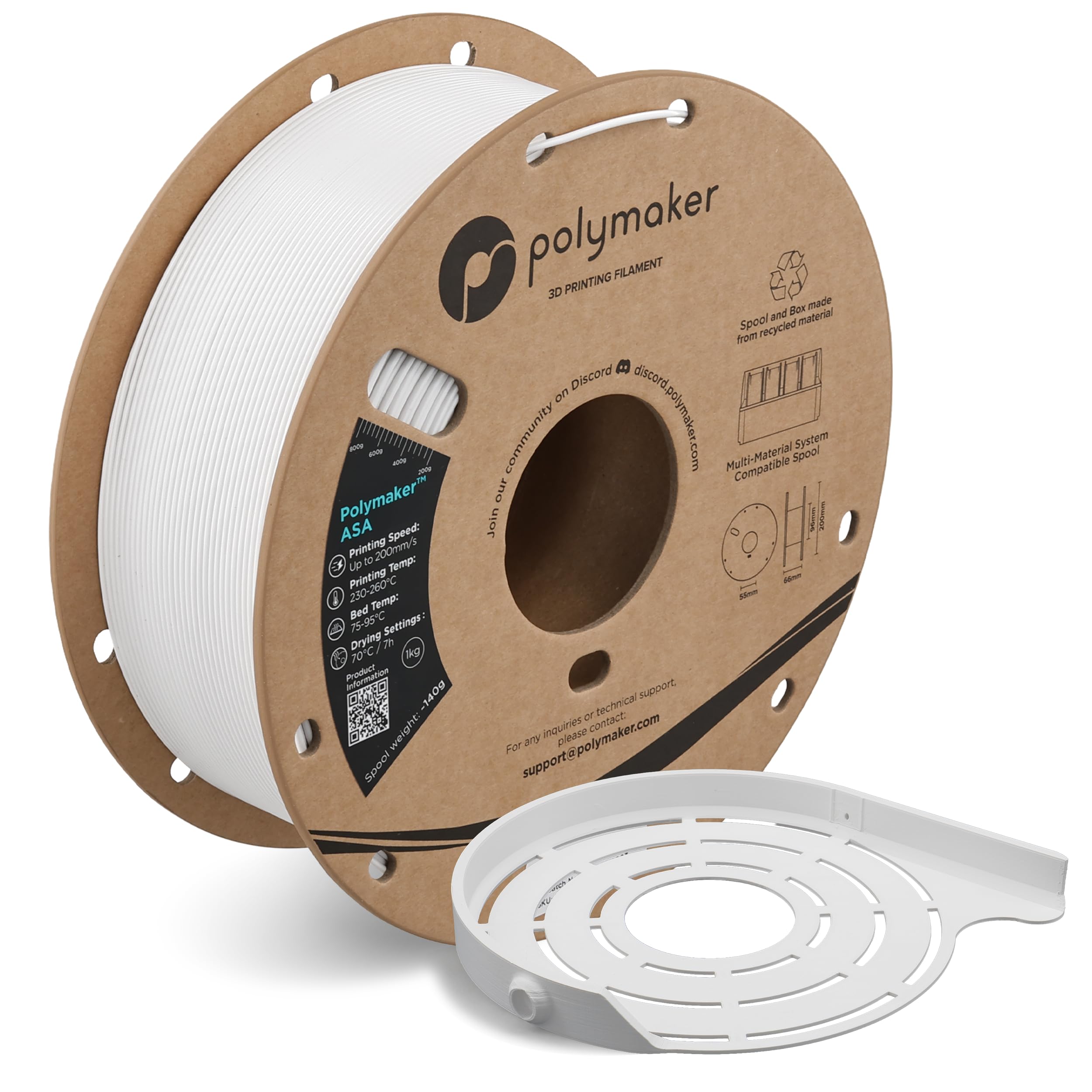
Polymaker ASA
Key details
- Material
- ASA
- Bed Temperature
- 90°C
- Heat Resistance
- Up to 100°C (212°F)
- Nozzle Temperature
- 250°C
A hundred degrees Celsius is the number that put this spool on top. That's the highest stated heat resistance of any filament in this guide, and for outdoor work it's the figure that matters most: a bracket on a sunny wall or a mount near a windshield can run far hotter than the air around it, and ASA that softens early lets the part bow out of shape. Polymaker pairs that ceiling with UV and weather resistance, and the listing gives you somewhere to start at a 250°C nozzle, 90°C bed, and 50 mm/s.
In the printer, our attention went to the flat parts, because that's where ASA usually embarrasses itself. Small brackets came off clean; a sign blank lifted at two corners until we got the chamber properly warm and added a brim. That's the material rather than the spool, but it's worth knowing before your first print, and it's why we treat an enclosure as part of the purchase instead of an upgrade.
What the extra spend buys is consistency across the reel, a white that photographs cleanly, and settings you don't have to reverse-engineer. Light-colored parts also stay cooler in direct sun than black ones and hide dust and pollen better, so if you're printing trim, a house number, or a garden bracket, that's a more useful property than the color swatch suggests.
If your part is a shaded planter or a cover that never meets serious heat, the budget spools below will do the job for less. If it will sit in the sun and carry load, this is the roll we reach for.
Pros
- Highest stated heat resistance in this group
- UV and weather resistance for permanent outdoor parts
- Listed starting settings of 250°C nozzle and 90°C bed
Cons
- Costs more than the budget ASAs here
Our top pick: nothing else here pairs a 100°C heat ceiling with UV resistance this convincingly, so it's the spool for a part that has to last a summer outdoors.