Best Portable Projector Screens of 2026

The first warm Friday of the year is when it hits you: the projector is fine, the screen is the problem. A screen that sags in the middle or leans over in a light breeze turns a backyard movie night into twenty minutes of re-staking poles in the dark. I've hosted enough of these to be picky about it, and over the past six months our team has set up 12 portable screens, stand models, staked models, and a couple of plain fabric sheets, in backyards, at a campsite, and against a living room wall.

Size and 4K claims get all the attention, but the screens I keep reaching for get the boring stuff right: a base that doesn't creep across the grass, hardware you can assemble without a second person, and fabric that gives up its fold lines once it's under tension. Reflectivity matters too. A little gain helps in a yard with porch lights on, but push it too far and the center of the image blows out while the corners go dull.

What's below is a mix of sizes and formats, because a screen for a tent and a screen for a driveway are not the same purchase. These are the ones that held their shape through a breezy evening and a careless pack-down.

1

Best Overall

STWUI 120-Inch Screen with Stand

85 /100
LBD Score Excellent

Key details

Assembly
Tool-free, about 8 minutes
Mounting
Stake-down floor stand
Screen Size
120 inches
Aspect Ratio
16:9
View on Amazon

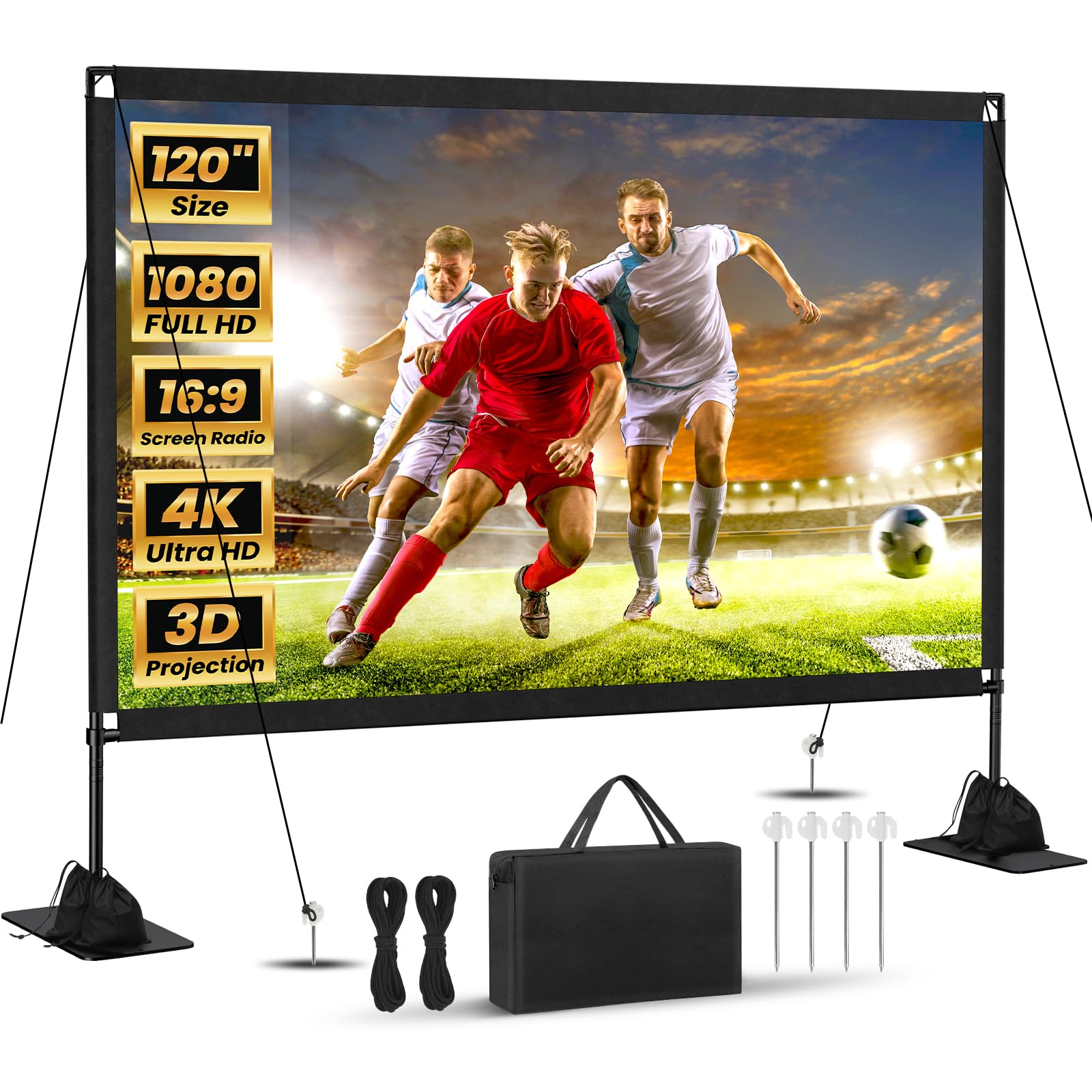
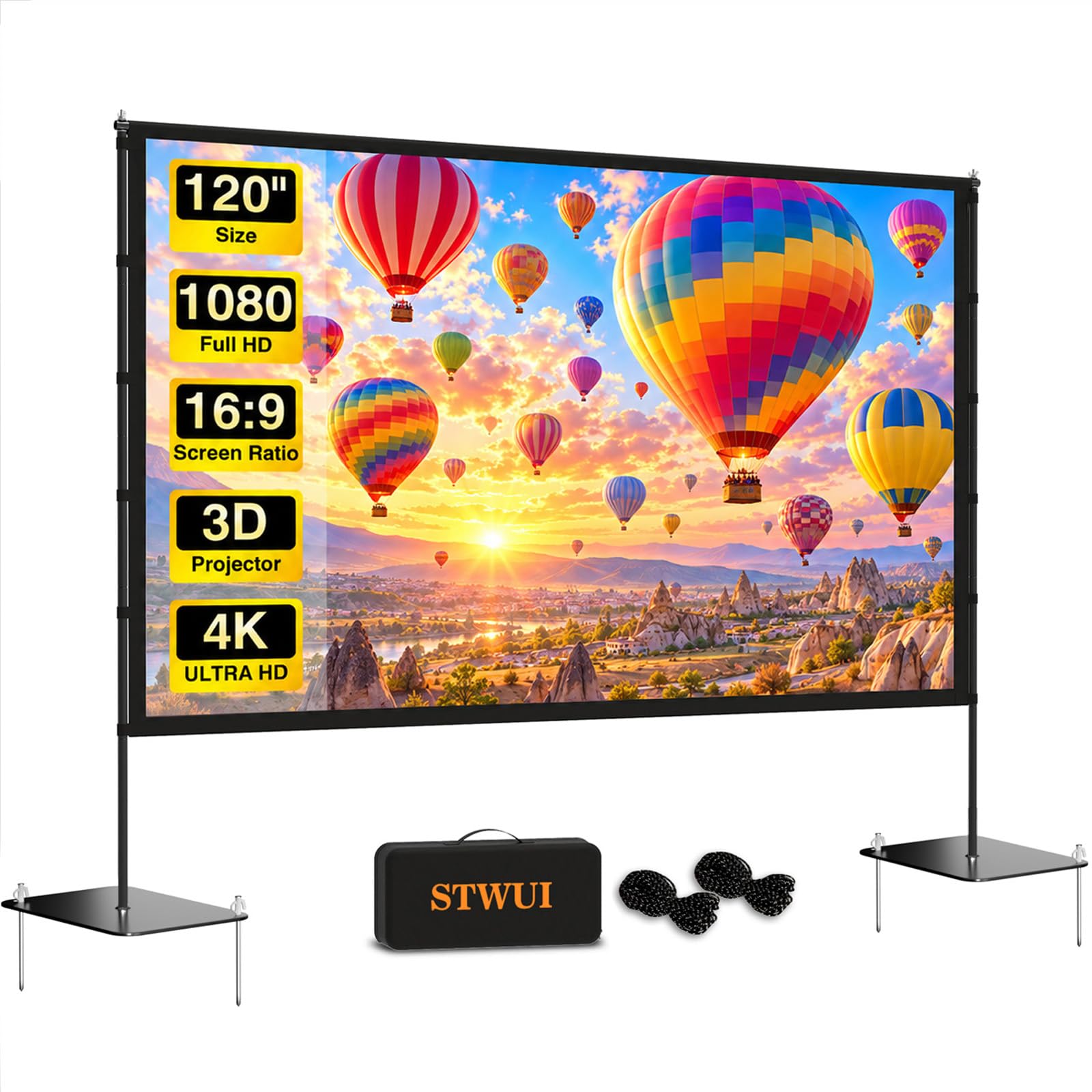
The stake-down base is what makes the STWUI our top pick. It is a 120-inch 16:9 screen on a metal frame with a widened base plate, and the base is designed to be staked into grass so you can pin the whole thing down instead of trusting a tripod to stay upright. We like that for a backyard because the screen is the part that catches the wind, and a base you can stake is the right answer. The frame is metal and the fabric is a thick woven milk silk, so it reads as outdoor gear rather than a temporary toy.

Setup is tool-free and modular. The frame breaks into tubes, the screen attaches with Velcro, and the listed assembly time is about eight minutes. The 160-degree viewing angle is wide enough for a spread-out patio, and the milk-silk surface is listed as wrinkle-free; the tensioned frame is what makes that claim useful. A 120-inch frame is easier with a helper, but one person can manage it in still air.

Where it beats the Paris RHÔNE is the anchoring: the Paris is the picture-surface pick, but the STWUI is the one built for grass and dirt. If your movie nights are mostly indoors against a wall, the Mdbebbron is lighter and simpler. The STWUI is the screen you set up when the yard is the theater, not the one you hang on a living room wall.

We recommend the STWUI for backyard movie nights, campsites with a vehicle, and any outdoor space where you can drive stakes. It is not the last word in picture gain, but it is the most complete outdoor package here.

Pros

  • Stake-down base anchors a 120-inch frame
  • Tool-free assembly in about eight minutes
  • Thick, wrinkle-resistant milk-silk surface
  • Packs into a carry bag for car travel

Cons

  • 120-inch frame needs a large wall or yard
Our verdict

For backyard and campsite movie nights, the STWUI is our top pick: its stake-down base gives a 120-inch screen a real chance in the wind.

Check Latest Price
2

Best Picture Surface

Paris RHÔNE 100-Inch Screen

89 /100
LBD Score Excellent

Key details

Gain
1.5
Weight
12.9 lb
Screen Size
100 inches
Stand Height
64 to 85 inches
View on Amazon

The first thing to notice about the Paris RHÔNE is the surface. It is a 1.5-gain PVC sheet with a multi-layer coating, not the thin polyester most portable screens use. That is the highest gain in this group, and it is the reason the Paris RHÔNE is our picture-surface pick: higher gain reflects more light back toward the audience, which helps when the projector is not especially bright. The 100-inch 16:9 size is also an easier fit than a 120- or 150-inch screen in a living room or a small yard.

The stand is an aluminum X-shaped tripod that adjusts from 64 to 85 inches, so you can lift the bottom edge above furniture or keep it low for seated viewing. The screen folds off the frame and goes into a carry bag, and the setup is designed for one person in about two minutes with three steps. Ground nails are included for outdoor use, which matters because a tripod by itself is not an anchor.

We think the Paris RHÔNE is the pick when picture surface matters more than packing weight. The PVC and 1.5 gain are the most light-reflective combination here, and the height-adjustable tripod makes it more flexible indoors than the fixed-height stands. It is heavier than the fabric screens at 12.9 pounds, so it is a car-and-backyard screen rather than a hiking one. If you want the same tripod convenience at a lower weight, the AODIOU is the travel alternative, though it gives up 20 inches and some gain.

Pros

  • 1.5-gain PVC gives a brighter image
  • Height-adjustable tripod spans 64 to 85 inches
  • One-person setup in about two minutes
  • Ground nails add outdoor anchoring

Cons

  • Tripod legs need clear floor space
Our verdict

We think the Paris RHÔNE earns its price for picture-first buyers who want the highest gain here and a height-adjustable tripod.

Check Latest Price
3

Best Budget

Mdbebbron 120-Inch Foldable Screen

91 /100
LBD Score Outstanding

Key details

Weight
1.7 lb
Mounting
Wall or rigging
Projection
Double-sided
Screen Size
120 inches
View on Amazon

A 120-inch screen that weighs 1.7 pounds is the whole idea behind the Mdbebbron. The fabric folds into a backpack or suitcase. You hang it from hooks, ropes, nails, or double-sided tape, which makes it the most flexible screen here if you already have a wall, fence, or pair of trees.

We like it most as the budget and backpack pick. The 120-inch viewing area is 104 by 58 inches, it supports double-sided projection, and the polyester is treated to resist creases when it is pulled taut. The included adhesive hooks are not magic: on textured or dirty walls they can let go, so plan on using the grommets with rope or your own hardware. That is a small fix, not a reason to skip it.

For backyard nights, the Mdbebbron is the screen you leave in the car and pull out when the wall is free. It will not give you the high-gain look of the Paris RHÔNE, but it packs smaller than a beach towel and costs less than the stand screens. If you need a freestanding screen, the STWUI is the better answer.

Pros

  • Folds to 1.7 pounds for backpack or suitcase
  • 120-inch viewing area at a budget price
  • Double-sided projection adds setup options

Cons

  • No stand; needs a wall or rigging
Our verdict

Our budget pick is the Mdbebbron: a 120-inch screen that folds to 1.7 pounds and hangs from a wall, fence, or trees.

Check Latest Price
4

Best for Rear Projection

ZUVMITG 120-Inch Screen with Stand

85 /100
LBD Score Excellent

Key details

Weight
12.5 lb
Included
Sandbags and stakes
Projection
Front and rear
Screen Size
120 inches
View on Amazon

Rear projection is the reason to look at the ZUVMITG. The 120-inch screen is listed for both front and rear projection, so you can put the projector behind the screen and keep the front side clear of cables, people, and furniture. That is a different setup from the other stand screens here, and it is useful when you want the audience on one side and the projector hidden on the other.

The rest of the kit is built for outdoors: a reinforced base, a metal frame, four ground stakes, and sandbags. The milk-silk fabric is washable and listed as wrinkle-resistant, and the 160-degree viewing angle is wide enough for a spread-out group. The package includes a carry bag, and the listed frame dimensions are 106 by 76 inches, so it is a serious 120-inch surface rather than a stretched 100.

The base is reinforced, but it still depends on the sandbags or stakes in a breeze; the frame does not magically hold itself down. If you mostly watch indoors or on a sheltered patio, the extra anchoring gear is more than you need. The rear-projection option is also a specific tool: if you only project from the front, you are paying for a capability you may not use.

We recommend the ZUVMITG for rear-projection movie nights and for buyers who want a fuller outdoor kit with sandbags and stakes in the box. It is not as surface-focused as the Paris RHÔNE, but it solves a problem those screens do not. If you need front projection only, the STWUI is the better default.

Pros

  • Front and rear projection in one screen
  • Sandbags and ground stakes included
  • Washable milk-silk fabric resists wrinkles

Cons

  • 12.5-pound kit is heavy for backpacking
Our verdict

Choose the ZUVMITG when you need rear projection; we like that it includes sandbags and stakes with its 120-inch stand.

Check Latest Price
5

Best for Travel

AODIOU 80-Inch Screen with Stand

88 /100
LBD Score Excellent

Key details

Weight
5.5 lb
Assembly
No tools required
Mounting
Tripod stand
Screen Size
80 inches
View on Amazon

The AODIOU is the screen that fits in a suitcase. The 80-inch model packs down to a carry bag, weighs 5.5 pounds, and uses an aluminum frame with a polyester surface. It is not the biggest screen here, but it is the one we take on a camping trip or set up in a spare room without clearing a wall.

Assembly is tool-free: the frame goes together with the stand, the screen stretches over it, and the whole thing breaks down into the bag. The 80-inch 16:9 surface measures 70 by 40 inches, and the 160-degree viewing angle is fine for a small group. The stand is a tripod, so it is more stable indoors than on a breezy lawn; that is the trade-off for the light weight.

We like the AODIOU for travel because it hits the size and weight balance that the bigger screens miss. It is easier to move than the Paris RHÔNE, and it sets up without tools, which matters when you are unpacking in the dark. If you need more image, the STWUI gives you 120 inches if you can trade suitcase portability for a bigger kit.

Pros

  • 5.5-pound kit fits in a suitcase
  • Tool-free aluminum frame
  • 80-inch 16:9 surface for small groups

Cons

  • 80-inch image is small for big groups
Our verdict

The AODIOU is the one we pack for camping: an 80-inch aluminum tripod screen that fits in a suitcase.

Check Latest Price
6

Best 150-Inch Screen with Stand

FvcDmik 150-Inch Screen with Stand

81 /100
LBD Score Excellent

Key details

Frame
Iron
Mounting
Floor stand with stakes
Screen Size
150 inches
Aspect Ratio
16:9
View on Amazon

A 150-inch screen is a commitment. The FvcDmik gives you that huge 16:9 surface on an iron frame, with ground nails and rigging ropes to hold it down, and a carry bag for storage. It is the screen you buy when the backyard movie is the event and you want the image to feel bigger than the gathering.

We think it is the best big-screen value in this set, provided you have a helper. The frame goes together without tools, the polyester surface is anti-crease, and the 150-inch size is genuinely theatrical. The stand is the weak point: it needs to be staked and roped evenly, so it takes more setup than a tripod. On a flat lawn with the anchors set, it does the job.

If you want the big image but not the frame, the AAJK gives you a 150-inch fabric surface you can hang instead. If you want a stand that feels more solid at a smaller size, the STWUI is the safer all-around pick.

Pros

  • 150-inch 16:9 image for big gatherings
  • Tool-free iron frame
  • Ground nails and rigging ropes included

Cons

  • 150-inch size needs a large, flat space
Our verdict

We see the FvcDmik as the 150-inch stand screen to stake down on a flat lawn, provided you have a helper.

Check Latest Price
7

Indoor Use

excelimage 80-Inch Tripod Screen

89 /100
LBD Score Excellent

Key details

Gain
1.2
Weight
8.5 lb
Mounting
Tripod or wall
Screen Size
80 inches
View on Amazon

The excelimage 80-inch is a tripod screen for people who want a compact image without a fabric-and-tape rig. It has a 1.2-gain glass-fiber surface, an aluminum tripod, and a 2-year warranty, and it sets up in about two minutes. That is a more finished package than the budget fabric screens, and it is why it stays in the conversation.

Indoors, the screen is bright and uniform with an HD projector, and the 80-inch size is easy to place in a spare room or classroom. The tripod folds down and the whole kit weighs 8.5 pounds, so it is portable in the car-and-closet sense rather than the backpacking sense. The four tension tubes do a good job of keeping the surface flat.

Outdoors is where the design shows its limits. The screen can sway or rotate in a light breeze, and the tripod is not heavy enough to resist a gust on its own. That does not make it a bad screen; it makes it an indoor-first screen that can go outside on a still night. Indoors, where the tripod sits on a hard floor, the wobble is a nonissue. If your movie nights are on an exposed lawn, the stake-down STWUI is the better choice.

We recommend the excelimage for indoor use, classrooms, and sheltered patios where you want a quick 80-inch tripod screen with a better surface than the cheapest fabric options. It is not the outdoor pick, and it is not the budget pick. The 2-year warranty and the 1.2-gain material are the reasons to pay more than the Mdbebbron.

Pros

  • 1.2-gain glass-fiber surface
  • Two-year warranty
  • Quick two-minute setup

Cons

  • Screen can arrive with creases
Our verdict

For indoor use, we recommend the excelimage's 80-inch tripod, 1.2-gain surface, and two-year warranty; it is not a windy-yard screen.

Check Latest Price
8

Giant Wall Screen

AAJK 150-Inch Foldable Screen

89 /100
LBD Score Excellent

Key details

Weight
2.8 lb
Mounting
Wall or rigging
Projection
Double-sided
Screen Size
150 inches
View on Amazon

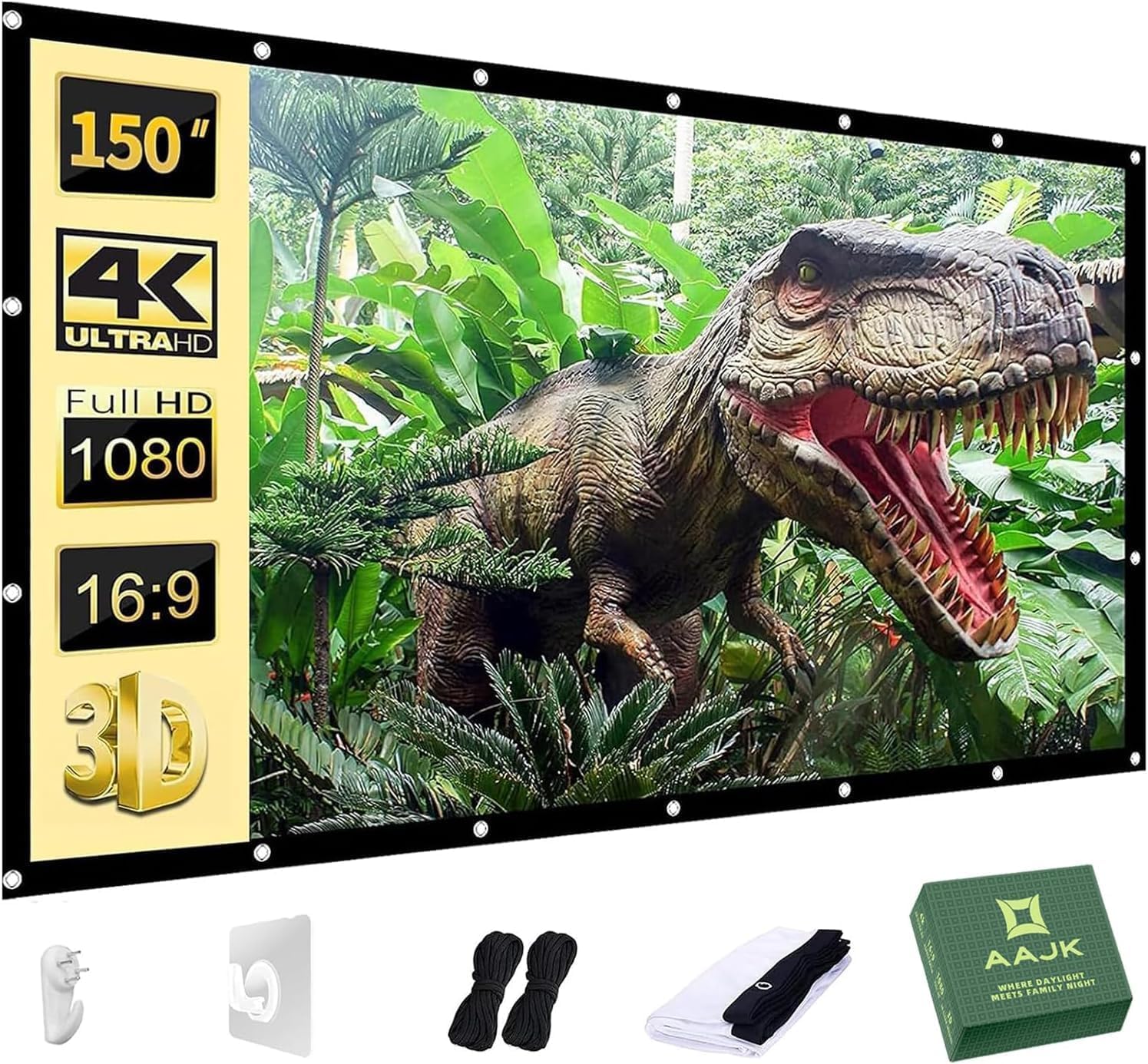
The AAJK is a hanging screen, and that is the point. It is a 150-inch sheet of polyester with a 132-by-73-inch viewing area, a 2.8-pound packed weight, and a foldable design that goes into a bag. We like it for the buyer who has a big blank wall, a fence, or two trees and does not want to assemble a frame.

The surface is white and double-sided, so you can project from either side, and the grommeted edge gives you plenty of places to tie it down. It is not black-backed, so it works best against a dark wall or with a backing behind it; on a bright or busy surface, the image can wash out. The anti-crease fabric smooths out when it is pulled taut, but it will show folds if you stuff it away wet or loosely.

For the money, this is the biggest image in the guide, and it is the one to choose if portability means folding rather than rolling. It is not as crisp as the PVC Paris RHÔNE. But if you have a place to hang it, the AAJK delivers a 150-inch picture with almost nothing to carry.

Pros

  • 150-inch viewing area at a budget price
  • 2.8 pounds folds into a bag
  • Double-sided projection

Cons

  • No stand; needs a wall or rigging
Our verdict

Hang the AAJK if you want 150 inches for very little: we like that it weighs 2.8 pounds and needs no frame.

Check Latest Price

How We Tested Portable Projector Screens

We started by pulling every portable screen we could find between 80 and 150 inches, including stand-and-frame kits, stake-down models, and foldable fabric sheets that hang from grommets. Anything with a pattern of complaints about collapsed poles, missing hardware, or frames that wouldn't lock got cut before testing. That left 12 screens, which we've lived with for six months through backyard movie nights, a camping weekend, a park birthday, and a few living room setups where the only open wall was behind the couch.

Setup was timed with a stopwatch, solo, from bag to taut screen, and we counted every piece that came out of the box. We raised each one on lawn, on packed dirt, and on a wooden deck, noting where ground nails bent in dry soil, where a stand needed sandbags to stay put, and whether the frame could be lifted into place by one person without help. Then we left them standing for a full evening to see what shifted.

To judge stability, we ran a box fan at low speed across the yard and watched for lean, drift, and flapping through a two-hour movie. Wrinkle resistance got its own test: we folded each screen the way the maker instructs, packed it in its carry bag, unpacked it 24 hours later, and projected a solid pale frame at night to see which creases threw shadows and which relaxed once tensioned.

Reflectivity we compared side by side with the same projector and the same footage, first with the yard lights off and then with the porch lights on, and we checked the rear-projection side of each double-sided screen for a washed-out center. Sturdiness showed up later, in the seams and grommets after repeated tensioning, so we logged fraying, pulled stitching, and any pole that had developed a wobble by month six.

How to Choose a Portable Projector Screen

Size and Aspect Ratio Come First

Measure the width and height you actually have before you fall for a 150-inch image. A 120-inch 16:9 screen like the Mdbebbron gives you a 104-by-58-inch viewing area, while the AAJK's 150-inch surface lists 132 by 73 inches. Those are different rooms and different yards. Match the aspect ratio to your projector, too: 16:9 is the default for movie and TV projectors, while 4:3 is for presentations and older projectors. A 16:9 image on a 4:3 screen leaves bars; a 4:3 image on a 16:9 screen leaves side space. Pick the format your projector actually throws.

Stand or Hang?

A stand gives you a freestanding image anywhere with a flat patch of ground, but it adds weight, assembly, and a footprint. A hanging screen is lighter and packs smaller, but it needs a wall, fence, or trees and a way to pull it taut. If you have a blank wall at home, the Mdbebbron or AAJK is the easier travel companion. If your backyard has no good hanging point, the STWUI or Paris RHÔNE earns its bulk. Decide from the site, not from the spec sheet.

The Stand Is Only as Good as Its Anchors

Tripod legs look stable in a showroom and behave differently on grass. Look for a base that accepts stakes, sandbags, or both, and plan to use them every time the screen is outdoors. The STWUI's stake-down base and the Paris RHÔNE's ground nails are more useful than a slightly thicker pole. A bare tripod on a breezy lawn will rotate or tip no matter how good the screen surface is. If you cannot anchor the stand, choose a smaller screen or move the movie indoors.

Surface, Gain, and Wrinkles

Polyester fabric is light and packable, but it depends on tension to look smooth. PVC and glass-fiber surfaces resist creases better and can carry more gain: the Paris RHÔNE lists 1.5 gain, the excelimage 1.2. Higher gain reflects more light back toward the audience, which helps a dim projector, but it can make the image less even from wide angles. For a dark room and a decent projector, a plain matte fabric is often enough. For a brighter room or a long throw, the higher-gain surface earns its extra weight.

Packability and Setup Time

Weight matters most on the last hundred yards. A 1.7-pound fabric screen disappears into a backpack; a 12.5-pound stand kit is a car-trunk object. Check the packed length as well as the weight, and count the setup steps: tool-free frames are faster, but a 120- or 150-inch screen still takes minutes and usually a second pair of hands. If you set up weekly, pay for the easier frame. If it is a few times a summer, the bigger image is worth the fuss.

Frequently Asked Questions

Final Verdict

For most buyers, the STWUI is the portable screen we recommend first: its 120-inch surface is big enough for a backyard crowd, and the stake-down base gives it a real advantage on grass. It is not the lightest or the brightest screen here, but it is the best balance of size, setup, and outdoor stability.

If picture quality is the priority and you will mostly set up on a patio, the Paris RHÔNE's 1.5-gain PVC and height-adjustable tripod are worth the extra weight. If you need a screen that disappears into a backpack, the Mdbebbron is the budget pick. Choose the site first, then the screen.