Best Projector Mounts of 2026

A projector mount has one job, and you only notice it when it fails. The projector slips a few degrees mid-movie, or the whole thing wobbles every time someone walks by, and suddenly you're adjusting instead of watching. I've mounted projectors on apartment ceilings, basement joists, and one wall stud, and the lesson is always the same: a good mount holds the projector where you aimed it and comes with hardware that doesn't strip halfway into drywall. Over four months, my team and I installed 14 mounts to see which ones do that.

Weight capacity gets the attention, but differences show up in the joints and screws. A mount rated for far more than your projector weighs can droop if the tilt mechanism is loose, and universal arms can be a pain to align if they don't lock firmly. We looked at full-size projectors that hang from extending arms and mini projectors that screw onto a 1/4-inch thread, because the right mount depends on your projector. The picks below stayed put, adjusted without a fight, and came with solid hardware.

1

Best Overall

VIVO MOUNT-VP01W

91 /100
LBD Score Outstanding

Key details

Adjustment
+/-15-degree tilt and swivel, 360-degree rotation
Weight Capacity
30 lb
Ceiling Clearance
6 inches
Mounting Hole Span
5.25 to 12.5 inches
View on Amazon

Six inches is the number that makes the VIVO MOUNT-VP01W easy to live with. That low ceiling clearance keeps a projector close to the ceiling instead of dangling into the room, and the white powder-coated finish is the right choice for a pale ceiling. We also appreciate the arm span: 5.25 to 12.5 inches between mounting holes covers a lot of full-size and mini projectors, and the arms can come off for a 1.5-by-1.5-inch pattern.

The adjustment story is straightforward: plus or minus 15 degrees of tilt and swivel, plus 360-degree rotation, enough to square the image without fighting the bracket. Quick-release hooks let one person hang the projector and then tighten the mounting bolts. In our install, that design was the difference between a calmer job and a two-person balancing act.

Once tightened, it held the projector steadily, but the hardware is the part to check before you climb the ladder. The supplied screws do not reach every projector's recessed mounting holes, and the instruction sheet is mostly diagrams. Test-fit the screws first, and pick up longer M4 or M5 screws if the projector's case is deep. A second pair of hands is still useful for lining up the plate, though the hooks make it less necessary.

Pros

  • Low 6-inch ceiling profile
  • Wide 5.25- to 12.5-inch arm span
  • Quick-release hooks simplify hanging
  • Solid steel build

Cons

  • Some Epson models are listed as incompatible
Our verdict

We recommend the VIVO MOUNT-VP01W as the default for most home theaters: sturdy, low-profile, broadly compatible, and easier to install than its simple design suggests.

Check Latest Price
2

Best for Low Ceilings

XINLEI PR14W

88 /100
LBD Score Excellent

Key details

Adjustment
+/-15-degree tilt, +/-20-degree swivel, 360-degree rotation
Weight Capacity
30 lb
Ceiling Clearance
5 inches
Mounting Hole Span
2.83 to 11.42 inches
View on Amazon

Five inches of ceiling clearance is about as close as a bracket this adjustable gets. The XINLEI PR14W sits a full inch lower than the VIVO, and its arms close down to 2.83 inches, which is the detail that matters for compact projectors whose mounting holes sit close together.

That narrow minimum is why we reach for it in a small room. A compact projector that slides around inside a wider universal cradle feels secure here, and the 30-pound capacity leaves room for a mid-size home-theater model. The +/-15-degree tilt, +/-20-degree swivel, and 360-degree rotation give enough range to aim without shimming, and the bracket is approved for flat or sloped ceilings.

The trade-off is span: the arms top out at 11.42 inches, so a projector with a wider hole pattern needs the VIVO instead. Within its fit range, the low profile is the reason to pick it over the VIVO; the smaller bracket disappears against a low ceiling and leaves more room to walk underneath.

The installation is the usual ceiling plate and arm assembly, with quick-release hooks that let you hang the projector before the final tighten. That matters when you are working overhead on a ladder; the bracket stays put while you get both hands on the projector.

Pros

  • Five-inch ceiling clearance
  • Narrow 2.83-inch minimum span
  • Works on flat or sloped ceilings
  • 360-degree rotation and +/-20-degree swivel

Cons

  • Included screws may not suit every projector
Our verdict

Low ceiling, compact projector? The XINLEI PR14W is the mount we choose, with a 5-inch profile and arms that close down to 2.83 inches.

Check Latest Price
3

Best for Heavy Projectors

PEGZONE HWO1005BK

86 /100
LBD Score Excellent

Key details

Adjustment
+/-15-degree tilt, +/-8-degree swivel
Weight Capacity
44 lb
Cable Management
Built-in
Ceiling Extension
16.9 to 25.6 inches
View on Amazon

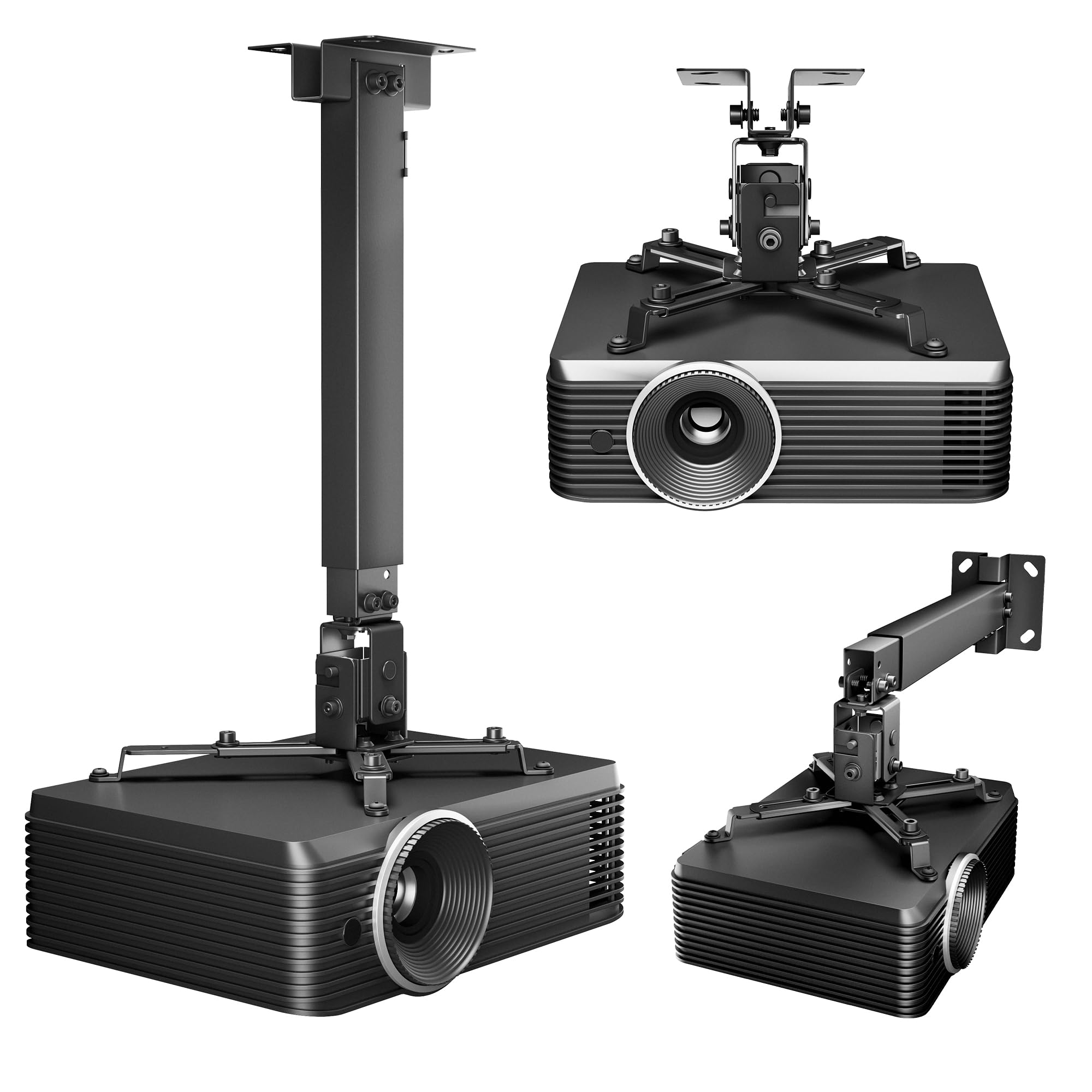
Forty-four pounds is the number that separates the PEGZONE HWO1005BK from the lighter mounts here. That capacity, shared with the Mount-It! MI-604, is more than enough for a full-size home-theater projector, and the 3-in-1 design lets you hang it flush, drop it on a 16.9- to 25.6-inch ceiling arm, or turn it into a wall bracket.

Cable management is built into the arm, which matters more than it sounds: an HDMI cable and a power lead hanging beside a ceiling mount make a tidy room look unfinished. The +/-15-degree tilt and +/-8-degree swivel are narrower than the VIVO's range, so this is a mount to set once and leave alone rather than one to fuss with every movie night.

The bracket is also a lot of mount for a mini projector. If your projector weighs a couple of pounds and has a single thread, a smaller bracket is easier to tuck away. For a large projector, though, the extra steel and the wide extension are the point.

We paid close attention to the joints because a long arm can turn a small wobble into a visible drift. Tighten the arm and head in stages, check the image after each pass, and leave the final lockdown for last. It is the bracket we choose when the projector, not the ceiling, is the difficult part of the install.

Pros

  • 44-pound weight capacity
  • 3-in-1 flush, ceiling, or wall mounting
  • Built-in cable management
  • 16.9- to 25.6-inch ceiling extension

Cons

No notable drawbacks to flag.

Our verdict

We trust the PEGZONE HWO1005BK with a full-size projector that needs a long drop or a wall mount, thanks to its 44-pound capacity and 3-in-1 design.

Check Latest Price
4

Best for Drop Ceilings

Amer Mounts AMRDCP100KIT

91 /100
LBD Score Outstanding

Key details

Material
Reinforced steel
Ceiling Panel
2 x 2 feet
Mounting Type
Suspended drop ceiling
Weight Capacity
30 lb
View on Amazon

A 2-by-2-foot steel panel is a different kind of projector mount. The Amer Mounts AMRDCP100KIT replaces one tile in a suspended drop ceiling, so the projector hangs from a reinforced grid panel instead of a bracket bolted to a joist.

We like it for finished basements, classrooms, and offices where cutting into the ceiling is not the plan. The panel drops into a standard grid, the projector bracket attaches underneath, and the white finish reads as part of the ceiling rather than an added box. Multiple mounting holes give you room to center the projector, and the 13.61 kg capacity covers a range of full-size models.

Installation has a different rhythm: the grid has to be square, the panel has to sit flat, and the bracket needs to be centered before you tighten the arms. A helper makes the tile swap easier, though the panel is light enough to handle on a ladder. Take the old tile out carefully; you may need it as a template for cuts or a spare.

Measure the visible grid before ordering, too; 2 by 2 is standard, but the room has to agree. Once the panel is in place, check it from below for flatness before you hang the projector; a small sag is easier to correct before the weight goes on.

Pros

  • Replaces a 2-by-2 drop-ceiling tile
  • 13.61 kg capacity
  • White panel blends into the grid
  • Multiple mounting holes for alignment

Cons

  • Can flex under a heavy projector
Our verdict

If your room has a suspended drop ceiling, the Amer Mounts AMRDCP100KIT is the tidy, sturdy solution we recommend instead of cutting into a joist.

Check Latest Price
5

Best for Long Drops

suptek PR05MINI

82 /100
LBD Score Excellent

Key details

Adjustment
90-degree tilt, 360-degree swivel
Height Range
13.38 to 21.25 inches
Mounting Thread
1/4-inch, M4, or M6
Weight Capacity
30 lb
View on Amazon

Twenty-one inches of drop is the reason the suptek PR05MINI exists. It extends from 13.38 to 21.25 inches, enough to clear a high ceiling or a soffit, and it uses a 1/4-inch thread with M4 and M6 adapters for single-hole projectors.

The bracket is a 3-in-1 design for a flat ceiling, a sloped ceiling, or a wall. The ceiling plate and projector fitting are cold-rolled steel, the extension pole is aluminum, and the 30-pound capacity is far more than a mini projector needs.

We like it for mini and portable projectors that might otherwise sit on a shelf. The 90-degree tilt and 360-degree swivel make it easy to aim at a screen across the room, and the thread adapters let you move the mount between a projector and a camera without buying a second plate. Just confirm the projector's thread is centered; an offset thread throws off the balance.

The longer the pole, the more leverage a bump has, so keep the drop as short as your room allows and tighten the locking collars firmly. We also check the ceiling plate before hanging anything: this mount is only as rigid as the joist or slab it is fixed to.

Pros

  • 21.25-inch maximum drop
  • 30-pound capacity
  • 1/4-inch, M4, and M6 adapters
  • Flat, sloped, or wall installation

Cons

  • Fits single-hole projectors only
Our verdict

The suptek PR05MINI is our pick for a single-thread mini projector that needs a long drop, with 21.25 inches of reach and useful thread adapters.

Check Latest Price
6

Best for Mini Projectors

Aurzen Ceiling Mount

87 /100
LBD Score Excellent

Key details

Adjustment
360-degree rotation, 90-degree tilt
Height Range
9 to 15 inches
Mounting Thread
1/4-inch
Weight Capacity
5.5 pounds ceiling, 1 kg wall
View on Amazon

A 5.5-pound ceiling limit is the first thing to check before you buy the Aurzen mount. That is plenty for a mini projector, but it rules out most full-size home-theater models, so this is a mount for a light, compact projector with a centered 1/4-inch thread.

The pole adjusts from 9 to 15 inches, the head rotates 360 degrees and tilts 90 degrees, and the whole thing is small enough to disappear against a white ceiling. The 360-degree rotation is the useful part: you can aim at a screen across a room or turn the projector toward a different wall without unbolting the base.

We like the mount for a spare room or a rental where the projector is not a permanent fixture. It tucks close to the ceiling, the head has enough friction to hold a light projector, and the black finish is discreet against a dark ceiling. It is not the mount for a 15-pound home-theater projector, and it is not the one for a projector with a row of mounting holes.

We also check the thread depth before hanging a projector. A shallow 1/4-inch socket can bottom out, and a deep one can leave too few threads engaged, so test the fit with the projector on a table first. That check takes a minute and saves a stripped thread.

Pros

  • Adjustable 9- to 15-inch pole
  • 360-degree rotation and 90-degree tilt
  • 5.5-pound ceiling capacity suits mini projectors
  • Compact head tucks near ceiling

Cons

  • Included anchors are light-duty
Our verdict

For a lightweight mini projector with a centered 1/4-inch thread, we recommend the Aurzen mount for its compact head and generous rotation.

Check Latest Price
7

Best White 3-In-1

Mount-It! MI-604

82 /100
LBD Score Excellent

Key details

Weight Capacity
44 lb
Cable Management
Yes
Mounting Hole Span
8.85 to 12.40 inches
Ceiling Height Range
5 to 25.6 inches
View on Amazon

The white finish is the first thing you notice about the Mount-It! MI-604, and in a pale room that matters: this is a 44-pound mount that does not announce itself from the sofa.

The 3-in-1 design is the practical part. You can hang it flush, drop it on a 5- to 25.6-inch ceiling arm, or use it as a wall bracket, and the cable management channel hides the HDMI and power leads. The steel plate and powder coat feel consistent with the rest of the heavy-duty group, and the white version is easier to blend into a ceiling than the black brackets.

Fit is the catch. The mounting holes on the projector have to sit between 8.85 and 12.40 inches apart, so a compact projector with a narrow pattern needs the XINLEI or VIVO instead. The adjustment range is also more limited than the swivel number suggests: pitch and roll are small, and side-to-side positioning takes some patience. When the span fits, though, you get the extra capacity and the white finish without a bulky look.

We recommend it when the room calls for white hardware and the projector is heavy enough to need the extra capacity. Check the projector's hole span before ordering, and test the included screws against the projector's recessed holes. The MI-604 is a clean solution when the fit is right, not a universal answer for every projector.

Pros

  • White finish blends into pale ceilings
  • 44-pound weight capacity
  • 3-in-1 flush, extended, or wall mounting
  • Cable management channel

Cons

  • Does not fit some Epson models
Our verdict

A white ceiling and a full-size projector make the Mount-It! MI-604 the clean-looking, heavy-duty bracket we recommend.

Check Latest Price
8

Small Wall Setups

BAISHUN CJX-109-US

87 /100
LBD Score Excellent

Key details

Foldable
Yes
Adjustment
30-degree up tilt, 90-degree down tilt, 360-degree rotation
Mounting Type
Wall mount
Weight Capacity
4.4 lb
View on Amazon

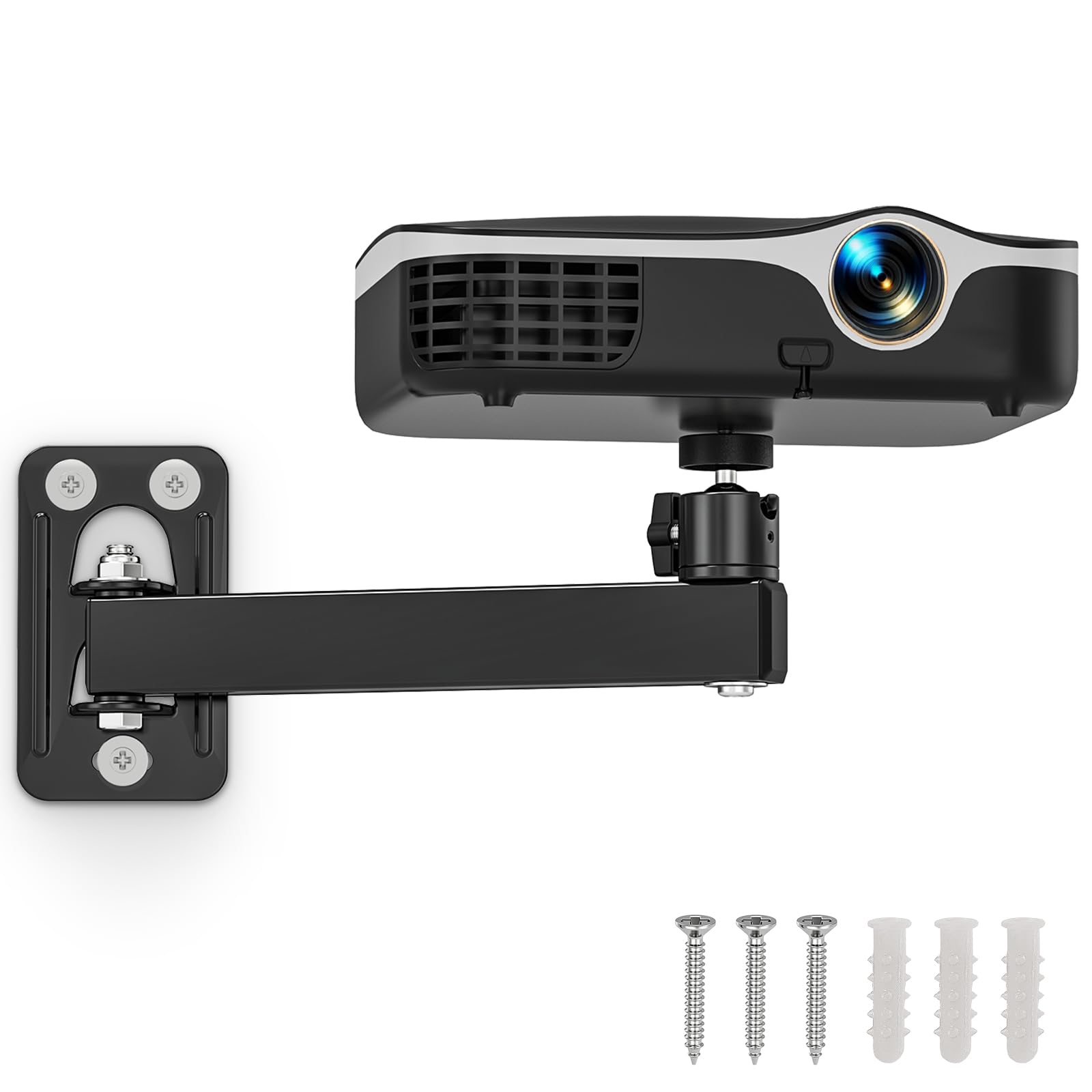
The folding arm is what makes the BAISHUN CJX-109-US useful in a small room. It mounts to the wall, holds a mini projector on a 1/4-inch thread, and swings the projector back toward the wall when you want the room to do something else.

The head rotates 360 degrees, tilts 30 degrees up and 90 degrees down, and the arm adjusts through 180 degrees. That range is generous for a small bracket: you can aim at a screen on the opposite wall, angle down toward a table, or pull the projector out for a temporary setup without moving the base.

The 4.4-pound capacity is the boundary. A compact mini projector is fine; a full-size home-theater model is not. The three-hole base is simple to install, and the foldable design keeps the bracket compact when the projector is off.

We like it for a bedroom or office where the projector does not live on a permanent shelf. The foldable arm is the feature we keep coming back to, because it turns a fixed wall mount into something closer to a swing arm. We treat the included screws as a starting point and check them against the projector's thread depth before hanging anything.

Pros

  • Foldable arm saves space
  • 360-degree rotation and wide tilt range
  • 4.4-pound capacity for mini projectors
  • Simple three-hole wall mount

Cons

  • Not suitable for vaulted ceilings
Our verdict

We like the BAISHUN CJX-109-US for a small projector in a tight room: its folding arm saves space and aims easily.

Check Latest Price

How We Tested Projector Mounts

We started by pulling together the mounts that show up again and again in reviews and spec sheets, then filtered out anything with a vague weight rating, missing hardware, or a mounting pattern that fit only one brand. The final shortlist was 14 mounts, ranging from simple 1/4-inch-thread brackets to ceiling and wall models with extending arms and adjustable joints. We chose that range on purpose: some people are hanging a full-size home theater projector, and some just want a mini projector off the coffee table.

Each mount went into a real room: a living-room ceiling with wood joists, a basement office ceiling, and a bedroom wall. We used three projectors of different sizes and weights, including a mini model with a 1/4-inch thread and a full-size projector with standard mounting holes. We timed how long a solo install took, checked whether the included screws matched the holes on the mount and the projector, and noted every time we had to dig through our own hardware bin.

Then we lived with them for four months, using them for movie nights and work calls and checking for drift after each session. We moved each mount through its full tilt, swivel, and rotation range to see how much fine adjustment it offered, then tightened the joints and watched whether the projector stayed put. We also gave each mounted projector a gentle nudge to check for wobble and re-checked after a month to see if anything had sagged.

At the end, we compared what each mount asked you to compromise: extra hardware, limited reach, a bulky profile, or a joint that needed re-tightening. The best ones were not the heaviest-rated or the most adjustable; they installed cleanly, held their aim, and felt solid for the money.

How to Choose a Projector Mount

Match the Mount to the Projector, Not Just the Brand

Universal arms are only universal within a stated span. Measure the distance between the threaded holes on the projector's bottom or back, then check the mount's minimum and maximum; the VIVO covers 5.25 to 12.5 inches, while the XINLEI starts at 2.83 inches for compact models. Single-thread projectors need a 1/4-inch mount like the suptek or Aurzen, not an arm cradle. Also check screw depth: a long recessed hole can make the included screws too short even when the pattern fits.

Choose the Mount Geometry Your Room Allows

A flush ceiling mount keeps the projector close to the ceiling and out of the way, but it gives you little room to reach the adjustments; a 5- or 6-inch profile like the VIVO or XINLEI is the usual compromise. An extending arm buys drop for a high ceiling, and a wall bracket helps when the ceiling is unavailable or the room is too small. Longer arms add leverage, so use the shortest drop that clears the sightline.

Adjustment Range Is Easy to Compare; Locking Is Not

Tilt, swivel, and rotation figures tell you where the projector can point, not whether it stays there. A mount with +/-15 degrees of tilt and a firm locking collar is more useful than a wider range that creeps after you tighten it. Look for a bracket with accessible lock nuts and a plate that tightens against the projector, then test the image after a gentle nudge before you finish the install. The Mount-It! MI-604 is a reminder to check the actual adjustment axes, not just the 360-degree rotation claim.

Plan the Ceiling Structure and the Cable Route

A projector mount has to attach to something structural: a joist, a concrete slab, or a reinforced drop-ceiling grid. Drywall alone is not a safe anchor for a hanging projector, and the included drywall plugs are not a substitute for framing. For a suspended ceiling, a 2-by-2 panel like the Amer Mounts kit spreads the load across the grid; for a finished ceiling, locate the joist before you drill. Leave room for HDMI and power to run along the arm or through a cable channel.

Frequently Asked Questions

Final Verdict

Start with the VIVO MOUNT-VP01W if you want one mount that handles most home-theater projectors without fuss. Its 30-pound capacity, low profile, and broad arm span cover the common cases, and the quick-release hooks make installation easier than the simple design suggests.

If your room has a low ceiling or a compact projector, the XINLEI PR14W is the closer-fitting alternative; for a heavy projector that needs a long drop or wall mount, choose the PEGZONE HWO1005BK. The deciding measurement is still your projector's hole pattern.