Best Smart Self-Watering Pots of 2026

The fastest way to kill a houseplant is to love it too much. Overwatering rots roots, and self-watering pots, the usual fix, often just relocate the problem, leaving soil soggy for weeks or a reservoir bone dry while the top of the pot still feels damp. A good one keeps the root zone evenly moist and lets you see what's going on under the soil line.

I have a pothos on a north-facing desk that has survived three moves and one radiator-dry apartment, so I'm a hard sell on anything claiming to water itself. Over five months, my team and I grew basil, pothos, and African violets in 14 self-watering planters, refilling reservoirs instead of reaching for the watering can.

Worth knowing: these pots work only as well as the mix inside them. Dense, peat-heavy soil wicks poorly and stays wet at the bottom, while a chunky, airy mix pulls moisture up evenly. Thin walls, loose saucers, and inner baskets that slide out when you lift the pot were the other quiet dealbreakers, and the picks below got all of it right.

1

Best Overall

YNNICO Self-Watering Planter Set (6-Piece)

93 /100
LBD Score Outstanding

Key details

Material
Matte black polypropylene
Watering
Cotton wick in bottom tray
Pot Sizes
8, 7, 6.5, 6, 5.5, 5 inches
Set Includes
6 pots, trays, and wicks
View on Amazon

Six pots, one in each size from 5 to 8 inches, in one of the least expensive sets here — that combination is why this YNNICO set is our top pick. Almost all indoor repotting happens inside that range, and the half-inch steps mean a plant that has outgrown its nursery pot has somewhere to go without a second order. It also solves a whole shelf at once: the 5-inch pot takes the cutting, the 8-inch takes the plant it becomes.

The watering side is deliberately low-tech, and we think that is the right call for something that lives on a shelf. A cotton wick drops into the bottom tray, the drainage holes let water move up into the soil, and whatever the plant does not drink stays in the tray instead of on your windowsill. It also means these behave like ordinary pots: top-water them and let the tray catch the runoff, or fill the tray and let the wick work for a week or two.

Polypropylene with a matte finish, a little over a kilogram for the set, and walls thick enough that a pot full of wet soil does not bow when you carry it. The black is the plainest finish on this page, which is what we want from six pots lined up on a sill — they read as furniture rather than decor.

What you give up is feedback. There is no window and no float, so the only way to know the tray is dry is to lift the pot and judge the weight, and the drainage holes are your fallback when you do not want to think about it at all.

Pros

  • Six sizes from 5 to 8 inches in one set
  • Wick and drainage allow bottom or top watering
  • Sturdy matte plastic that holds its shape
  • Budget price for six pots with trays

Cons

  • Nothing above 8 inches for floor plants
Our verdict

Our pick for most people: six sizes from 5 to 8 inches, a wick and drainage that let you water either way, and sturdy plastic that holds its shape.

Check Latest Price
2

Best for Large Houseplants

QRRICA Self-Watering Pots (5-Pack)

92 /100
LBD Score Outstanding

Key details

Finish
Matte white plastic
Watering
Wick feeder, up to 2 weeks
Pot Sizes
10, 9, 8, 7.5, 7 inches
Set Includes
5 pots, saucers, and wicks
View on Amazon

Ten inches across at the top of the range is the reason to choose this QRRICA set over our top pick. A monstera, rubber plant, or fiddle-leaf that has outgrown an 8-inch pot needs volume as much as it needs water, and the 7, 7.5, 8, 9, and 10-inch pots here cover the jump from shelf plant to floor plant in a single purchase.

The watering design is the part we prefer. Each pot takes a removable wick feeder that pulls from its own reservoir, and QRRICA puts the run time at up to two weeks — a fair ceiling for a slow-drinking plant in a cool room, less so for anything pushing new leaves in July. Because the feeder lifts out, a clogged wick is a replacement rather than a reason to retire the pot.

Matte white, mesh drainage holes, and a saucer under each one. The mesh earns its place: it keeps soil out of the reservoir while letting water through, so you are not growing a layer of silt in the bottom. Empty, they are light; planted, a 10-inch pot is still manageable to carry to the tub for a rinse.

The footprint is the price of the size. A 10-inch pot wants floor space or a deep shelf, and the saucers are wide enough that a crowded plant stand gets awkward in a hurry.

Pros

  • Pots up to 10 inches for floor plants
  • Removable wick feeder can be replaced
  • Mesh drainage keeps soil out of the reservoir
  • Light enough to move when planted

Cons

  • No water-level indicator; refills go by weight
Our verdict

Buy this set when the plant you are rescuing has outgrown an 8-inch pot; the 10-inch size gives a monstera or rubber plant root room smaller sets cannot.

Check Latest Price
3

Best for Patio Plants

Fielda 8/10/12 Inch Self-Watering Pots

92 /100
LBD Score Outstanding

Key details

Use
Indoor and outdoor
Drainage
Removable saucer trays
Watering
Cotton wick with water-level window
Pot Sizes
8, 10, 12 inches
View on Amazon

The first thing you notice is the window cut low on the side of the pot, right where the reservoir sits. Fielda's set comes in 8, 10, and 12-inch sizes — statement-plant territory — and each pot pairs that sight glass with a cotton wick and a removable saucer tray.

Fielda makes these from a high-temperature-resistant plastic and lists them for indoor and outdoor use, which is a different proposition from the thin nursery plastic elsewhere on this list. A 12-inch pot on a covered porch, holding herbs or a small tree, is exactly the job it is shaped for, and the plastic is built to shrug off sun and rain rather than fade through a season.

We rate this as the patio pick of the group, and the window is most of the reason. Outside, a pot dries faster and the plant is usually bigger, so reading the reservoir at standing height beats kneeling to lift 12 inches of wet soil. Indoors it does the same job for a fiddle-leaf in a bright corner.

The catch is scale. Eight inches is the smallest pot in the set, so nothing here suits a violet or a 4-inch cutting; this is the set you buy for the big plants and fill in around with something smaller.

Pros

  • Water-level window you can read standing up
  • Three large sizes for floor plants
  • Cotton wick with removable saucer trays
  • Plastic rated for sun and rain

Cons

  • Starts at 8 inches, so nothing for small plants
Our verdict

The one to take outdoors: 8, 10, and 12-inch pots with a water window you can read standing up, in plastic built for sun and rain.

Check Latest Price
4

Best for Propagation

Bluepro Clear Self-Watering Pots (18-Pack)

90 /100
LBD Score Outstanding

Key details

Body
Clear plastic
Watering
Wick, up to 7 days
Pot Sizes
4, 5, 6.5 inches
Set Includes
18 pots, trays, and wicks
View on Amazon

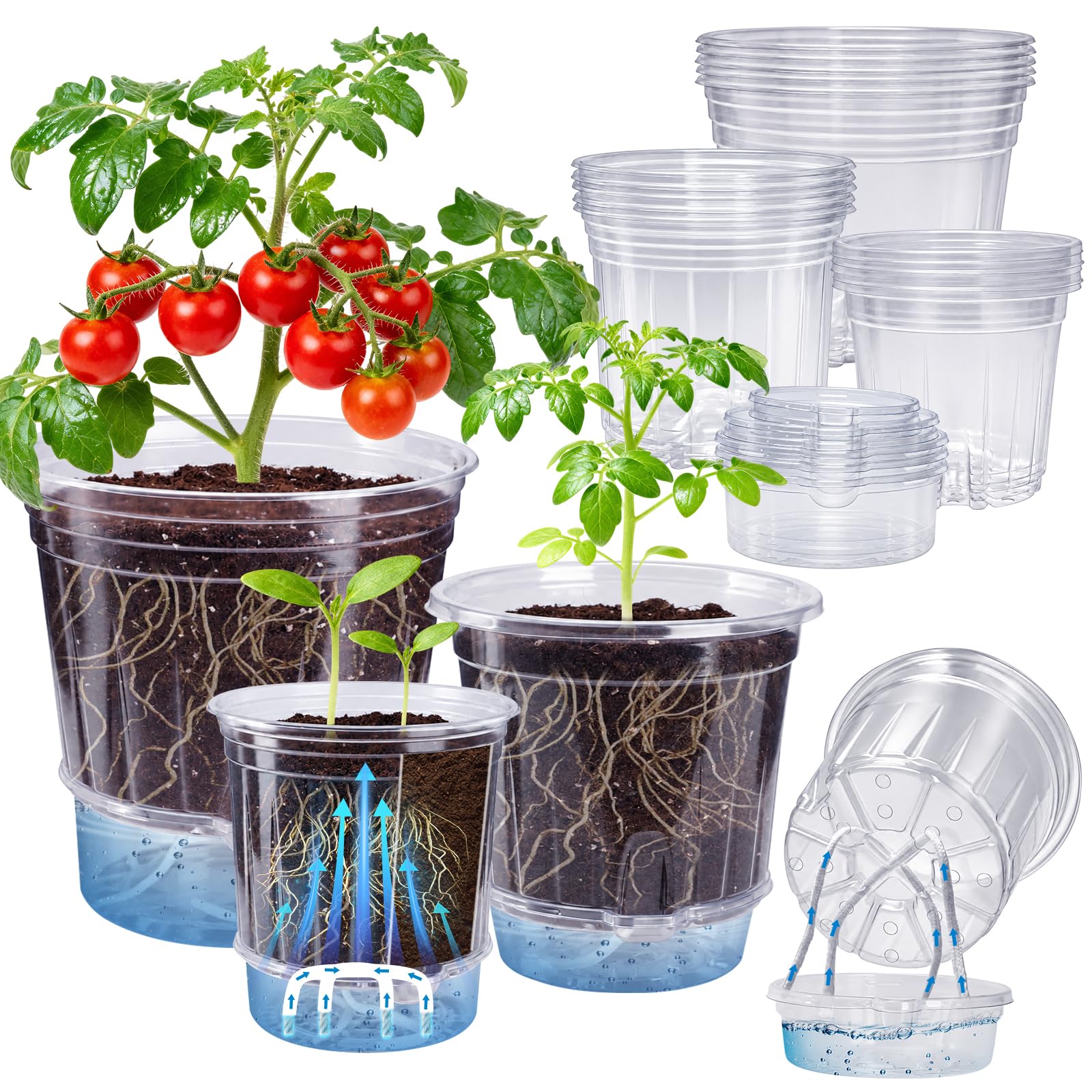
Clear plastic, six pots each in 4, 5, and 6.5 inches, every one with a reservoir tray and a wick already fitted. This is a propagation and nursery set rather than a display set, and it is the one we reach for when the question is whether a cutting has rooted rather than how it looks on a shelf.

The visibility is the feature we valued most. Because the body is clear, the water in the tray shows without lifting anything — the same information a gauge gives you, minus a mechanism that can stick or go missing. Watching roots reach the side of a 4-inch pot also settles the repotting question faster than tugging at the stem to see whether it holds.

The wick pulls from the tray and Bluepro rates the supply at up to seven days, an honest figure for a small pot in a warm room. The trade-off is the plastic: the walls are thin and flex when you squeeze them, which helps when you are popping out a root ball and is less reassuring when a 6.5-inch pot full of wet soil is going up on a high shelf.

Keep them out of direct sun. Clear plastic and standing water is the combination that turns a reservoir green, and these do better in bright indirect light, where you can still see everything happening at root level.

Pros

  • See roots, soil, and water without lifting
  • Six pots in each of three sizes
  • Wicks and reservoir trays included
  • Washable and reusable across plant stages

Cons

  • Thin walls flex under a full pot
Our verdict

Choose the 18-pack if you propagate, start seeds, or rehab cuttings: clear walls show roots and reservoir water at a glance, and thin plastic does not matter here.

Check Latest Price
5

Best for African Violets

Planterhoma 5 Inch Self-Watering Pots (10-Pack)

91 /100
LBD Score Outstanding

Key details

Material
White plastic
Pot Size
5 inches
Water Level
Indicator on the outer pot
Set Includes
10 pots with wicks
View on Amazon

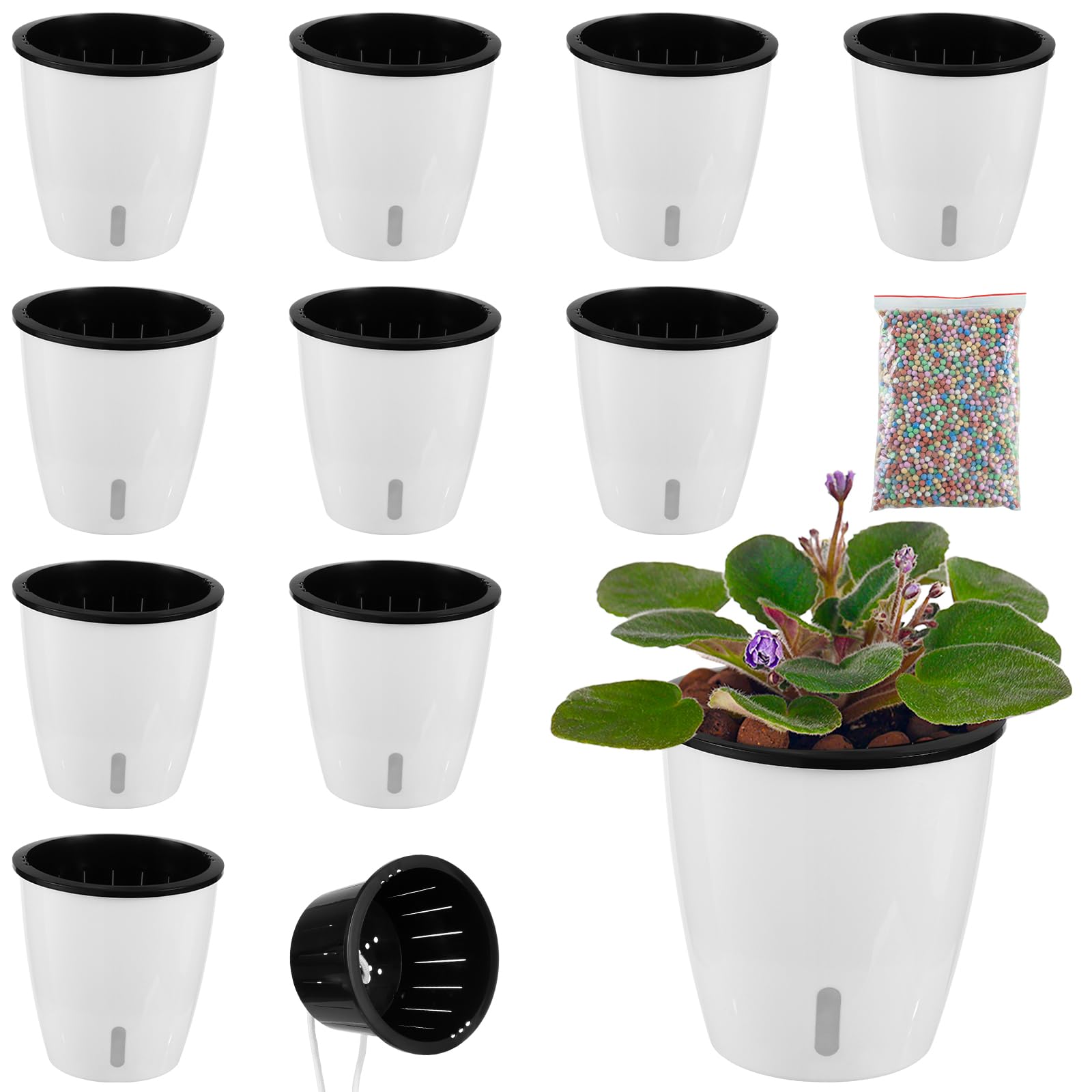
Ten five-inch pots, each with a wick and a water-level indicator, at the lowest cost per pot of anything here that is not clear nursery plastic. If you keep a shelf of African violets, that arithmetic is the argument. The design backs it up: a violet wants steady moisture at the roots and dry leaves, which is exactly what a reservoir under a wick delivers.

Each pot is two layers — a black inner pot for soil, a white outer pot for water — with the indicator set where you can read it without lifting anything. The inner pot pulls out easily for a look at the roots or a top-up, and the whole thing is light enough that a windowsill of ten does not feel like a shelf of terracotta.

Plant something top-heavy, a violet that has gone broad and lush, and the light outer pot can feel tippy once the reservoir runs low. Set them back from the edge of the shelf rather than right up against the glass, and that is the end of the problem.

Pros

  • Ten pots at a low per-pot cost
  • Water-level indicator on every pot
  • Inner pot lifts out for root checks
  • Suits violets, orchids, and cuttings

Cons

  • Only one size: 5 inches
Our verdict

For a windowsill of African violets: ten 5-inch pots with readable water indicators and a wick that keeps moisture at the roots and off the leaves.

Check Latest Price
6

Best Looking

D'vine Dev Terracotta Self-Watering Pot (2-Pack)

90 /100
LBD Score Outstanding

Key details

Pot Size
6 inches
Watering
Porous terracotta, no drainage hole
Water Level
Visible through the glass
Set Includes
2 terracotta pots and glass cups
View on Amazon

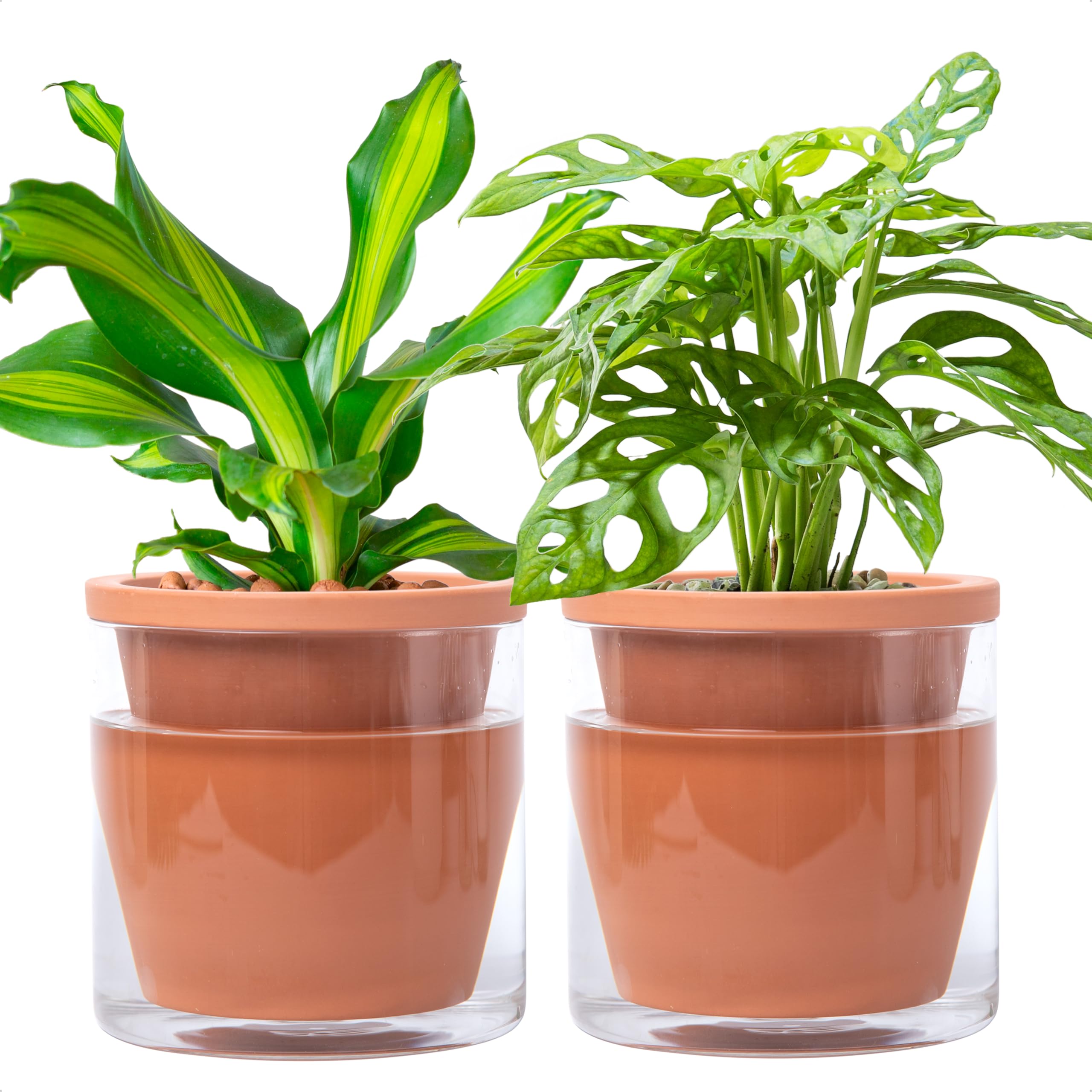
An unglazed terracotta pot sitting in a clear glass cup. There is no wick and no drainage hole: the clay is the wick, drawing water up through the porous wall as the soil dries, and the glass shows how much is left.

The proportions are what make it work. Six inches of terracotta sits flush in the cup, so the pot reads as one object rather than a plant in a bucket, and the unglazed clay darkens as it takes up water — a quiet signal that the system is running.

Two things to know first. Without a drainage hole you cannot top-water or flush the soil; the plant gets what the clay pulls and nothing else, which suits violets, herbs, and small ferns and frustrates anything that wants a fast dry-out. And the taper means the inside holds less than a 6-inch nursery pot, so a plant with a wide root ball needs the next size up.

It is also the costliest per pot here by a distance, which is the whole question: easy to justify on a desk or side table where people actually see it, harder to justify across a shelf of utility plants.

Pros

  • Terracotta and glass look genuinely good
  • Porous clay waters without a wick
  • Water level visible through the glass
  • No drainage hole means no drips

Cons

  • No drainage hole, so no top-watering or flushing
  • Inside is narrower than a 6-inch nursery pot
Our verdict

Buy the pair if you want self-watering that looks like pottery, and your plants — violets, herbs, small ferns — like steady moisture rather than a soak and a dry-out.

Check Latest Price
7

Windowsill Plants

Fielda 6 Inch Self-Watering Pots (5-Pack)

90 /100
LBD Score Outstanding

Key details

Drainage
Holes with removable trays
Pot Size
6 inches
Water Level
Window on the side
Set Includes
5 pots, trays, and labels
View on Amazon

Six inches is the workhorse size for houseplants that have been around a while, and this Fielda five-pack is aimed at exactly that shelf: medium pothos, philodendron, snake plants, and the herbs you keep near the kitchen window.

Each pot has a water-level window, a cotton wick, drainage holes, and a removable tray, plus five plant labels in the box. We were skeptical about the labels and then found them genuinely useful — five identical black pots on one shelf is a naming problem, and a marker pen settles it in about a minute.

The set is one size, so it is for moving five medium plants into better pots rather than building a collection from scratch; for that, the six-size YNNICO set covers more ground.

Where it earns its place is the combination of a readable window and a pot that stays put when a plant leans, plus a matte black finish that disappears against a bookshelf. For a first set of five plants that all want the same treatment, this is the one we hand people.

Pros

  • Window shows the water without lifting
  • Drainage holes plus removable trays
  • Labels included for a shelf of lookalikes
  • Sturdy enough that a full pot stays put

Cons

  • Raised drainage bump under the root ball
Our verdict

Buy this pack for five medium houseplants: the window and wick take the guesswork out of watering, and the labels keep a row of black pots straight.

Check Latest Price
8

Violets and Orchids

Vanavazon 6 Inch Self-Watering Pots (3-Pack)

91 /100
LBD Score Outstanding

Key details

Pot Size
6 inches
Watering
Cotton wick, double layer
Water Level
Visible reservoir
Set Includes
3 pots with wick ropes
View on Amazon

Two pieces: a planted inner pot and an outer reservoir that seats underneath, with a cotton wick running between them. On paper it is the tidiest self-watering arrangement here, because soil never sits in water and the level shows through the outer pot. In practice the joint is the weak point. The halves need a firm, even push to mate, and lifting the pot by the rim alone can leave the reservoir behind.

The parts that matter do work. The reservoir holds water away from the crown, which is what a violet needs, the wick keeps the root ball evenly damp, and the pot looks better than most of the plastic here — rounded, clean white, not obviously inexpensive.

Seat the two halves on a flat surface, press down from the top with both hands, and carry the finished pot from the base. Do that and it is a tidy home for a violet or a small orchid on a windowsill; skip it and you get water across the shelf, which is the kind of thing that puts people off self-watering pots altogether.

Pros

  • Double layer keeps soil out of the water
  • Cotton wick rope included
  • Water level visible from the side
  • Looks better than most plastic pots here

Cons

  • One size, and only three pots in the pack
Our verdict

A neat, good-looking 6-inch pot for violets and small orchids, with the reservoir held away from the crown, so long as the two halves are properly seated.

Check Latest Price

What Five Months With 14 Self-Watering Pots Taught Us

To build the shortlist, I started where a shopper starts: the two designs that dominate the category, a wick pot with an inner basket that sits down into a reservoir and a single pot with a built-in reservoir and a side window. From there I filtered by size, something that fits a windowsill, a bookshelf, or a standard nursery pot without repotting, and cut anything without drainage holes, since even a self-watering pot needs a way to flush salt buildup.

Fourteen planters ran for five months in the places these pots actually live: a kitchen windowsill of basil, a north-facing desk with pothos, a bedroom nightstand with an African violet, and a bathroom shelf. I filled each reservoir to its line, then checked moisture two inches down every third day, noting whether the top of the soil stayed dusty while the bottom went sour, whether water stood in the reservoir, and whether the wick stayed in contact with water rather than drying out above it.

Thickness and secure attachment separated the winners fast. I squeezed the rim and sides of each pot to see which walls flexed and which cracked, then lifted each one by the outer pot after watering to see whether the inner basket, saucer, or wick assembly stayed put or dropped out. I also set every pot on a bright shelf and a shaded sill to judge how seams, water windows, and visible reservoirs read in daylight.

The last check was a nine-day trip with every reservoir topped off, which showed which plants came back standing and which had bone-dry soil or a swamp at the bottom. Cost per pot in a multi-pack, and whether saucers and spare wicks came included, settled the rest.

How to Choose a Self-Watering Pot

How Long You Want to Go Between Refills

The reservoir is only half the equation, because the plant is the other half. A wick moves water as the soil dries, so a resting pothos in a cool room can stretch a full tray for two weeks while the same pot in July empties in days. QRRICA rates its wick feeder at up to two weeks and the clear propagation sets at seven days. If you travel, buy the largest reservoir that fits and pair it with a plant that is not in active growth.

Whether You Want to See the Water

There are three ways to know: a window or indicator on the pot, a clear body you can look through, or a hand on the rim to judge the weight. The first two are worth a little more money if you forget to water, because lifting a 12-inch pot of wet soil to check is the point where self-watering stops being convenient. Our top pick relies on weight and works fine at 5 to 8 inches; at Fielda's 12 inches, the window earns its keep.

Sizing the Pot to the Root Ball

Measure the nursery pot across its top, not the plant across its leaves, then go up an inch or two. Watch two traps. A stated size can describe the outside of the pot: D'vine Dev's 6-inch terracotta tapers, so the inside holds less than a 6-inch nursery pot. And thin clear plastic flexes, which is fine for a cutting and less so for a lopsided plant on a high shelf. Half-inch steps, as on our top pick, help with plants that fall between sizes.

Where the Water Goes

Two designs, two different messes. A pot with drainage holes and a separate tray lets you water from the top, but the tray can overflow onto furniture, so empty it after watering. A sealed reservoir, like D'vine Dev's glass cup or any double-layer pot, keeps water away from the soil and nothing drips, but nothing flushes either, so minerals accumulate. On wood, choose the sealed design or set the pot in a saucer you trust.

Which Plants Actually Like a Wick

Constant, even moisture suits African violets, ferns, peace lilies, orchids in bark, and most aroids. It does not suit succulents, cacti, or anything that wants to dry out completely, because the wick keeps delivering while the roots stay wet. For leca and pon, a double-layer pot with an inner basket, like Planterhoma's, is easier to work with. For everything else, a chunky mix with perlite stops the wick from over-delivering.

Frequently Asked Questions

Final Verdict

If you want one set that handles most of a houseplant collection, buy the YNNICO six-pack. The 5-to-8-inch spread covers the repotting most of us actually do, and the wick plus drainage means you can water from the top or the bottom.

For a plant that has outgrown everything, step up to QRRICA's 10-inch pots, which give a monstera or rubber plant the root room smaller sets cannot. And if the pot itself is the gift, the terracotta-and-glass pair is the one people keep.