Best Smart Thermostats for Heat Pumps of 2026

A heat pump is a patient machine. It raises the temperature of a house gradually, pushing out air that feels closer to lukewarm than hot, and that patience is precisely what most thermostats don't have. When a room sits a degree below setpoint, a dumb or badly configured thermostat panics and calls for the backup electric strips — the most expensive heat in the house, and the reason some people's January bill looks like a mortgage payment. The right thermostat for a heat pump is one that knows how to wait, and that hands you the controls to decide exactly when the strips are allowed to fire.

I've lived with heat pumps in drafty old houses and in tight new construction, and the lesson is always the same: what's printed on the box matters less than how the thing is configured for your system. Stage counts, auxiliary lockout, remote sensors that read the cold bedroom instead of the hallway, and an app you can actually operate at 11 p.m. are what separate a good match from a frustrating one. My team and I installed 12 smart thermostats across eight months, on systems ranging from a single-stage heat pump to a dual-fuel setup with a gas furnace as backup, and the differences showed up fast.

Some of these are for people who want to set a schedule once and never think about it again; others reward a homeowner who enjoys tuning stage delays and differentials. The list below is sorted by that instinct as much as by anything else.

1

Best Overall

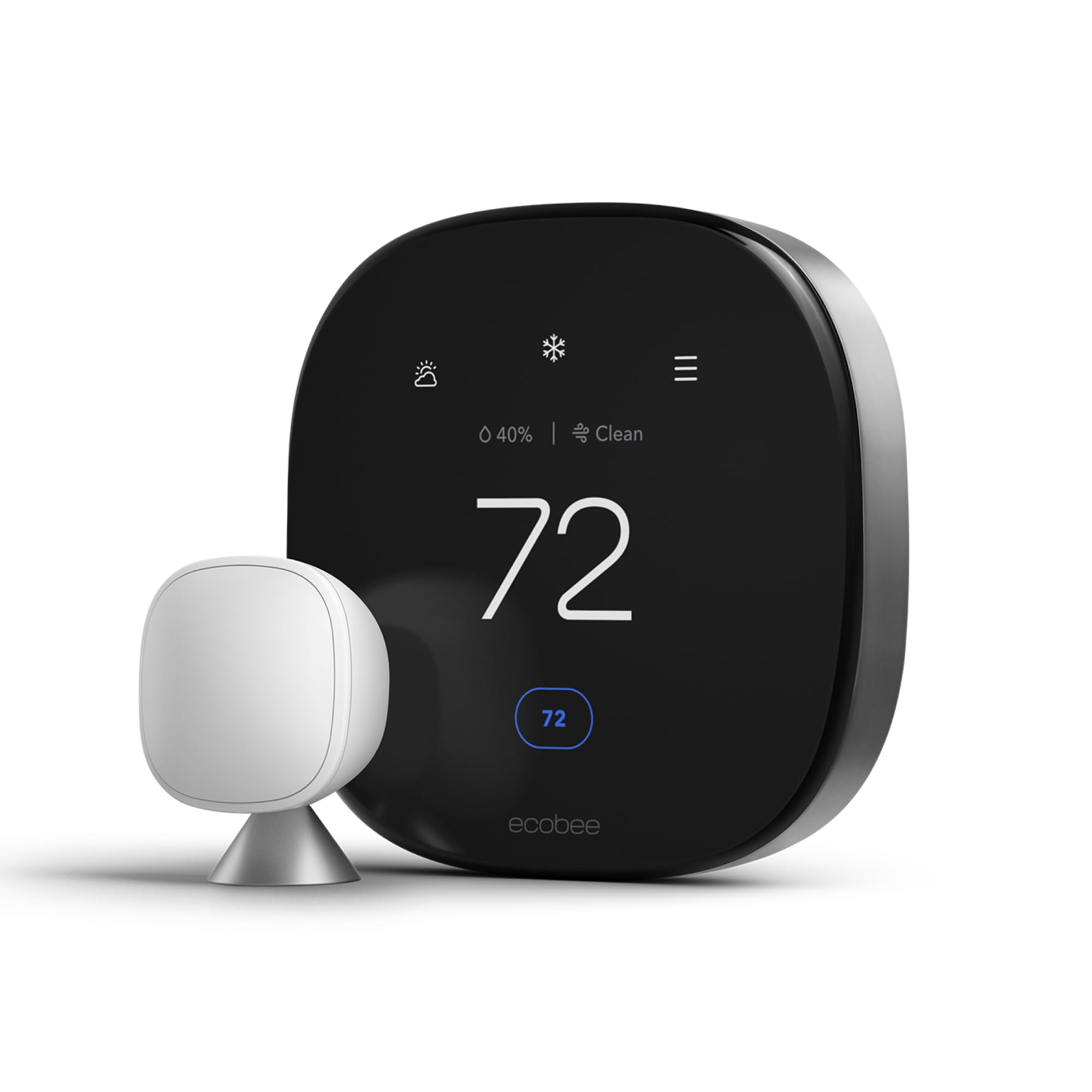
ecobee Smart Thermostat Enhanced

89 /100
LBD Score Excellent

Key details

C-wire
Power Extender Kit included
Warranty
3 years
Smart Home
Alexa, Siri, Google Assistant
System Support
Air conditioner, boiler, furnace, heat pump, humidifier
View on Amazon

The piece of this kit we care about most for a heat pump is the small adapter in the box. Plenty of heat pump installs leave four wires at the wall and no spare conductor for a C wire, and the Power Extender Kit borrows the wires you already have to keep the thermostat powered. With the trim plate and the wire labels, the whole retrofit is designed to be finished in an afternoon by the person who owns the house.

That's why it's our top pick for heat pump systems. Heat pump is on ecobee's own list of supported systems, the company puts compatibility at 90% of HVAC equipment, and the app walks you through the wiring terminal by terminal, including a reminder to photograph the old connections before you disconnect anything. Once it's running, occupancy sensing does the daily work: it eases off when the house is empty and can preheat or precool before you walk in.

One thing to settle before you order. A heat pump with combined wires or a proprietary communicating control won't work with it, so run ecobee's compatibility checker with your outdoor unit's model number in hand rather than guessing from the wire colors at the wall. That single step is the difference between a thermostat that installs in an hour and one that goes back in the box.

Pros

  • Power Extender Kit included for no-C-wire installs
  • App walks through wiring step by step
  • Occupancy sensing and preheat built in
  • Three-year manufacturer warranty

Cons

  • Room sensor sold separately
  • Early failures turn up on some units
Our verdict

Buy this one if your heat pump has to work with the wires already in the wall: the adapter is in the box and the app handles the rest.
Check Latest Price
2

Best Budget

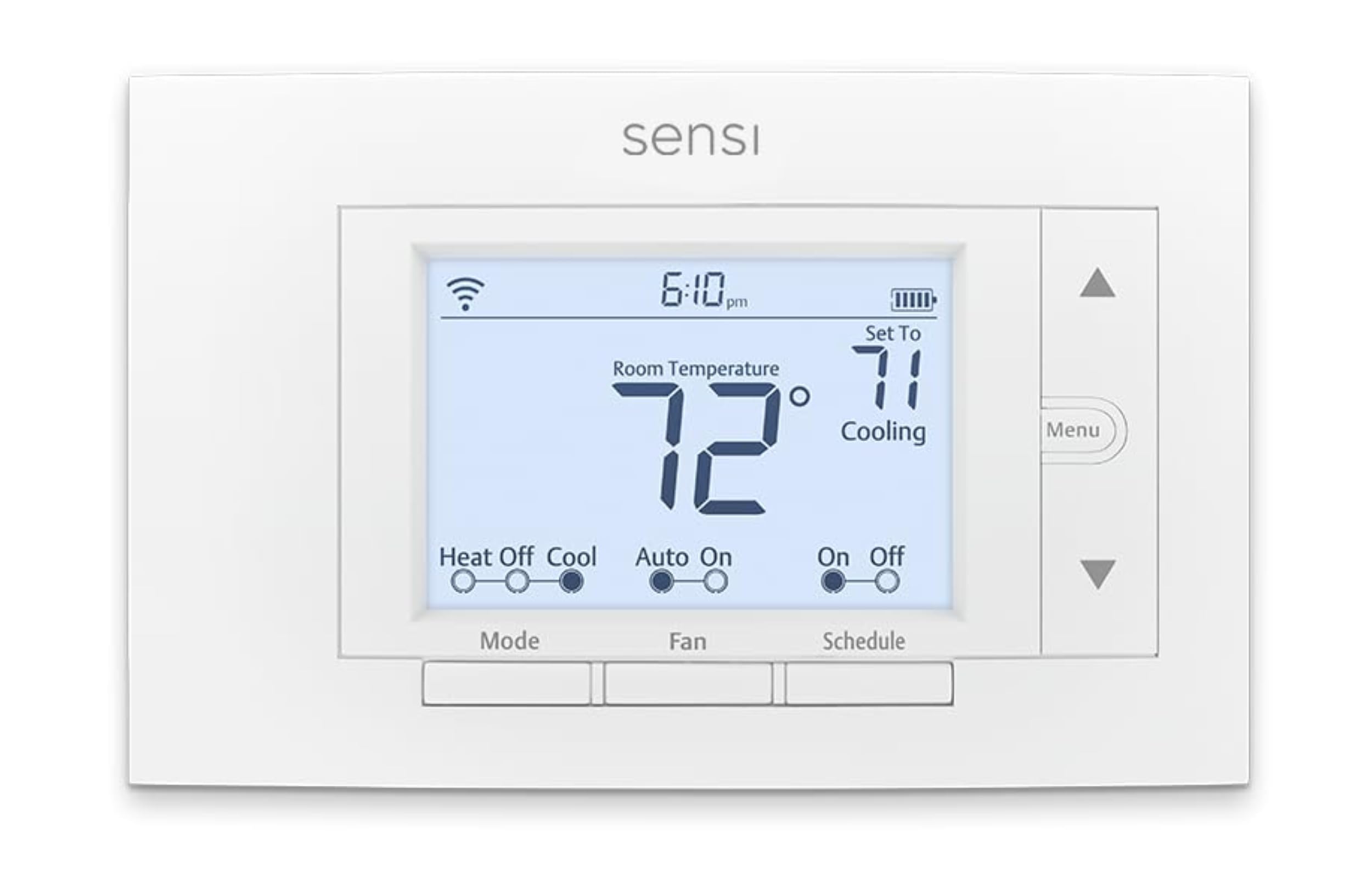
Sensi Smart Thermostat ST55

89 /100
LBD Score Excellent

Key details

Power
2 AA batteries included
Warranty
3 years
Smart Home
Alexa, Google Assistant, HomeKit, SmartThings
System Support
Air conditioner, boiler, furnace, heat pump
View on Amazon

Four wires at the wall and no C terminal is the most common reason a heat pump owner gives up on a smart thermostat, and the Sensi is our budget answer to it. It runs on the two AA batteries in the box, so there's no adapter to buy and no fifth wire to fish through the wall. It also fits the footprint of the thermostat you're replacing, which means no patching and painting around a smaller plate.

The rest is deliberately plain: buttons instead of a touchscreen, a 5-inch display, and an app that handles scheduling, usage reports, and a maintenance nudge when the filter is due. It works with Alexa, Google Assistant, HomeKit, and SmartThings, and Sensi's promise not to sell your personal information is a small thing that matters more than it used to.

We rate it the value pick rather than the default for one reason: the radio is the weak part of an otherwise easy sell. When the connection holds, this is the simplest thermostat in the group to live with and one of the easiest to install — the built-in level is a genuinely nice touch — but a thermostat that keeps falling off the network is a dumb thermostat with a good app. With the router in the next room and modest expectations, the savings are real.

The battery-only install is also the one to watch. Short cycling can show up in that configuration, so give it a week before you trust the schedule you built, and land the C wire if your wall has one to spare.

Pros

  • Installs without a C wire on battery power
  • Built-in level and app-guided setup
  • Works with all four major platforms
  • Three-year warranty at a budget price

Cons

  • Wi-Fi can drop and need re-pairing
Our verdict

Our budget pick for a heat pump with no C wire — just expect the network connection to be the least reliable part of it.

Check Latest Price
3

Best for Two-Stage and Dual Fuel

Honeywell Vision Pro 8000

88 /100
LBD Score Excellent

Key details

C-wire
Required
Staging
Up to 3 heat/2 cool
Smart Home
Alexa
View on Amazon

This is the one we point at when the heat pump has a gas furnace behind it. Staging up to 3 heat and 2 cool is more than anything else in this group offers, and it's what a two-stage heat pump with a backup furnace asks for: the thermostat has to run the compressor stages, call for backup heat when it should, and stay out of the furnace's way when it shouldn't. Under-buying here is how a system ends up leaning on the wrong heat source all winter.

The trade-off is that this is a contractor's thermostat. It needs a C wire, the interface is a touchpad with menus organized for whoever commissioned the system, and remote control runs through Honeywell's connected-service platform rather than the polished consumer apps elsewhere on this page. What you get for that is hardware that feels like it belongs in a mechanical room rather than a hallway, and a record with the people who install HVAC for a living.

One condition is worth knowing before you decide between this and a cheaper pick: Honeywell's five-year manufacturer coverage applies with proof of professional installation. Have it installed, keep the invoice, and this becomes the best-protected thermostat in the group by a wide margin.

Pros

  • Up to 3 heat/2 cool staging
  • Handles a heat pump with furnace backup
  • Five-year manufacturer warranty with pro install
  • Alexa voice control

Cons

  • Requires a C wire
  • Menus built for installers, not homeowners
Our verdict

The pick for a two-stage heat pump or a heat pump with a furnace behind it, and worth having installed to keep the five-year coverage.

Check Latest Price
4

Best Design

Google Nest Learning Thermostat (4th gen)

88 /100
LBD Score Excellent

Key details

C-wire
Not required in most homes
Smart Home
Alexa, Siri, Google Assistant
Room Sensor
Nest Temperature Sensor (2nd gen) included
System Support
Most 24V systems, including gas, electric, oil, forced air, heat pump, and radiant
View on Amazon

The 4th-gen Nest is the one people notice. The polished ring, the larger display, the way the screen wakes as you walk past — it's the only thermostat here a guest would comment on, and if it's going in a hallway rather than a utility closet, that counts for something.

This bundle adds the Nest Temperature Sensor, and for a heat pump house we think that's the more useful half. A bedroom over the garage that never matches the hallway is the classic heat pump complaint, and the sensor lets the thermostat average the two rooms or favor the one you're actually in. Heat pump is on the compatibility list, and Nest says most homes won't need a C wire.

Two things keep it off the top spot for us. The 4th gen lives in the Google Home app and doesn't appear in the older Nest app, which is a real adjustment if you're upgrading from a previous Nest. And the premium buys the finish and the sensor rather than more heat pump capability, so what you're paying for is how it looks and where it measures. Calibrate it against a room thermometer in the first week — a few of these run a couple of degrees off, and that's the sort of thing you want to find out in October rather than January.

Pros

  • Temperature sensor included in the bundle
  • The best-looking thermostat in this group
  • No C wire needed in most homes
  • Works with all three major assistants

Cons

  • Runs only in the Google Home app
  • Premium price for the finish and sensor
Our verdict

Buy it for the finish and the bundled sensor; the heat pump support is solid but no deeper than the cheaper ecobee's.

Check Latest Price
5

Sensors and Alexa

ecobee Smart Thermostat Premium

87 /100
LBD Score Excellent

Key details

C-wire
Power Extender Kit included
Smart Home
Alexa, Siri, Google Assistant
Room Sensor
SmartSensor included
System Support
Air conditioner, boiler, dehumidifier, electric baseboard heater, furnace, heat pump, humidifier
View on Amazon

Think of the Premium as our top pick with a sensor in the box, a metal body, and Alexa built into the unit itself. The sensor is the part a heat pump owner should care about: it goes in the room that never matches the thermostat's reading, and the system works from that room instead of the hallway. Bought separately, that sensor is a meaningful chunk of the price difference.

The extras are real but quirkier than the price suggests. You can stream a video doorbell on the screen and ask Alexa to play music from a wall in your hallway, which is either delightful or beside the point depending on your house, and the air quality readout is a pleasant bonus rather than a reason to buy. The 95% compatibility figure is the highest in this group, and the Power Extender Kit is still included for a wall without a C wire.

Whether it's worth the step up depends entirely on the house. If two rooms disagree all winter, the bundled sensor makes this the cheaper way to solve it and the Premium makes sense. If your system is straightforward and you just want the heat pump handled properly, the Enhanced does the same job and takes a sensor later — and this is the pick on the page we're least sure of over five years, which is a strange thing to pay more for.

Pros

  • SmartSensor included in the box
  • Highest compatibility claim in this group
  • Alexa and Siri built into the unit
  • Power Extender Kit still included

Cons

  • Temperature readings run several degrees off on some units
  • The most expensive pick in this group
Our verdict

Worth the extra only if you want the bundled sensor and built-in Alexa — otherwise the Enhanced does the same heat pump work for less.

Check Latest Price

How We Tested Smart Thermostats for Heat Pumps

We started by pulling compatibility documentation for every major model and filtering hard: if a thermostat couldn't be configured for at least two heating stages plus auxiliary heat, or couldn't control when that auxiliary heat kicked in, it didn't make the cut. That left 12 units, which we installed in homes with air-source heat pumps — single-stage, two-stage, and one dual-fuel system — and lived with for eight months, from the first cold snaps of heating season through the first weeks of cooling.

Installation was timed and done solo first. We killed the breaker, photographed the existing wiring, and ran each unit's own compatibility check before touching a terminal, then noted whether the house had a C-wire, what the workaround was if it didn't, and how long the whole job took. After the plate went on, we looked at it in daylight — the gap against the drywall, the finish, whether the screen was legible from across the room.

To judge temperature control, we placed standalone data loggers in the coldest bedroom and the warmest room and compared them against the thermostat's own reading and its remote sensors. During cold snaps we watched auxiliary heat runtime in each app's history and cross-checked it against the meter. We tested wifi by pulling the router mid-afternoon, splitting the bands, and walking to the far corner of the house to see whether schedules kept running locally and whether reconnection was automatic. Then we handed the app to a family member who doesn't enjoy this stuff and asked them to change a weekday schedule. We logged every reboot, dropped sensor, and squint-worthy menu along the way — and counted a subscription or a forced pro install against the sticker price.

How to Choose a Smart Thermostat for a Heat Pump

Count the wires at the wall first

Pull the old thermostat off the wall and count conductors before you read another specification. A heat pump usually leaves four or five, and if there's no C wire among them, the thermostat you choose has to work without one. Two picks here solve it inside the box — the ecobee Enhanced and Premium include a Power Extender Kit, and the Sensi runs on AA batteries. The rest need a C wire or an added adapter, so this is the check that eliminates the most options.

Photograph the terminals before you disconnect anything. Those letters are the only record of which wire ran the reversing valve, and the setup app will ask.

Match the staging to your equipment

The terminal letters describe what your system can do: O/B is the reversing valve, AUX or E is backup heat, and Y2 or W2 means a second stage. A single-stage heat pump with electric backup is the common case, and most of this group fits it. A two-stage heat pump, or one paired with a gas furnace, needs more terminals and more logic — up to 3 heat/2 cool, which is the Vision Pro 8000's territory here. Buy below your system's staging and the thermostat cannot use equipment you already own.

What the smart features are worth on a heat pump

Two capabilities earn their keep: reporting and remote control. Usage reports show how long the system ran and when, which is where the auxiliary-heat question usually starts, and app control means you can shift a schedule without walking to the hallway. Room sensors matter more than screens do — a house with one room that never agrees with the thermostat gets more from a sensor than from a bigger display, and both the Nest bundle and the ecobee Premium include one.

Decide who installs it

Most of these are genuine do-it-yourself jobs: the ecobee app walks through the terminals one at a time and the Sensi ships with a built-in level. What changes the answer is the equipment, not your confidence. A dual-fuel setup, a communicating control, or a zoned system belongs to a technician, and some jurisdictions require a licensed installer for the low-voltage connection. Switch the air handler's breaker off before you touch a wire, every time.

Frequently Asked Questions

Final Verdict

Buy the ecobee Smart Thermostat Enhanced. For most heat pump houses the deciding factor isn't the screen or the assistant — it's whether the thermostat can be powered by the wires already in the wall and whether it will run auxiliary heat sensibly, and the Power Extender Kit plus a heat pump on the supported list answer both. Run the compatibility checker with your model number before you order, because that is the step that actually matters.

If you're heating with a two-stage heat pump, or a heat pump paired with a gas furnace, get the Honeywell Vision Pro 8000 instead: three heat stages, two cool, and the longest coverage here once it's professionally installed.