Best Smart Thermostats of 2026

A thermostat is the one thing in your house you touch every day and think about almost never—until it kicks the heat on at 6 a.m. while you're asleep, or you walk into a 62-degree living room because nobody told it otherwise. A smart one is supposed to fix that: it follows your schedule, adjusts from your phone, and trims a little off the bill. What the listings bury is that the gap between a great one and a maddening one usually comes down to the wiring already in your wall and whether the app still behaves six months in.

I've lived with three of these in a creaky old house whose boiler has opinions, and the install is where most people stall out. We spent six months with 12 thermostats, installing each one ourselves, wrecking their schedules, and running them through the back half of heating season and the first warm weeks of cooling.

One thing to know before you shop: many of these want a C-wire, the constant low-voltage line behind your current unit, and a few can make do without one. Check your wall plate first, then read on for the ones that earned their keep on install, temperature control, and app design.

1

Best Overall

ecobee Smart Thermostat Enhanced

89 /100
LBD Score Excellent

Key details

C-wire
Power Extender Kit included
Warranty
3 years
Room Sensing
Built-in occupancy sensing
HVAC Compatibility
About 90% of systems
View on Amazon

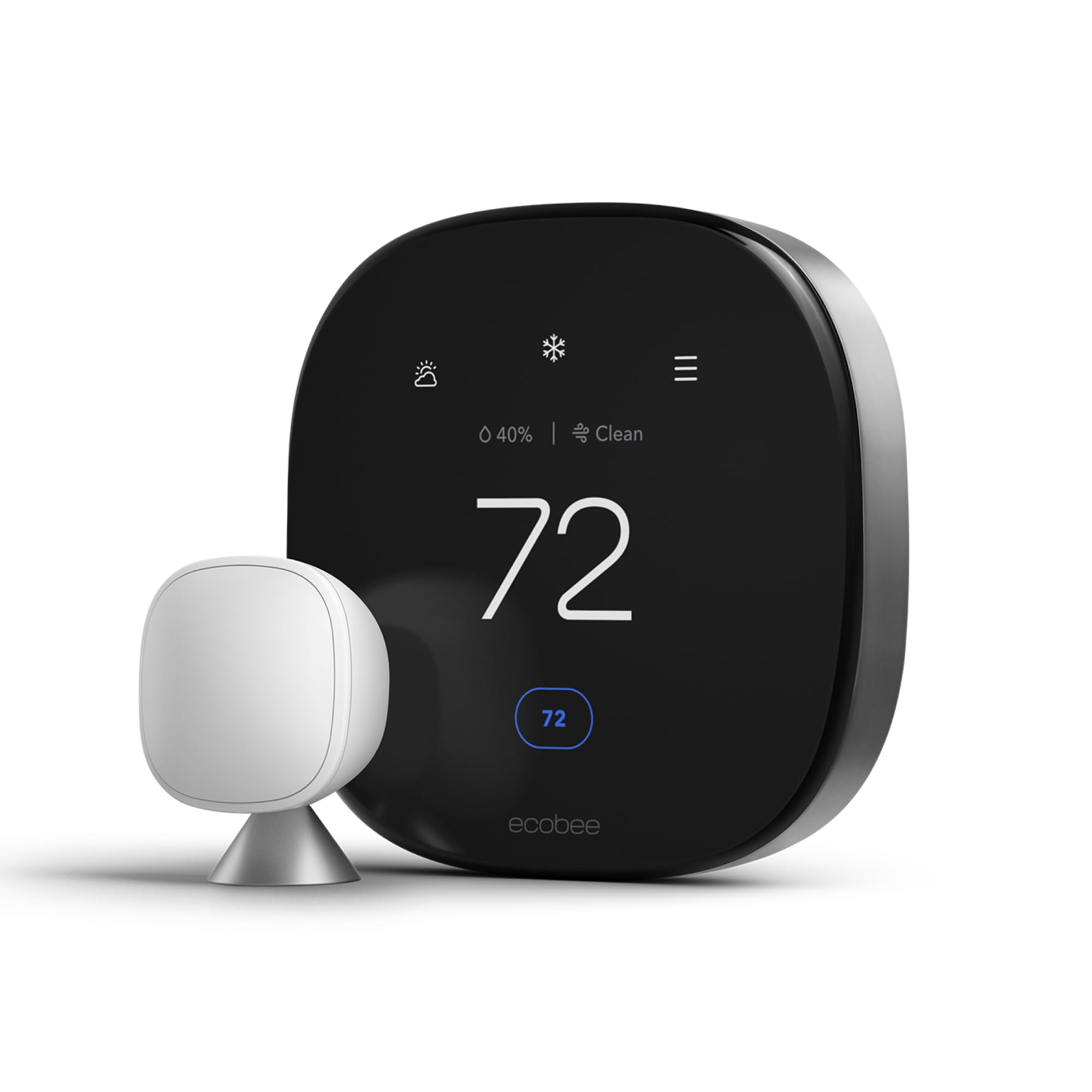
The decision that sinks a thermostat install isn't the screen or the app — it's the bundle of wires behind the old unit. The ecobee Enhanced is our top pick because it settles that argument in the box: a Power Extender Kit for homes with no C-wire, a trim plate to cover the paint ring the old thermostat left behind, and a rating for about 90% of the HVAC systems out there. Run the compatibility checker before you order and most houses are done arguing.

Occupancy sensing is the part that earns its keep once the novelty wears off. The thermostat notices when the house empties, lets the temperature drift, and pulls it back before you walk in — the work a separate sensor does, handled by the unit itself. The app runs on a phone, tablet or Apple Watch, so dropping the heat from the driveway is one tap.

The wiring is where it asks for patience, and heat pump owners should run the compatibility checker rather than assume. If one room in your house is always the wrong temperature, the Premium's included sensor is the better spend — this unit senses whether people are home, not what a bedroom down the hall is doing.

Pros

  • No-C-wire adapter and trim plate in the box
  • Rated for about 90% of HVAC systems
  • Occupancy sensing handles away and home on its own
  • App covers phone, tablet and Apple Watch

Cons

  • No remote room sensor in the box
  • Fussier wiring job than the Sensi
Our verdict

Our pick for most homes: it covers about 90% of systems and brings the no-C-wire adapter with it, so the install is one order instead of two.
Check Latest Price
2

Best for Simple Swaps

Sensi ST55 Smart Thermostat

89 /100
LBD Score Excellent

Key details

C-wire
Not required in most homes
Display
5-inch screen with buttons
Warranty
3 years
Voice Assistants
Alexa, Google, HomeKit, SmartThings
View on Amazon

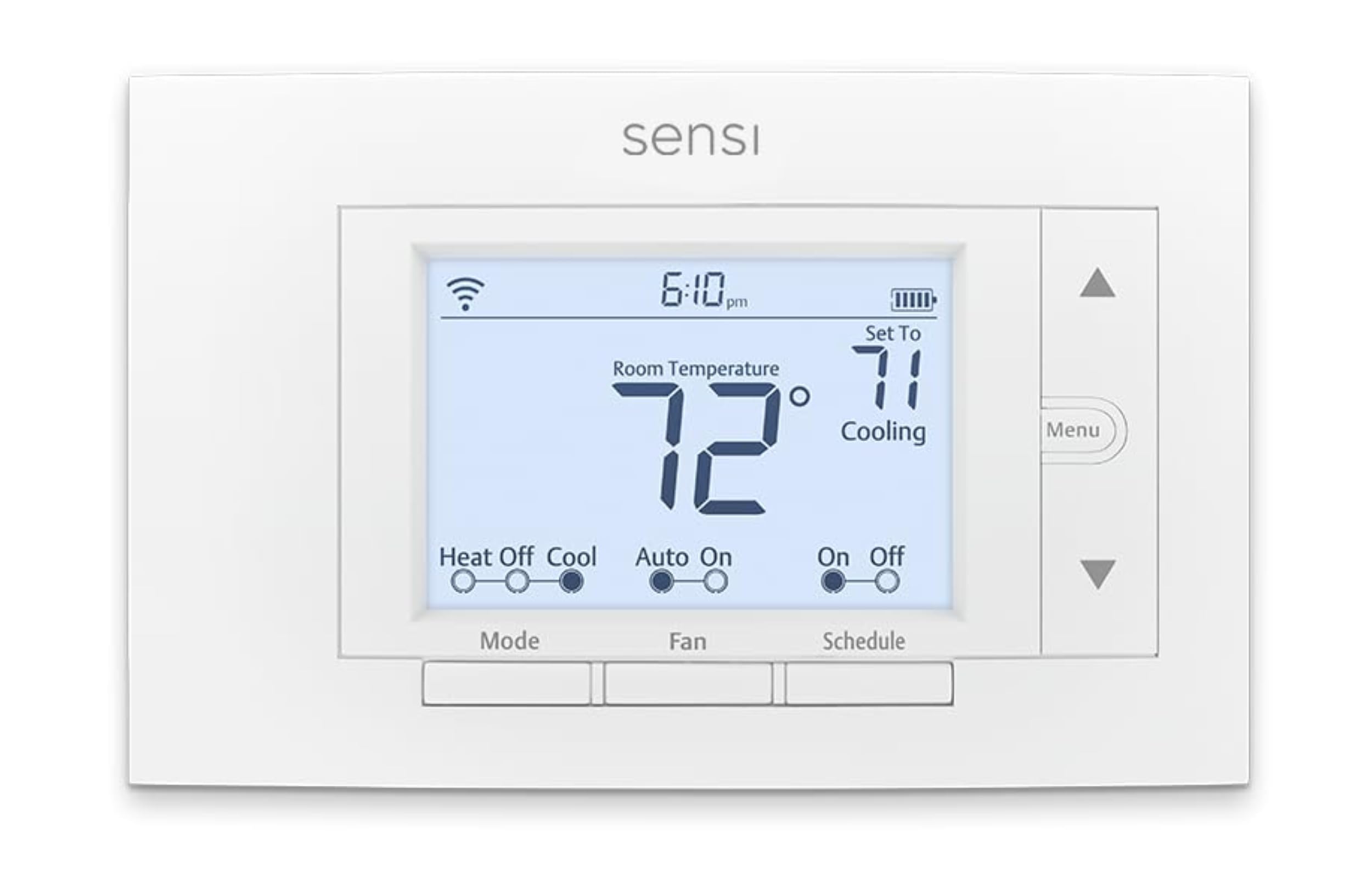
Sensi built this one to disappear. It's a 5.88-inch-wide rectangle with buttons and a plain display, shaped to land on the same footprint as the thermostat you're replacing — no patching, no touch-up paint, and no explanation needed for the family member who refuses to run an app.

That's most of its appeal, and it's why we keep pointing people here when they want a thermostat rather than a gadget. It works in most homes without a C-wire, the app walks you through tagging each wire during install, and it talks to Alexa, Google Assistant, Apple HomeKit and SmartThings — broader smart-home reach than the Honeywell here, for noticeably less money.

Set it up once and it behaves the way a hallway thermostat should: the schedule lives in the app, the buttons on the wall work as a manual override, and the three-year warranty is generous for this category. Nothing about it is exciting, and that's the point.

Pros

  • Works without a C-wire in most homes
  • Covers the old thermostat's footprint
  • Alexa, Google, HomeKit and SmartThings support
  • Three-year warranty

Cons

  • Wi-Fi connections can drop and need re-adding
  • Long-term reliability is the weakest in this group
Our verdict

Buy this if you want a thermostat rather than a gadget: it runs without a C-wire in most homes, covers the old wall footprint, and skips the touchscreen entirely.

Check Latest Price
3

Best Display

Honeywell Wi-Fi 9000 Color Thermostat

89 /100
LBD Score Excellent

Key details

C-wire
Required
Display
4.5-inch color touchscreen
Programming
7-day, day-by-day schedules
Voice Control
Alexa
View on Amazon

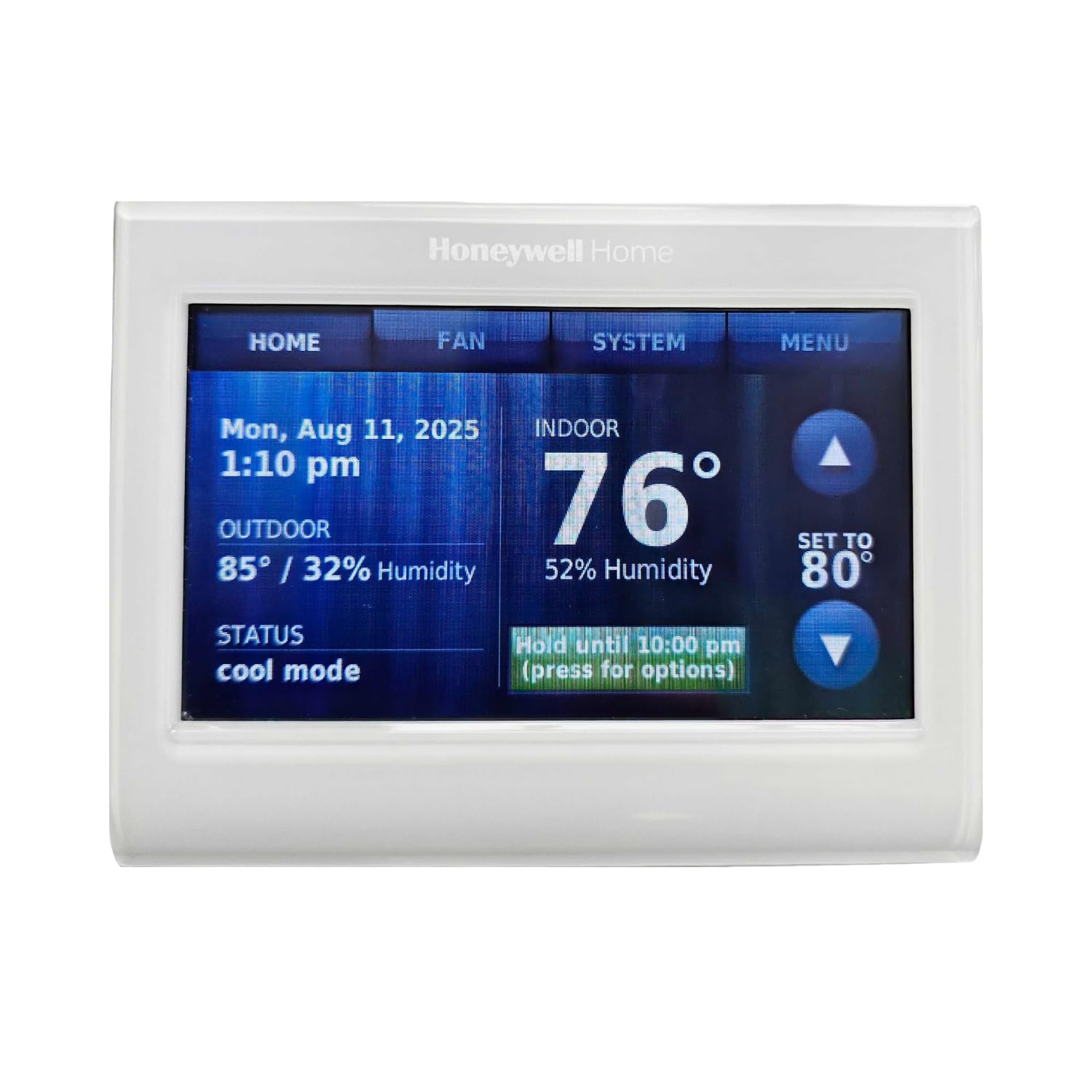
The 4.5-inch color screen is the reason to choose this one. Indoor and outdoor temperature sit on the home screen beside the humidity, which is the sort of thing you glance at on your way out the door, and the background color is yours to set — a small touch that matters more than it should in a hallway you walk past twenty times a day.

Behind the screen it's a seven-day programmable thermostat with the Total Connect Comfort app, Alexa voice control and on-screen alerts and reminders. The per-day programming is the part we care about most: weekends and weekdays rarely want the same schedule, and this one lets you set each day instead of forcing you into a weekday block and a weekend block.

What narrows its audience is the equipment list. Honeywell rates it unsuitable for dual-fuel heat pumps without a fossil kit, so check your system before ordering rather than after the box is open. Get past that and it has the most informative display of anything here, and it's the one a household of mixed tech comfort will use without ever opening an app.

Pros

  • 4.5-inch color screen with indoor and outdoor readings
  • Schedules set day by day, not weekday and weekend
  • Alexa voice control and on-screen alerts

Cons

  • Requires a C-wire to power it
  • Touchscreen needs a firm, deliberate tap
Our verdict

The best screen in the group and the easiest one for a mixed-tech household to live with, as long as you have a C-wire and not a dual-fuel heat pump.

Check Latest Price
4

Best Design

Google Nest Learning Thermostat (4th Gen)

88 /100
LBD Score Excellent

Key details

C-wire
Not required in most homes
Display
60% larger with Dynamic Farsight
In The Box
Nest Temperature Sensor (2nd gen)
Works With
Alexa, Siri, Google Assistant, Matter
View on Amazon

Polished gold, an aluminum ring that turns under a thumb, and a display 60% larger than the model it replaces — this is the only thermostat in the group designed to be looked at. We think that matters more than it sounds like it should when the thing is going on a hallway wall you've stared at for years.

A Nest Temperature Sensor comes in the box, so the thermostat can work off a bedroom instead of the hallway where it's mounted — the exact problem that pushes most people to replace a thermostat at all. Dynamic Farsight keeps the time, the weather or the temperature readable from across the room and dims itself when the room goes dark.

It handles most 24V systems, heat pumps and radiant floors included, and no C-wire is needed in most homes. Scheduling and remote control cover the same ground as the ecobee Enhanced, so what the extra money buys is the finish and the sensor — a fair trade if the thermostat hangs somewhere you actually see it, a poor one if it lives in a closet next to the furnace.

Pros

  • Temperature sensor included in the box
  • Display 60% larger, with Dynamic Farsight
  • Works with Alexa, Siri and Google Assistant
  • No C-wire needed in most homes

Cons

  • Runs in the Google Home app, not the Nest app
  • Temperature readings can sit a couple of degrees off
Our verdict

The one to buy when the thermostat hangs somewhere you look at it: a sensor comes in the box and the finish is worth the premium, but the app and the readings aren't perfect.

Check Latest Price
5

Best for Uneven Rooms

ecobee Smart Thermostat Premium

87 /100
LBD Score Excellent

Key details

Voice
Alexa and Siri built in
In The Box
SmartSensor, Power Extender Kit, trim plate
Air Quality
Built-in monitor
HVAC Compatibility
About 95% of systems
View on Amazon

Every house has one room that runs a few degrees off, and the Premium's answer ships in the box: a SmartSensor that reads the room you're actually sitting in and tells the thermostat to work from that number instead of the hallway.

It's the same core thermostat as the Enhanced we recommend for most homes, plus the sensor, an air quality monitor and Alexa and Siri built into the unit itself — so it doubles as a small speaker for timers and weather and can pull a live view from an ecobee doorbell. That combination earns its place in an older house with a converted porch or a bedroom over the garage, where one sensor genuinely changes how the place feels.

Sensor pairing is the fussiest part of setup. Put the sensor where it can see the room rather than a lamp or a supply vent, give it a few minutes to settle, and don't judge the thermostat's accuracy in the first hour. If your house already heats evenly, you're paying for a feature you'll never use.

Pros

  • Room sensor included for uneven houses
  • Alexa and Siri built into the unit
  • Air quality readings on the thermostat
  • Power Extender Kit included for no-C-wire homes

Cons

  • Top of the price range in this group
Our verdict

Buy it for the room that never heats right: the included SmartSensor and built-in Alexa make it the most capable unit here, at the highest price.

Check Latest Price
6

Simple Single-Stage

Riseem STN701W Wi-Fi Thermostat

89 /100
LBD Score Excellent

Key details

Wi-Fi
2.4GHz only
C-wire
Required
Display
LCD with large digits
Compatibility
Single-stage 1 heat/1 cool only
View on Amazon

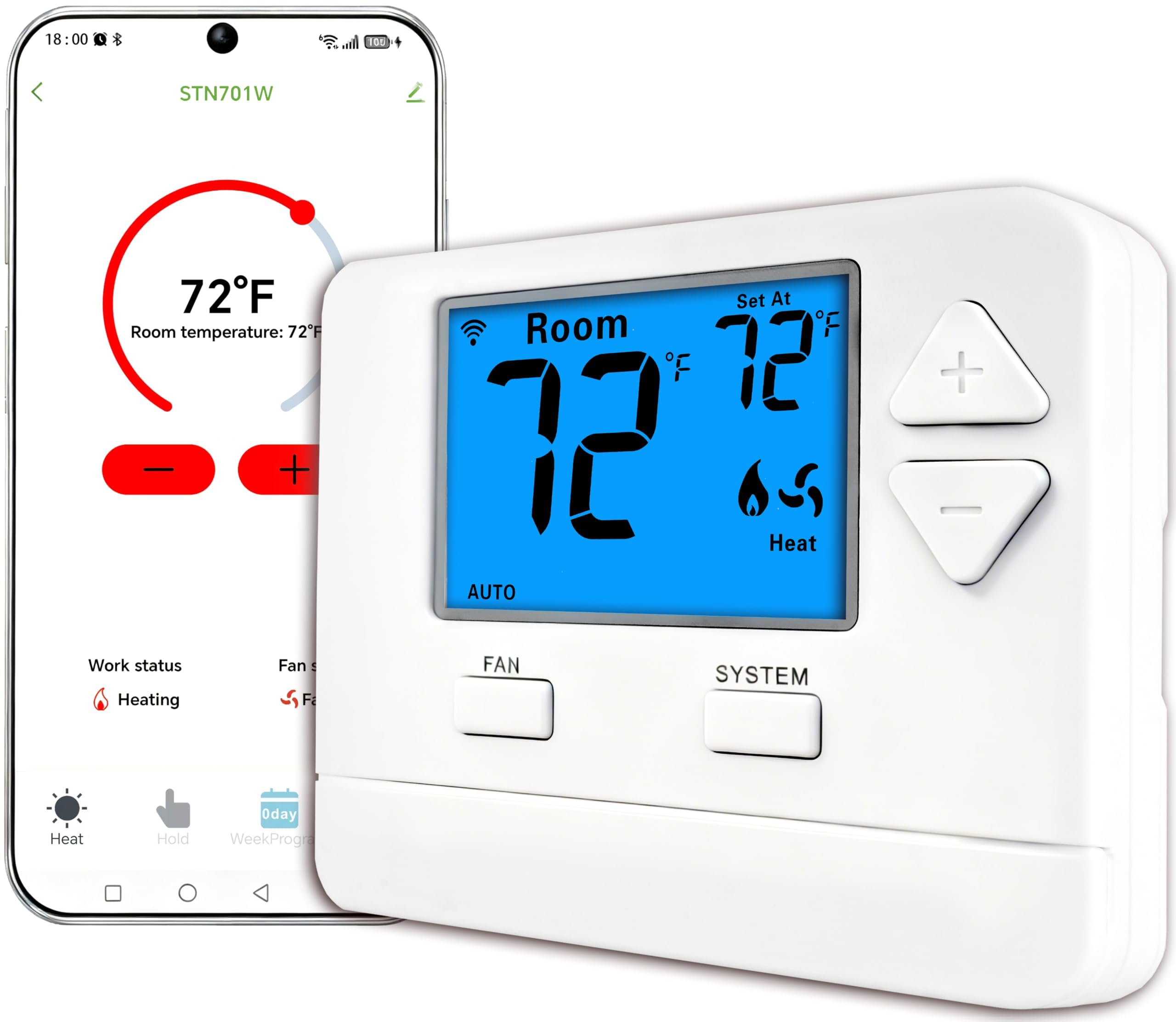
If your system is one stage of heat and one stage of cooling, and you already have a C-wire, this is the least expensive route onto Wi-Fi in the group: a plain LCD thermostat with big digits, a phone app and a seven-day schedule.

The display is the nicest thing about it. The numbers are large enough to read from across the room, the blue backlight is bright without glowing like a nightlight, and installation is a short job with clearly labeled terminals and stickers for your old wires. What we didn't expect at this price is an adjustable temperature differential — the swing setting that keeps a furnace from short-cycling — which you can change from the menu instead of living with.

The limits are why it sits this far down. Single-stage conventional systems only, no heat pumps, no second stage, no heat-only or cool-only setups, and the radio is 2.4GHz only, so a mesh network that steers everything to 5GHz will fight you. For a cabin, a rental or an office over the garage on a simple furnace, that's an easy trade; for the house you live in with a heat pump, it's the wrong purchase.

Pros

  • Large, bright, easy-to-read display
  • Adjustable temperature differential
  • Least expensive route to a Wi-Fi thermostat here
  • Labeled terminals make the install quick

Cons

  • Single-stage 1 heat/1 cool systems only
  • 2.4GHz Wi-Fi only, no 5GHz
Our verdict

A good cheap pick for a cabin or rental on a single-stage furnace with a C-wire, and the wrong purchase for anyone with a heat pump.

Check Latest Price

How We Chose and Tested the Best Smart Thermostats

We started with a shortlist of roughly 30 models pulled from manufacturer specs, current listings, and reviews from people who'd lived with them for a year or more. We filtered out anything that needed a proprietary hub to work, anything that wouldn't run on the systems most U.S. homes actually have—single-stage, heat pump, boiler—and anything whose app hadn't been updated in recent memory. That left 12 thermostats, which we installed in real houses: mine, two neighbors', and a cabin that sits empty most weekdays.

Installation came first, because it's the part that scares people. We killed the breaker, photographed the existing wiring, and timed each swap from plate removal to a working display, noting which units demanded a C-wire adapter and which sipped power from the existing circuit. We then built schedules and paired each thermostat to Wi-Fi from the same corner of the house, timing how long pairing took and whether it survived a router reboot and a deliberately dropped connection. Every app got the same treatment: changing the temperature from the couch, building a seven-day schedule on a phone screen, and hunting for vacation mode without opening the manual.

Then we just lived. We tracked morning warm-up and overnight setback against a separate thermometer across the room, and noted which units overshot the set point by two degrees or undershot it by four. Remote sensors went into a bedroom that runs cold and a hallway that runs hot, to see whether the system averaged them or fixed on the wrong one. We also logged the unglamorous stuff: faceplates that yellowed or held fingerprints, displays we couldn't read in afternoon sun, schedules that quietly stopped running, and whether the sensors and extras in the box matched what the price implied.

How to Choose a Smart Thermostat

Settle the C-wire question first

Most smart thermostats want a C-wire, the constant 24-volt feed that keeps the screen and radio alive, or a way to work without one. What matters is whether the adapter comes in the box: the ecobee Enhanced and Premium both ship with a Power Extender Kit, while the ecobee Essential expects you to buy one separately. That difference is one installation versus two orders.

Photograph your old wiring before you disconnect anything, label each wire, and run the manufacturer's compatibility checker against your actual equipment. If your thermostat has only two wires and no C terminal, buy a model whose box already contains the adapter — or one like the Sensi that runs without a C-wire in most homes.

Match the equipment, not the marketing

Compatibility is about stages and equipment type. A single-stage gas furnace with one cooling stage is the easy case; heat pumps, two-stage systems and dual-fuel setups — a heat pump paired with a fossil-fuel furnace — are where installs go wrong. The Honeywell Wi-Fi 9000, for one, isn't rated for dual-fuel heat pumps without a fossil kit.

Count the terminals at your old thermostat. Y2, W2, O/B and AUX each tell you something about what you own, and checking those letters against a compatibility list takes five minutes and saves a return.

Decide between occupancy sensing and a room sensor

These solve different problems, and buyers routinely pay for the wrong one. Occupancy sensing inside the unit, as on the ecobee Enhanced, handles away and home: the house drifts while you're out and recovers before you return. A separate room sensor, included with the Nest Learning and the ecobee Premium, handles the bedroom that's always cold.

If your complaint is that the house is fine but the office is freezing, pay for the sensor. If it's that nobody's home between eight and six, built-in occupancy is enough and the extra money belongs somewhere else.

Live with the app, not just the wall unit

Displays split into simple screens with buttons, like the Sensi, and color touchscreens, like the Honeywell and both ecobees. Neither is better in the abstract: buttons are easier for guests, touchscreens carry more information. What matters after a month is the radio behind the screen.

Wi-Fi dropouts are the most common complaint across every model here, and a thermostat you can't reach from your phone is just a programmable one. Confirm your router offers a 2.4GHz band, and check the warranty — Sensi and ecobee both cover their units for three years, which is the number that matters when a thermostat dies in month thirteen.

Frequently Asked Questions

Final Verdict

If you want one answer, it's the ecobee Smart Thermostat Enhanced. It covers about 90% of systems, puts the adapter for a C-wire-less house in the box, and adjusts on its own when the place empties — the three things that make a smart thermostat worth installing rather than just interesting.

Take the Sensi ST55 instead if you want a plain, button-operated swap that most homes can wire without an adapter. Take the Nest Learning Thermostat if the unit is going on a wall you look at every day, and the ecobee Premium if one room in your house is always the wrong temperature.