Best Soundbars with Subwoofers of 2026

A new TV can ruin movie night: the picture is gorgeous, the sound is thin, so you nudge the volume up through every quiet scene and lunge for the remote when the explosions hit. A soundbar with a separate subwoofer fixes both halves of that — one part handles voices, the other what you feel in your chest. We've spent eight months with 12 of these systems, and the gap between good and mediocre shows up within ten minutes of a movie.

Spec sheets won't settle it. Wattage is the least useful number on the box, and a subwoofer you can barely hear at low volume is doing its job better than one that booms through the house. What separates these is how fast they pair, whether calibration changes anything, and whether dialogue mode clarifies voices or just makes them louder.

Setup varied wildly, too — some made sound in under five minutes, others had me squinting at a remote in a dim room, hunting menus. The picks below earned their place on movie night, game day, and the 9 p.m. news.

1

Best Overall

TCL S55H 2.1 Soundbar

87 /100
LBD Score Excellent

Key details

Power
220W
Channels
2.1
Subwoofer
Wireless, 5.5-inch
Immersive Audio
Dolby Atmos, DTS Virtual:X
View on Amazon

The S55H does something most of this group leaves to your ears: it sets its own levels. A one-time calibration routine listens to the room and rebalances the bar around where the couch actually sits, which is often the difference between dialogue you follow and dialogue you keep grabbing the remote to rescue. The JBL runs a calibration pass of its own; most of the others simply don't.

That is a big part of why this is the bar we tell most people to buy. Two channels and 220W won't pressurize a large room the way the JBL does, but the TCL gets the fundamentals right: Dolby Atmos and DTS Virtual:X processing, a wireless 5.5-inch subwoofer you can push into a corner, and HDMI eARC so one cable and the TV remote handle everything. At 2.36 inches tall and about 32 inches wide, it disappears under most sets.

In a normal living room the low end carries explosions and a bass line without turning to mush, and dialogue stays in front of the effects instead of behind them — the thing we care about most on a weeknight drama. The app gives you separate bass, midrange and treble sliders plus movie, music and news presets, and once calibration is done the remote can stay in the drawer.

Where it gives ground is overhead. With two channels and a virtualizer, height effects in an Atmos mix are suggested rather than placed above you, so think of this as a wide, clean front stage rather than a dome of sound. If you want the ceiling involved, that is a different class of system and a different budget.

Pros

  • One-time calibration balances the bar for your room
  • Dolby Atmos and DTS Virtual:X processing
  • Wireless 5.5-inch sub frees up placement
  • HDMI eARC, optical and Bluetooth inputs

Cons

  • Volume steps jump from quiet to very loud
  • Atmos height effects are virtual, not overhead
Our verdict

The soundbar we recommend to most people: Atmos processing, a wireless sub and self-calibration in one uncomplicated system that suits a normal living room.
Check Latest Price
2

Best for Big Bass

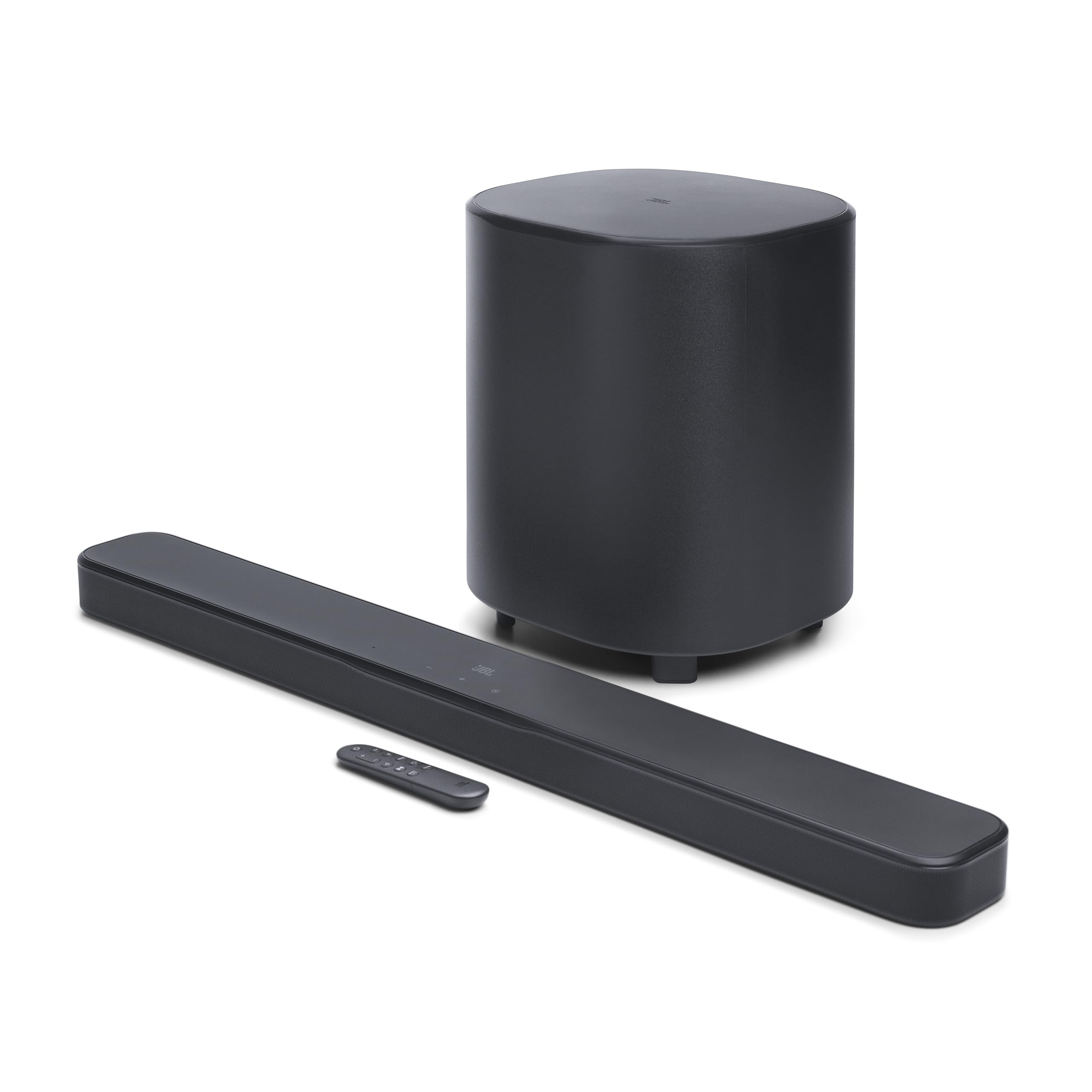
JBL Bar 500MK2

87 /100
LBD Score Excellent

Key details

Power
750W
Channels
5.1
Subwoofer
Wireless, 10-inch
Immersive Audio
Dolby Atmos
View on Amazon

Ten inches of subwoofer driver fed by 750 watts is the reason this system exists, and the difference is not subtle. Nothing else here produces bass with this much weight behind it — the same explosion that sounds tidy on a 5-inch cabinet lands in your chest on this one. If your complaint about your TV is that everything sounds thin, start here and work backward.

It is also the most complete system in the group. Five channels with Dolby Atmos, MultiBeam 3.0 spreading the front stage wide, PureVoice 2.0 holding dialogue above the effects, and a calibration pass of its own. The bar is 37 inches long and 2 inches tall — a low plank that sits under a big set without covering the bottom of the picture. Wi-Fi and AirPlay sit alongside HDMI, optical, USB and Bluetooth, so music from a phone doesn't need the TV switched on.

What that buys costs you in two places: money and floor space. The subwoofer is a piece of furniture in its own right, and this is comfortably the most expensive system we cover. Installation over HDMI is straightforward, but the wireless side is fussier, so get eARC working first and add Wi-Fi and Bluetooth once the TV link is stable.

Pros

  • 10-inch wireless subwoofer with real output
  • Dolby Atmos over 5.1 channels
  • Wi-Fi, AirPlay, HDMI, optical and USB inputs
  • Easy Sound Calibration built in

Cons

  • Subwoofer cabinet is bulky to place
  • Wireless pairing is the fussiest part of setup
Our verdict

For anyone who wants the room to move: a 10-inch sub and 750 watts make this the most cinematic system here, if you have the space and the budget.

Check Latest Price
3

Best Budget Surround

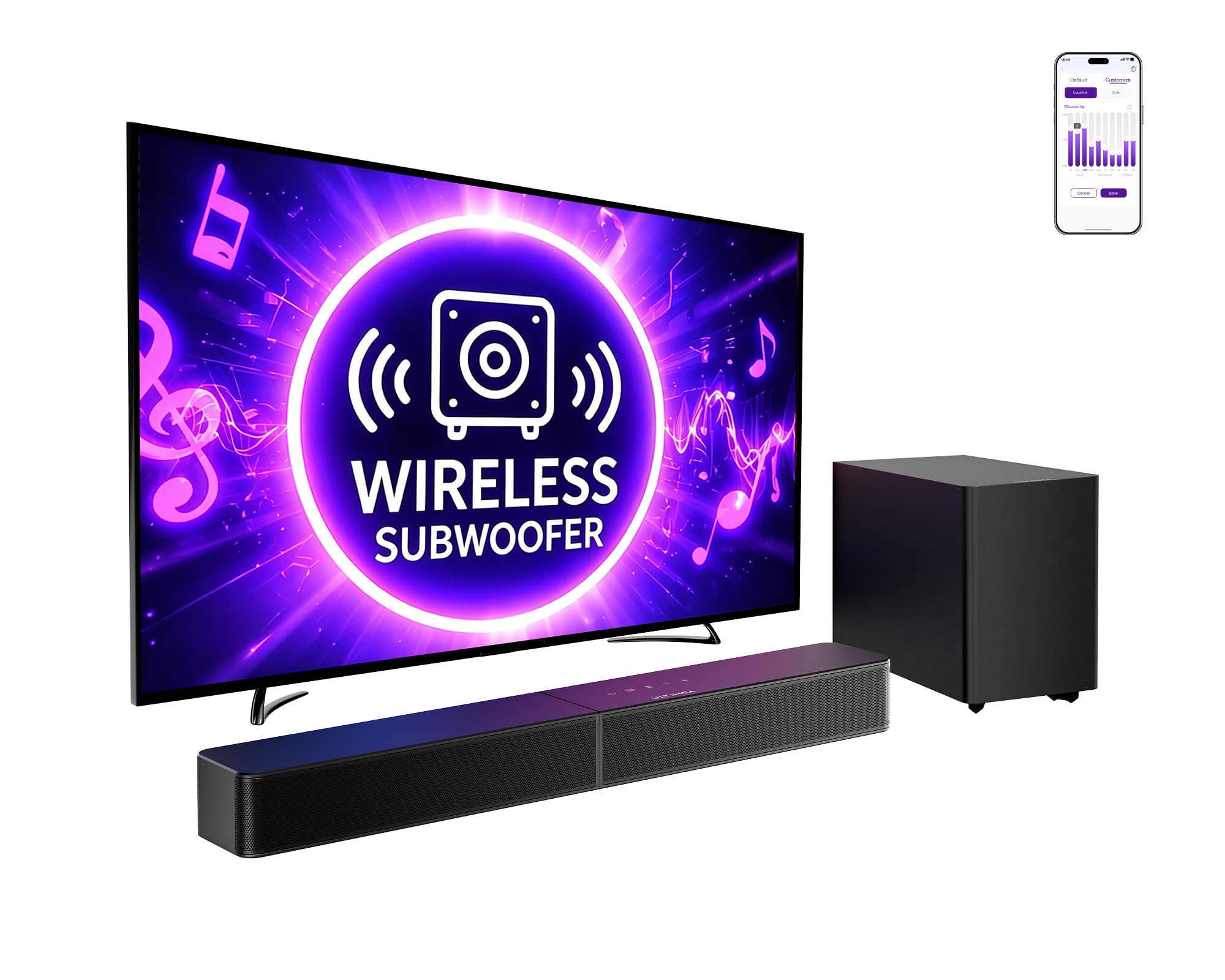
ULTIMEA Poseidon M60

87 /100
LBD Score Excellent

Key details

Power
300W
Channels
5.1
Subwoofer
Wired, 5.25-inch
Immersive Audio
Dolby Atmos
View on Amazon

Five separate channels and Dolby Atmos from the least expensive surround system in this group. The bar carries five drivers, two of them side-firing, so effects travel past the edges of the TV instead of stopping at it, and the 300W amplifier has enough headroom for a living room.

The compromise is the subwoofer. It is wired — a 5.25-inch driver in a wooden cabinet — so it has to sit within cable reach of the bar, which usually means beside the TV stand. In exchange you get bass that is tighter and more textured than the money suggests, and HDMI eARC carries lossless Atmos from a modern set. VoiceMX lifts dialogue, and the app gives bass, midrange and treble separately rather than a single tone knob.

We think that is a fair trade for a first surround system. Side-firing drivers are not rear speakers — nothing arrives from behind you — but the front stage is much wider than a 2.1 bar at the same money, and setup is genuinely a couple of cables and the app.

The subwoofer is the part to watch. A sub that cuts out is the failure to look for here, so give the system two loud movie nights while the return window is open and you will know whether you got a good one.

Pros

  • Five channels and Dolby Atmos processing
  • Side-firing drivers widen the front stage
  • HDMI eARC carries lossless Atmos
  • App EQ for bass, midrange and treble

Cons

  • Wired subwoofer limits where it can sit
Our verdict

The best value in surround here: five channels and Dolby Atmos for less than the other 5.1 systems, with a wired sub as the trade.

Check Latest Price
4

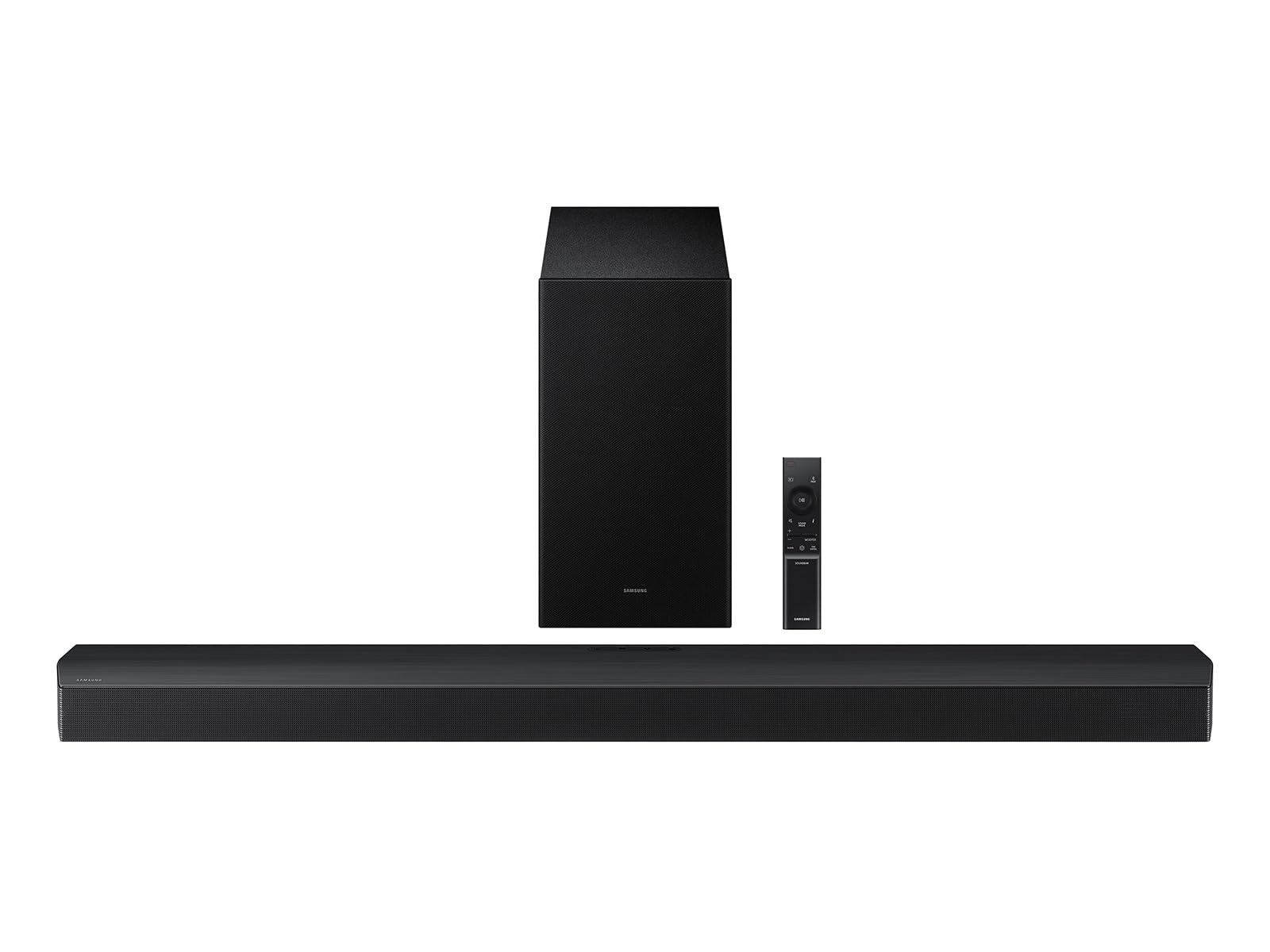
Best for Samsung TVs

Samsung HW-B750F

84 /100
LBD Score Excellent

Key details

Power
400W
Channels
5.1
Subwoofer
Wireless
TV Pairing
Q-Symphony
View on Amazon

If there is already a Samsung TV in the room, this bar has an argument the others don't. Q-Symphony drafts the television's own speakers into the front stage, so the set and the bar play together instead of the bar replacing the set. Add 5.1 channels with built-in side speakers, a 400W amplifier and a wireless subwoofer, and it is a lot of system.

We rate it second only to the JBL on outright scale, and ahead of it if you own the matching TV. The side-firing drivers push effects wide, Adaptive Sound re-tunes for each scene, and Voice Enhance lifts dialogue without you touching a slider. On a Samsung set the handoff is automatic enough that one remote covers both.

Take the Samsung TV out of the room and the value wobbles, because Q-Symphony is the headline and it does nothing on another brand. What is left is a competent 5.1 bar at a price where the TCL throws in calibration and the JBL throws in a much bigger sub. The bar and the TV also do not always wake together, so spend ten minutes on the HDMI-CEC settings on day one rather than living with two remotes.

Pros

  • Q-Symphony uses the TV's speakers too
  • 5.1 channels with built-in side speakers
  • 400W with a wireless subwoofer
  • Voice Enhance and Adaptive Sound per-scene tuning

Cons

  • Q-Symphony only works with a Samsung TV
Our verdict

The pick for a Samsung household: Q-Symphony folds the TV's speakers into the system, and 5.1 channels with a 400W amp fill the room.

Check Latest Price
5

Best With Rear Speakers

LG S40TR

85 /100
LBD Score Excellent

Key details

Power
400W
Channels
4.1
Subwoofer
Wireless
Rear Speakers
Included
View on Amazon

Rear speakers in the box are the whole reason to look at the S40TR, and they arrive with one caveat: a cable links the two surrounds, and each needs power where it sits. Plan the corners of the room before you order. The payoff is worth it — effects come from behind your shoulder, which no other system here can do, and with 400W and a wireless subwoofer this is the least expensive route to genuine surround channels in this group.

Hearing a car pull away behind you changes what a film does, and Dolby Audio processing keeps the front channels distinct enough that dialogue doesn't get buried under the rears. With an LG TV, WOW Orchestra adds the television's speakers to the mix and the WOW interface lets one remote run both.

It isn't the tidiest system to live with. Bluetooth is the weak input and connections can drop when you switch sources, and on some sets the surround mode has to be reselected after the TV comes back on. Neither ruins a movie night, and both stop being surprises once the routine settles.

Pros

  • Rear speakers deliver true behind-you effects
  • 400W with a wireless subwoofer
  • WOW Orchestra uses an LG TV's speakers
  • Dolby Audio processing

Cons

  • Bluetooth drops when you switch sources
Our verdict

Real surround for a midrange price: rear speakers in the box, 400W behind them, and the only system here that puts effects behind your head.

Check Latest Price
6

Best Ultra-Slim

Polk Audio Signa S2

89 /100
LBD Score Excellent

Key details

Inputs
HDMI ARC, optical, Bluetooth
Drivers
Five full-range
Subwoofer
Wireless, 5.25-inch
Bar Height
2.15 in
View on Amazon

Two point one five inches. That number is why the Signa S2 still earns a place: it slides under a low TV stand shelf, sits in front of a set whose bottom edge nearly touches the furniture, and fits on a mantel where a four-inch bar covers the screen. Just over 35 inches wide and under four pounds, it is also a one-person wall mount.

The rest of the package is old-school but sensible — five full-range drivers, VoiceAdjust to push dialogue forward, a wireless 5.25-inch subwoofer, and HDMI ARC, optical and Bluetooth inputs. There is no Atmos processing and no room calibration; this is a bar that wants to make TV sound better and then get out of the way.

Auto shut-off is the quirk to know about: the bar can decide an input has gone quiet and switch itself off, and it doesn't always wake on the first press. Worth recognising before you conclude the thing has died halfway through a film.

For a bedroom, a spare room, or a living room whose stand has no height to spare, it remains a sensible buy. The sub adds real depth, dialogue comes through far clearer than any TV speaker manages, and the slim profile solves a fit problem the taller bars here simply can't. At this point in its life, the appeal is the shape and the simplicity rather than the feature list.

Pros

  • 2.15-inch profile fits tight TV stands
  • VoiceAdjust lifts dialogue
  • Wireless 5.25-inch subwoofer
  • HDMI ARC, optical and Bluetooth inputs

Cons

  • Remote needs a clear line of sight
  • Bluetooth streaming can drop
Our verdict

The slim-bar specialist: 2.15 inches tall, a wireless sub and VoiceAdjust dialogue for anyone whose TV stand has no room to spare.

Check Latest Price
7

Best Small-Room Pick

ULTIMEA Poseidon M30

85 /100
LBD Score Excellent

Key details

Power
240W
Inputs
HDMI ARC, optical, Bluetooth 6.0
Channels
2.1
Subwoofer
Wireless, 5.25-inch
View on Amazon

Bedrooms, apartments and home offices are where the M30 makes sense. The bar is 23.6 inches wide — small enough for a dresser or a desk — the subwoofer is wireless, so it only needs an outlet, and 240W is plenty when the listening position is a bed or a chair a couple of feet away.

It is a 2.1 system, so don't buy it expecting surround: the mica-reinforced drivers and BassMX processing are about clear speech and a sub that digs lower than the bar can alone, and the app's EQ is where you fix a boomy corner or a muffled news broadcast. HDMI ARC rather than eARC, plus optical and Bluetooth 6.0, covers a TV, a console and a phone without a switcher.

Consistency is where it slips: volume doesn't hold steady between sources, so moving from the TV to your phone means reaching for the remote again. In a second room, where that is a small annoyance rather than a nightly one, it is the least fussy way to add real bass to a small TV.

Pros

  • Wireless sub fits any corner with an outlet
  • 23.6-inch bar suits small rooms
  • HDMI ARC, optical and Bluetooth 6.0
  • App EQ for bass, midrange and treble

Cons

  • Bluetooth pairing isn't always reliable
Our verdict

Our pick for a bedroom or apartment: a compact 2.1 bar with a wireless sub that's easy to hide and easy to set up.

Check Latest Price
8

Simple Samsung Setups

Samsung HW-B550F

84 /100
LBD Score Excellent

Key details

Power
300W
Channels
2.1
Subwoofer
Wireless
Immersive Audio
DTS Virtual:X
View on Amazon

Set this beside our top pick and the arithmetic gets awkward: the B550F is a 2.1 system with 300W and a wireless subwoofer, and it costs more than the TCL that adds Atmos processing and a calibration routine. What Samsung brings instead is a set of listening modes — Bass Boost, Adaptive Sound and Voice Enhance — that are genuinely worth having if you prefer one button to an app.

Those modes are well judged. Bass Boost adds weight without smothering dialogue, Voice Enhance makes news and drama easier to follow, and DTS Virtual:X widens the front stage from a bar that is only 33.8 inches wide. Setup is a real strength: HDMI or optical, and the subwoofer pairs itself.

The catch is that the features which make a Samsung bar sing mostly live on the models above this one, and connectivity is the shakiest part of the package — the bar can lose its link to the TV and sit silent until you reconnect it. That is the kind of thing you notice at the start of a film, not during the credits.

So it is a solid 2.1 bar that installs in minutes and sounds pleasant, in a group where the competition is simply stronger. Buy it for Samsung's listening modes and the uncomplicated setup; buy the TCL if Atmos and self-calibration are what you came for.

Pros

  • Bass Boost, Adaptive Sound and Voice Enhance modes
  • DTS Virtual:X virtual surround
  • Wireless subwoofer pairs itself
  • Simple HDMI or optical install

Cons

  • Costs more than our better-equipped top pick
Our verdict

A tidy 2.1 Samsung bar with useful sound modes and an easy install, though our top pick does more for less.

Check Latest Price

How We Tested Soundbars With Subwoofers

We started with spec sheets — channel count, whether a subwoofer was included and wireless, HDMI eARC versus optical-only, and app control — then filtered by price so every system here could be judged against the ones a shopper would actually be choosing between. Twelve made the cut, and I ran them for eight months in my living room, in a carpeted basement room with soft furniture, and in an apartment with neighbors on the other side of one wall.

Setup was timed from the moment I cut the tape to the first sound out of the speakers, with a stopwatch running while I paired the subwoofer, connected to a TV over HDMI, and added a phone over Bluetooth. I unplugged each subwoofer and moved it across the room to see if it reconnected on its own, then carried a phone into another room to find where the wireless signal dropped. Remotes got used in a dark room, specifically to check whether I could read the display and change inputs without turning on a light.

For sound, every system played the same three scenes — a whispered family argument, a car chase, and a crowd-heavy football broadcast — once at a normal evening volume and again at a level I'd use after the kids went to bed. I noted whether dialogue stayed intelligible in the quiet passages, whether the bass disappeared at low volume or stayed balanced, and whether the dialogue or voice-enhancement mode actually separated voices from the score or simply raised the center channel. Before trusting any auto-calibration, I ran it twice and compared results, and I listened with the subwoofer in two different corners of the room. Value came down to one question: are the features I actually used during those eight months on the model, or held back for an upgrade?

How to Choose a Soundbar with a Subwoofer

Start With Where the Subwoofer Can Sit

A wired subwoofer has to live within cable reach of the bar, which usually means beside the TV stand. A wireless one only needs a power outlet, so it can go behind the couch or across the room where the bass often sounds better. Wireless never means cable-free — the cabinet still plugs into the wall — but it does free you from the bar's corner.

If the room is tight and the sub can sit next to the TV, the wired ULTIMEA M60 is a sensible place to save. If the sub has to go somewhere specific, pay for wireless, as on the ULTIMEA M30 or the TCL.

Decide How Much Surround You Actually Want

Two channels and a sub is a large step up from TV speakers and plenty for a bedroom. Five channels add side or rear speakers and put effects around you rather than in front: the LG S40TR does it with a rear pair, while the ULTIMEA M60 widens the front with side-firing drivers and nothing behind you.

The trap is Atmos. A 2.1 bar with Atmos processing simulates overhead sound; it does not place anything above your head. If height effects are the goal, you are shopping for a bar with dedicated up-firing drivers, which is a different class of system from everything here.

Match the Connection to Your TV

HDMI eARC is the connection to want: one cable, TV-remote volume, and enough bandwidth for lossless Atmos. ARC does the same job with less headroom. Optical works with almost any set but cannot carry Atmos at all, which is why an Atmos bar on an older TV can sound ordinary.

Check the back of your TV before ordering. If the only output is optical, buy for clear stereo sound and ignore the Atmos badges; if you have eARC, the TCL and the ULTIMEA M60 both use it properly.

Measure the Gap Above Your Stand

Bar height decides whether a soundbar works in your room, and it is the spec people forget. The Polk Signa S2 is 2.15 inches tall and the TCL 2.36; anything much taller than the gap between the stand and the bottom of the screen blocks the picture or bounces the remote's signal.

Then check width against the set. A 37-inch bar like the JBL dwarfs a 43-inch TV, while the 23.6-inch ULTIMEA M30 suits a smaller screen in a bedroom.

Listen for Dialogue, Not Just Bass

Every system here can make an explosion loud; the difference shows up in a quiet scene. Dialogue lifters — VoiceAdjust on the Polk, PureVoice on the JBL, VoiceMX on the ULTIMEAs, Voice Enhance on the Samsungs — do more for nightly viewing than another hundred watts.

Set the subwoofer level first, then the bar volume, and leave the bass alone after that. A sub run hot is what makes a soundbar tiring by the second episode.

Frequently Asked Questions

Final Verdict

Buy the TCL S55H. It is the soundbar we recommend to most people because it handles the three things that go wrong with a first system — muffled dialogue, thin bass and a bar that never feels set up right — with Atmos processing, a wireless 5.5-inch sub and a one-time calibration routine.

If bass is the whole point, move up to the JBL Bar 500MK2 and its 10-inch sub. If you want effects arriving from behind you, the LG S40TR is the only system here that puts them there, provided you can run power and a cable to the rear corners.