Best Soundbars for Large Rooms of 2026

A big room exposes every weak spot in a TV’s built-in speakers. Dialogue thins out at the couch, explosions turn to mush, and the back row hears something closer to a laptop than a movie theater. I’ve found that what fixes it isn’t just more volume; it’s a system with clean power, a separate subwoofer, and surrounds that can put sound behind you. Over the past nine months, my team and I tested seven soundbars built for larger spaces, from all-in-one Atmos bars to models with detachable surrounds and wireless subs.

The surprise is how often the spec sheet misleads. A bar can tick every Atmos box and still bury dialogue, or promise wireless surrounds and still leave a mess of power cables. We paid attention to setup, connectivity, volume before distortion, sound controls, and whether the wireless links stayed reliable after the novelty wore off. Value matters too, because the jump from good to great here is rarely linear. The picks below are the ones that made a large room feel intentional rather than merely loud.

1

Best Overall

JBL Bar 1000MK2

84 /100
LBD Score Excellent

Key details

Output
480W RMS
Channels
7.1.4
Subwoofer
10-inch wireless
Surround Speakers
Detachable wireless
View on Amazon

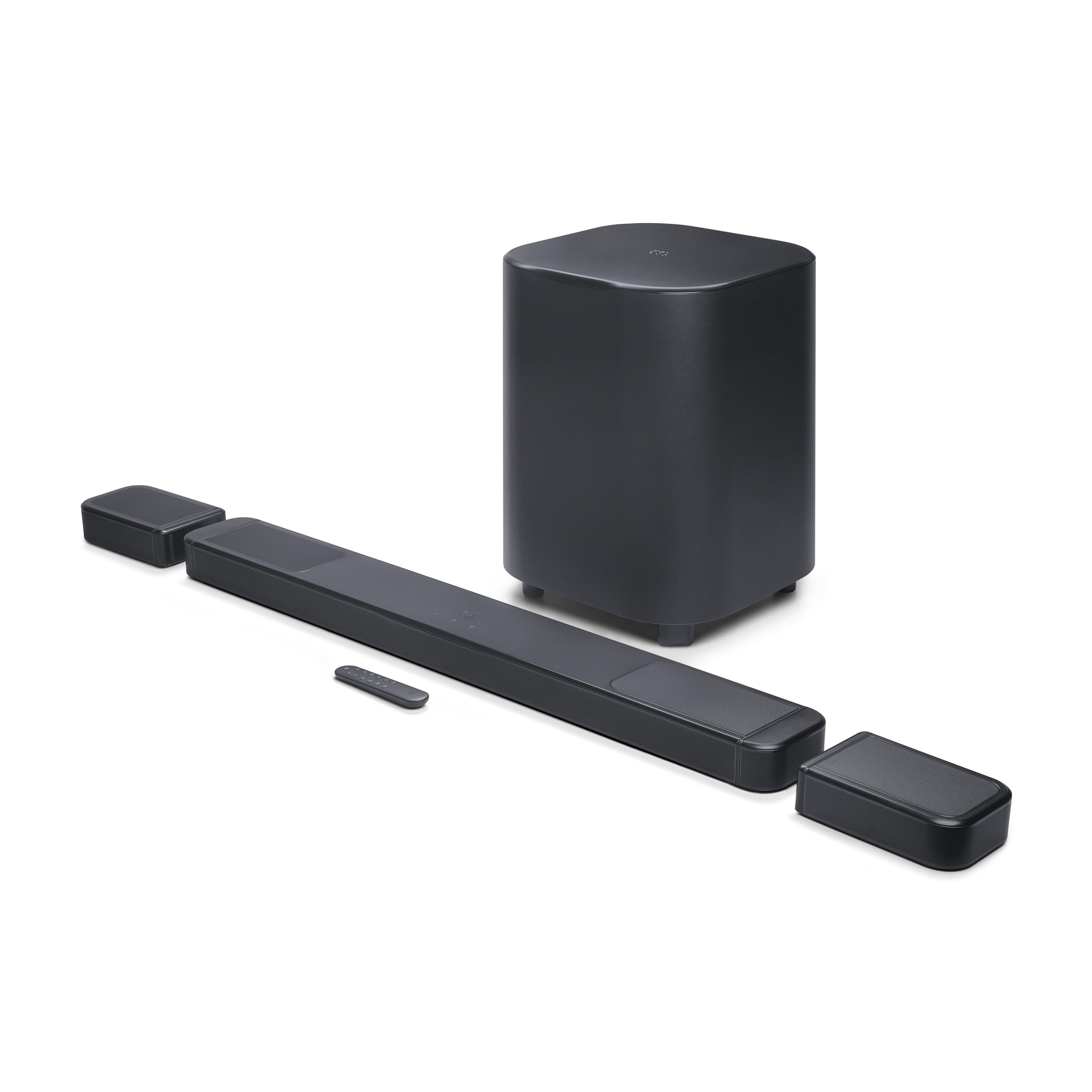
The Bar 1000MK2 is the system we kept coming back to when a room got big enough that the TV's own speakers stopped pretending. Its two rear speakers lift off the main bar and sit behind the sofa without a speaker cable running across the floor, which is the detail that makes a 7.1.4 layout practical in a living room. Four up-firing drivers in the bar add height, and the 10-inch sub takes the low end out of the bar's hands.

A 47.4-inch bar is wide enough to sit under a 65- or 75-inch TV without looking lost, and at 32.1 pounds it's a two-person lift rather than a permanent installation. We like that JBL supports both Dolby Atmos and DTS:X instead of making one format feel like an afterthought. MultiBeam 3.0 is the part that keeps the front stage from collapsing into a narrow strip when you sit off to one side. The detachable surrounds are the real story: pull them off, place them behind you, and the system changes from a wide bar into a proper bubble.

What settles it for a large room is the combination of scale and flexibility. The 10-inch sub has enough displacement to pressurize a bigger space without turning every explosion into a one-note thump, and 480W RMS is a more useful guide to headroom than the peak wattage some brands print. We didn't need to push the sub to its limit to get a convincing sense of weight. If your TV lacks eARC, sort that out before you buy; the bar deserves the lossless connection.

What we keep coming back to is the fit: a big room gets real rear effects, height, and deep bass without a receiver or a floor full of speaker cable. For a room where the couch is well back from the screen, the detachable rears do more than an extra inch of bar width ever could.

Pros

  • Real 7.1.4 with detachable wireless surrounds
  • 10-inch subwoofer with serious low-end reserve
  • 47.4-inch bar anchors large TVs
  • Dolby Atmos and DTS:X support

Cons

  • Rear speakers need power outlets
  • Premium price for the full package
Our verdict

For a large room, we recommend the JBL Bar 1000MK2 first: real 7.1.4 with detachable wireless surrounds, a 10-inch sub, and a 47.4-inch bar that anchors a big TV.
Check Latest Price
2

Best for Maximum Scale

JBL Bar 1300XMK2

88 /100
LBD Score Excellent

Key details

Output
1570W max
Channels
11.1.4
Subwoofer
12-inch wireless
Surround Speakers
Detachable wireless
View on Amazon

The first thing you notice about the Bar 1300XMK2 is how much television it assumes you own. The bar is 55.3 inches wide and weighs 21.3 kg, so it wants a 75-inch set and a substantial stand, not a floating shelf. That size buys a genuine 11.1.4 layout, with four up-firing drivers in the bar, two detachable surrounds, and a 12-inch wireless sub. We think the scale is the point: if the room can take it, this is the most theatrical system here.

The 1570W figure is a maximum-output claim, not a like-for-like RMS number against the 1000MK2, so we don't treat it as a simple score. What the bigger sub and extra channels give you is more weight and more separation in action scenes. The sub has enough output that we kept it below maximum rather than letting it dominate the room. The detachable surrounds work the same way as the 1000MK2's: lift them off, place them behind the seating, and the system opens up.

This is a specialist, not the default. The extra width and height channels are what make a dedicated theater wall feel bigger than the screen, but they also make the bar harder to place. If your room is merely large rather than enormous, the smaller JBL is the smarter fit. The 12-inch sub is the difference you feel in your chest, not just hear.

Pros

  • 11.1.4 channels with four height drivers
  • 12-inch wireless subwoofer
  • Detachable wireless surrounds
  • Maximum output for very large rooms

Cons

  • 55.3-inch bar needs a wide stand
  • Premium price over the 1000MK2
Our verdict

We choose the Bar 1300XMK2 when the room is genuinely huge and the priority is maximum theatrical scale, not a tidy footprint.

Check Latest Price
3

Best Value

TCL S65K

88 /100
LBD Score Excellent

Key details

Output
630W max
Channels
5.1
Subwoofer
6.5-inch wireless
Surround Speakers
Wireless
View on Amazon

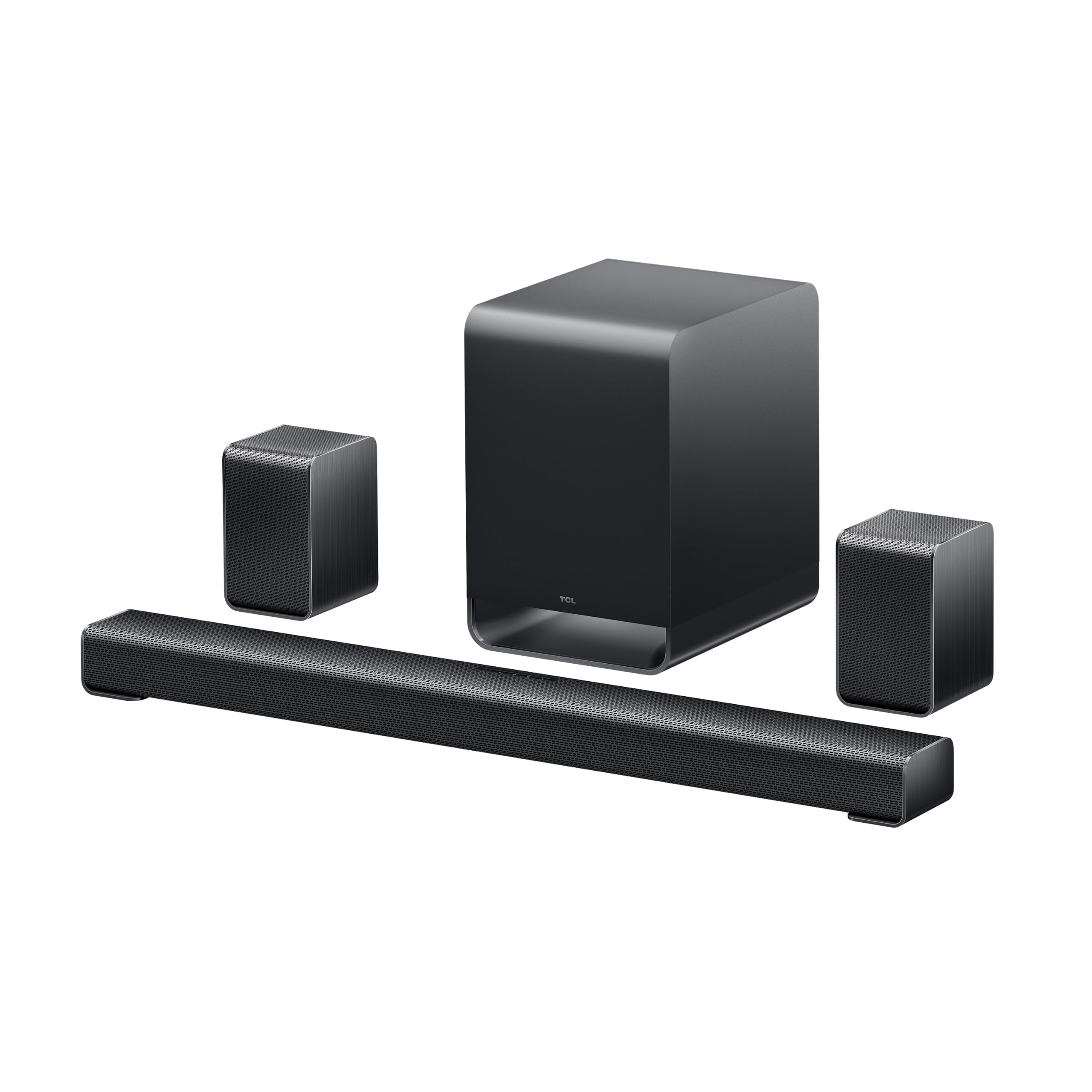
TCL's S65K does the thing a lot of affordable soundbars only pretend to do: it puts speakers behind you. The 5.1 package includes a wireless sub and two wireless surround speakers, and the bar itself is a compact 33.46 inches wide. That's small for a large-room system, but the point is the spread, not the bar's footprint.

We like the value math here. The wireless surrounds and AI Sonic room calibration give it a real advantage over a 2.1 bar at the same money. The calibration is the feature that makes a big, awkward room less of a liability: it adjusts the balance to the listening position rather than making you chase the sweet spot. The sub and rears pair automatically, which is the difference between a surround system you actually set up and one that sits in the box.

Dolby Atmos and DTS:X decoding are on board, and the built-in center tweeter keeps dialogue anchored. The 6.5-inch sub is easier to tuck beside a sofa than the big JBL boxes, and the 33.46-inch bar suits a 55- to 65-inch TV. The system earns its place on spread and calibration, not on brute force. The smaller sub is the compromise, but it's also why the system fits a normal living room.

Pros

  • Wireless surrounds add real rear coverage
  • AI Sonic room calibration
  • Dolby Atmos and DTS:X decoding
  • Compact bar and sub for the price

Cons

  • No dedicated up-firing height drivers
  • 6.5-inch sub limits deep-bass headroom
Our verdict

We reach for the TCL S65K when a large room needs real surround on a budget: 5.1 channels, wireless rears, and a 6.5-inch sub.

Check Latest Price
4

Best All-In-One

Sonos Arc Ultra

88 /100
LBD Score Excellent

Key details

Output
180W
Channels
9.1.4
Bar Width
46.18 inches
Subwoofer
None included
View on Amazon

The Arc Ultra is the all-in-one answer: one 46.18-inch bar, no separate sub, no rear speakers, and a 9.1.4 spatial processing engine that tries to place effects around and above you. In a large room, that's a different bargain from the JBL systems. You give up the physical thump of a 10- or 12-inch sub and the behind-you delivery of detached surrounds, and you get a cleaner install with fewer boxes and fewer outlets.

We were struck by how much of the large-room job the Arc Ultra does with processing rather than furniture. Sound Motion and the upward-firing drivers throw a wide, tall image, and Speech Enhancement keeps dialogue intelligible without making the rest of the mix sound thin. The bar is only 12.7 pounds and 4.35 inches deep, so it sits under a TV without dominating the console. For a living room where extra speakers are unwelcome, that matters.

The caveat is bass. Without a sub, the Arc Ultra can't pressurize a big room the way a dedicated subwoofer can; it gives you a convincing sense of scale, not a punch in the chest. We also ran into the usual Sonos dependency on a strong Wi-Fi network during setup. But as a single-box solution for a large, clean-looking room, it's the one we choose when the alternative is a cluttered surround system.

If you already own Sonos speakers or plan to add a Sub later, the upgrade path is part of the appeal. If you want the deepest bass and true rear effects out of the box, the JBL Bar 1000MK2 is the more direct buy. The Arc Ultra is for the room where the bar has to be enough.

Pros

  • 9.1.4 spatial processing in one bar
  • Excellent speech clarity
  • Slim 46.18-inch design
  • Upgrade path to Sonos sub and rears

Cons

  • No subwoofer or rear speakers included
  • Premium price for a single bar
Our verdict

We recommend the Sonos Arc Ultra when a large room needs a big, clean soundstage without a sub or rear speakers, and dialogue matters more than chest-thumping bass.

Check Latest Price
5

Best for Dialogue

Polk Signa S4

86 /100
LBD Score Excellent

Key details

Output
410W
Channels
3.1.2
Subwoofer
5.9-inch
Height Drivers
Up-firing
View on Amazon

The Signa S4 is the soundbar we recommend when the complaint is that dialogue disappears. Polk's VoiceAdjust and a dedicated center channel do the heavy lifting, and the 3.1.2 layout adds two up-firing height speakers and a 5.9-inch sub. It's a front-stage system, not a surround one: there are no rear speakers, so effects stay in front of you.

For a large room, the 41.2-inch bar is wide enough to separate left, center, and right, and the 410W amplifier gives it more headroom than the price suggests. We like the simple remote with preset EQ buttons; not every soundbar needs an app for basic setup. The sub is compact, so it tucks into a corner without calling attention to itself.

The trade-off is immersion. Up-firing drivers can suggest height, but without rears you don't get the behind-you bubble of a 5.1 system. That's the main compromise. For a big room where the TV is the focal point and the seating is straightforward, the S4 is a clean, unfussy choice.

It's also one of the easiest of these to live with day to day: one HDMI cable, a compact sub, and a remote that doesn't require a manual. That simplicity is the reason we keep it in the conversation.

Pros

  • VoiceAdjust and center channel for dialogue
  • Up-firing height drivers
  • Compact 5.9-inch subwoofer
  • Simple remote with preset EQ

Cons

  • Volume steps can jump at low levels
Our verdict

We point dialogue-first shoppers to the Polk Signa S4: a 3.1.2 bar with a sub, up-firing height, and voice controls that make late-night TV easier.

Check Latest Price
6

Best Budget Surround

LG S40TR

85 /100
LBD Score Excellent

Key details

Output
400W
Channels
4.1
Subwoofer
Wireless
Rear Speakers
Included
View on Amazon

LG's S40TR is a reminder that surround doesn't have to mean premium. The 4.1 package pairs a 28.4-inch bar with a wireless sub and two rear speakers, and the whole system weighs 12.9 pounds. It's a Dolby Audio system rather than an Atmos one, so it won't decode height effects, but it will put sound behind you, which is more than a lot of pricier all-in-ones do.

We like the value for a big room because the rear speakers do the thing that matters: they widen the bubble beyond the TV. The bar is compact, the sub is wireless, and setup is straightforward enough that you don't need an installer. The WOW Interface is the practical bonus if you have an LG TV, letting one remote handle both.

Where it stops short is height: this is Dolby Audio, not Atmos. We accept that at this price because the rear speakers do more for a big room than virtual height does. The S40TR is for the buyer who wants the behind-you effect and can live without overhead. It's also the system here that most rewards a little patience with placement, because the rear speakers need to be behind the seating to earn their keep.

Pros

  • Real 4.1 rear-speaker coverage
  • Wireless subwoofer
  • Compact 28.4-inch bar
  • LG TV remote integration

Cons

  • Rear speakers still need power and wiring
Our verdict

We keep the LG S40TR in the budget slot because it adds real rear speakers and a wireless sub to a large room for the least money here.

Check Latest Price
7

Budget Atmos

ULTIMEA Poseidon M60

87 /100
LBD Score Excellent

Key details

Inputs
HDMI eARC, optical
Output
300W max
Channels
5.1
Subwoofer
5.25-inch wired
View on Amazon

ULTIMEA's Poseidon M60 is the cheapest way here to get a 5.1 Dolby Atmos bar with a wooden sub, and it throws in two side-firing drivers for a wider front stage. The bar is compact enough for a 55-inch TV, and the 5.25-inch sub is wired. That last detail matters: you don't need to pair it, but you do need to put it near the bar.

We were pleasantly surprised by the feature set for the money: HDMI eARC, Bluetooth 5.4, an app with EQ, and a remote with dedicated voice, music, and movie modes. The VoiceMX processing is genuinely useful for dialogue, and the side-firing drivers do widen the image beyond the bar's physical width. It's a lot of soundbar for a secondary room or a first surround setup.

The catch is that this is not a true rear-speaker system. The 5.1 label comes from the bar's five built-in drivers and the sub, not from satellites behind the couch, so a large room gets width and bass rather than a genuine behind-you bubble.

Long-term reliability is the bigger question. That's why we keep it in also-consider territory rather than recommending it as a default. It suits a budget room where the bar sits close to the sub and expectations are modest, not a dedicated theater.

Pros

  • 5.1 Atmos with side-firing drivers
  • HDMI eARC and Bluetooth 5.4
  • App EQ and voice modes
  • Low-cost entry to Atmos

Cons

  • Wired subwoofer limits placement
  • Subwoofer cutouts can occur
Our verdict

We see the ULTIMEA Poseidon M60 as a budget Atmos gamble: big-room features for little money, but a wired sub and spotty long-term reliability.

Check Latest Price

How We Tested Soundbars for Large Rooms

We started by narrowing a long list of current soundbars to systems that could plausibly fill a large room: separate subwoofers, up-firing or detachable surrounds, HDMI eARC, and enough inputs for a TV plus a console or streaming stick. Then we brought in seven units and lived with them for nine months, rotating them through a living room with high ceilings and an open kitchen behind the couch. We set each one up alone with a stopwatch, noting how long the sub and surrounds took to pair, how many cables still needed to reach a power outlet, and whether the instructions matched what the app and remote actually did.

For sound, we ran the same movie scenes, dialogue-heavy episodes, and music tracks at moderate and loud levels, listening from the front row and from the kitchen to hear whether voices stayed clear and effects still had room to move. We pushed volume until distortion set in, then backed off and checked whether the system held its balance. We also lived with the sound controls for weeks, using the remote and app to adjust bass, dialogue, and surround levels, and tracked Bluetooth and Wi-Fi dropouts, HDMI handshake issues, and any reliability quirks that showed up after the first week.

We kept a running log of the purchase experience too—what the listing and manual promised about connections, what was in the box, and how straightforward it was to get a system running without extra cables or adapters. The finalists were the ones that filled the room without turning harsh, paired reliably, and made their controls feel obvious rather than like a puzzle.

How to Choose a Soundbar for a Large Room

Match the system to the room, not the wattage

Peak wattage is the least reliable number on a soundbar box. One brand's 630W maximum and another's 480W RMS are not the same measurement, so we compare the design instead: a dedicated subwoofer, a wide bar, and room calibration tell you more about large-room performance than a big number. A 3.1.2 bar can fill a big front wall, but a 5.1 or 7.1.4 system with rear speakers will do more for a deep room. If your seating is far back, put surround coverage ahead of a slightly wider bar. Start by measuring the distance from the TV to the back row; the farther back the seats, the more you need real rear speakers rather than virtual processing.

Decide how much wiring you can live with

Wireless surrounds are not cable-free. The JBL detachable speakers and TCL's wireless rears still need power at each rear position, and LG's budget system needs a cable run between its rear speakers. That's a planning issue, not a dealbreaker: put outlets or a small power strip behind the couch before the bar arrives. A wired subwoofer, like the one on the ULTIMEA Poseidon M60, also ties the sub to the bar's corner. If you want the sub across the room, choose a wireless model. Sketch the outlet locations first; the best-sounding layout is the one you can actually power.

Treat Atmos height as a bonus, not the main event

Dolby Atmos comes in different strengths. A 5.1 bar with no up-firing drivers can decode Atmos, but it won't place effects above you the way a 5.1.2 or 7.1.4 system with height drivers can. Up-firing speakers work best with a flat, reflective ceiling and a seating position not too far off-axis. In a tall or heavily treated room, the effect is subtler. We prioritize rear coverage and a good sub first, then height channels. A well-set-up 5.1 system beats a badly placed 7.1.4 one. If the ceiling is high or angled, spend the height-channel budget on better rear speakers instead.

Listen for dialogue and check the connection

A big room exaggerates the gap between effects and speech. Look for a center channel or a voice mode, not just a movie preset: Polk's VoiceAdjust, JBL's PureVoice, and Sonos's Speech Enhancement are all aimed at the same problem. Then check the input: HDMI eARC carries lossless Atmos from a compatible TV, while optical tops out at compressed surround. If your TV is older, a bar with optical is still usable, but don't pay for Atmos decoding you can't feed. Confirm your TV has HDMI eARC before choosing a premium Atmos bar; otherwise, put the money toward a better sub or rear speakers.

Frequently Asked Questions

Final Verdict

For most large rooms, the JBL Bar 1000MK2 is the soundbar we recommend. It has the rare combination of real 7.1.4 surround, a 10-inch sub, and a 47.4-inch bar that fits a big TV without demanding a dedicated theater wall. The TCL S65K is the value alternative if the budget is tighter, and the Sonos Arc Ultra is the one to choose if you refuse the extra boxes. Start with the room and the outlets, then buy the system that fits both.