Best Speedlights for Canon Cameras of 2026

The first time I bounced a flash off a reception hall ceiling instead of firing it straight at someone's face, my portraits stopped looking like passport photos. A speedlight is a small, aimable sun you can dial down to a whisper or crank up to beat noon — and the hard part is finding one that fires every time, talks to your Canon, and doesn't quit mid-ceremony.

We've spent seven months firing 12 speedlights — on-camera, off-camera, in pairs — at receptions, in dim living rooms, and in flat noon sun, and the pattern held: the ones worth carrying are reliable first and clever second. Ignore the guide number for a minute; it's quoted at one zoom position and full power, so it says almost nothing about recycle speed or battery life.

The real fork in the road is the hot shoe. A flash with a plain center pin will fire on a Canon, but you lose TTL, high-speed sync, and camera-side exposure compensation — most of what you're paying for. The picks below are the ones I'd hand to a friend, pro or not.

1

Best Overall

Godox TT685II-C

87 /100
LBD Score Excellent

Key details

Power Source
4 AA batteries
Zoom Coverage
20-200mm
High-speed Sync
Up to 1/8000 sec
Exposure Control
TTL and manual
View on Amazon

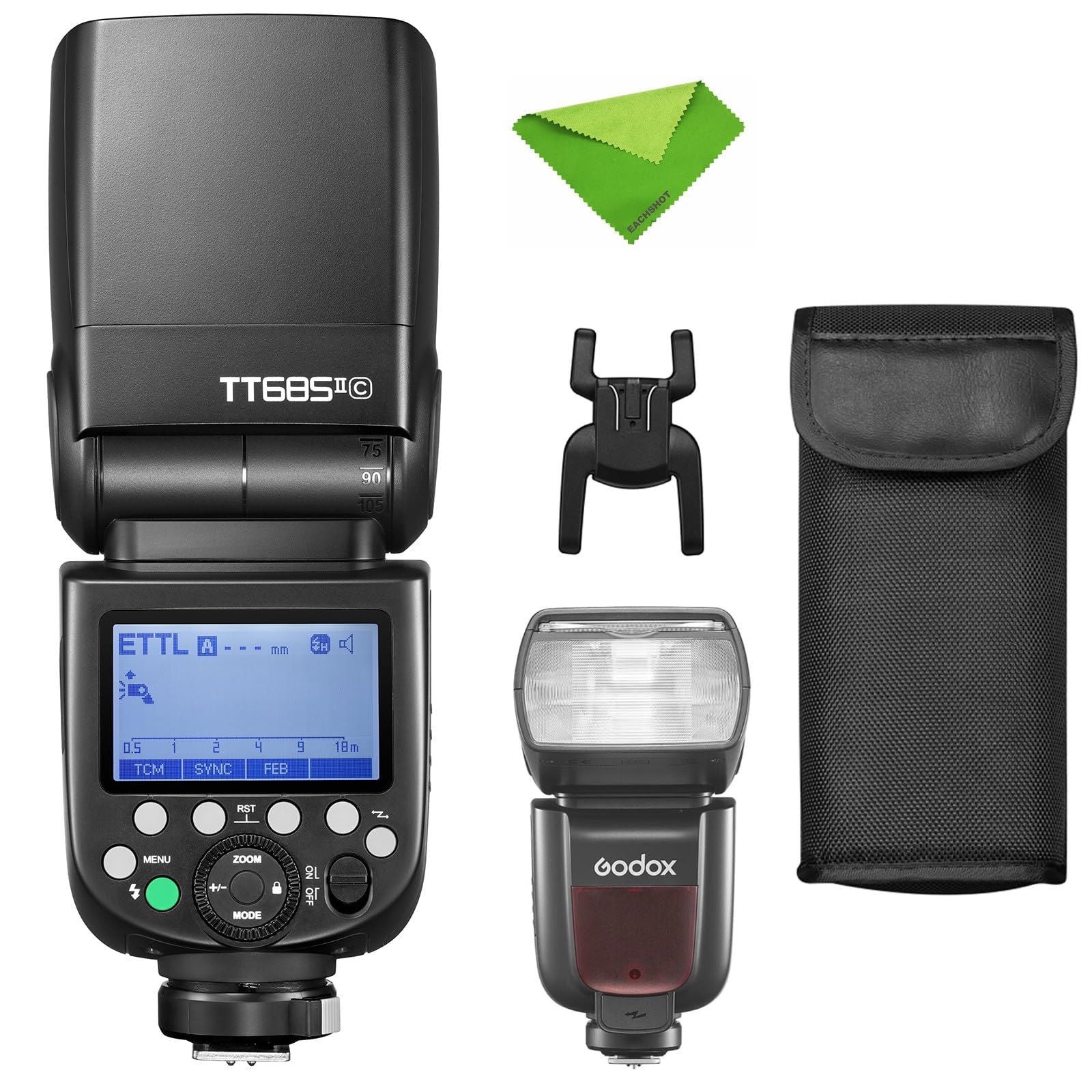
The handshake between flash and camera is what you're really paying for, and the TT685II-C does it properly. Mounted on an EOS body it meters through the lens with E-TTL II, syncs at up to 1/8000 sec, and follows the camera's own exposure settings instead of asking you to do the arithmetic. Guide number 60 at ISO 100 with a head that zooms from 20mm to 200mm means it has the reach for a dark reception hall and the spread for a small living room.

Two details earned their place in our kit. The quick-release lever clamps the shoe without the fiddly screw collar older flashes use, which matters when you're moving between bodies in a hurry. And the TCM button converts a TTL exposure into the manual power level that produced it, so you can shoot a frame on the meter and then lock that look in for a sequence. That is the fastest route from trusting the camera to overriding it that we've handled on a flash at this level.

Power comes from four AAs. We count that as an advantage on a trip, where eight cells and a charger outlast any built-in pack, and a chore at a long event where you're swapping rather than shooting. If you'll be at full power for hours, a lithium-ion unit is the more comfortable tool. For everything else the AA bay is a fair trade for what this flash does not cost you.

One thing to check before you order: on a body like the R50, which lacks the legacy hot-shoe contacts, this flash needs Canon's AD-E1 adapter to communicate. On an R5, R6 Mark II, R7, 90D, or 5D Mark IV it's a straight fit, and that dedicated Canon E-TTL II build is why we trust it over a generic single-contact unit with the same guide number.

Pros

  • E-TTL II metering that speaks Canon's language
  • 1/8000 sec high-speed sync for wide apertures
  • GN60 with 20-200mm zoom coverage
  • TCM button converts TTL into a manual level

Cons

  • Runs on four AA batteries
  • R50 bodies need Canon's AD-E1 adapter
Our verdict

For most Canon shooters we recommend the TT685II-C: it meters through the lens, syncs to 1/8000 sec, and puts GN60 in the air for midrange money.

Check Latest Price
2

Best Canon-Brand Option

Canon Speedlite EL-10

86 /100
LBD Score Excellent

Key details

Power Source
4 AA batteries
Canon Connection
Multi-function shoe
Exposure Control
Automatic and manual
Maximum Shutter Speed
1/4000 sec
View on Amazon

The EL-10's foot is a multi-function connector rather than a standard hot shoe, and that one fact decides who should buy it. On a compatible EOS R body it hands flash settings to the camera's own menu system and can command up to 15 additional Speedlite units as a master. On a DSLR, or an older mirrorless body without the new shoe, that conversation is exactly what you lose.

We appreciate how little thought it asks for. There is no translation layer between flash and camera — the settings are reached through the body, and the two were designed to the same standard. The head pulls back to 90 degrees and swivels 150 degrees left and 180 degrees right, a wider sweep than most, which makes bouncing off a side wall easy in a tight room where the ceiling is dark or too high.

It is not the power buy. The TT685II-C is the brighter flash for less money, and the EL-10's maximum shutter speed is listed at 1/4000 sec against the Godox's 1/8000, with a 1/200 sec sync and four AAs in the grip. What you pay for is the certainty that the thing on your shoe came from the people who built the shoe, with one manual and one warranty covering both.

For a single R body and a lot of bounced light, that certainty is the whole purchase, and the 150-degree left swivel is the specification we'd point a hesitant buyer to first — it reaches the wall behind your own shoulder, which is the bounce that flatters most faces.

Pros

  • Flash settings live in the camera menu
  • Master control for up to 15 Speedlites
  • Wide swivel: 150 degrees left, 180 right
  • One brand, one manual, one warranty

Cons

  • Multi-function shoe bodies only
  • Less light output than the Godox pick
Our verdict

Buy the EL-10 if you shoot EOS R bodies and want camera-menu control from the company that built your camera; it is the least fussy flash here.

Check Latest Price
3

Best Round-Head Light

Neewer Z1-C

88 /100
LBD Score Excellent

Key details

Battery
2600mAh lithium-ion
High-speed Sync
1/8000 sec
Exposure Control
TTL, manual, stroboscopic
Full-power Shots
480
View on Amazon

A round flash head exists for one reason: light falls off evenly toward the edges of the frame instead of hot-spotting in the middle. The Z1-C pairs a circular fresnel head with a magnetic dome diffuser in the box, and the result at portrait distance is the gentlest on-camera light among these picks — closer to a small softbox than to the hard pop of a bare rectangular head.

The rest of the package is event-ready. The 2600mAh pack is rated for 480 full-power shots with a 1.5 sec recycle, TTL and manual sit within easy reach, high-speed sync runs to 1/8000 sec, and the magnetic ring takes Neewer's own dome, gels, and grid without a strap or a bracket. We got more from that last part than we expected: swapping a gel between setups takes a second rather than a minute of fumbling.

We judge this the best light quality for the money of the flashes here, and the compromise is radio. Neewer's Q system runs four groups and 32 channels and works well with its own triggers, but it does not join a Godox X setup at all. If your bag is already Godox, this is a second trigger system to carry, not an addition to the one you have.

Output is 76Ws, plenty for a room and short of a stadium, and the listed 1/300 to 1/20000 sec flash duration is short enough to freeze a hand mid-gesture in dim light. For portraits, receptions, and any job where you'll be shooting people close in, the round head is the reason to pick it over a cheaper rectangular flash with the same power.

Pros

  • Round head spreads light evenly to the edges
  • Lithium-ion pack rated for 480 full-power shots
  • Magnetic mount takes diffusers and gels fast
  • TTL, HSS to 1/8000 sec, and stroboscopic modes

Cons

  • Neewer Q radio, not Godox X
  • Battery can work loose mid-shoot
Our verdict

We reach for the Z1-C when the look of the light matters more than the spec sheet: the round head and included dome give the softest on-camera light in this group.

Check Latest Price
4

Best Manual Value

Godox TT600

92 /100
LBD Score Outstanding

Key details

Guide Number
60 (m, ISO 100)
Power Source
4 AA batteries
Recycling Time
0.1-2.6 sec
Exposure Control
Manual only
View on Amazon

Manual flash is where money goes furthest, and the TT600 is the proof: GN60 output and a built-in 2.4G receiver for the least money in this roundup. It fires from 1/128 to full power in eight manual steps, has S1 and S2 optical slave modes for firing off another flash, and talks to the rest of Godox's X system from up to 100 meters away.

What it doesn't have is any automation. There's no TTL, so the camera will not meter the flash for you, and the 1/8000 sec high-speed sync in the listing only arrives when a TTL trigger, sold separately, is doing the talking. That's a real limitation on a dance floor and no limitation at all in a studio, where you want every head locked to a fixed power and nothing changing behind your back.

In the hand it feels heavier and more solid than its price suggests, and the recycle is quoted at 0.1 to 2.6 seconds with roughly 230 full-power pops from four AAs at a steady 5600±200K. Consistency is what we ask of a manual flash — the same output at the power you dialed, frame after frame, so a three-light setup stays balanced — and it's the reason this one stays in the bag rather than being a curiosity.

Buy it as your second, third, and fourth light, or as the first if you've decided to learn flash properly. It also makes a sensible backup for a TTL head you already own: same guide number, same radio system, so a failure on a shoot costs you a swap rather than a reshoot.

Pros

  • GN60 output for the least money here
  • Built-in 2.4G X receiver, 100 m range
  • About 230 full-power flashes on four AAs
  • S1 and S2 optical slave modes

Cons

  • Manual only, with no TTL metering
  • High-speed sync needs a separate TTL trigger
Our verdict

If you light manually and off-camera, the TT600 is the value pick here: GN60 output and a built-in 2.4G receiver for the least money in this roundup.

Check Latest Price
5

Small Kits

Neewer Z160 SE

87 /100
LBD Score Excellent

Key details

Output
20Ws, GN15 at ISO 100
Power Source
1200mAh lithium-ion
Recycle Time
2.8 sec
Exposure Control
Manual only
View on Amazon

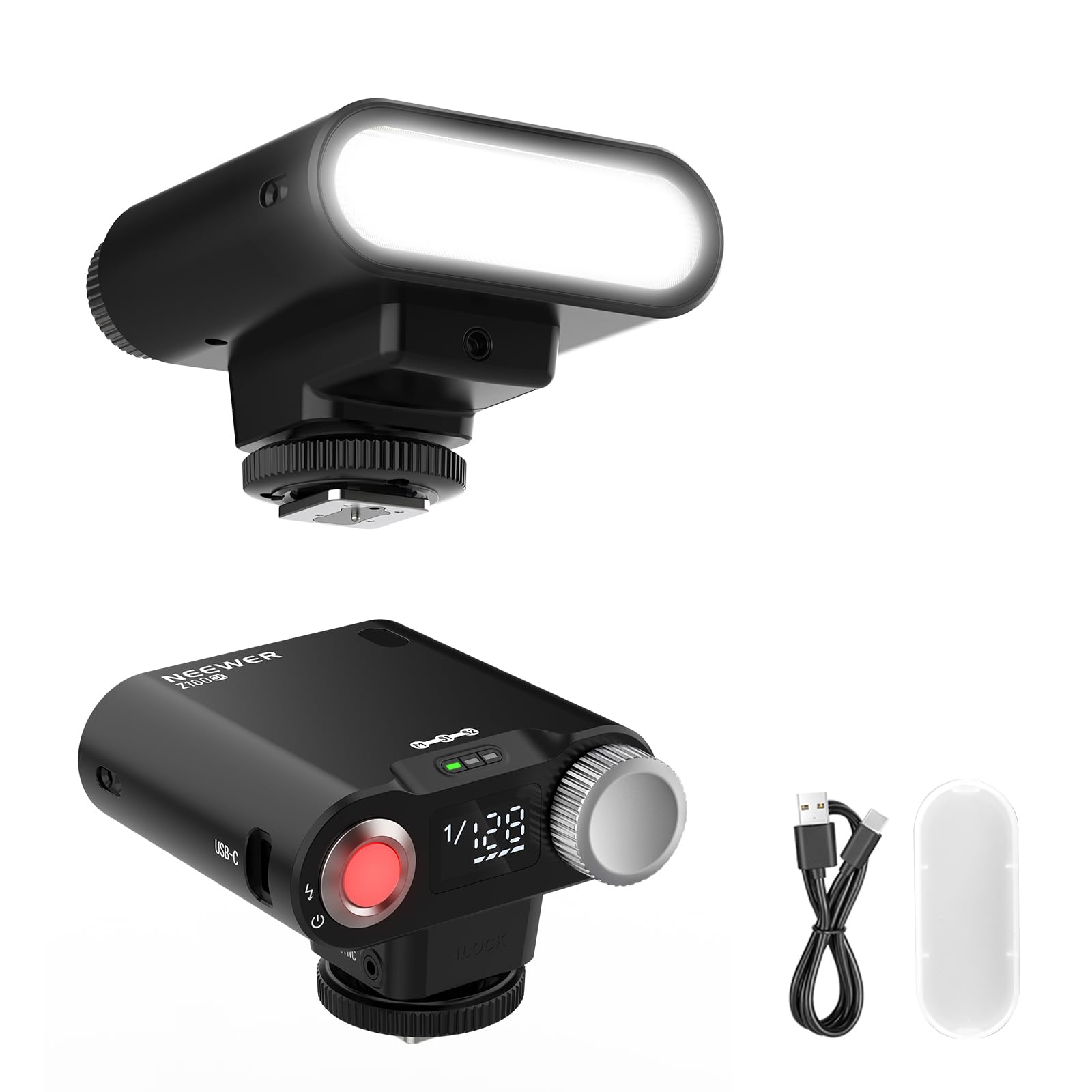
Twenty watt-seconds is not much light, and that is the point. The Z160 SE is a compact manual flash with a rotary power dial and a small display, GN15 at ISO 100, fixed 35mm coverage, a 2.8 sec recycle, and a built-in 1200mAh battery. It is the sort of thing that lives in a jacket pocket and turns a flat indoor snapshot into a picture with shape to it.

What surprised us is how much we liked the dial. One hand, one turn, and the power steps visibly from full down to 1/128 while the screen tells you where you are without a menu. On a small mirrorless body it feels proportionate in a way a full-size speedlight does not, and the lithium battery means no last-minute hunt for four fresh AAs before you leave the house.

It is a single-contact flash, so there is no TTL, no high-speed sync, and no camera-menu control — you set power and aperture yourself. The spec also notes it works only in mechanical shutter mode on mirrorless bodies that offer both shutters, which rules out silent-shutter shooting. Those limits are fine for a light you use at arm's length with the camera in your hand, and they are decisive if you are chasing a moving subject around a dim room.

Where it earns its place is fill: a stop of light on a backlit face outdoors, a little punch at a small gathering, a highlight in a product shot. Its 6000±200K output is a touch cooler than the 5600K flashes here, close enough that a single white-balance nudge covers a scene lit by both.

Pros

  • Compact body with a fast rotary power dial
  • Manual power from full down to 1/128
  • Built-in 1200mAh rechargeable battery
  • 20Ws output for close-range fill

Cons

  • No TTL and no high-speed sync
  • Mechanical shutter only on mirrorless bodies
Our verdict

A pocketable fill light for small kits and close work, as long as you accept manual power and no high-speed sync.

Check Latest Price

How We Tested the Best Speedlights for Canon Cameras

We started by gathering every current Canon-compatible speedlight we could find — from Canon and the major third-party makers — reading spec sheets and flagging which ones claimed full TTL communication with modern mirrorless bodies versus a plain center-pin trigger. Anything discontinued got cut. That left 12 units, which we've lived with for seven months.

Each one went on both a Canon mirrorless body and an older DSLR for the same three shots: a straight portrait in a dim living room, a bounce off a ten-foot white ceiling, and a backlit subject at noon with high-speed sync switched on. We noted whether the camera recognized the flash in its own menu, whether TTL landed the exposure or needed a stop of compensation, and whether the flash actually fired above the camera's sync speed. Then we handed each one to a photographer who'd never touched that model and timed how long it took to drop to 1/16 power and tilt the head — first in a lit room, then in the dark by feel.

Battery life got its own run: full-power pops until the flash refused to fire, plus an evening of a few hundred mixed TTL frames, comparing recycle time on the first pop against the twentieth and counting dropped frames during bursts. We also shot the same white wall at every power level to check color consistency frame to frame, and after seven months of being packed between lenses, we looked at shoe wobble, head lock, and whether the battery door still closed tight.

How to Choose a Speedlight for Your Canon

TTL or Manual

TTL fires a brief pre-flash, the camera reads the light that comes back, and the flash quenches at the power that makes the exposure right. Manual means you pick a level from full power down to 1/128 and adjust as the distance changes. Choose TTL when your subject moves between rooms and distances, which is why the TT685II-C is the flash we hand most Canon owners. Choose manual when you're building two or three lights and want ratios that don't drift between frames. That's the TT600's job, and it costs considerably less.

Not Every Hot Shoe Contact Is Used

Every flash here mounts on a Canon shoe, but they don't all talk to it. A single-contact flash fires from the center pin and nothing else: no TTL, no high-speed sync, no settings in the camera menu. Dedicated units such as the Godox -C models and Canon's own Speedlites use the extra pins for metering and control.

Canon's newer bodies complicate this. The R50 dropped the legacy contacts, so a third-party flash needs Canon's AD-E1 adapter to communicate there at all. Look at the shoe on your camera before you assume a flash will speak to it.

Guide Number, Zoom, and What High-Speed Sync Costs

Guide number is reach. Divide it by your aperture and you get a rough working distance in meters at ISO 100 and full power. The catch is that it's quoted at a particular zoom setting: a GN60 head at 200mm throws far more light than the same head at 20mm, and bouncing off a ceiling takes most of it away again.

High-speed sync is the other half of the trade. It lets you use flash above your camera's sync speed, but it pulses the tube and cuts output. A 1/8000 sec ceiling is there for fill at f/1.8 in daylight, not for lighting a stage from the back of a hall.

AA or Lithium-Ion

Four AA cells are the old answer and still a good one: cheap, replaceable anywhere, and three spare sets weigh less than a lens. A lithium-ion pack recycles faster — the Z1-C is rated at 1.5 seconds and 480 full-power shots — but when it's flat you charge rather than swap, so a second pack belongs in the real cost. We prefer lithium-ion for events and AAs for travel and multi-light setups, where a bag of spare cells outlasts any single pack.

What the 2.4G Badge Actually Buys

An optical slave mode is free and needs no trigger: the flash fires when it sees another flash go off. It also needs line of sight, struggles in a bright room, and can't be adjusted from the camera position. A 2.4G system — Godox's X, Neewer's Q — needs a trigger or a master flash on the camera, but works around corners, in groups, with power changes made from where you're standing. Buy into the ecosystem you intend to keep, because a Neewer Q flash will not join a Godox X trigger, or the other way around.

Frequently Asked Questions

Final Verdict

The Godox TT685II-C is the flash we point most Canon owners to. It meters through the lens with E-TTL II, syncs to 1/8000 sec, and puts a GN60 head with 20-200mm coverage in your bag for midrange money — the practical answer for weddings, portraits, and any room where the light keeps changing.

Buy the Canon Speedlite EL-10 instead if you shoot EOS R bodies and want the flash settings living in your camera menu, and accept that it won't serve a DSLR. If you light manually and off-camera, the TT600 hands you the same guide number and a 2.4G receiver for far less, and asks only that you set the power yourself.