Best Thermal Cameras of 2026

The coldest room in my house sits above the garage, and for two winters I blamed the windows. Then a friend handed me a thermal camera, and fifteen minutes later I was staring at a blue stripe running along the sill plate — air leaking in nowhere near the glass. These tools don't tell you what's wrong; they tell you where to look, which is why a clear readout matters more than a long spec sheet.

Over the past eight months, my team and I have pointed ten thermal cameras at drafty sills, loaded breaker panels, hot brake rotors, and laptop boards, and the same few things separated the useful ones from the frustrating ones: accuracy you can actually verify, an image that stays readable in a dim basement, and menus you can work with cold hands.

One thing worth knowing before you compare: the resolution number sellers print largest is usually an enhanced figure, not the sensor's true infrared resolution, so two cameras with similar badges can look wildly different. The picks below include handheld units and phone plug-ins, and every one of them earned a place by finding something real.

1

Best Overall

TOPDON TC004

90 /100
LBD Score Outstanding

Key details

Display
3.5 in
Battery Life
8 hours
IR Resolution
256 x 192, 512 x 384 TISR
Temperature Range
-4°F to 1022°F
View on Amazon

Detail is what you pay for, and the TC004 is where detail starts to arrive. Its sensor is 256 x 192 — roughly four times the pixel count of the 128 x 128 budget handhelds here — and TISR enhancement lifts the displayed image to 512 x 384, enough to pick one warm breaker out of a crowded panel or the cool edge of a damp patch rather than a general blur across a ceiling. A 3.5-inch screen and a red laser pointer that marks the spot you are measuring finish the job, and we think this is the camera most people should buy first.

The rest of the specification supports that. The range runs from -4°F to 1022°F, which covers HVAC, electrical, and building work with room to spare, and the documentation is unusually complete: 64 GB of internal storage, video recording, Wi-Fi transfer to the TopInfrared app, and PC-side analysis. A camera that only shows you a problem on its own screen is a diagnostic tool. One that hands you a labelled image to send to a contractor or a client is a reporting tool, and this is one of the few models here that manages both.

The honest caveat on TISR is that 512 x 384 is generated, not captured. Small targets still resolve like a 256 x 192 sensor, so treat the enhancement as cleaner edges rather than new information — which is still a different class from the 128 x 128 cameras further down this list.

Pros

  • Native 256 x 192 sensor shows components, not blobs
  • Video recording and 64 GB of internal storage
  • Wi-Fi transfer and PC analysis for write-ups
  • Laser pointer marks the measurement spot

Cons

  • Eight-hour runtime is the shortest of the full-size handhelds here
Our verdict

The camera we tell most people to buy: real 256 x 192 detail, a readable 3.5-inch screen, and video plus PC reporting at a midrange price.
Check Latest Price
2

Best Compact Handheld

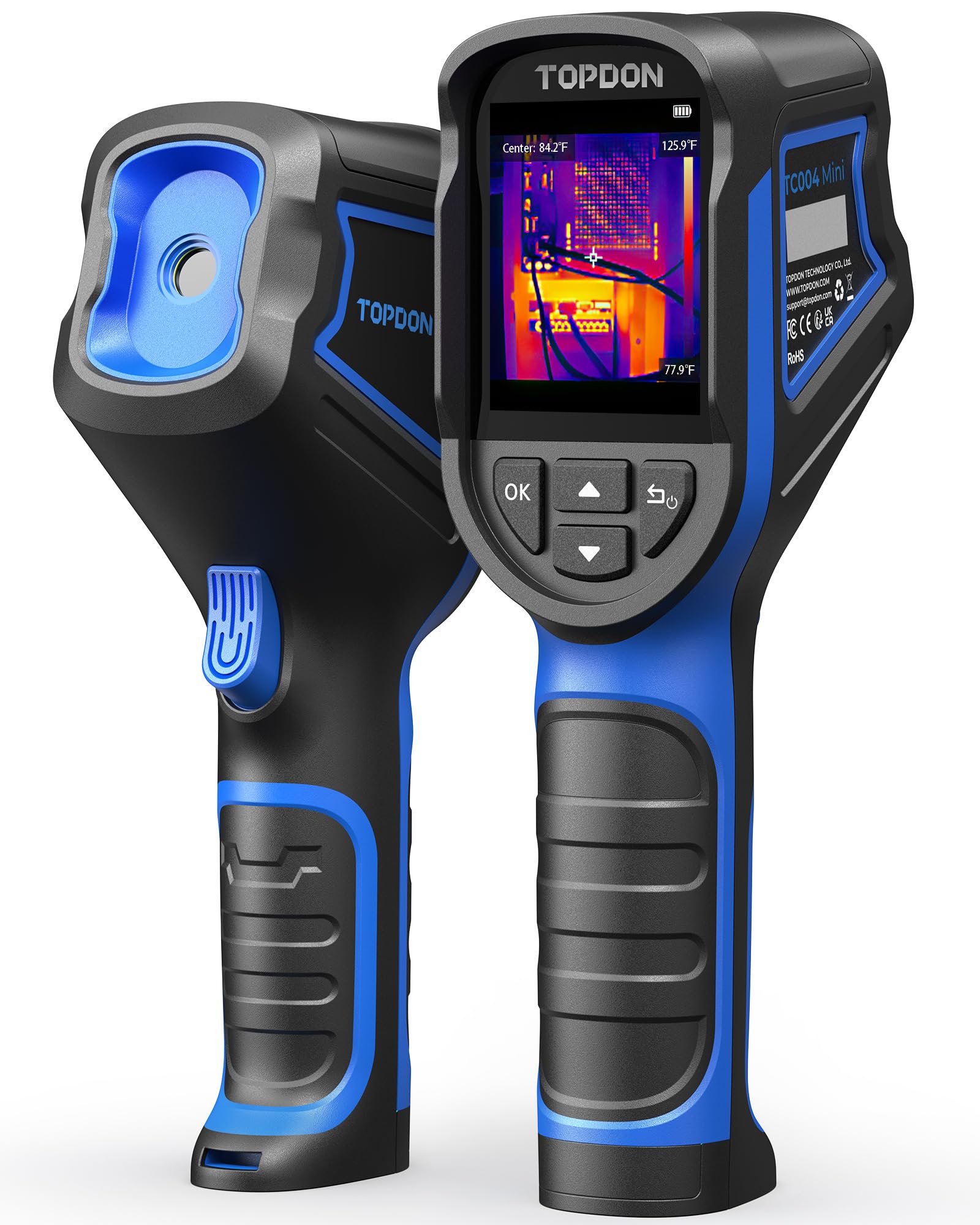
TOPDON TC004 Mini

87 /100
LBD Score Excellent

Key details

Battery Life
15 hours
Field Of View
40° x 30°
IR Resolution
128 x 128, 240 x 240 TISR
Temperature Range
-4°F to 842°F
View on Amazon

Some thermal cameras live in a case on a shelf; this one is built for a tool bag. It is small, it is rated for 15 hours of use, and it measures from -4°F to 842°F at ±3.6°F or 2%, which is the whole specification sheet a maintenance check actually needs. If your thermal imaging is a series of two-minute stops — a radiator that is not heating, a draft under a door, a breaker warmer than its neighbours — the Mini is enough camera.

We found the narrow 40° x 30° field of view suits that work better than the 50-degree lenses on the budget models. A wide lens shows you a room at low magnification; this one magnifies what is directly in front of you, which is what you want when the target is a valve or a socket rather than a whole wall. The 25Hz refresh keeps the image steady as you pan across a panel.

The sensor is 128 x 128, enhanced to 240 x 240, and that sets the ceiling. Programmable high and low temperature alarms mean you can sweep a wall and let the camera flag anything crossing a threshold instead of watching the palette yourself. That is the right feature set for maintenance checks and the wrong one for a formal inspection report.

Pros

  • Fifteen-hour battery outlasts the other TOPDON handheld here
  • Narrow view magnifies a valve or a socket
  • High and low alarms for sweeping a wall
  • 25Hz refresh keeps the image steady

Cons

  • Small screen is awkward to read at arm's length
  • Enhanced detail softens on distant targets
Our verdict

A pocketable handheld for quick checks: the narrow view and 15-hour battery suit maintenance walkarounds, as long as you do not need fine detail.

Check Latest Price
3

Best Big-Screen Handheld

Thermal Master Thor002

87 /100
LBD Score Excellent

Key details

Display
3.5 in, 640 x 480 IPS
Battery Life
10.5 hours
IR Resolution
512 x 384 X³
Temperature Range
-4°F to 1022°F
View on Amazon

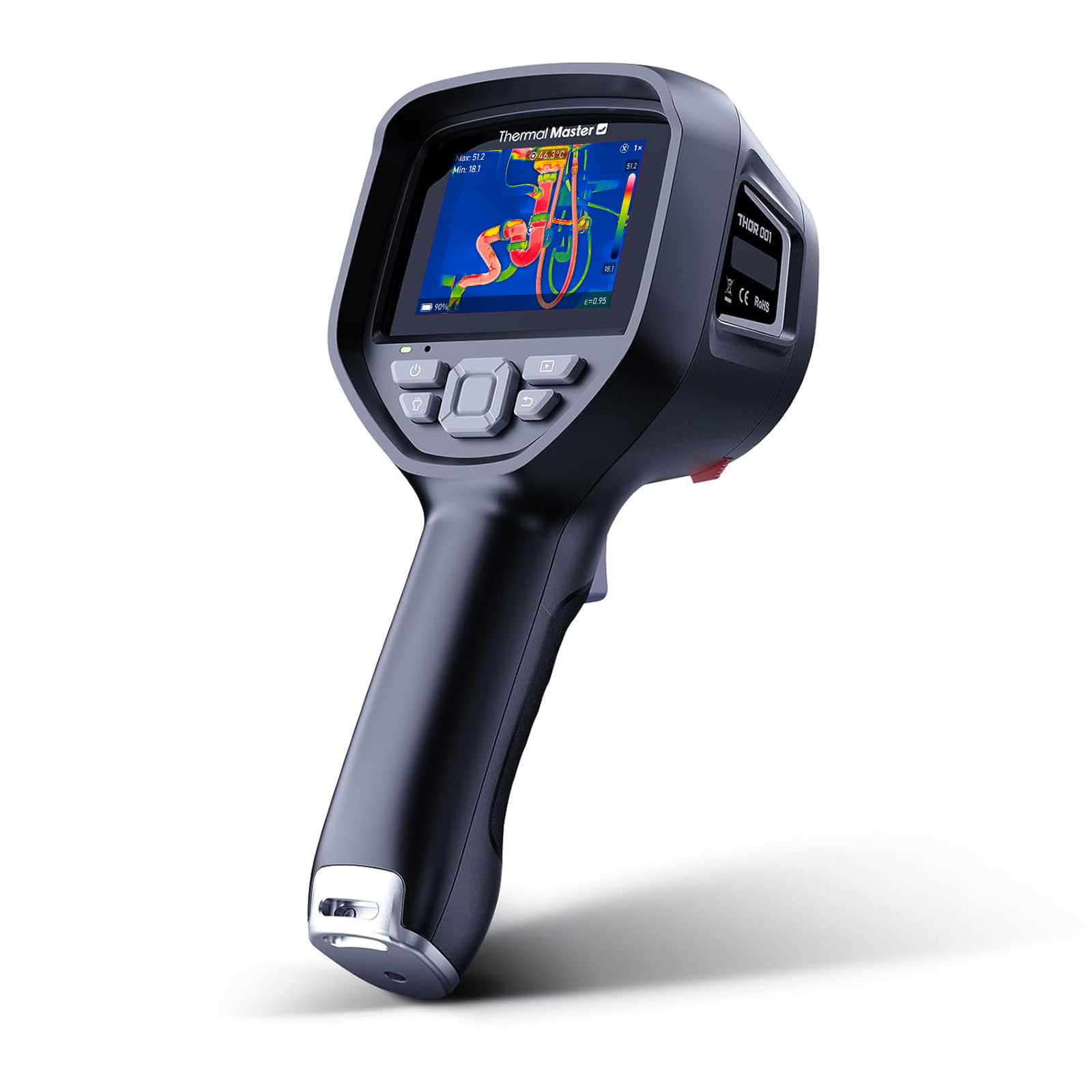
Spend more than our top pick and the money goes, first, to the screen. The Thor002's 3.5-inch 640 x 480 IPS panel is the sharpest display in this group by a clear margin, and the 2MP visible-light camera behind it means the thermal image can be laid over a real photograph instead of read as an abstract colour map. Standing under ductwork looking up, that pairing is easier on the neck than a 2.8-inch screen.

The 4.3mm lens extends detection range, and 4x digital zoom with a laser pointer helps when the target is across a room. What impressed us is the charging: 18W fast charging on a 5000mAh battery rated for 10.5 hours puts most of a working day back during a lunch break. Files move over USB to a PC for live analysis or over Wi-Fi to the companion app.

Temperature is where to slow down. The range reaches 1022°F at ±3.6°F, but the readings are the part we trust least: some agree with a reference thermometer and some drift, so check yours against a known source before you put a number in front of a client. For finding the fault rather than certifying it, the screen and the reach do the work.

Pros

  • Sharpest display here at 3.5 inches and 640 x 480
  • 2MP visible-light camera for fused images
  • 18W fast charging refills a 10.5-hour battery quickly
  • Longer lens and laser for distant targets

Cons

  • Temperature readings vary enough to warrant a reference check
Our verdict

The handheld for overhead and long-range work: the biggest, sharpest screen here, with a reference check for anyone who needs defensible numbers.

Check Latest Price
4

Best Battery Life

AMPBANK H128

88 /100
LBD Score Excellent

Key details

Accuracy
±1%
Drop Rating
6.6 ft
Battery Life
24 hours
IR Resolution
128 x 128, 240 x 240 TISR
View on Amazon

Twenty-four hours is the number that separates the H128 from everything else here. Nobody works a camera for twenty-four hours straight, but nobody wants to think about charging either, and a camera that comes off a shelf ready to go is the one you actually reach for. Add a 6.6-foot drop rating and a compact body, and this is the one we hand to people who inspect for a living rather than once a season.

The trade-off is detail. Its sensor is 128 x 128, enhanced to 240 x 240, so a wall or a vent reads clearly and a component on a board does not. Accuracy is the strong suit instead: readings within ±1% with 0.1°C resolution, a tighter claim than most of this group makes.

What we noticed is how little it asks of you. There is a tripod mount for steady before-and-after shots, high and low alarms turn a slow sweep of a room into a pass-or-fail check, and the runtime is long enough that charging never enters the decision. That combination is what a maintenance camera should be.

Pros

  • 24-hour battery means it is always ready
  • ±1% accuracy and 0.1°C resolution
  • Survives a 6.6-foot drop
  • Tripod mount for steady comparison shots

Cons

  • Display is hard to read in bright light
  • Fine detail is limited by the 128 x 128 sensor
Our verdict

The one to leave in the van: 24 hours per charge, a drop rating, and tighter accuracy than most, with fine detail as the compromise.

Check Latest Price
5

Best for Circuit Boards

Thermal Master P3

82 /100
LBD Score Excellent

Key details

Focus
Manual
Connection
USB-C
IR Resolution
256 x 192, 512 x 384 X³
Temperature Range
-4°F to 1112°F
View on Amazon

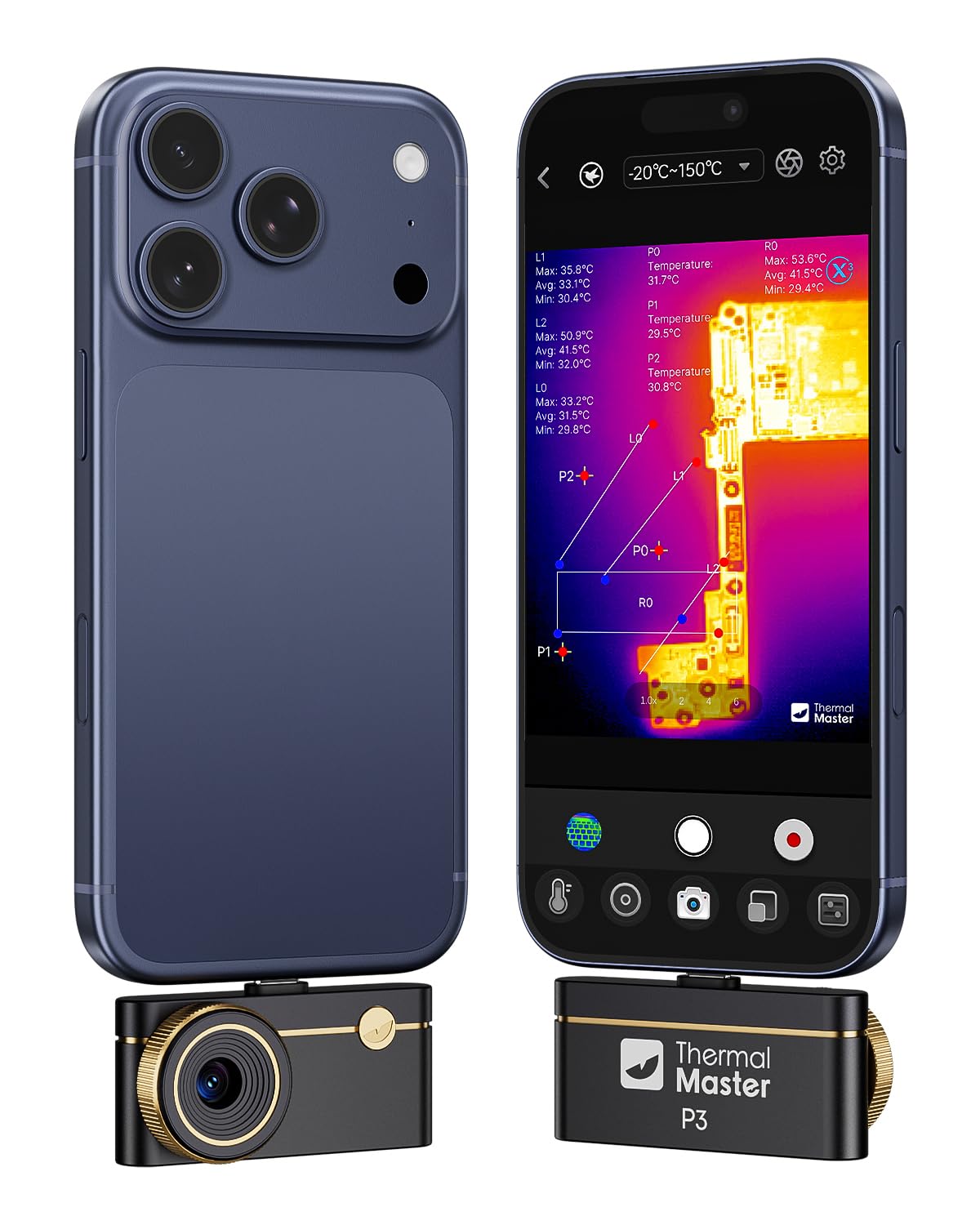
Circuit boards are where most thermal cameras fall apart. A fixed-focus lens at minimum distance smears a transistor into the capacitor beside it, and the whole point of pointing a camera at a board is to find the one component that is hot. The P3's manual focus ring fixes that: a 256 x 192 sensor enhanced to 512 x 384, focused by hand at macro distance, resolves individual components on a populated board.

That makes it our pick among the phone modules for electronics work rather than general inspection. It plugs into USB-C on Android and newer iPhones, with a Lightning adapter in the box for older ones, and the app carries the heavy features: 15x digital zoom, 12 palettes, high and low temperature alarms, and point-by-point measurement. With no battery inside it barely adds weight to your pocket.

The manual focus is a macro tool first. At longer distances it takes a light touch to keep a wall or a panel sharp, and it rewards a steady hand. In exchange it is the only module here that gets close enough to a board to be genuinely useful, and the palettes and point measurement give you something to do with the image once you have it.

Pros

  • Manual focus for sharp macro shots of circuit boards
  • 512 x 384 enhanced output and NETD under 35mK
  • USB-C and a Lightning adapter cover both phone types
  • 15x zoom and 12 palettes in the app

Cons

  • Every image has to go through the app
  • Draws power from your phone, not its own battery
Our verdict

For board-level fault finding, this is the phone module to buy: manual focus does what fixed lenses cannot.

Check Latest Price
6

Best Budget Handheld

AccuMEMS GT14S

87 /100
LBD Score Excellent

Key details

Battery Life
14 hours
Field Of View
50°
Temperature Range
-4°F to 1022°F
Thermal Sensitivity
NETD < 50mK
View on Amazon

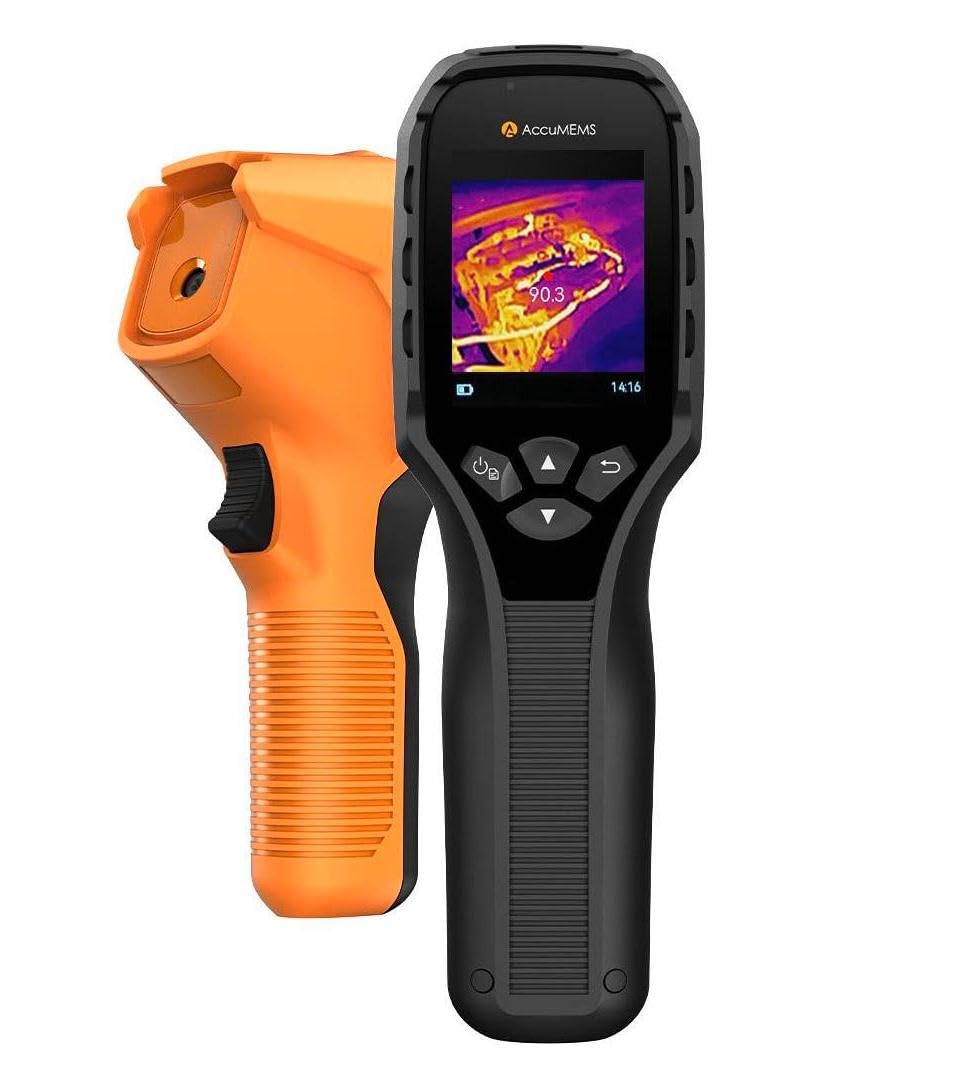
Thermal sensitivity is the figure that decides whether a camera shows you a problem or just a picture of a wall. This one is quoted at NETD under 50mK, with differences down to 0.05°C detectable, and it pairs that with a 50-degree field of view wide enough to take in a doorway and the skirting beside it in a single look. On a budget handheld, those are the right two priorities.

The dual mode is the quietly useful part. Thermal imaging finds the problem — the cold stripe above a window, the warm patch over a cable — and the thermometer mode then gives you a single number for it without swapping tools. We prefer that arrangement to a menu full of analysis features you will use twice.

Battery life is rated at 14 hours, which is a week of odd jobs on a charge, the 2500mAh cell is built in and charges over USB-C, and there is a one-year warranty behind it. What this camera is not is a bench instrument: buy it for walls, windows, vents, radiators, and the ceiling stain you have been ignoring, and reach for something with more sensor behind it when the target is a component on a board.

Pros

  • NETD under 50mK picks up small temperature differences
  • Dual thermal and thermometer modes
  • 50-degree view covers a doorway in one look
  • 14-hour battery built in

Cons

  • IR sensor resolution is not published
Our verdict

A household thermal camera done properly: sensitive, wide-viewed, and simple, with a thermometer mode that gives you a number instead of a colour.

Check Latest Price
7

PC-Based Reporting

FOXWELL HT280

91 /100
LBD Score Outstanding

Key details

Display
2.8 in, 320 x 240
Accuracy
±3.6°F or ±2%
Temperature Range
14°F to 932°F
Thermal Resolution
260 x 260 TISR
View on Amazon

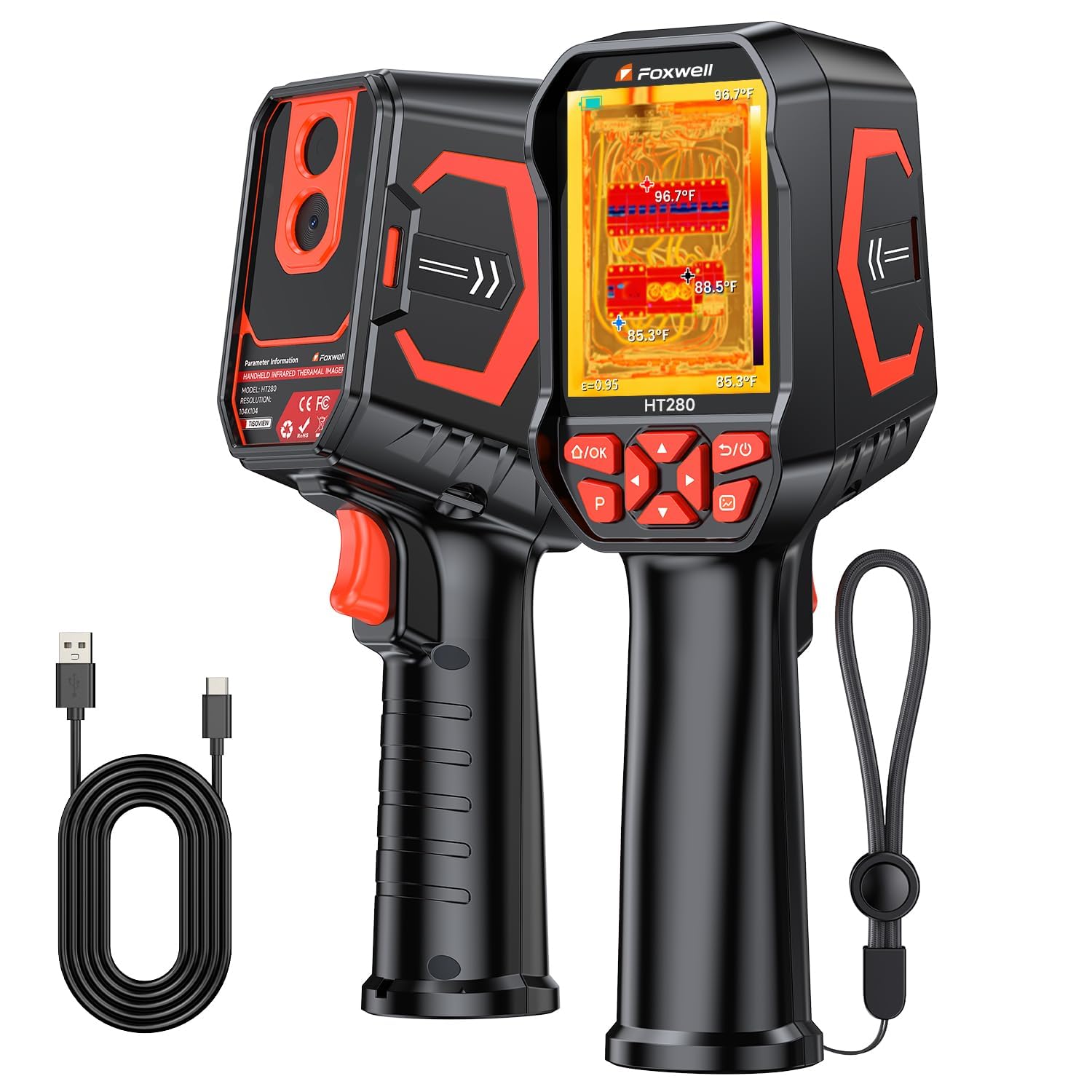
A 2.8-inch screen sounds like a compromise until you see the panel: 320 x 240 in that space is dense, and nine palettes let you pick the one that makes a gradient obvious rather than pretty. The 50° x 50° field of view is the widest square here, so you can sweep a wall corner to corner without stepping back.

Where it earns its place is on the PC side. Images and video transfer to Windows for point, line, and area analysis, and the software renders 2D and 3D views — the second turns a warm patch into a shape you can interpret instead of a spot you have to describe. Internal memory holds more than 20,000 images, enough to shoot a whole walkthrough and sort it out at a desk.

The limits are worth knowing up front. The measurement range stops at 932°F, which covers electrical and HVAC work but not the hot end some cameras here reach, and thermal resolution is quoted as 260 x 260 with TISR enhancement, so treat that figure as an enhanced image rather than a native sensor count.

We point this at technicians who already work from a laptop — the ones who finish an inspection and then write it up. A dense little screen for the walkround and real analysis software for afterwards is an unusually complete pairing at this level. It is a camera for someone whose deliverable is a report, not just an answer.

Pros

  • Nine palettes for reading different gradients
  • Point, line, area, and 3D analysis on a PC
  • Stores more than 20,000 images internally
  • Widest field of view here at 50° x 50°

Cons

  • Analysis software runs on Windows only
Our verdict

The pick for anyone whose inspection ends in a report: a dense 2.8-inch screen on site and genuine analysis software back at the desk.

Check Latest Price
8

Everyday Spot Checks

RISION Magic

87 /100
LBD Score Excellent

Key details

Power
From phone
Connection
USB-C
IR Resolution
160 x 120, 320 x 240 QuadIR
Temperature Range
-4°F to 1112°F
View on Amazon

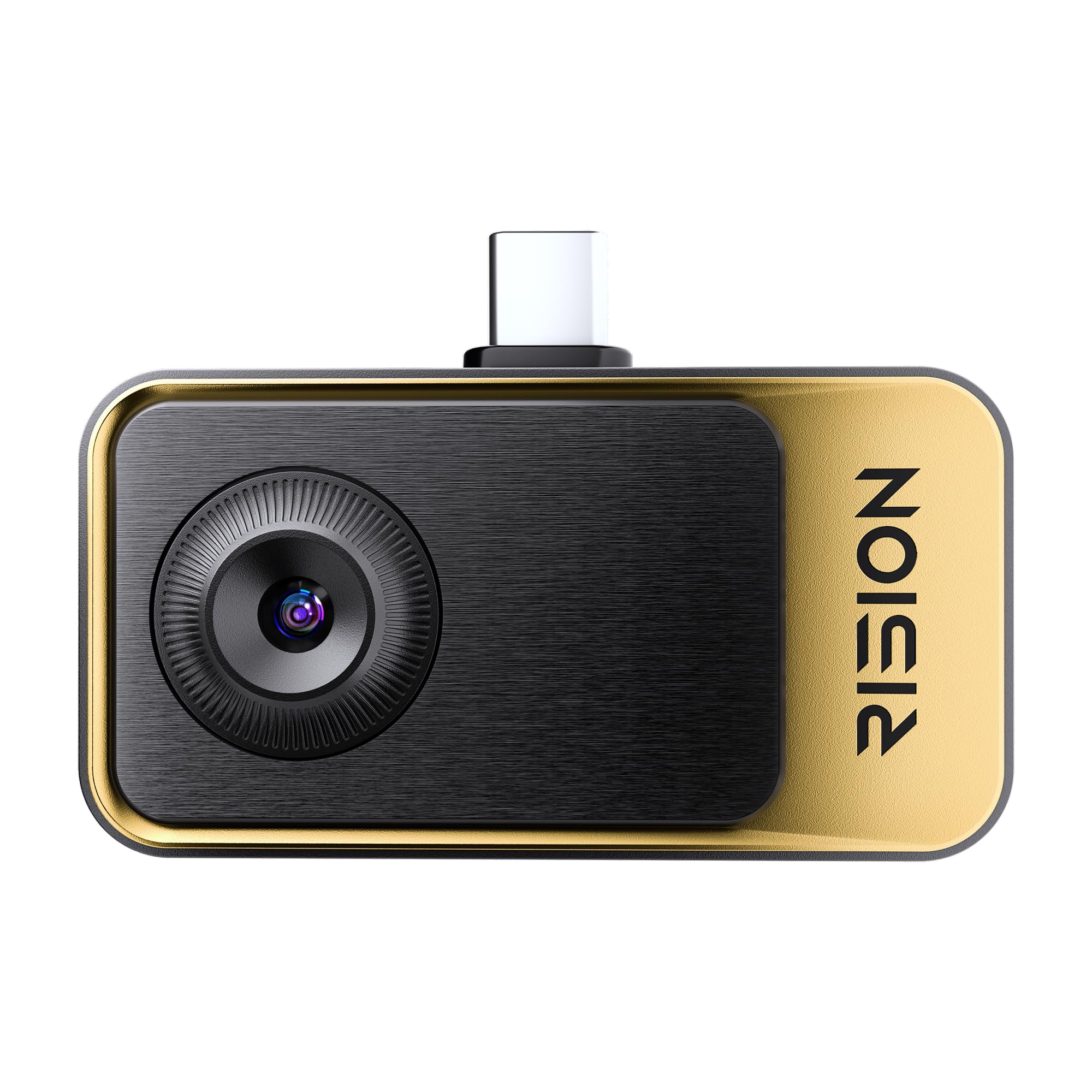
The plug-in camera has one advantage that never shows up on a specification sheet: it is already with you. No battery to charge, no case to remember, no separate screen — the RISION lives in a pocket and turns the phone you are carrying into a thermal imager in about the time it takes to open an app.

The image holds up better than the price suggests. A 160 x 120 sensor upscaled to 320 x 240 through QuadIR, with the phone's own visible-light camera fused over the top, gives you a thermal map that is easy to line up with the thing you are actually looking at. Live hot and cold spot tracking does the reading for you, and the app runs without an account, which is the detail we appreciated most — nothing to sign up for before you can check a window.

One thing to plan around: the USB-C plug faces away from you by default, so you will be holding the phone at an angle in tight spots, and the camera needs a firm seat before the app picks it up. Windows and phones are the whole story here.

For a homeowner chasing drafts, or a technician who wants a second opinion without carrying a second device, it is the least fussy way into thermal imaging we have found here. Where it stops is close work: there is no manual focus, so a board full of components stays a blur of warm rectangles.

Pros

  • No battery to charge; it runs from your phone
  • 320 x 240 QuadIR output with visible-light fusion
  • Live hot and cold spot tracking
  • App works without an account

Cons

  • Macs are not supported
Our verdict

The module to keep in a pocket: plug it into the phone you already carry and read a wall in seconds.

Check Latest Price

How We Tested the Best Thermal Cameras

We started by pulling every thermal camera we could find with a real temperature readout, a way to export images, and enough availability to actually buy one, then filtered by sensor resolution, temperature range, battery claims, and price. That left ten cameras spanning handheld units with built-in screens and plug-in models that turn a phone into a display.

Testing ran for eight months, across two seasons of ordinary house work. In winter we walked the same circuit every time: baseboards, window frames, rim joists in the attic, and the seal around the garage door. In summer we threw a dryer and a space heater on one circuit and scanned the panel under load, then checked supply registers, a car's brake rotors after a drive, and a laptop mid-game. A tub of ice water and a cast-iron pan on the stove gave us reliable hot and cold targets.

For accuracy, we read each camera against a contact thermometer on the same target several times and noted how far off it landed, hot and cold. For image quality, we scanned one known-drafty wall and asked whether the leak and the studs behind it read clearly or dissolved into a grainy smear. We timed how long it took to get from power-on to a saved image, one-handed and in a dim basement, since that's where most of this work happens, and noted whether a 2.8-inch screen was legible at arm's length in daylight or whether the larger 3.5-inch panel was worth the bulk. We drained batteries on full days of attic and crawlspace work, exported clips to phone apps and desktop analysis software to see how much fiddling it took, set temperature alarms and walked away, and tried fine work like tracing a circuit board to see what a manually focused lens bought over a fixed one.

How to Choose a Thermal Camera

Read the Native Resolution, Not the Big Number

Look past the headline figure to the sensor underneath it. A 128 x 128 sensor has 16,384 pixels of real data; a 256 x 192 has 49,152. The TISR, X³ and QuadIR figures in the titles are enhancement — they clean up edges and make an image look sharper, but they do not create detail that was never captured. In practice, 128 x 128 finds a cold wall and a warm breaker; 256 x 192 separates one breaker from the one beside it.

Field of view works the opposite way. A 50-degree lens takes in a whole doorway at once, while the 40° x 30° view on the TOPDON TC004 Mini magnifies a smaller area. Buy wide for scanning rooms, narrow for isolating components, and treat the enhanced number in a product title as a picture-quality claim rather than a specification.

Handheld or Phone Module?

A handheld has its own screen, its own battery, and buttons you can work with gloves on, and it usually brings PC software for writing up afterwards. A module such as the RISION Magic or the Thermal Master P3 plugs into your phone, borrows a screen you already know, and never needs charging — but it cannot be used without a phone, and everything routes through an app.

If you inspect in the cold or the wet, take the handheld. If the camera is something you want to have on you rather than plan around, the module wins. Check the port before you buy: USB-C covers most recent phones, older iPhones need a Lightning adapter, and Mac desktops are commonly left out.

Range, Accuracy, and Emissivity

Nearly every camera here spans more temperature than a house or a panel will ever show you, so the top of the range is rarely the deciding specification — the plus-or-minus figure and the emissivity setting are. Most quote ±3.6°F or 2%, which is fine for finding a problem and marginal for certifying one, and the AMPBANK H128's ±1% claim stands out against that.

Emissivity is the part buyers forget. Shiny metal, glass, and wet surfaces do not radiate like drywall, so a camera set for one reads the other wrong. Put a strip of matte tape on the target and measure that, or set emissivity properly before you trust a number enough to act on it.

Screen, Battery, and Build

You will read the image outdoors, often in a ceiling cavity or a plant room, so brightness and size matter more than pixel count. A 3.5-inch screen is a different experience from a 2.8-inch one, and a 640 x 480 IPS panel is a different experience again.

Runtime runs from eight hours to twenty-four on a charge, or none at all if the camera is phone-powered. Add a drop rating only if the camera will live in a van or a tool bag — the budget handhelds here quote 6.6-foot drops, and on site that is a genuine difference rather than a line on the box.

Frequently Asked Questions

Final Verdict

If you want one camera to do the job properly, buy the TOPDON TC004. Native 256 x 192 detail, a 3.5-inch screen, video, and PC analysis cover finding the fault and proving it, which is more than most people need and almost nothing they will regret.

Two situations change the answer. Working out of a tool bag with five minutes per stop, the TC004 Mini's 15-hour battery and narrow view suit it better. Chasing a hot component on a circuit board, the Thermal Master P3's manual focus is the only thing here that gets close enough.