Best Trail Cameras of 2026

A trail camera works while you're asleep, three miles from the nearest road, and you find out how it went only when you walk back out to it. The letdown is rarely one bad photo — it's a card full of empty frames, a battery that quit in week two, or 300 shots of a swaying branch.

I've run cameras on the same deer trail and backyard fence line for years, and over the past eight months my team and I have lived with 13 of them, cellular and SD-card alike. What we learned: the megapixel number on the box matters far less than trigger speed, detection range, an app that doesn't fight you, and how the thing behaves in the cold.

The picks below are sorted by how you'll actually use one — set-and-forget models for a property you visit monthly, cellular cameras that text you a photo from a mile out, cheap ones worth buying four at a time. Each one earned its spot in daylight, at 2 a.m., and after a week of rain.

1

Best Overall

GardePro E5S

87 /100
LBD Score Excellent

Key details

Night Vision
100 ft no-glow
Trigger Speed
0.1s
Photo Resolution
64MP
Video Resolution
1296P
View on Amazon

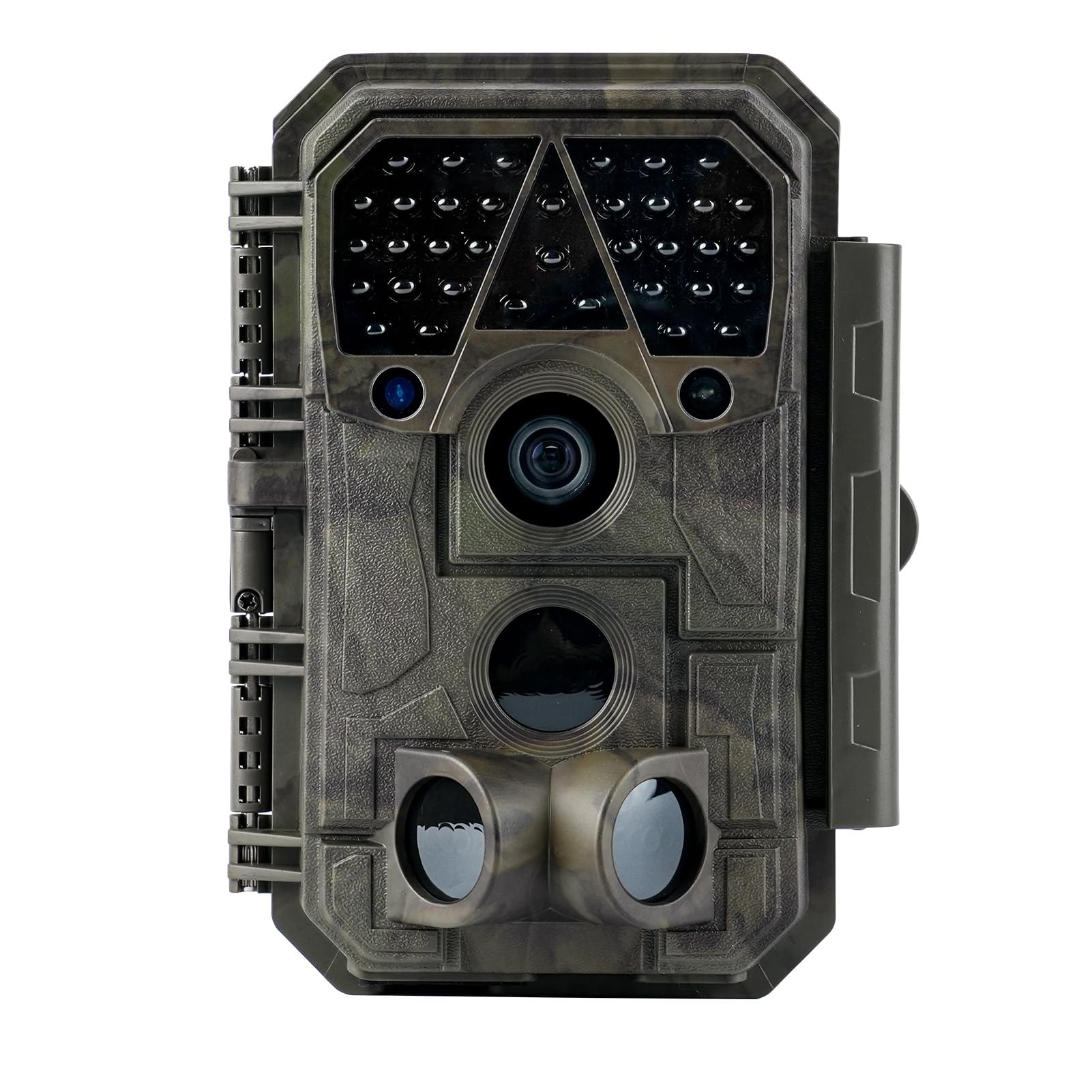
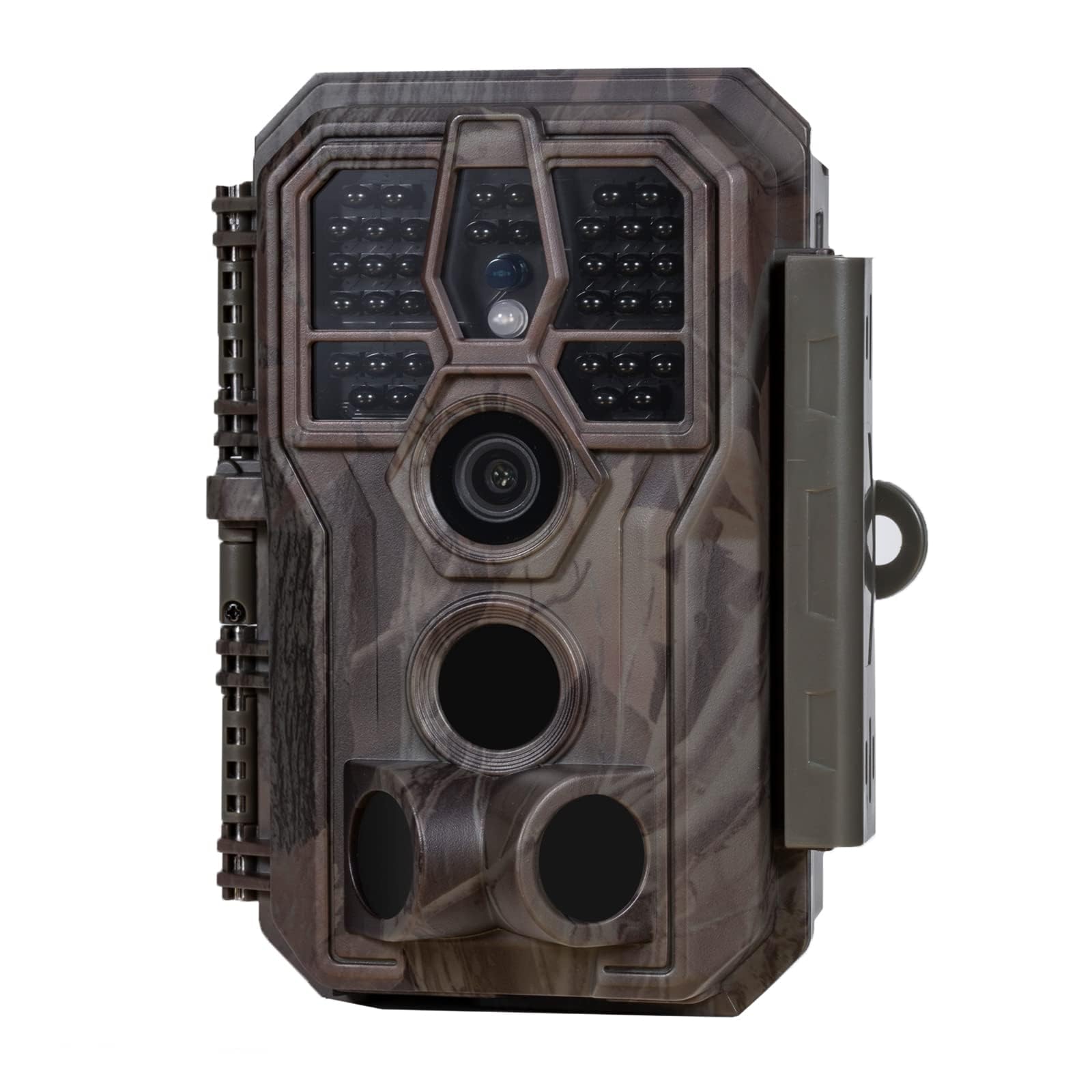
A 0.1-second trigger is the kind of spec that sounds like marketing until you watch a squirrel cross a logging road and disappear before a slower camera wakes up. The E5S pairs that speed with three PIR sensors and a 120-degree detection arc, and that combination is why it is our top pick. It is not the only fast camera here, but it is the one that best balances speed, image quality, and a no-subscription setup.

The 64MP stills and 1296P video are more resolution than most people need for scouting, but they leave room to crop a buck at the edge of a food plot. Night vision reaches 100 feet with no-glow infrared, which is the right choice for a camera you do not want to spook animals with. In our testing, the image was at its best when the camera was aimed at a clearing rather than into thick brush; that is true of every trail camera, but it matters more when you are counting on one camera to cover a ridge.

The E5S runs on eight AA batteries or the optional GardePro SP350 solar panel, and the IP66 housing is built for rain, snow, and a season in the woods. We appreciate that the power options do not lock you into a proprietary battery; if the solar panel is not practical where you hunt, ordinary AA batteries are. The 1/4-inch-20 thread is the detail we kept using: it lets you swap the strap for a standard mount when a tree is not the right spot.

What it does not do is send photos to your phone. If remote access is the whole point, the Tactacam REVEAL X 3.0 is the better tool. For everyone else, the E5S is the camera we reach for first when we want to leave a camera out for a long stretch and not think about a data plan.

Pros

  • 0.1-second trigger with three PIR sensors
  • 64MP photos and 1296P video
  • 100-foot no-glow night vision
  • Easy to set up and operate

Cons

  • No SD card or AA batteries included
Our verdict

Our best overall pick for no-subscription scouting, with a fast trigger, sharp stills, and 100-foot no-glow night vision.
Check Latest Price
2

Best Cellular

Tactacam REVEAL X 3.0

87 /100
LBD Score Excellent

Key details

Battery Life
Up to 6+ months
Connectivity
Multi-carrier LTE
Photo Resolution
4K
Video Resolution
1080p
View on Amazon

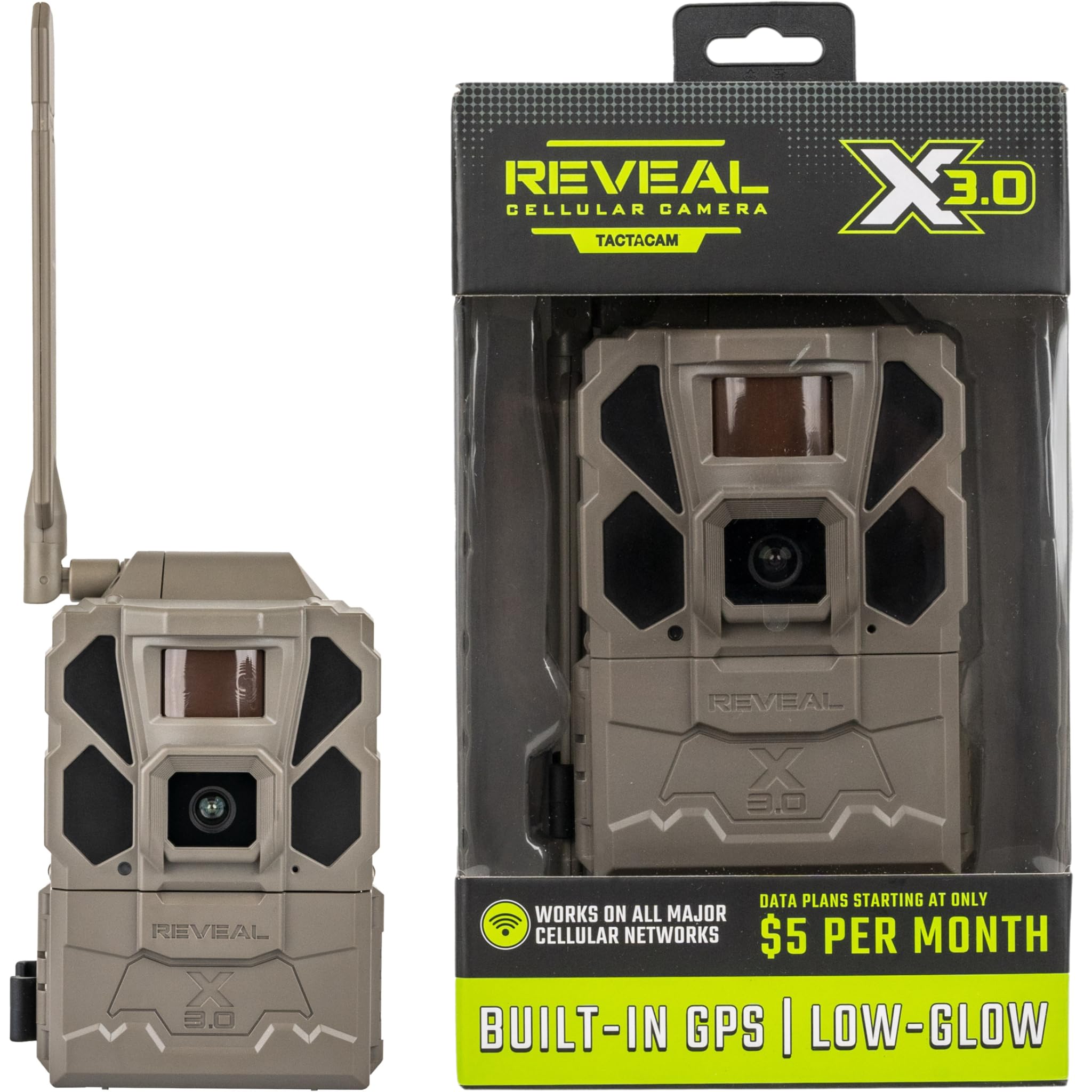
Cellular cameras usually ask you to juggle a SIM card, an SD card, and a data plan before you see a single deer. The REVEAL X 3.0 removes two of those steps: the SIM is pre-installed and auto-connects to AT&T or Verizon, and photos go straight to built-in storage and the app. No card to buy, format, or forget at home.

That convenience is why it is our cellular pick. The 4K photos and 1080p video are sharp enough to sort a young buck from a shooter, and the 96-foot night range is useful on a field edge. The app also shows where each camera sits on a map, which sounds minor until you have two cameras on the same ridge.

Battery life is the variable. Tactacam rates it at up to six months, but that depends on signal strength and how often you ask for uploads; a weak signal is harder on the battery than a strong one. Do not mount one without checking coverage at the exact spot. The sub-half-second trigger and three-shot burst are the other reason it works for moving game.

The built-in GPS is the detail that matters once you have more than one camera on a property; the app can show you which one is which. If remote access is the reason you are buying a trail camera at all, this is the one that makes the least work for you.

Pros

  • Auto-connects to AT&T or Verizon LTE
  • No SD card needed; built-in storage
  • 4K photos and 1080p video
  • Built-in GPS in the app

Cons

  • Requires a cellular data plan and site coverage
  • Battery life varies with signal and settings
Our verdict

The cellular camera we choose for remote scouting, because it skips the SD card and locks onto the stronger carrier automatically.

Check Latest Price
3

Best Solar/Wi-Fi

MAXDONE Solar WiFi

87 /100
LBD Score Excellent

Key details

Power
Solar + rechargeable
Connectivity
Wi-Fi and Bluetooth
Photo Resolution
64MP
Video Resolution
4K
View on Amazon

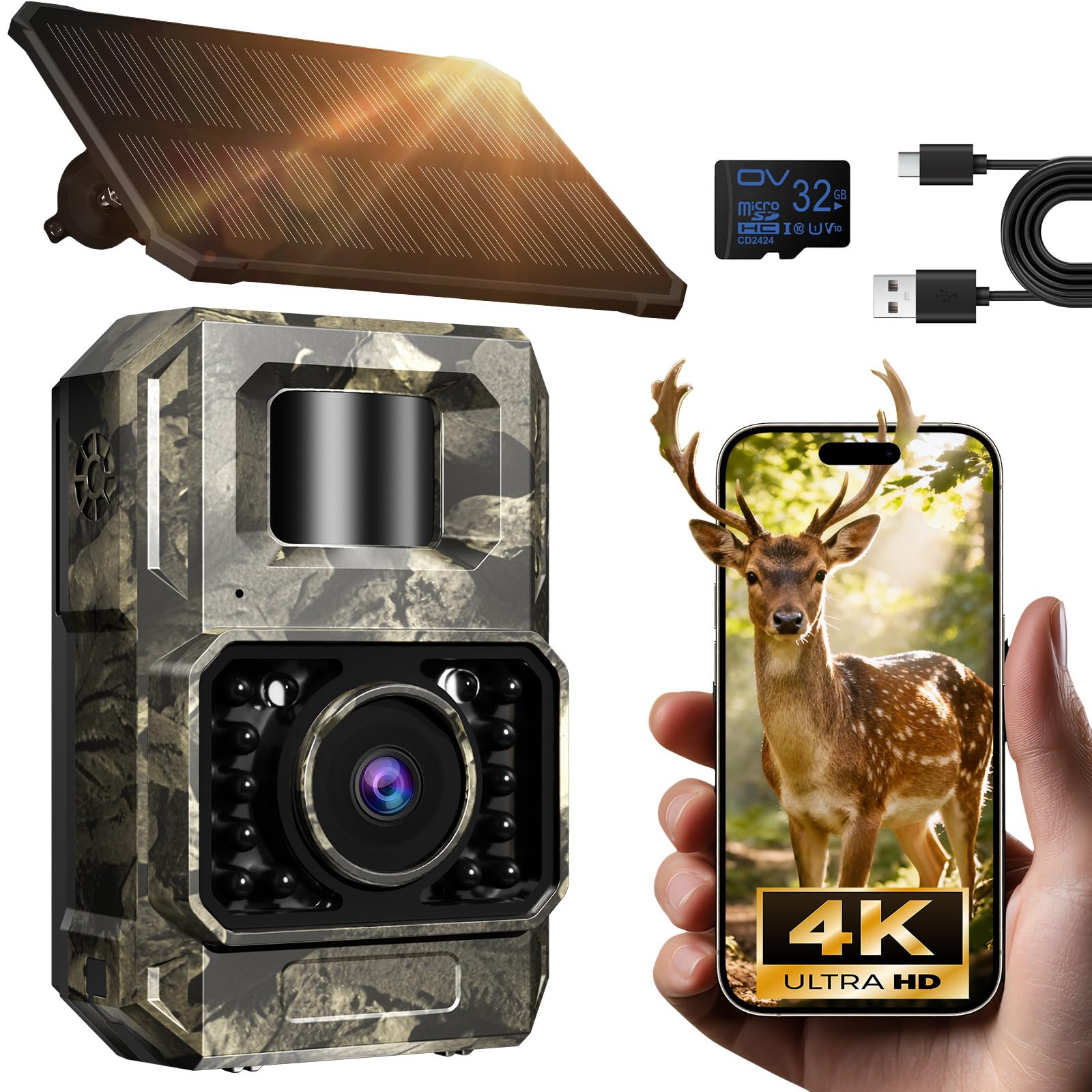
A solar panel on a trail camera sounds like a gimmick until you think about where these things live: a fence line, a feeder, a back gate you do not want to visit every week. The MAXDONE makes the panel and a rechargeable battery part of the camera, and for a backyard or near-home setup, that is the most useful thing about it.

The Wi-Fi and Bluetooth connection is for your phone, not for remote scouting. You use the TrailCam GO app within range of the camera, which is fine for a yard or a barn but not for a ridge miles from the truck. In our testing, the app was the quickest way to check aim and pull a clip without opening the housing; when the signal dropped, moving closer fixed it.

The 64MP photos and 4K video are the best value story here, and the 100-degree lens covers a good slice of ground without the fisheye look. Night vision reaches 65 feet, which is shorter than the 100-foot cameras in this guide but enough for a feeder or a back door. The detachable panel is the detail we appreciated: you can angle it toward the sun while the camera faces the gate.

Pros

  • Solar panel and rechargeable battery
  • 64MP photos and 4K video
  • Wi-Fi and Bluetooth app control
  • 32GB card included

Cons

  • Wi-Fi is local only, not cellular
  • Connectivity can be finicky
Our verdict

Our pick for a backyard or near-home camera, with solar charging and app control that make short visits easy.

Check Latest Price
4

Best for On-Camera Playback

Meidase P70

85 /100
LBD Score Excellent

Key details

Max Card Size
512GB
Trigger Speed
0.1s
Photo Resolution
64MP
Video Resolution
1296p
View on Amazon

Most trail cameras make you carry the card back to a computer before you know whether the camera is aimed at anything. The Meidase P70 puts a 2.4-inch color screen on the housing, so you can check the last photo and delete a bad angle on the spot. The H.264 video is the other practical touch: the files are smaller and easier to move than the bloated clips some cameras produce.

The screen is not a touchscreen, and the buttons take a minute to learn, but the menu is straightforward once you are in it. We used it to confirm framing before walking away, which is the job. The 0.1-second trigger and 100-foot no-glow night vision are the same headline numbers as the GardePro E5S, so the P70 is not giving up speed or reach to get the screen.

What sold us on the P70 is the combination of that screen and the file handling. You can check a card on the tailgate, then copy smaller H.264 clips without waiting all afternoon. The camera also supports cards up to 512GB, which is useful if you run it for long stretches and do not want to swap media. That is a different kind of convenience from remote access, but it is the kind that matters when you are already at the camera.

The P70 is non-cellular and non-Wi-Fi, so it will not send a photo to your phone. That is the trade-off for the lower running cost and the on-camera screen. The six-foot mounting strap is the small detail we liked most: it wraps a bigger tree than the short straps on most cameras here.

Pros

  • 2.4-inch screen for on-camera review
  • H.264 video keeps files smaller
  • 0.1-second trigger and 100-foot no-glow
  • Supports cards up to 512GB

Cons

  • No SD card or batteries included
Our verdict

Our pick for checking photos at the camera, with a big screen and smaller files that make field review less of a chore.

Check Latest Price
5

Cellular Two-Pack

Moultrie Edge 2

86 /100
LBD Score Excellent

Key details

Connectivity
Multi-carrier LTE
Cameras Included
2
Photo Resolution
36MP
Video Resolution
1080p
View on Amazon

Two cellular cameras in one kit is the reason the Moultrie Edge 2 is here. If you want to watch a gate and a food plot without buying two separate cellular units, the bundle gets you there with one setup routine and one app.

The specs are sensible for the job: 36MP photos, 1080p video, a 100-foot detection range, and a low-glow infrared flash. Setup through the Moultrie Mobile app is straightforward, and the camera runs on a battery tray, so you can handle a set of batteries without fumbling with loose cells in the field.

The catch is power. Battery drain can be heavy, and that is enough to keep the Edge 2 out of our top tier. If you want two cellular cameras and can manage frequent battery changes, it is still a practical kit; if the cameras are going on a remote ridge, the Tactacam's battery story is easier to live with.

The Edge 2 does not need an SD card to send photos, and the app keeps them organized by camera. The two-year warranty is the longest in this group, and that matters for a camera that lives outside.

Pros

  • Two cellular cameras in one kit
  • 36MP photos and 1080p video
  • 100-foot detection with low-glow flash
  • Two-year warranty

Cons

  • Battery drain can be heavy
  • Cellular plan and coverage required
Our verdict

A practical two-camera cellular kit if you can live with frequent battery changes and want a long warranty.

Check Latest Price
6

Multiple Locations

WOSODA Mini 4-Pack

86 /100
LBD Score Excellent

Key details

Night Vision
65 ft
Cameras Included
4
Photo Resolution
30MP
Video Resolution
1080p
View on Amazon

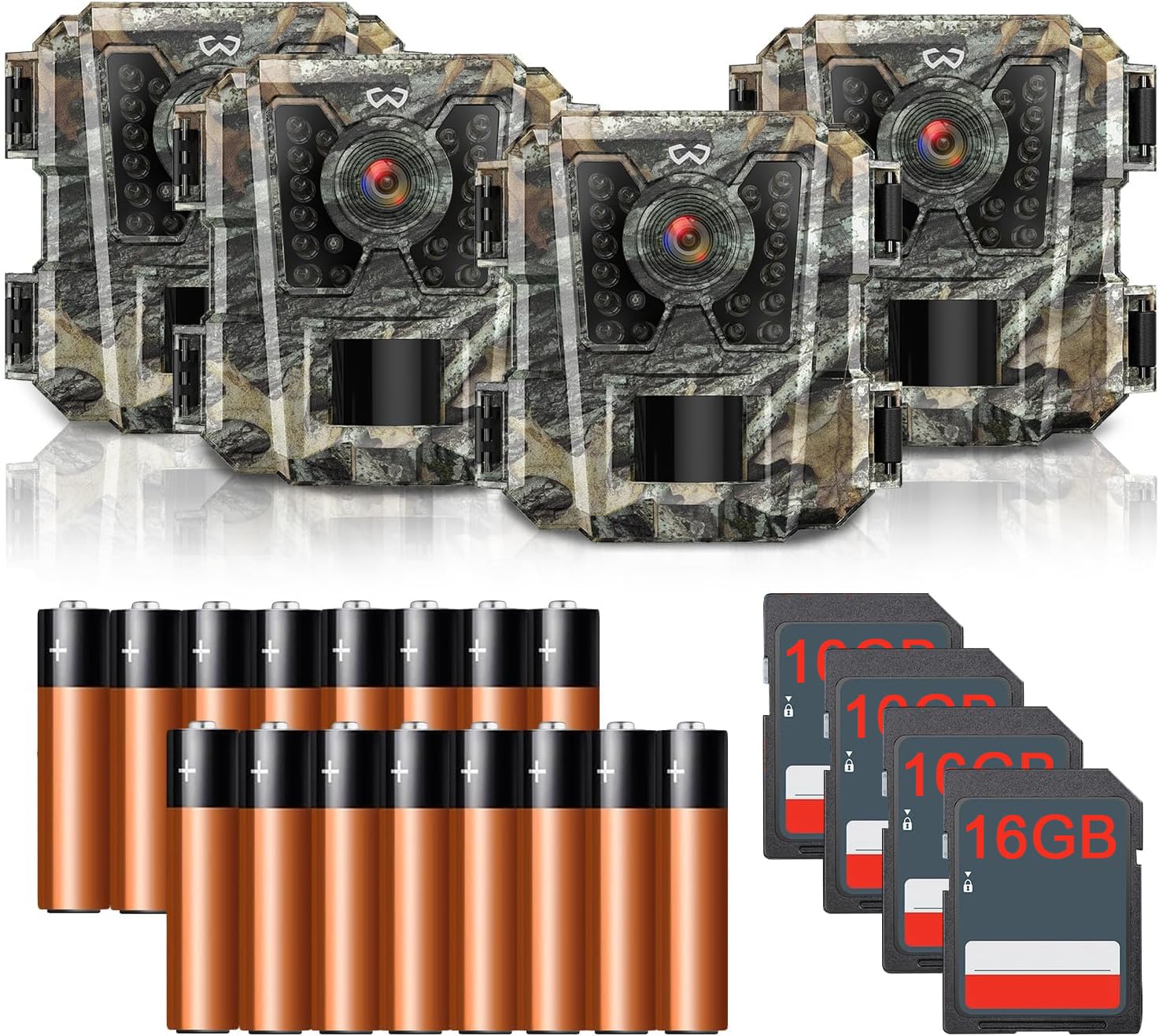
If you have ever moved one camera between three treestands, you know the appeal of a four-pack. The WOSODA mini kit gives you four small camo cameras for four separate spots, so you can leave the high-traffic trail, the scrape line, and the back gate covered at the same time.

That is the appeal: four cameras for four spots, without paying for four full-size units. The trade-off is in the specs. These are 30MP stills and 1080p video with a 0.3-second trigger and 65 feet of night vision, so they are close-in cameras, not long-field cameras. For a feeder, a fence line, or a yard, that is enough. For a wide-open field edge, the 100-foot models here are the better fit.

Each camera runs on four AA batteries, which means a single 16-pack covers all four at once, a small thing that simplifies the first setup. The compact camo body is easy to hide, and the mounting strap is simple to hang. The risk is reliability: some units stop working, and the shorter night range is a real limit. Buy them for close-in coverage and check each camera after the first week, not for a remote ridge where a failure costs you a season.

Pros

  • Four cameras for multiple locations
  • 30MP photos and 1080p video
  • Runs on four AA batteries per camera
  • Compact camo body

Cons

  • 65-foot night range is shorter
  • Some units stop working
Our verdict

A smart buy for covering several close-in spots at once, as long as you accept a shorter night range and some reliability risk.

Check Latest Price

How We Chose and Tested the Best Trail Cameras

We started by pulling every trail camera we could find with real user reviews, then filtered for what decides whether a camera is usable: power source, carrier support on cellular models, detection range, waterproof rating, and whether the menu made sense without the manual. That left 13 cameras, each of which spent at least three weeks strapped to a tree or fence post over eight months.

Setting each one up was its own test. I timed the clock from box to first saved photo and skimmed the manual only once, noting where the menu lost me and whether the app paired on the first try or the fourth. Once deployed, I walked the detection zone at a normal pace, then a jog, then a crawl, and counted missed passes.

Every week I pulled cards and scrolled the entire roll: dawn and dusk frames, plus night shots of a person at 20, 40, and 60 feet. I was looking for motion blur on animals, washout from the IR flash, and whether the flash spooked the deer. Alkaline and lithium batteries went through a cold snap with the percentage logged at each visit, the solar model sat in partial shade on purpose, and a sprinkler plus two freezes answered the durability question. Every video clip got watched with the sound on.

The cellular cameras got their own scorecard: how long a photo took to reach my phone, how often the app dropped, and what the plan cost across a season, since the monthly bill is part of the value. What separated the finalists was simple — they were still taking sharp, properly exposed photos on the last day, not just the first.

How to Choose a Trail Camera

Cellular, Wi-Fi, or Card-Only

Start with how you will retrieve photos. A cellular camera sends images to your phone, but it needs a data plan and a signal at the camera; check coverage before you buy. The Tactacam REVEAL X 3.0 is the clearest example here, with auto-carrier LTE and no SD card. Wi-Fi is a shorter leash: the MAXDONE Solar WiFi lets you pull files on your phone within range, which suits a backyard or barn. Card-only cameras like the GardePro E5S are the simplest to run, but you have to walk out and swap cards.

Trigger Speed and Detection

Megapixels sell cameras; trigger speed is what gets the animal in the frame. Look for a 0.1- to 0.3-second trigger and a wide detection arc. The GardePro E5S uses three PIR sensors and a 0.1-second trigger, and the Meidase P70 also lists 0.1 seconds. A 0.3-second camera can still work on a feeder, but it is more likely to catch a tail. Do not assume a higher megapixel count fixes a slow trigger; it does not.

Night Vision and Flash Type

Night range is about infrared illumination, not the detection range. A camera with a 100-foot no-glow flash can light up a field edge; a 65-foot model is better for a close trail or backyard. No-glow 940nm IR is less likely to spook animals, while low-glow 850nm can carry farther. The GardePro E5S and Meidase P70 both list 100-foot no-glow, while the MAXDONE and WOSODA mini cameras list 65 feet. Match the range to the distance you actually expect, not the biggest number on the box.

Power, Storage, and Weather

Decide how often you want to visit. Eight AA batteries are common; a solar panel or rechargeable battery reduces swaps, but only if the panel gets sun. The MAXDONE includes a solar panel and rechargeable battery, and the GardePro E5S can use an optional solar panel. Check what is in the box: some cameras include an SD card, and some do not. A 32GB card is a practical start, and some models accept 256GB or 512GB cards. Look for at least IP65 sealing and a latch that feels secure.

Frequently Asked Questions

Final Verdict

The GardePro E5S is the trail camera we recommend first for most people: a 0.1-second trigger, three PIR sensors, 64MP stills, and 100 feet of no-glow night vision, with no subscription to manage. If you need photos on your phone, the Tactacam REVEAL X 3.0 is the better tool, provided you have coverage where you hunt. For a backyard setup, the MAXDONE Solar WiFi is the easier one to live with.