Best Transparent Filament for Glassy 3D Prints of 2026

Transparent filament makes a promise the first print usually breaks: the spool looks like glass, and the part comes off the bed looking like frosted plastic. That's not a bad batch — clarity comes from temperature, flow, and wall thickness, and the filament itself only carries you part of the way. What a good clear spool actually buys you is a consistent diameter, winding that doesn't tangle at hour nine, and enough light transmission that a lampshade or vase glows instead of going gray.

I've been running the same two printers for years, and I've learned the hard way that a mid-print tangle is worse than any cosmetic flaw. Over four months, my team put 16 spools of clear and translucent filament — PLA, PETG, and one polycarbonate — through real parts, not just test cubes. The trade-off is that PETG and PC want slower speeds and more heat, and both string more than PLA, plus every wisp catches the light on a clear print in a way it never would on a solid color. The spools below are the ones we'd load again, sorted by what each is genuinely good at.

1

Best Overall

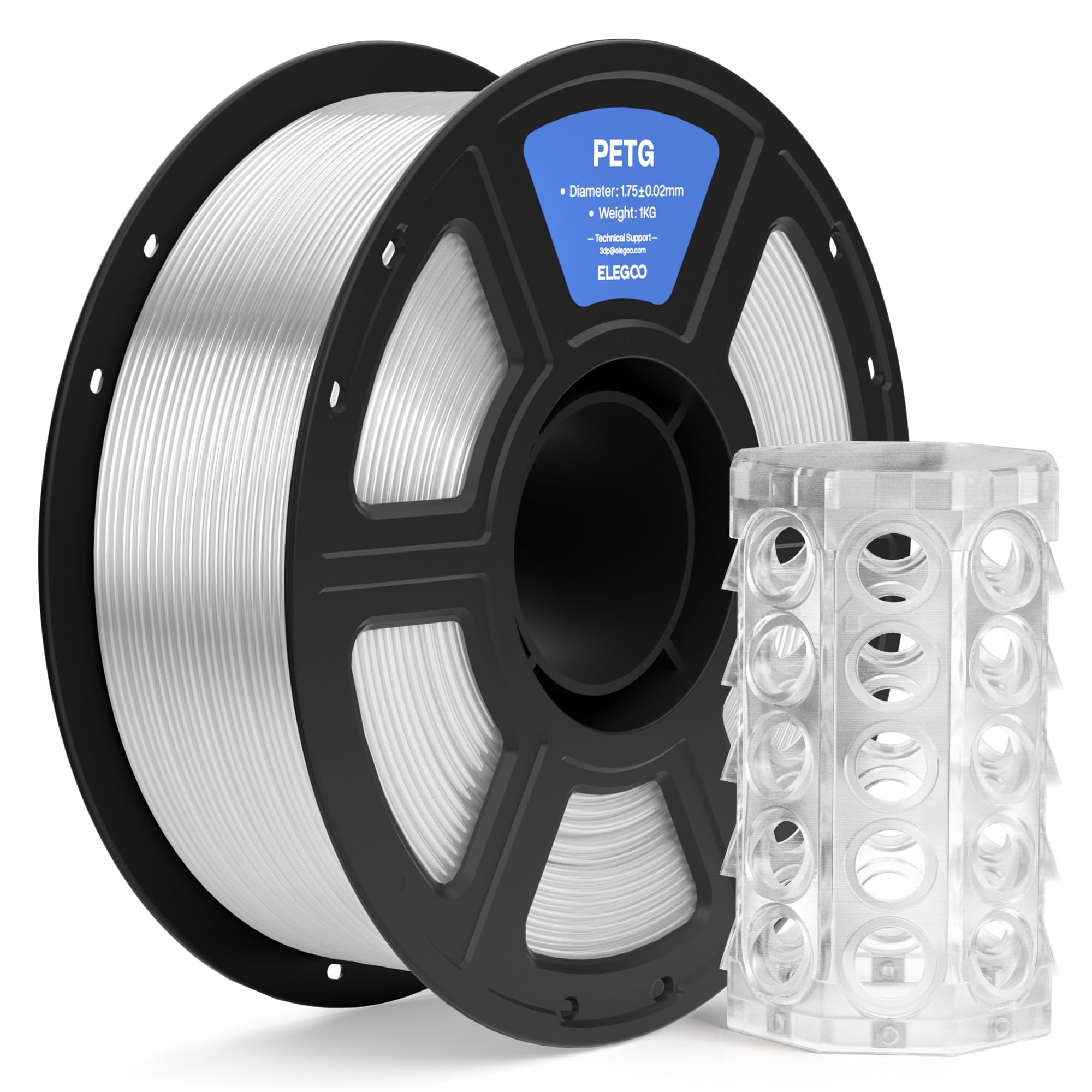
ELEGOO PETG Transparent

92 /100
LBD Score Outstanding

Key details

Diameter
1.75 mm
Material
PETG
Tolerance
±0.02 mm
Spool Size
1 kg (2.2 lb)
View on Amazon

Every transparent filament question ends in the same place: will this spool give me see-through parts without a weekend of calibration? For most printers the answer here is yes. The ELEGOO is PETG, so it brings impact resistance and a little heat tolerance that clear PLA can't match, and the ±0.02 mm diameter keeps extrusion steady enough that we stopped checking on it mid-print. It also happens to be the least expensive kilo in this group, which isn't the reason to buy it but doesn't hurt.

Light is what you're paying for, and you get it. Walls come out glossy and slightly cool rather than milky, and an LED tucked inside a print still reads as the color you wired in. Bed adhesion holds on a clean PEI sheet without a brim, which matters more with PETG than with PLA — a first layer that lifts takes the whole print with it.

PETG does ask for PETG settings: hotter nozzle, slower outer wall, less part-cooling than PLA likes. Stringing shows up first on travel moves, so tune retraction before blaming the filament. Once that's close the spool is undemanding, and a 0.6 mm nozzle is worth trying — thicker walls mean fewer internal surfaces for light to scatter off.

Pros

  • Prints cleanly with little tuning
  • Glossy, genuinely translucent walls
  • Tight ±0.02 mm diameter
  • Least expensive 1 kg spool here

Cons

  • Spools can arrive with crossed windings
Our verdict

Our pick for most people: it prints cleanly on stock PETG settings, stays properly translucent, and costs less than the other 1 kg spools here.
Check Latest Price
2

Highest Rated

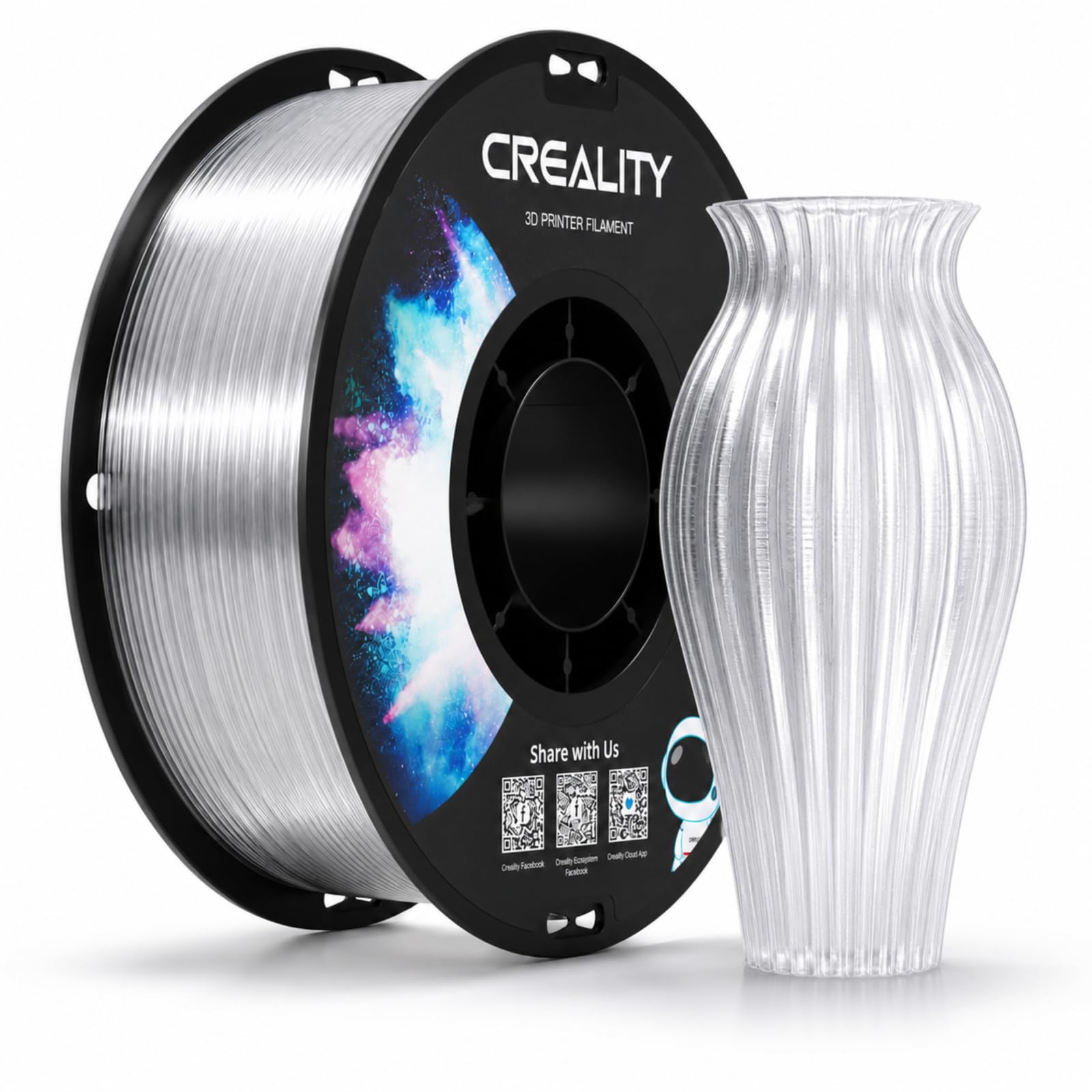
Creality PETG Transparent

92 /100
LBD Score Outstanding

Key details

Finish
Transparent, glossy
Material
PETG
Tolerance
±0.02 mm
Spool Size
1 kg (2.2 lb)
View on Amazon

Glossy is the word that keeps coming back. Walls printed in Creality's transparent PETG come out with a wet-looking sheen instead of the faintly cloudy surface a lot of clear PETG settles into, and for display models and light covers that sheen sells the glass effect more than raw light transmission does.

What we keep returning to is consistency. Prints come off clean, layer adhesion holds on a plain PEI sheet without a raft, and the same settings carry from one spool to the next — the sort of filament that lets you stop thinking about the spool and start thinking about the model. That's rarer in clear materials than it should be, and it's why this one sits near the top of this set on print reliability.

Where it gives ground is strength under real load: some prints come apart at the layer lines when a part is doing structural work, so keep brackets and clips in a matte spool and let this one handle the visible surfaces. It also costs more than our top pick without printing obviously clearer, which is the honest reason it isn't the default recommendation.

Pros

  • Glossy, near-colorless walls
  • Reliable bed adhesion without a brim
  • Consistent from spool to spool

Cons

  • Costs more than our top pick
Our verdict

The glossiest, most consistent clear PETG in this group — worth the extra over our top pick if glassy walls and fuss-free adhesion are what you're after.

Check Latest Price
3

Best Clear PLA

ELEGOO PLA Translucent

93 /100
LBD Score Outstanding

Key details

Diameter
1.75 mm
Material
PLA
Tolerance
±0.02 mm
Spool Size
1 kg (2.2 lb)
View on Amazon

Clear PLA is the low-effort route to see-through parts, and this is the spool we hand someone whose printer has never run anything but PLA. The temperatures stay in familiar territory, there's no enclosure to think about, and warp is a non-issue on a textured sheet. Of the translucent PLA options in this group, it behaves most like ordinary PLA, which is exactly the compliment it needs.

The result is translucent rather than glass: light passes, colors behind the print show through, and thin walls read far clearer than thick blocks. It carries the same soft gloss as the rest of the ELEGOO line, so edges catch light nicely on curved surfaces and vase-mode pieces.

Two limits are worth knowing before you commit to a project. Heat is the big one — PLA softens well below what PETG and PC shrug off, so keep it for shelf pieces and models rather than anything that lives in a car or beside a hot bulb. The pleasant surprise is moisture: unlike the PETG and PC spools here, an opened bag of PLA still prints a month later, which makes this the spool to leave loaded on a printer you use in bursts.

Pros

  • Runs on a standard PLA profile
  • Translucent with light behind it
  • Forgiving about open-air storage

Cons

  • Thin decorative parts snap if flexed
Our verdict

The easiest route to translucent parts on a stock printer: no enclosure, no hot end upgrade, and a profile you almost certainly already have.

Check Latest Price
4

Best for High-Speed Printers

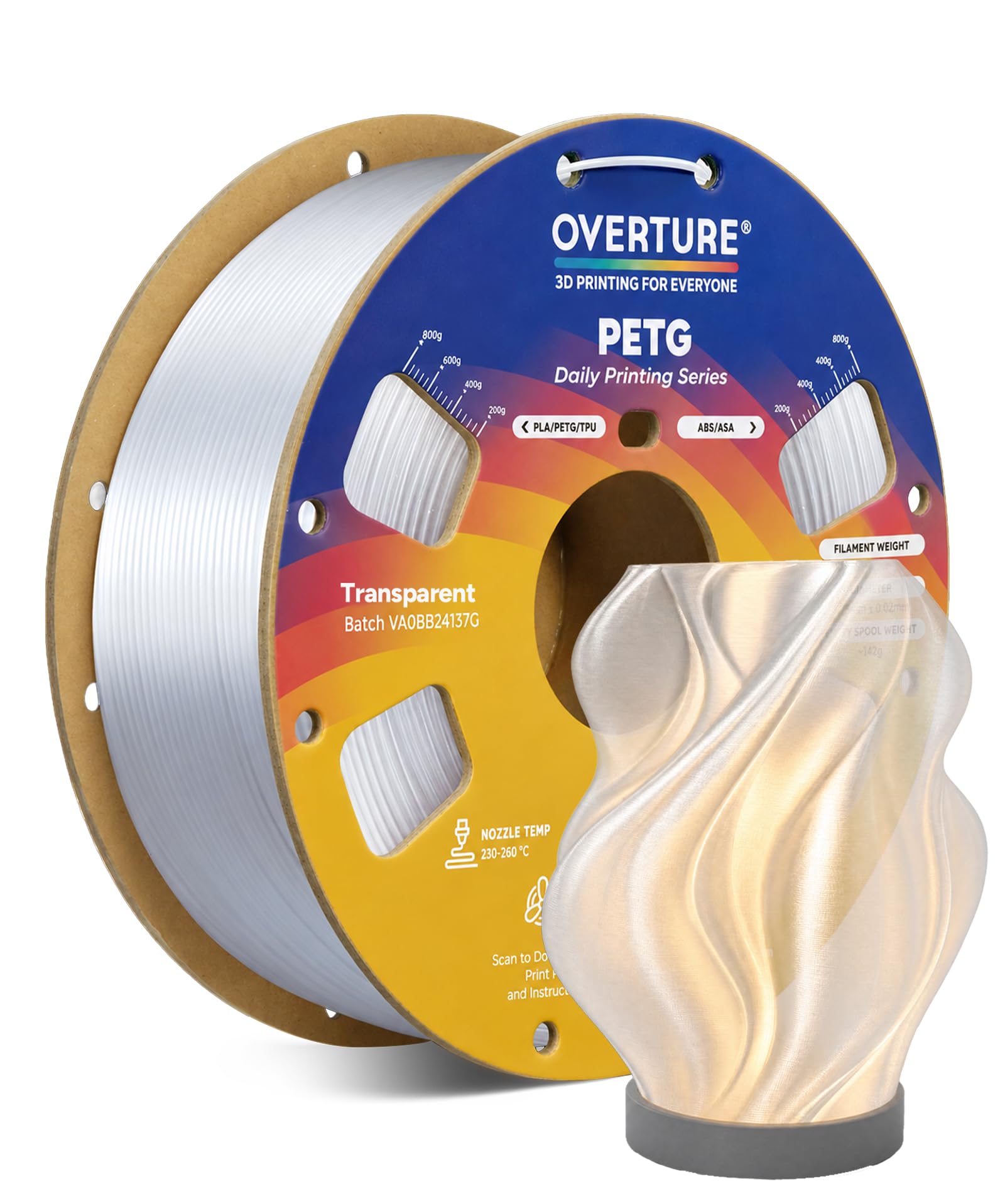
OVERTURE High Speed PETG

88 /100
LBD Score Excellent

Key details

Material
PETG
Spool Size
1 kg (2.2 lb)
Nozzle Temp
230–260°C
Print Speed
Up to 300 mm/s
View on Amazon

Three hundred millimeters per second is the headline, and it's the whole reason to look at this spool. It's built for the fast machines — Bambu Lab, K1, Voron — with a 230–260°C nozzle window and a 65–70°C bed that matches how those printers run PETG, plus winding tidy enough for a multi-material unit.

The record here is genuinely divided, and we think the split comes down to two habits: drying the spool and slowing the first layer. Do both and this is one of the more capable PETGs in the group, laying clean walls at speeds that would starve a standard spool. Skip both and a twenty-hour print can end in a nest of strings on a bare bed. It isn't a spool to load and walk away from on faith.

Small things earn it a place too. The spool carries remaining-length markings, so you can see what's left before committing to a long job, and it drops into AMS-style units without an adapter. If your printer tops out at ordinary speeds, though, the speed rating buys you nothing and our top pick is the steadier bet.

Pros

  • Rated for 300 mm/s printing
  • Fits AMS-style multi-material units
  • Remaining-length markings on the spool

Cons

  • Bed adhesion is the weak point
Our verdict

Rated to 300 mm/s and wound for multi-material units, this is the clear PETG to load when your printer already runs hot and fast.

Check Latest Price
5

Best Frosted Finish

GIANTARM Clear PETG

86 /100
LBD Score Excellent

Key details

Finish
Clear, soft frosted
Material
PETG
Spool Size
1 kg (2.2 lb)
Nozzle Temp
220–250°C
View on Amazon

Not every clear print should be glass. This spool lands closer to etched glass than window glass — a soft, frosted translucency that blurs what's behind it and, in exchange, hides layer lines better than any of the glossy clears in this group.

Printing it is uneventful in the best way. Prints come off clean straight out of the bag at ordinary PETG temperatures, stringing is close to absent on default retraction settings, and the 220–250°C window means it runs on anything that can already print PETG. Nothing about it asks you to rebuild a working profile.

For decorative work we reach for this before the glassier spools, because a frosted surface makes a visible layer stack look deliberate rather than unfinished. That's the trade: you give up the last bit of clarity and get a finish that needs no sanding, plus the most forgiving print behaviour here. Light still passes through; it just arrives diffused.

Pros

  • Frosted finish hides layer lines
  • Almost no stringing on default settings
  • Prints cleanly straight out of the bag

Cons

  • Occasional kinks in the winding
Our verdict

Near-zero stringing and a frosted finish that hides layer lines make this the one to reach for when glass isn't the goal.

Check Latest Price
6

Best for Strength and Heat

Polymaker PolyLite PC

90 /100
LBD Score Outstanding

Key details

Finish
Transparent, light-diffusing
Diameter
1.75 mm
Material
Polycarbonate
Spool Size
1 kg (2.2 lb)
View on Amazon

Polycarbonate is the heavy lifter of the clear family: the toughest and most heat-resistant material in this group, and the one that turns a desktop printer into a small engineering shop. PolyLite PC is the version that behaves like a printing material rather than a laboratory problem.

Its transparent grade is a diffuser, not a window. Polymaker builds this one to spread light, which makes it the right spool for a lampshade, a light panel or a lens cover and the wrong one if you want to read text through a print. That distinction saves a lot of disappointment — plenty of people buy clear PC expecting glass and get a soft glowing panel instead.

Printing it is a hardware question first. Polycarbonate runs hot, so an all-metal hot end and a machine that holds a high, stable bed temperature are the entry fee, and an enclosure plus ventilation stop being optional once you're printing at those temperatures.

The case for it is narrow and clear: light covers, jigs that sit near a motor, anything that gets hot or gets dropped. Nothing else here survives a hot enclosure, and nothing else diffuses light this evenly, which is why the extra outlay makes sense for those parts and nowhere else.

Pros

  • Real polycarbonate strength and heat resistance
  • Light-diffusing transparent finish
  • Prints cleanly once temperatures are right

Cons

  • Brittle sections can shatter in the feed path
  • Needs a high-temperature hot end
Our verdict

For parts that see heat or load, this is the pick: real polycarbonate strength with a light-diffusing finish, given a hot end that can reach the temperature.

Check Latest Price
7

Cheap Decorative Prints

SUNLU PLA Transparent

88 /100
LBD Score Excellent

Key details

Material
PLA
Tolerance
±0.02 mm
Nozzle Temp
200–230°C
Spool Diameter
8.00 in
View on Amazon

Two clear PLAs carry most of the attention in this group, and SUNLU's is the warmer of the two: 200–230°C at the nozzle, a 50–65°C bed, and a finish that leans soft rather than sharp. It behaves like a standard PLA on a standard profile, so nothing about your workflow has to change.

Printed, it's translucent rather than clear. Light passes, edges glow, and a thick block stays milky — normal for clear PLA, and worth knowing before you plan a window pane. Some spools also carry a faint yellow cast that shows up on pale prints, so check the first few metres if color accuracy matters to the model.

Brittleness is where this spool parts company with the rest. Clear PLA is snappier than the opaque version to begin with, and this sits at the snappier end: it can break between the spool and the extruder, especially where it makes a tight bend into a reverse Bowden tube or a multi-material feed. We still keep a spool around for cheap ornaments and quick test prints, but a twelve-hour unattended run is not where it belongs.

Pros

  • Inexpensive way to try clear PLA
  • Translucent edges under backlight
  • Standard 8-inch spool fits most holders

Cons

  • Snaps between spool and extruder
  • Can arrive with a yellow tint
Our verdict

Cheap clear PLA for ornaments and test prints — expect translucency rather than glass, and don't leave it running unattended overnight.

Check Latest Price
8

Colored Light Pipes

AMOLEN Crystal PLA 4-Pack

88 /100
LBD Score Excellent

Key details

Pack
4 × 200 g
Colors
Green, pink, orange, blue
Material
PLA
Tolerance
±0.02 mm
View on Amazon

Four 200 g spools — green, pink, orange and blue — is the right way to sell colored translucent PLA: enough for a lampshade in one color and a test piece in another without opening a full kilo of anything.

Light is the point, and these deliver. With an LED behind them they read as colored glass, RGB strips come through with the hue intact, and curved walls pick up a faintly marbled look that plain clear filament can't give you.

The trade-off is quantity. Two hundred grams disappears fast on anything bigger than a desk toy, and you'll be swapping spools mid-project if you commit to a single color for a large print. Bed adhesion also wants a slow first layer before it settles down on a textured sheet.

Our read: it earns its place for decorative, color-forward work and for anyone experimenting with light-pipe designs, where four hues in small spools beat one kilo of clear. For a single clear spool feeding functional parts, the 1 kg options here are the better buy.

Pros

  • Four translucent colors in one box
  • Light passes through with color intact
  • Consistent ±0.02 mm diameter

Cons

  • 200 g spools run out quickly
  • Most expensive per gram in this group
Our verdict

Four translucent colors in small spools, made for lamps and light pipes; by weight it's the priciest way to buy clear filament here.

Check Latest Price

How We Tested 16 Spools of Clear Filament

We started with roughly 40 listings and narrowed them by material, claimed diameter tolerance, spool weight, and whether the color was genuinely transparent or merely tinted. That left 16 spools of clear and translucent PLA, PETG, and one polycarbonate, all bought at retail rather than sent as samples. Each one sat on our shop shelves for four months, opened and used, not resealed in a bin.

Every spool printed the same three objects on two machines, one with a direct-drive extruder and one with a Bowden tube: a single-wall vase in spiral mode, a small mounting bracket, and a 40-millimeter cube. I ran a stringing tower on each and reprinted the vase at a slower speed, since clear filament grows wisps that a solid color hides. We logged first-layer adhesion on textured PEI and on bare glass, and counted any print that lifted, warped, or failed outright.

To judge clarity instead of trusting the label, we held each vase against a lamp and compared how much light passed through the wall and how visible the layer lines were. Winding got its own check: we unwound a few meters by hand looking for kinks, then ran at least one overnight print per spool to see whether a tangle would stall a job halfway through. Calipers at five points along each spool told us whether the stated tolerance held. We weighed spools before and after printing to see how much usable material a roll actually delivered for the money, and I left one open on the bench for a week to learn which materials started popping and hissing from moisture.

How to Choose Transparent 3D Printer Filament

Pick the material before the clarity claim

Every listing on this page promises transparency; the material decides what you actually get. PLA is the easiest to print and the most brittle, and it softens in a warm car. PETG brings impact resistance and a little heat tolerance, at the cost of hotter, slower printing and more stringing to tune out. Polycarbonate is the toughest and most heat-resistant of the three, and it needs a hot end that can reach the temperature.

Choose by what the print has to survive rather than by which spool looks clearest in a photo. A lampshade on a shelf is PLA work, a bracket near a motor is PC work, and most other jobs land on PETG.

Print for clarity, not just for strength

A clear spool printed like an ordinary model comes out cloudy, because light scatters at every surface it crosses. The fix is fewer internal surfaces: three or four perimeters, solid walls, minimal or no infill, a hot nozzle and a slow outer wall. Thicker layers often look clearer than fine ones, since fewer interfaces stack up inside the same wall.

The classic mistake is printing a transparent vase at 15% infill, where the internal lattice is what you end up seeing. Print the walls solid and the part reads glassy; print it for speed and it reads like frosted plastic no matter what the spool cost.

Check the winding, and keep the filament path gentle

Winding matters more with clear filament than with opaque: a crossed strand can jam a spool hours into a print, and clear PLA is brittle enough that a tight bend into a reverse Bowden tube or a multi-material feed is exactly where it snaps. Watch the first metre or two of a new spool and unwind any loose loops before starting a long job.

A gentle path from spool to extruder — no sharp bends, nothing pulling the filament sideways into the feeder — buys more reliability here than any slicer setting.

Match tolerance and speed to your printer

Diameter tolerance tells you how evenly the filament feeds. ±0.02 mm is the tight figure most spools here hold; ±0.03 mm is the looser one, and it shows up as slightly uneven extrusion on fine detail. Speed ratings only matter if your machine can use them — a 300 mm/s spool buys nothing on a printer that runs at 80, and the faster profiles sometimes need slowing down for clear parts.

Neither number tells you anything about clarity. Both tell you how much tuning to expect before your first good print.

Frequently Asked Questions

Final Verdict

For most people the ELEGOO PETG is the spool to buy: it prints clean on stock PETG settings, stays properly translucent, and costs less than the other kilos here. Pay more for the Creality if glossy walls and fuss-free adhesion matter more than price, or step up to the Polymaker PC when the part has to survive heat or load.

If your printer has only ever run PLA, the ELEGOO translucent PLA gets you clear prints with nothing new to learn — and if you want color rather than clarity, the AMOLEN four-pack is the fun answer.