Best Tripods for Video Shooting of 2026

Shaky footage is the fastest way to make a good video look amateur. A tripod should make a pan feel like a deliberate camera move, not a wrestling match, and it should hold a loaded camera steady while you step away. But tripods are a bundle of tradeoffs: the sturdiest legs are often the heaviest, the most adjustable models can feel fussy, and a smooth head can cost more than the legs.

I've shot enough interviews and tabletop demos to know the head matters as much as the legs—a fluid head gives you controlled pans and tilts, while a ball head is quicker for stills and odd angles. Over the past seven months, my team and I tested 14 video tripods, from heavy-duty aluminum legs to travel models and overhead rigs. We judged build quality, weight on the move, how easily each one switched between tripod and monopod or overhead setups, stability under a loaded camera, and whether the whole package felt worth the money. The picks below are the ones I'd trust with a loaded camera.

1

Best Overall

NEEWER TP74

92 /100
LBD Score Outstanding

Key details

Weight
10.9 lb
Payload
17.6 lb
Head Type
Fluid drag pan head
Max Height
74 in
View on Amazon

The NEEWER TP74 is the one in this group that feels like a video tripod first and a stills tripod second. Its fluid drag head pans and tilts without the snatch of a ball head, and the two quick-release modes let us swap between a standard camera plate and a DJI RS or Manfrotto-style plate without rebuilding the rig. That flexibility matters on a shoot where the camera changes between a gimbal and a tripod.

The 17.6-pound payload is more than most solo shooters need, but it is the margin that keeps a mirrorless body, a 70-200, and a monitor from feeling perched. We also paid attention to the three-section legs: fewer joints mean fewer places to check when you are setting up in a hurry, and the flip locks have a positive feel. The 74-inch maximum height is enough for standing interviews without pushing the center column all the way up.

Compared with the K&F Concept T254A7, the TP74 gives up reach but gains a more conventional video workflow. Compared with the SmallRig CT-10, it is the more planted choice for a seated interview or a locked-off event camera. If your work is mostly pans, tilts, and repeatable plate changes, this is the tripod we reach for.

Pros

  • Fluid drag head gives smooth pans
  • Two QR modes fit Manfrotto and DJI RS plates
  • 17.6-pound payload leaves room for a full rig
  • 74-inch max height suits standing shots

Cons

  • Heavy at 10.9 pounds
  • Folded length is 36 inches
Our verdict

For most video shooters, the NEEWER TP74 is the tripod we recommend: a fluid head, two plate modes, and a planted 17.6-pound payload in one deliberate studio-and-event package.

Check Latest Price
2

Best for High Angles

K&F Concept T254A7

92 /100
LBD Score Outstanding

Key details

Weight
4.5 lb
Monopod
Detachable
Payload
22 lb
Max Height
90 in
View on Amazon

The K&F Concept T254A7 goes to 90 inches, which is the first thing to know about it. That height gets a camera above a crowd or into an overhead product shot, and the legs hinge through a wide range for low angles and uneven ground. We kept reaching for it when the shot needed altitude rather than a standard eye-level setup.

What sold us is the combination of reach and control. The 22-pound payload and 28mm center column give it more headroom than you might expect from a travel-oriented tripod, and the detachable monopod turns it into a quick second support when the tripod is too much. The four-section legs extend quickly, and the flexible leg angles are the reason it handles a tabletop overhead one minute and a low-angle shot the next.

We treat it as a problem-solver rather than the default. It is the tripod for the shot that needs height or an unusual angle, not the one we grab for a standard interview. The included bag and the folding design make it easier to live with than its footprint suggests.

Pros

  • 90-inch max height for overhead shots
  • Legs splay through 0-180 degrees
  • 22-pound payload supports a full rig
  • Detachable monopod adds a second support

Cons

  • Ball head lacks fluid drag for smooth pans
  • 4.5-pound build is a pack commitment
Our verdict

If your video needs height, the K&F Concept T254A7 is the specialist we recommend: 90 inches of reach, flexible legs, and a 22-pound payload for overhead and unusual angles.

Check Latest Price
3

Best Travel Hybrid

SmallRig CT-10

88 /100
LBD Score Excellent

Key details

Weight
3.4 lb
Payload
33 lb
Head Type
Ball head
Max Height
71 in
View on Amazon

The SmallRig CT-10 is the tripod we grab when the car is full and the shot list is still long. It converts to a monopod, folds to about 17 inches, and still rates for a 33-pound payload, which makes it a genuine hybrid rather than a travel toy. The 71-inch maximum height is enough for most standing shots, and the four-section legs collapse small enough to live in a backpack.

We like the monopod conversion for the moments when a full tripod is too much gear: the camera stays supported while you move, and you do not have to plant three legs in a tight space. The ball head levels quickly, which is useful when you are switching between a phone and a camera, and the 33-pound rating gives you room for a heavier lens than the tripod's weight suggests.

The compromise is the ball head: it levels fast but does not give the damped drag of a fluid head, so a deliberate pan takes a steady hand. For travel, hybrid, and monopod work, that is a fair trade. The 71-inch height and 3.4-pound weight make it the one we carry when we are not sure what the day will ask for.

Pros

  • Converts from tripod to monopod
  • 33-pound payload supports heavier rigs
  • 3.4 pounds with a compact fold
  • 71-inch max height

Cons

  • Leg-angle locks need a deliberate squeeze
Our verdict

For travel and hybrid shoots, the SmallRig CT-10 is the one we recommend: a 33-pound payload, a 71-inch reach, and a monopod conversion in a 3.4-pound package.

Check Latest Price
4

Light Camera Setups

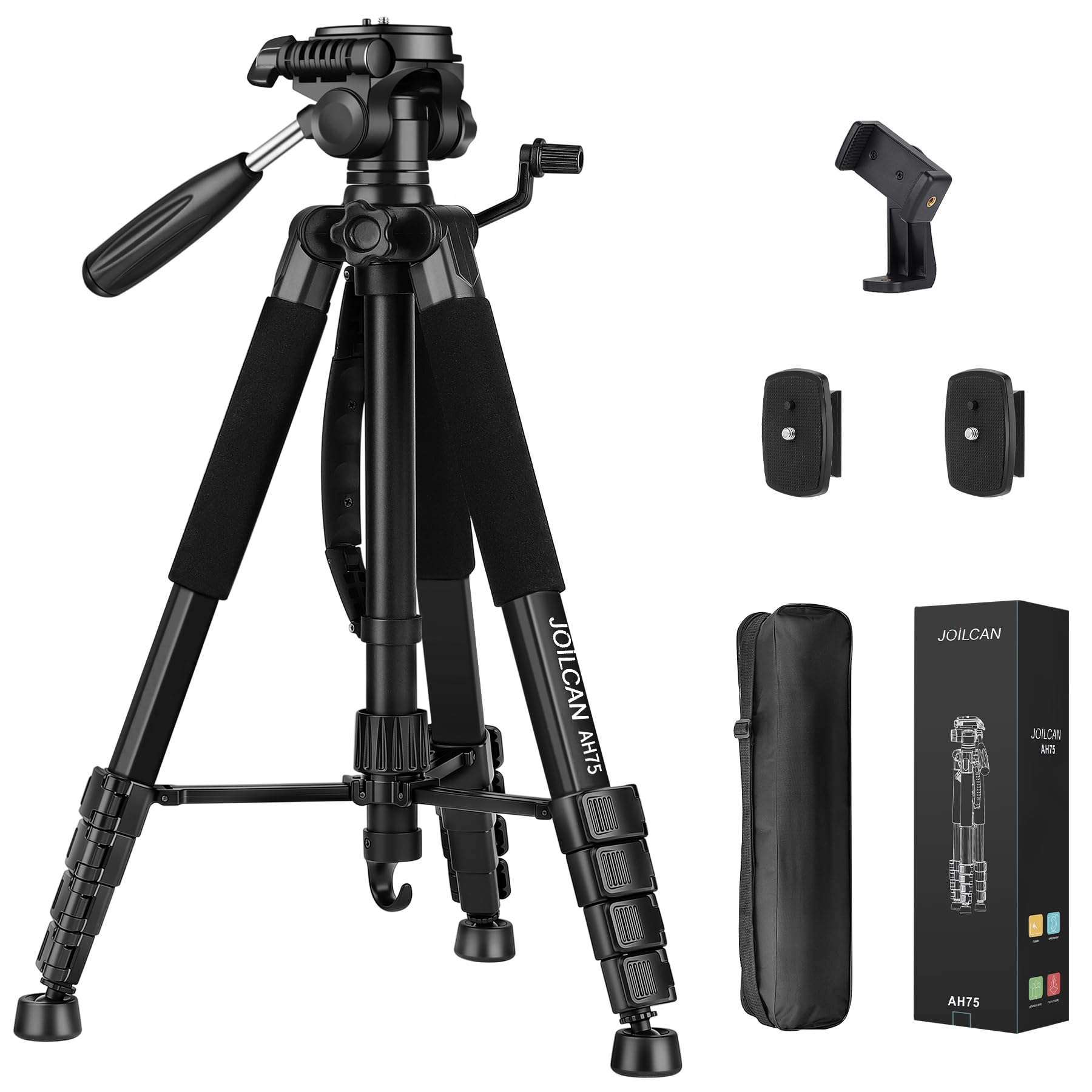
JOILCAN AH75

91 /100
LBD Score Outstanding

Key details

Weight
2.6 lb
Payload
15 lb
Head Type
3-way pan head
Max Height
74 in
View on Amazon

The JOILCAN AH75 is the budget option in this group, and it makes its case with a simple three-way pan head, two quick-release plates, and a phone mount in the box. That package covers a phone, a small mirrorless camera, and a quick switch between the two without asking you to buy extra accessories.

The 74-inch height and 15-pound payload are generous for the money, and the pan head has separate locks for pan and tilt, which is the right layout for a locked-off shot. We also appreciate the two plates: one can stay on the camera while the other stays on the phone clamp, so you are not unscrewing anything in the middle of a shoot.

The head is the part that asks for care. With a phone or a small mirrorless camera, it holds; with a heavier lens and a cage, the camera can creep on the plate, and the leg locks need a firm hand at full height. That is why we treat it as a light-duty pick: it is a lot of tripod for the money, but it is not the one we choose for a long lens or a crowded event where the camera gets bumped.

Pros

  • Budget-friendly pan-head setup
  • Includes phone mount and two plates
  • 74-inch max height
  • 15-pound payload

Cons

  • Phone holder is a weak point
Our verdict

For phone-first and light-camera video on a budget, the JOILCAN AH75 is the one we recommend: 74 inches of height, a pan head, and a phone mount in the box, as long as you keep the rig light.

Check Latest Price

How We Tested the Best Tripods for Video

We started by building a shortlist of 14 tripods from research, spec sheets, and reader reviews, filtering out anything with vague load ratings, plastic-looking leg locks, or a head that couldn't be swapped or adjusted. We kept the mix deliberately broad: heavy-duty aluminum legs, travel-friendly models, two-in-one tripod-monopods, and overhead rigs for top-down shots. Price mattered, but only as part of value—we compared what each tripod included against what it asked you to spend.

Testing ran for seven months, in the same real-world settings where I actually shoot: a living-room interview setup, a local park with a breeze, a cramped hallway for low-angle shots, and a tabletop demo corner for overhead work. I set up each tripod alone and timed it, extended and collapsed every leg section, and noted whether the leg locks slipped or felt cheap under a loaded camera. To check stability, I mounted a camera with a mid-weight lens, raised the center column, and watched for drift while I panned and tilted; then I hung a loaded gear bag from the center hook and checked for flex. I also tested each head's drag and lock, swapped quick-release plates in a hurry, and walked each folded tripod to the car by its carry bag to judge weight and bulk.

By the end, I'd set up and broken down each tripod dozens of times. We looked for smooth pans, locked-off shots that stayed locked, legs that held their position on uneven ground, and heads that didn't droop when tilted. We also checked whether the extra features—detachable monopod legs, horizontal arms, phone mounts—felt useful or just added weight. The tripods that scored best were the ones that stayed sturdy without becoming a chore to carry, and that gave us enough adjustability to shoot low, high, and overhead without a second rig. We compared the whole package against the price to decide which ones were genuinely good value.

How to Choose a Video Tripod

Start With the Head

For video, the head does the work you will feel every time you pan or tilt. A fluid drag head gives you resistance through the movement, so a slow reveal stays smooth instead of snatching at the start and stop. A ball head levels quickly and packs small, but it is better for locked-off shots than for repeatable camera moves. The NEEWER TP74 is our default here because its fluid head suits interviews and event coverage; the K&F Concept T254A7 is the one to choose when height matters more than panning. A three-way pan head can work for static shots, but check that the pan and tilt locks are separate.

Match Height to the Shot

A 74-inch tripod handles most standing eye-level shots, while a 90-inch model is for overhead work, crowds, or high-angle product shots. Check the minimum height too if you shoot low angles, and remember that more leg sections pack shorter but add joints that can flex. We prefer three-section legs for studio work and four-section legs for travel. The K&F Concept T254A7 earns its place with 90 inches of reach; the SmallRig CT-10 is the easier one to carry.

Treat Payload as a Rig Budget

The payload rating is not just the camera body. Add the lens, cage, monitor, microphone, and quick-release plate, then leave some headroom for a lens that hangs off-center. A tripod rated for 15 pounds can still feel marginal with a heavy zoom if the legs are light. If you regularly use a long lens or a full cage, the TP74's 17.6-pound rating and the SmallRig's 33-pound rating give you more room to work.

Decide How Far You'll Carry It

A video tripod is a transport decision as much as a support decision. The TP74 weighs 10.9 pounds and folds to 36 inches, which makes it a studio, event, or car-based tool. The SmallRig CT-10 is 3.4 pounds and folds to about 17 inches, so it is the one that goes in a backpack. Pick the heaviest tripod you will actually carry, not the heaviest one you can lift.

Check the Plate and Mount

Quick-release plates are the small part that can make a tripod annoying. If you already use Manfrotto 501PL or 504PL plates, or a DJI RS gimbal, look for a head that accepts them; the TP74 has two QR modes for exactly that reason. Otherwise, standard 1/4-inch and 3/8-inch screws cover most cameras and cages. Buy a spare plate for each camera or phone clamp so you are not swapping plates between shots.

Frequently Asked Questions

Final Verdict

Most video shooters should start with the NEEWER TP74. Its fluid head gives you the smooth pan and tilt that a ball head can't, the dual plate modes make it easy to move between rigs, and the 17.6-pound payload leaves room for a real lens and monitor. It is a heavy tripod, but that weight is the price of a planted shot.

If you need 90 inches of reach for overhead or crowd work, choose the K&F Concept T254A7. If you need a support that can travel all day, the SmallRig CT-10 is the better compromise.