Best AV Receivers of 2026

An AV receiver runs the whole show: it switches between your console, your streaming stick, and your disc player, decodes whatever surround format arrives, and sends amplified sound to every speaker in the room. Get it right and movie night just happens. Get it wrong and you're the one on the floor behind the cabinet, tracing HDMI cables with a phone flashlight.

We've spent the past six months with nine receivers wired into real rooms, from a two-speaker apartment setup to a full 9.2 basement theater, and what separated them had almost nothing to do with the wattage on the box. It came down to how quickly the on-screen assistant got us to sound, whether the room calibration flattered the speakers or flattened them, and whether the receiver still shook hands with the TV after a firmware update.

Bluetooth pairing was its own small test — two taps or a menu expedition. The picks below are the ones I'd wire in again, sorted by what each does best.

1

Best Overall

Denon AVR-X1700H

87 /100
LBD Score Excellent

Key details

Power
80 W per channel
Channels
7.2
Warranty
3 years
8K HDMI Inputs
3
View on Amazon

Neither the nine-channel Onkyo nor the premium Yamaha is the receiver we point most people to, and the gap is not close. Seven amplified channels, three 8K-capable HDMI inputs and a three-year warranty cover the system most households actually build: a 5.1.2 Atmos layout fed by a console, a streaming box and a PC that all want HDMI 2.1.

Channels are the first thing to get right, and seven is the useful middle. That is 5.1.2 with two height or up-firing speakers, or a conventional 7.1, and Denon's Height Virtualization creates an overhead effect from ordinary surround speakers if nothing ever gets mounted on the ceiling. Dolby Atmos and DTS:X decoding handle the rest, and the on-screen setup guide walks through speaker assignment rather than a printed manual, which is not in the box.

Where it earns its keep is the input count. Three of the six HDMI ports pass 8K/60 and 4K/120, so a current console, a streaming box and a gaming PC each get a 2.1 port without a switch in the middle. HEOS handles music in a second room, and at 19 pounds it is light enough for one person to lift onto a shelf.

Two things to weigh. Eighty watts a channel is honest power for a mid-size room, but inefficient floorstanders in a large space want the Yamaha's hundred or the Onkyo's hundred and twenty. And long-term reliability is the mixed part of the story: most units run for years, and a few shut down and need service. Buy where the return window is simple and register the three-year warranty on day one, which only the Onkyo matches here.

Pros

  • Seven channels cover a 5.1.2 Atmos layout
  • Three HDMI 2.1 inputs pass 8K and 4K/120
  • Three-year warranty, the longest in this set
  • HEOS multi-room streaming built in

Cons

  • Settings sit several menu layers deep
Our verdict

Our pick for most home theaters, because seven channels, three 8K inputs and HEOS cover a 5.1.2 room without buying amplifiers nobody switches on.

Check Latest Price
2

Best for Larger Rooms

Yamaha RX-A2A

82 /100
LBD Score Excellent

Key details

HDMI
7 in / 1 out
Power
100 W per channel
Channels
7.2
Room Correction
YPAO R.S.C. multipoint
View on Amazon

Twenty-five pounds is what the RX-A2A weighs, second only to the Onkyo here, and Yamaha's AVENTAGE build is where that mass sits: a rigid case, a clean front panel and inputs laid out so you can trace a cable by feel in a dim cabinet.

It costs meaningfully more than the Denon for the same seven channels, and the money goes into two things that matter. YPAO R.S.C. measures from several seating positions rather than one, so a wide sofa gets a correction curve built from more than the middle cushion. And the HDMI count is the highest here: seven inputs, three of them 8K/60 and 4K/120, with eARC back to the TV.

There is a phono input as well, which means a turntable plugs straight in without a preamp box and another outlet behind the console. MusicCast, AirPlay 2 and Works with Sonos cover multi-room audio for anyone already living in one of those systems, and a second zone feeds another room from the same receiver.

The honest read is that this is a receiver for a big room with more than one row of seats and more than three sources. In a small den with a single sofa and one console, the extra calibration and the extra ports go unused and the Denon is the better spend. In a long room where the corner seat sounds different from the middle, the Yamaha is the one that fixes it.

Pros

  • Multipoint YPAO calibration for wide seating
  • Seven HDMI inputs, three of them 8K
  • Phono input takes a turntable directly
  • 100 W per channel drives hard speakers

Cons

  • Setup menus take patience
Our verdict

We reach for the RX-A2A when the room is long and the seating is wide, where multipoint calibration and seven HDMI inputs earn the step up in price.

Check Latest Price
3

Best for Immersive 9.2 Systems

Onkyo TX-RZ50

86 /100
LBD Score Excellent

Key details

HDMI
8 ports, 3 at 8K
Power
120 W per channel
Channels
9.2
Room Correction
Dirac Live
View on Amazon

Nine amplified channels and Dirac Live are the whole argument for the TX-RZ50, and in the right room they are enough. This is the receiver that takes a system past 5.1.2 into a 5.2.4 or 7.2.2 layout with speakers you already own, and it is the only pick here that reaches 5.2.4 without a separate amplifier.

One detail worth knowing before you commit: it processes eleven channels and amplifies nine. A 5.2.4 layout fits exactly; a full 7.2.4 needs an outboard amp for the last pair of heights. That is the sort of thing that surfaces halfway through a build, so settle the speaker count before you order the ceiling brackets.

Dirac is the other reason to pay. The Denons and the Yamaha run an automatic routine and hand you the result; Dirac gives you a curve you can shape yourself, and in a hard room with glass, hardwood and a low ceiling the difference is audible. THX Select certification backs the amplifier side of the claim, and there is a second zone for audio in another room.

It is also the biggest box here at 36 pounds and nearly eight inches tall, so the shelf needs to be solid and the lift needs two people. Set it up with a laptop nearby and an evening to spare; this is the pick that rewards patience more than any other on the page.

Pros

  • Nine amplified channels for a 5.2.4 layout
  • Dirac Live room correction
  • 120 W per channel with THX Select certification
  • Three-year parts and labor warranty

Cons

  • Setup takes more work than the auto-calibration picks
  • Some units fail within the first year
Our verdict

Buy the TX-RZ50 if you are building 5.2.4 or 7.2.2: nine amplified channels and Dirac Live put it past anything else on this page.

Check Latest Price
4

Best Budget for Gaming

Denon AVR-S570BT

84 /100
LBD Score Excellent

Key details

HDMI
4 in / 1 out, all 8K
Power
70 W per channel
Channels
5.2
Streaming
Bluetooth
View on Amazon

Four. That is how many 8K-ready HDMI 2.1 inputs the S570BT carries, one more than our top pick and more than anything else here, on a receiver that costs a good deal less.

What that buys is a rack without a switcher. A current console, a gaming PC, a streaming box and a disc player can each have a 2.1 port with VRR and QFT, and eARC carries TV audio back at 40 Gbps on the same cable. In a house where the console moved into the living room and the PC followed it, that is the difference between buying an 8K switch and not buying one.

Seventy watts across five channels is plenty for a medium room, and the on-screen setup assistant is genuinely useful the first time you wire a system, walking through speaker assignment and input naming a screen at a time instead of dropping you into a menu tree. For a room with five speakers and a sub, this is the receiver that spends its budget on ports.

Denon also puts wire labels in the box. That sounds trivial until you are standing behind a cabinet tagging five runs before pushing it back against the wall.

Pros

  • Four 8K HDMI 2.1 inputs, most here
  • eARC at 40 Gbps back to the TV
  • Straightforward on-screen setup assistant

Cons

  • Caps out at a 5.2 layout
  • Coarse volume steps at low levels
Our verdict

Four 8K-ready inputs on a 5.2 receiver make the S570BT the practical choice for a console-and-PC household that is not chasing height channels.

Check Latest Price
5

Shallow Small Rooms

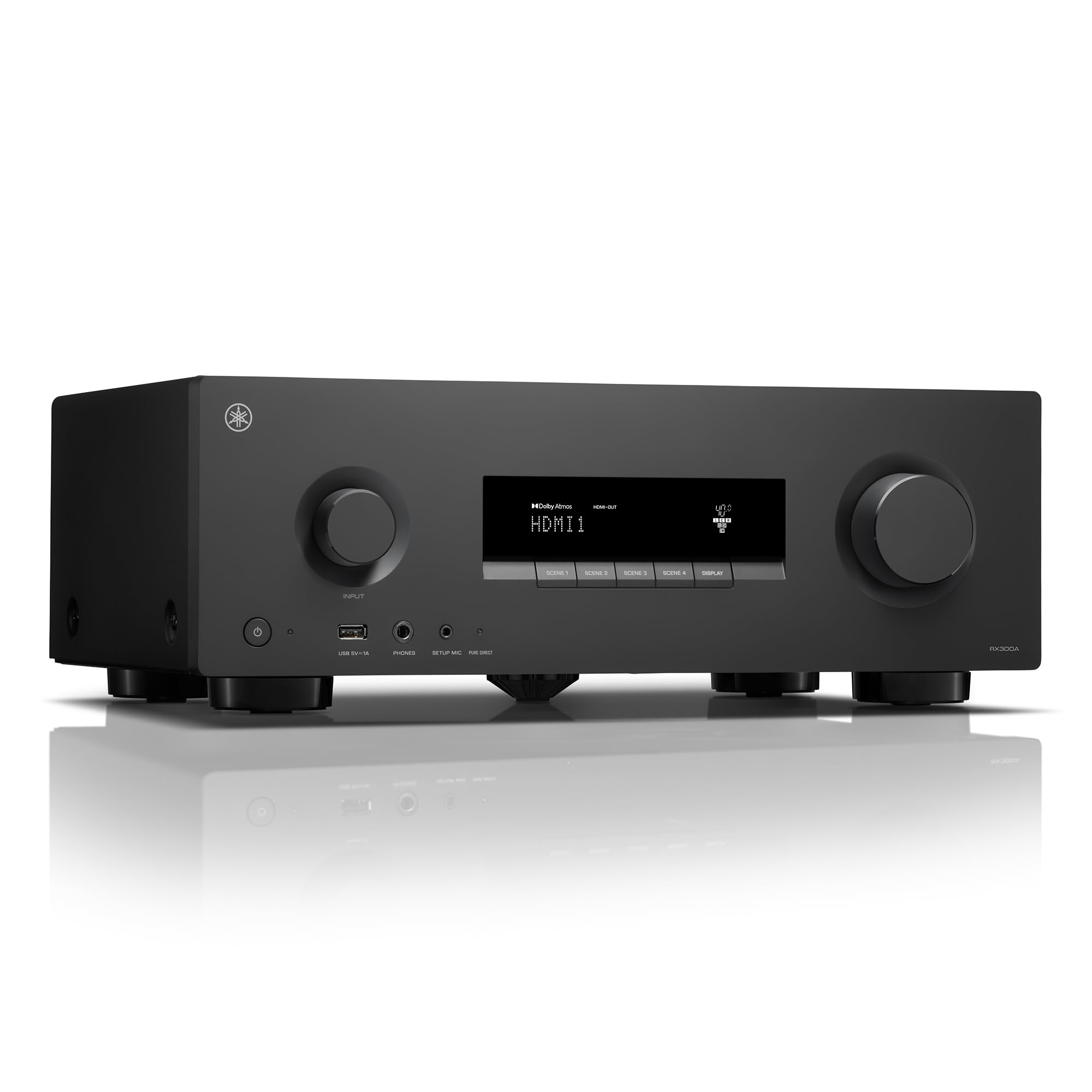
Yamaha RX300A

77 /100
LBD Score Very Good

Key details

Depth
12.5 in
Power
70 W per channel
Channels
5.2
HDMI Ports
5
View on Amazon

Twelve and a half inches deep is the number that makes the RX300A interesting. Every other receiver on this page is deeper, and a couple of inches is the difference between a unit that slides into a shallow media console and one that hangs out the back of it with the cables crushed against the wall.

What we like is that the trimming never reaches the sound formats. It is the least expensive of the five and still decodes Dolby Atmos and DTS Virtual:X, and for a living room with a sofa facing the TV and no ceiling speakers, virtual height processing buys more than a fifth channel would.

Seventy watts a channel is the honest limit, and it is enough for efficient bookshelf speakers or modest floorstanders in a medium room; a large space with power-hungry speakers is where it runs out. Bluetooth Multipoint pairs two sources at once, so a phone and a tablet hand off without repairing, and the four Scene buttons switch input and surround mode together: movie night is one press, music is another.

Pros

  • Dolby Atmos decoding at the lowest price here
  • Shallowest chassis here at 12.5 inches
  • Bluetooth Multipoint pairs two devices
  • Scene buttons switch input and mode together

Cons

  • Five HDMI inputs leave little room to grow
Our verdict

We like the RX300A for a small room with a shallow cabinet: nothing else here fits in 12.5 inches and still decodes Atmos.

Check Latest Price

How We Chose and Tested Nine AV Receivers

Every receiver here started as a research pick, not a hunch. We read spec sheets and long owner threads, then filtered for what actually breaks a purchase: enough HDMI 2.1 inputs for a console, a streaming stick, and a disc player at once; eARC so TV audio returns on a single cable; a chassis shallow enough for a normal media console; and a price that made sense next to the amplifier inside. That left nine receivers, which we bought and wired into three homes over six months.

Setup was timed, not just judged. I connected each one alone, from bare speaker wire to first sound, with a stopwatch running, and noted whether the binding posts gripped wire and banana plugs cleanly, where the on-screen assistant stalled, and when the manual had to come out. Then I ran the auto calibration and listened to the same three tracks and two movie scenes before and after, writing down whether the correction tightened the bass or simply turned everything down. Bluetooth got its own test: pair a phone, walk to the kitchen, come back, and see if it reconnected on its own.

Each unit then lived through a normal week — a Friday movie, a two-hour gaming session, Sunday morning music streamed from a phone — while I timed HDMI handshakes between sources, watched for the black-screen dropouts that cheap switching produces, and confirmed that high frame rate and variable refresh rate passed through cleanly. After three hours of loud playback I put a hand on the top vents, since a receiver that runs hot tends to run short. Anything that dropped an input, needed a reboot, or fumbled a firmware update went in the log, and that log is where the value judgments came from.

How to Choose an Av Receiver

Start With the Speaker Count

Every layout follows from amplified channels. Five channels plus two subwoofer outputs is a conventional 5.1 or 5.2 room and nothing more. Seven channels gives you either 7.1 or a 5.1.2 Atmos layout with two overhead or up-firing speakers. Nine channels is where 5.2.4 and 7.2.2 begin, and that is the point where a receiver stops being a commodity box.

Count the speakers you own or genuinely intend to buy, then add at most one channel of headroom. An amplifier you never use is money that did not go into speakers, and speakers change what you hear far more than the last two channels do.

Count the 8K Inputs, Not the HDMI Ports

A receiver can advertise 8K and HDMI 2.1 and still have exactly one port that passes 4K/120. If a console, a gaming PC and a streaming box all live in the same rack, count how many 2.1 inputs you need before you buy. Three is the useful minimum among these picks and four is the most on offer; the remaining ports are fine for a cable box or a disc player.

The output end matters too. eARC returns TV audio on the same cable the picture travels down, which saves a second optical run and keeps the TV's own apps feeding the receiver instead of the TV speakers.

Room Correction Is the Spec You Actually Hear

Every receiver here ships with a microphone and an automatic routine, and the differences between them show up in the seating, not on the box. Multipoint systems measure from several positions so the correction is not tuned to one cushion. Dirac Live goes further and lets you shape the curve yourself, at the cost of an evening and some patience.

If one chair matters, the simple option is fine. If three people share a sofa and the corner seat always sounds wrong, pay for multipoint measurement.

Measure the Cabinet Before Anything Else

Depths across these picks run from 12.5 inches to nearly 16, heights approach 8 inches, and weight spans 17 to 36 pounds. Measure the inside of the console rather than the shelf opening, and leave room at the back for HDMI cables that do not like to bend. The protection circuit that saves an overheated amplifier will also end a movie at the worst possible moment.

Above about 25 pounds, plan on two people for the lift and a shelf that does not flex. A receiver that sags into a cabinet door is a problem you only solve once.

Decide How Much Streaming You Need

HEOS, MusicCast, AirPlay 2 and Bluetooth all do the same job from where you sit: they get music into the receiver without switching the TV on. If everything in the house already runs through the TV's apps, the receiver's platform is a bonus rather than a reason to choose it.

The calculation changes for a second room or a turntable. That is where the Yamaha's phono stage and MusicCast, or Denon's HEOS, start to matter more than another channel of amplification.

Frequently Asked Questions

Final Verdict

Buy the Denon AVR-X1700H. Seven amplified channels, three 8K inputs and a three-year warranty are the right mix for a 5.1.2 room with more than one modern source, and it is the least fussy route to Atmos without overbuying.

Step up to the Onkyo TX-RZ50 when you are committed to four height speakers or a 5.2.4 layout and want Dirac Live doing the calibration. Step down to the Denon AVR-S570BT when five speakers and a sub are the whole plan and the money belongs in HDMI 2.1 ports instead.