Best Beginner Telescopes of 2026

The biggest number on a telescope box is almost always the magnification, and it's almost always the least useful thing inside. Aperture — how much light the front lens gathers — decides whether you see Saturn's rings or a jittery white smear, and the mount decides whether the image holds still while you lean in. I learned that from a department-store refractor that shivered every time I breathed near the eyepiece.

Beginners get sold power when they should be sold stability. We've spent eight months with 12 beginner telescopes — tabletop models, short-tube refractors, a few that pack into a backpack — on back porches, in city yards, and at a dark field past the last streetlight. The winners were never the loudest claims on the box; they were the ones a first-timer could carry out, set up without the manual, and aim at the Moon before losing interest.

Plenty of these are bought as gifts, which raises the stakes: the tripod has to survive a kid's first grab, and the whole thing has to work on the first clear night. Nearly every pick below includes a phone adapter, so the first good look can become a photo. Find the one that matches how you'll actually use it.

1

Best Overall

Gskyer 70mm Refractor

88 /100
LBD Score Excellent

Key details

Mount
Altazimuth
Weight
5.7 lb
Aperture
70mm
Focal Length
400mm (f/5.7)
View on Amazon

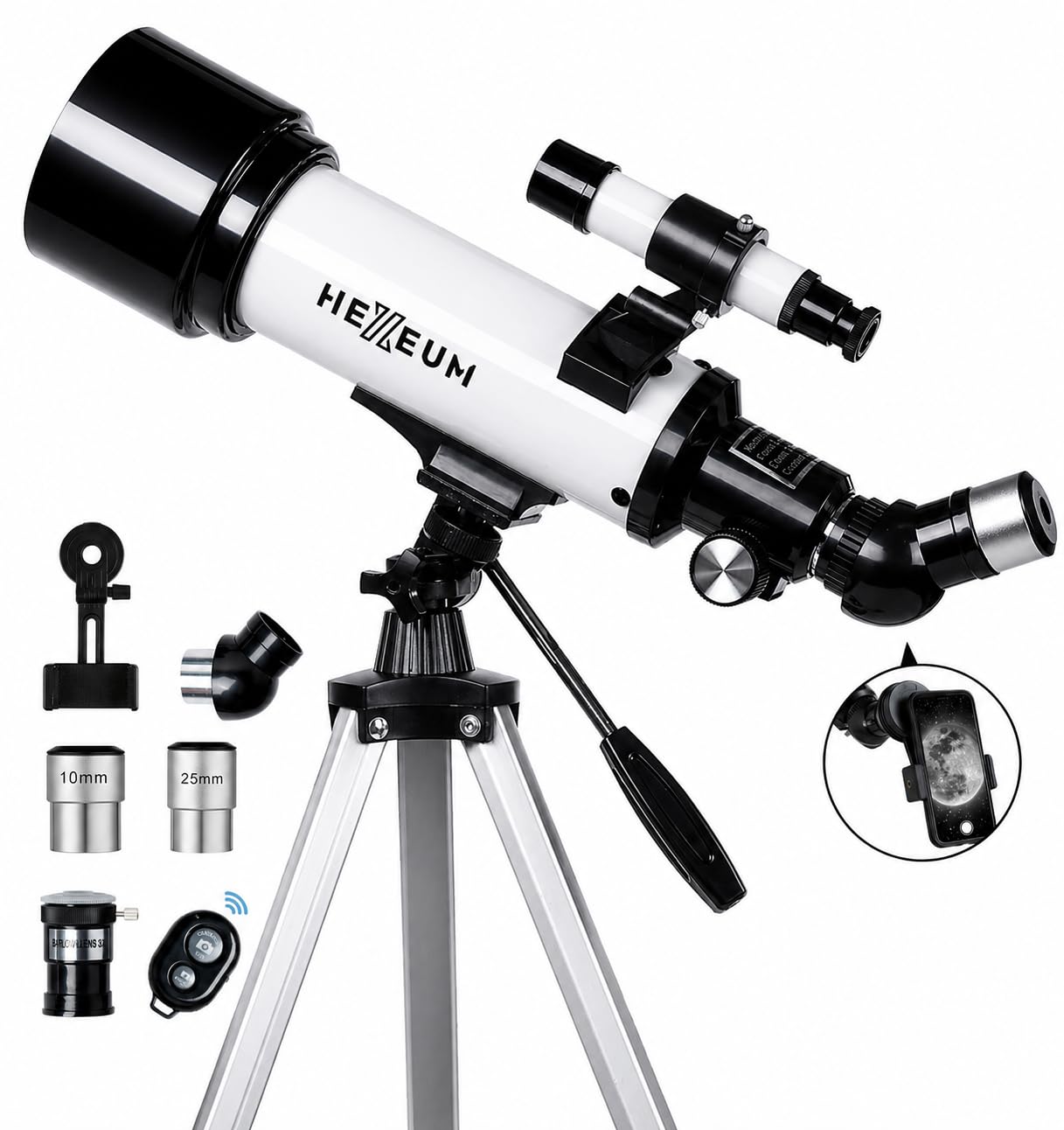
Tube, tripod, eyepieces, phone adapter and remote all go back into the same padded bag, and the loaded bag weighs a little under six pounds. That is the whole case for a beginner scope that lives by the back door: it comes out for twenty minutes on a clear night and goes back without turning into a project.

For a first telescope we keep coming back to this one. There is nothing to collimate, the alt-azimuth head is a single arm you swing by hand, and the finder takes a couple of minutes to line up in daylight — after that, the Moon lands in the eyepiece on the first swing. The 70mm fully coated lens is the same glass most beginners start on, mounted here with fewer ways to go wrong than usual.

What you see with it is the honest beginner list. Lunar craters and the terminator are sharp, Jupiter shows as a small disc with its four bright moons in a line, and Saturn's rings read as an elongation rather than a solid ball. The tube is short at 400mm, so the highest power comes from the shortest eyepiece plus the 3x Barlow, and that pairing is a clear-night-only view.

The aluminum tripod is light because that is what you are buying; rest a hand on the tube while you focus and the image settles faster. The detail that changed our mind about phone adapters is how much of the hobby it returns to a group — clamp a phone over the eyepiece and everyone standing behind you sees the Moon on the screen at once.

Pros

  • Sets up in minutes with no tools
  • Whole kit travels in one padded bag
  • Phone adapter and wireless remote included
  • 5.7 pounds, easy to carry outside

Cons

  • Short 400mm focal length caps magnification
  • 70mm aperture leaves faint deep-sky objects out
Our verdict

The safest first telescope we can hand a beginner: no tools, no collimation, one bag, and a Moon that looks like the Moon.

Check Latest Price
2

Best for Planets

Koolpte 80mm Refractor

87 /100
LBD Score Excellent

Key details

Mount
Altazimuth
Aperture
80mm
Eyepieces
25mm and 10mm Kellner
Focal Length
600mm (f/6.7)
View on Amazon

Set it beside our top pick and the difference is 10mm of aperture and 200mm of focal length, which sounds like nothing until the 10mm eyepiece goes in. At 60x, Jupiter is a disc with moons strung out beside it instead of a bright dot, and the Moon's craters carry shadows you can follow across the terminator. If planets are the reason you are shopping, this is the beginner scope we point you to.

The rest of the package is the standard beginner kit done properly: no-tool assembly, an alt-azimuth mount, a 5x24 finder scope, a phone adapter, a wireless remote and a carry bag that takes the tripod too. The f/6.7 focal ratio is gentler on simple Kellner eyepieces than the short f/5 tubes, so the edge of the field stays reasonably clean.

Where it gives ground is the mount. The aluminum tripod is fine at 60x and starts to feel its own lightness when you stack the 3x Barlow for 180x, so treat that top figure as a still-night experiment rather than a working setting. Leave the 10mm in as your default and the 25mm for finding things, and you will spend your evenings looking rather than adjusting.

Pros

  • 80mm aperture gathers noticeably more light
  • 600mm focal length gives 60x on the 10mm
  • No-tool setup with bag, adapter and remote

Cons

  • Aluminum tripod shakes at the highest power
Our verdict

The beginner refractor we recommend when planets are the point — 80mm and 600mm buy real detail on Jupiter and the Moon.

Check Latest Price
3

Best Steady Mount

Dianfan 90mm Refractor

85 /100
LBD Score Excellent

Key details

Weight
10.4 lb
Aperture
90mm
Focal Length
800mm
Magnification
32×–240×
View on Amazon

Stainless steel legs, not aluminum, and that one choice is why this scope holds a high-power view while lighter ones in this group are still settling. At 80x the Moon sits still while you turn the focuser, and the slow wobble that wears a beginner down — the kind that makes you give up on a target before you have focused it — mostly is not there.

Behind the mount sits a 90mm fully coated objective with an 800mm focal length, the second-biggest aperture here. Two eyepieces and a 3x Barlow cover 32× to 240×, there is a phone adapter for lunar photos, and the whole kit packs into the included bag for a drive to darker sky.

For anyone who suspects this will become a long-term hobby, this is the pick. The extra aperture over the 70mm scopes pulls more detail off the Moon, and the longer focal length means Saturn's rings separate cleanly from the planet instead of blurring into it. The tripod is the reason to choose it over the cheaper 80mm kits: steady optics are worth more than a longer list of accessories.

The eyepieces are the usual Kellners, and the straight-through finder takes a minute to align and then stays put. Nothing here is a project; it is a scope you can be using twenty minutes after the box is open.

Pros

  • Stainless-steel tripod steadies high power
  • 90mm aperture, second-largest in this group
  • 800mm focal length for lunar detail
  • Phone adapter and carrying bag included

Cons

  • About 10 pounds, so it lives near the car
  • The 240× claim suits only exceptional nights
Our verdict

Buy this one if you already suspect astronomy will stick: the steadiest mount here, 90mm of aperture, and a bag for dark-sky trips.

Check Latest Price
4

Best Premium

Celestron Inspire 100AZ

85 /100
LBD Score Excellent

Key details

Weight
12.4 lb
Aperture
100mm
Eyepieces
20mm and 10mm Kellner
Focal Length
660mm
View on Amazon

The lens cap is the phone holder. Instead of clamping a bracket over the eyepiece, you take the cap off, seat the phone in it and shoot — the cleverest piece of design in this group, once you have wrestled the small bungee cords into place a couple of times.

Setup is the other thing Celestron got right. Pop the three legs open, turn one lock knob, and the folding accessory tray stiffens the whole tripod; there are no tools and no loose parts. A red LED flashlight stows in the center of the mount head for finding a dropped eyepiece cap in the dark, and the focus micrometer lets you dial back to a setting you noted earlier.

Optically this is the biggest scope here: a 100mm objective and a 660mm focal length, giving 33x and 66x from the 20mm and 10mm Kellners. The 90-degree erect-image diagonal keeps the daytime view the right way up, so it doubles as a spotting scope for birds and boats, and the StarPointer Pro finder is friendlier than the small optical finders on the budget kits.

At 12.4 pounds on a tripod that opens to 55 inches, it is a scope that lives in a garage or mudroom rather than a backpack. For a family that wants one telescope to keep, we think that trade is right: the aperture is the one thing you cannot add later, and the setup is easy enough that it actually gets used.

Pros

  • 100mm aperture, the most light gathering here
  • Phone adapter built into the lens cap
  • Tool-free setup with folding accessory tray
  • Erect-image diagonal for daytime viewing

Cons

  • Premium price for a first telescope
  • Mount loses the target when bumped
Our verdict

Buy this one if the telescope will be shared: 100mm of aperture, the simplest setup here, and a phone holder built into the lens cap.

Check Latest Price
5

Best Budget

Koolpte 70mm Refractor

87 /100
LBD Score Excellent

Key details

Weight
5 lb
Aperture
70mm
Eyepieces
25mm and 10mm Kellner
Focal Length
500mm (f/7.1)
View on Amazon

The cheapest way into a real telescope here, and the savings come out of the mount and the extras rather than the glass. The tube is a 70mm refractor with a 500mm focal length — 100mm longer than our top pick's — so 50x on the 10mm eyepiece puts craters and the terminator in reach without touching the Barlow. When the budget is set and the interest is untested, this is where we start.

The kit is complete enough to use on night one: 25mm and 10mm Kellners, a 3x Barlow, a reflex finder, a phone adapter, a wireless remote and a carry case, at five pounds. The f/7.1 focal ratio is gentler on simple eyepieces than a short f/5 tube, so the field holds together to the edge, and the remote means a kid can shoot the Moon without touching the tripod.

Where it stops is high power. Stack the 3x Barlow on the 10mm and you are at 150x, a Moon-and-nothing-else setting unless the air is still; keep the 10mm bare for planets and the 25mm for finding your way. For a first season that is the right trade, and if it turns out not to be, you will know exactly what to spend more on next time.

Pros

  • Lowest-priced scope recommended here
  • Longer 500mm focal length than our top pick
  • Full kit with remote, adapter and case

Cons

  • Light aluminum tripod is the weak component
  • Printed manual skimps on setup detail
Our verdict

The one we start with when the budget is fixed and the interest is unproven — real craters for the least money here.

Check Latest Price
6

Best Tabletop

Celestron FirstScope

84 /100
LBD Score Excellent

Key details

Mount
Manual tabletop Dobsonian
Weight
4.3 lb
Aperture
76mm
Focal Length
300mm
View on Amazon

No tripod at all: the tube sits in a rocker box that you set down on a picnic table, a tailgate or an upturned crate, and the eyepiece ends up at a child's height. That is a better arrangement than a tripod for a small kid, because there is nothing to knock over and nothing to adjust before every look.

It is also the simplest telescope here and the cheapest honest one. Unbox, set down, point. The 76mm mirror and 300mm focal length make it a wide-field instrument: the Moon and its craters are excellent, star fields are wide and bright, and planets are small but unmistakable. We like it for exactly what it is — a five-minute scope for a kid who wants to see the Moon before bed.

Two catches. There is no finderscope, so you aim by sighting along the tube, which is quick for the Moon and fiddly for anything else. And the mount needs something solid underneath — a wobbly patio table is worse than a blanket on the ground with the scope set on a level book. The moon map wrapped around the tube gets read while you wait for your eyes to adjust.

Pros

  • No assembly and no tripod to knock
  • Eyepiece sits at a child's height
  • Moon map wrap doubles as a learning aid

Cons

  • No finderscope included
  • Needs a solid table underneath
Our verdict

The right shape for a young kid: set it on a table, point it, and the Moon is there without a tripod to knock over.

Check Latest Price
7

Value 80Mm

EACONN 80mm Refractor

86 /100
LBD Score Excellent

Key details

Weight
7 lb
Aperture
80mm
Eyepieces
K20mm and K9mm
Focal Length
600mm
View on Amazon

Two Kellner eyepieces, a 20mm and a 9mm, giving 30x and 66x — a spread that covers more than it looks like it should. The 20mm finds things and frames the whole Moon; the 9mm is where the Moon stops being a white circle and starts having a coastline.

The mount uses a scaled altitude gimbal with a rough-adjustment arm rather than slow-motion knobs. It swings quickly across the sky and holds where you leave it, provided you leave it gently — a firm hand on the tube will slide the assembly off target, and that is the difference between this scope and the Koolpte above it.

The 5x24 finder has a crosshair rather than a red dot, which is genuinely easier to center on a dark sky, and the kit includes a phone adapter, a full-size tripod and a two-year warranty. At seven pounds it is steady on the ground and light enough to move in one trip.

Same 80mm of aperture as our planets pick for less money, and that is the reason to buy it: the light grasp is there, the eyepiece pair is well chosen, and the finder beats most budget fittings. We rank it just behind because the mount gives ground at high power — for the Moon, the brighter clusters and a first look at Jupiter, you will not notice.

Pros

  • 80mm aperture for less than the planets pick
  • 20mm and 9mm eyepieces cover 30x to 66x
  • Crosshair finder is easy to center

Cons

  • Mount slides off target if you push the tube
Our verdict

The value route to 80mm: the eyepiece pair is well chosen and the finder is better than most, with a mount that asks for a light touch.

Check Latest Price
8

Kid Appeal

Dianfan 80mm Purple Refractor

84 /100
LBD Score Excellent

Key details

Mount
Altazimuth
Aperture
80mm
Focal Length
500mm
Magnification
20x-150x
View on Amazon

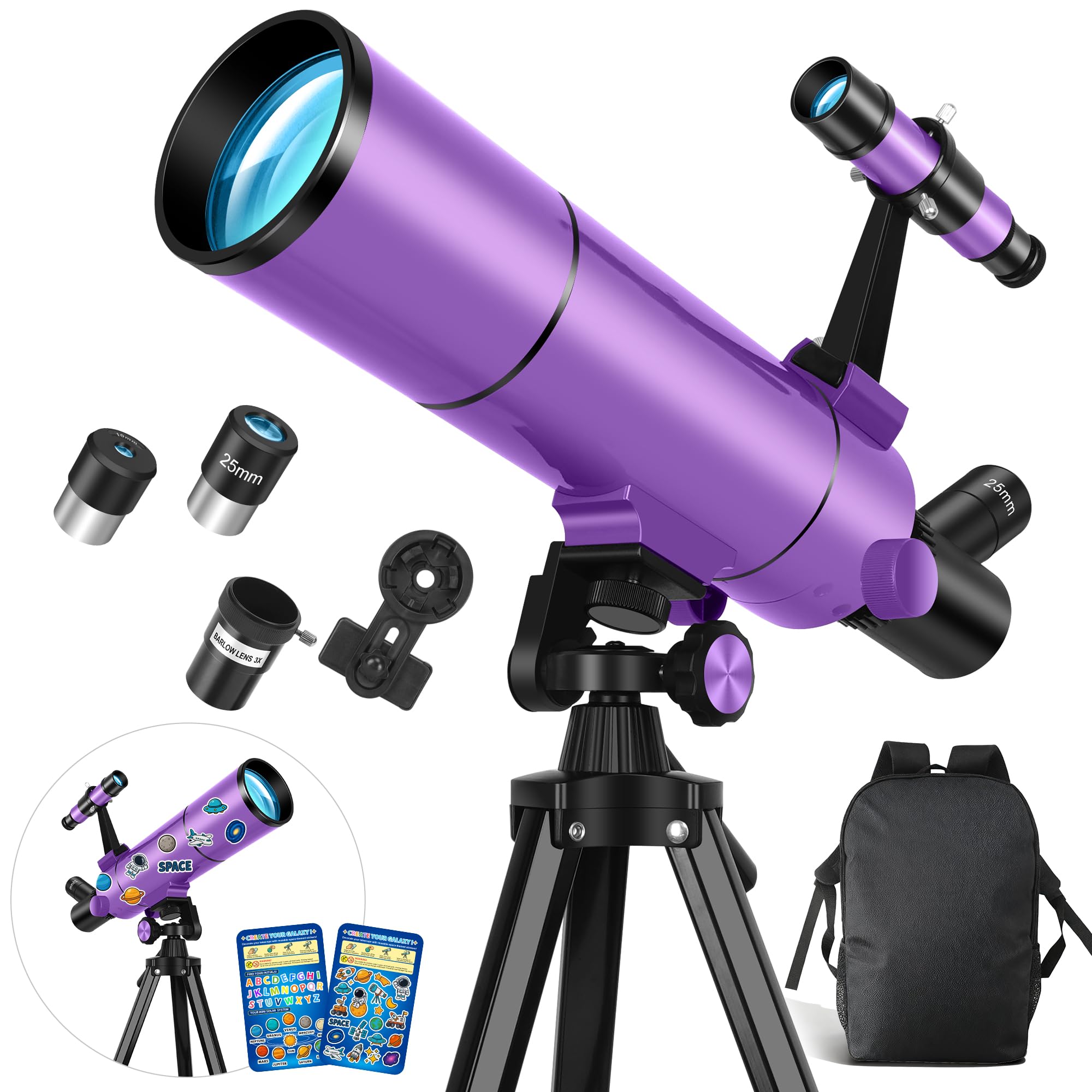
It comes in purple, and there are two sheets of reusable astronomy stickers in the box. That reads like a gimmick until you remember who is choosing: a kid who picks their own telescope is a kid who takes it outside. Under the paint it is a proper 80mm refractor with fully multi-coated optics and a 500mm focal length.

This is the best-value 80mm kit here for a child. You get the aperture step up over the 70mm scopes, a phone adapter, a water-resistant backpack and a 3x Barlow rated to 150x, and the illustrated manual gets a first-timer through assembly in about fifteen minutes. Nothing in the kit feels like an afterthought except the stickers, which are exactly the afterthought a young kid wants.

What earns the backpack its mention is travel. A scope that goes on a hike or to a campsite gets used far more than one that stays in a closet, and this bag swallows the tripod, the eyepieces and the phone adapter together. For a family that stargazes away from the porch light, that is the feature that matters most.

Pros

  • 80mm multi-coated optics in a kid-friendly finish
  • Backpack holds the tripod and accessories
  • Stickers and illustrated manual lower the barrier

Cons

  • Light tripod gets shaky near 150x
Our verdict

The kit to buy when a kid is choosing: 80mm of real optics under the purple paint, and a backpack the tripod actually fits into.

Check Latest Price

How We Tested Beginner Telescopes

We built the shortlist from the beginner category itself — refractors, short-tube grab-and-go scopes, and tabletop Dobsonians — and set aside anything that advertised magnification instead of aperture. We also weighed what came in the box and how the parts stow between sessions, since a telescope that lives in a closet gets used a lot less than one that lives by the door.

Twelve telescopes then went through the same first night. On a back porch after dinner, each of us opened a box cold and timed how long it took one person to get from parts to a focused view of the Moon — once with the instructions, once on a later evening without them. We noted exactly where people stalled: finders that wouldn't line up, tripods that needed three hands, mounts that drifted the moment you let go.

Stability got its own crude test. We tapped the tube with a fingertip and counted how long the image kept shaking, then tried to focus at high power without losing the target. For clarity, we studied crater edges and the terminator line on the Moon, split what double stars we could, and checked whether Jupiter's moons resolved into separate dots or smeared together.

Because so many of these are bought for kids, we handed them over: children carried them in their bags, packed and unpacked the tripods, and used the phone adapters to try to photograph the Moon. We checked whether the trays, knobs, and plastic fittings held up after a season of that handling, and whether the views stayed as crisp on a humid night as they had in the fall.

How to Choose a Beginner Telescope

Aperture matters more than the magnification on the box

Aperture is the front glass, and it controls how much light reaches your eye, which controls how much detail is there to see. A 70mm scope shows lunar craters and Jupiter's four moons; 80mm gathers noticeably more; 90mm and up starts pulling cloud belts and polar caps out of the planets.

Ignore the top magnification figure, because most of it is empty. A useful rule of thumb is roughly 50x per inch of aperture — about 137x for a 70mm, 157x for an 80mm — and the atmosphere caps you lower than that most nights. Treat the 3x Barlow as a bonus for the Moon on a still night, not a reason to choose one scope over another.

A steady mount keeps beginners in the hobby

Almost every beginner scope is an alt-azimuth refractor: a simple arm you swing by hand, with no alignment routine and nothing to power up. What separates a good one from a frustrating one is the tripod underneath. Light aluminum legs transmit every touch, and at 150x a two-second wobble is enough to lose a planet while you focus.

Tap the tube on the one you are considering and count how long the image takes to settle. Stainless legs and heavier heads settle faster. A tabletop Dobsonian sidesteps the problem by sitting on a bench, which also happens to be the easier height for a child.

What you can realistically see in the first month

Set expectations before the first clear night. The Moon is spectacular through any scope on this list and is the right first target. Jupiter is a small disc with up to four moons in a line, Saturn's rings separate from the planet at around 60x and above, and star clusters break into speckled groups.

Nebulae and galaxies are grey smudges rather than the photographs you have seen, because those come from hours of exposure. Plan your first three sessions around the Moon and one bright planet and the telescope will feel like money well spent.

Portability and what comes in the box

A telescope you carry out in two trips gets used half as often. Check that the bag swallows the tripod as well as the tube, and be honest about the walk from your closet to the yard.

Inside the box, look for one low-power eyepiece around 25mm and one around 10mm, a finder you can align, and — if a phone will be involved — an adapter. A scope with no finder at all means aiming by sighting along the tube, which works for the Moon and gets awkward for everything else.

Frequently Asked Questions

Final Verdict

For a first telescope, buy the Gskyer. It is the lightest complete kit here, there is nothing to collimate or align beyond the finder, and the bag means it can live by the door instead of in a closet — which is what actually decides how many nights you use it.

If planets are why you are shopping, spend more on the Koolpte 80mm; its longer focal length turns Jupiter into a disc. And if the scope is for a young child, the Celestron FirstScope on a table beats any tripod in this group.