Best Overall
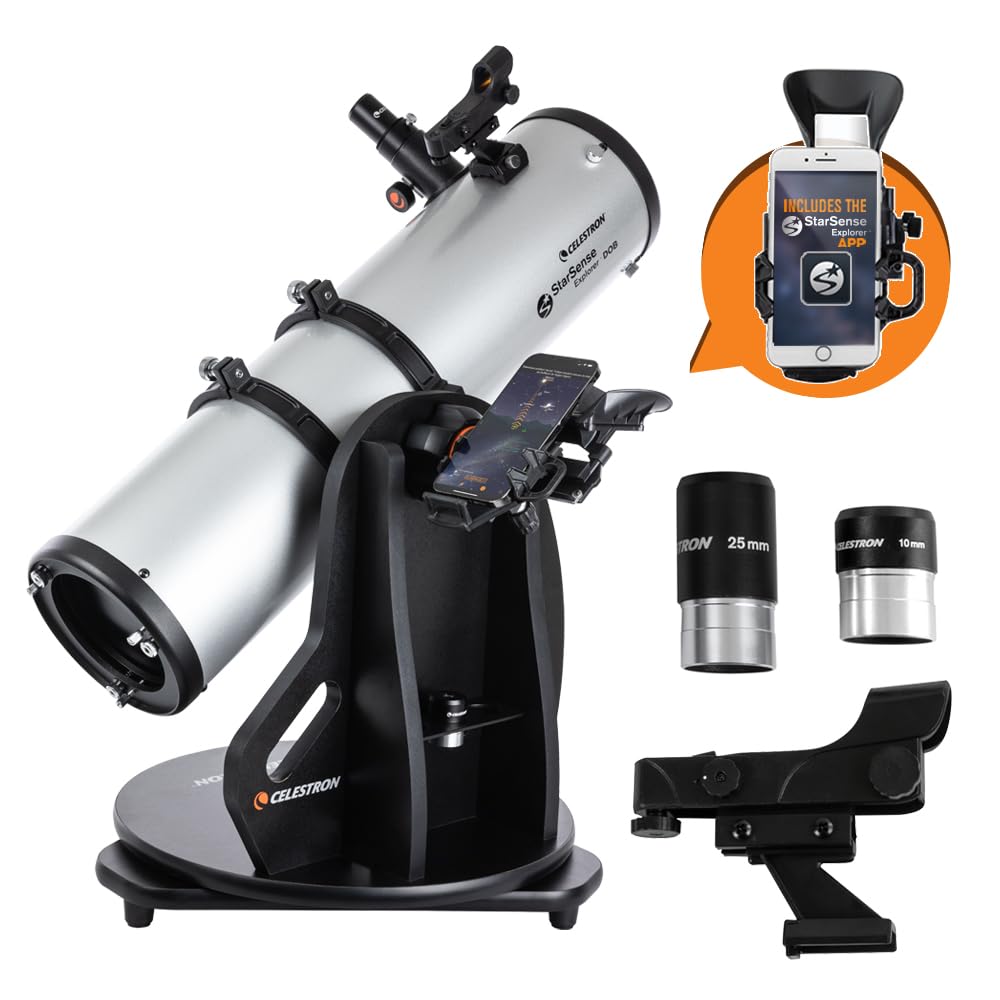
Celestron StarSense Explorer 150mm Dobsonian
Key details
- Mount
- Tabletop Dobsonian
- Weight
- 25 lb
- Aperture
- 150 mm (6 in.)
- Focal Length
- 650 mm
Pointing the scope is the part beginners quit over, and the StarSense dock on this Celestron is the most convincing answer in this guide. You set a phone in the cradle, the app compares the camera's view against its star map, and arrows walk you to the target. It is the difference between hunting a faint smudge for twenty minutes and actually finding it.
Six inches of aperture on a 650mm tube is the most light in this group, and it shows where it counts: the Moon and planets are bright and detailed, and globular clusters and the brighter nebulae stop being theoretical. The Dobsonian rocker base is the steadiest thing here as well, a solid box rather than three extending legs, so the view holds while you turn the focuser.
The catch is where it sits. This is a tabletop base, so it wants a sturdy, level surface at a sensible height, and at 25 pounds it travels as two pieces rather than one. A balcony with nowhere to put a table, or a yard without a bench, turns that into real friction. If your observing spot has a bench or a garden table, none of it matters. Two Kellner eyepieces, a red-dot finder, an eyepiece rack, and a collimation cap come in the box.
We still put it first because it removes both beginner failure points at once, finding the object and holding it still, and backs that up with enough aperture to make the search worthwhile. Compared with the 90mm refractors here, it is the difference between a telescope that shows you the sky and one that shows you the Moon.
Pros
- App-guided pointing finds faint objects by name
- Six inches of aperture reaches deep-sky objects
- Dobsonian base holds the view still
- Collimation cap and eyepiece rack included
Cons
- Manual base, so objects drift without tracking
- Assembly instructions are the weak link
If you want galaxies and nebulae rather than just lunar craters, and you have a steady table to set it on, this is the telescope we point people toward.