Best Camera Monopods of 2026

A monopod is a trade: you give up the three-legged calm of a tripod and get something you can plant with one hand while the light is already changing. I've spent plenty of Saturday mornings on a sideline with one braced against my chest, and it always comes down to the same question — once a heavy lens is up there, does the column stay exactly where you put it?

Over six months, my team and I ran 12 monopods through that scenario, from bare aluminum sticks to carbon fiber models with ball heads, pivoting feet, and one-button height locks. Price mostly buys you less wobble, not more features: nearly any of them will hold a camera steady for a moment, but not all stay put while you pan, and fewer still pack short enough that you actually bring them along.

One thing no listing tells you is that section count is a personality trait. Five sections collapse shorter but take longer to extend, and twist collars feel very different from flip levers once your hands are cold and damp. The picks below all survived the season; which one fits depends on how you shoot.

1

Best Overall

SmallRig Carbon Ball Head Monopod

86 /100
LBD Score Excellent

Key details

Head Type
Ball head
Max Height
65.6 in
Folded Length
26.8 in
Load Capacity
11 lb
View on Amazon

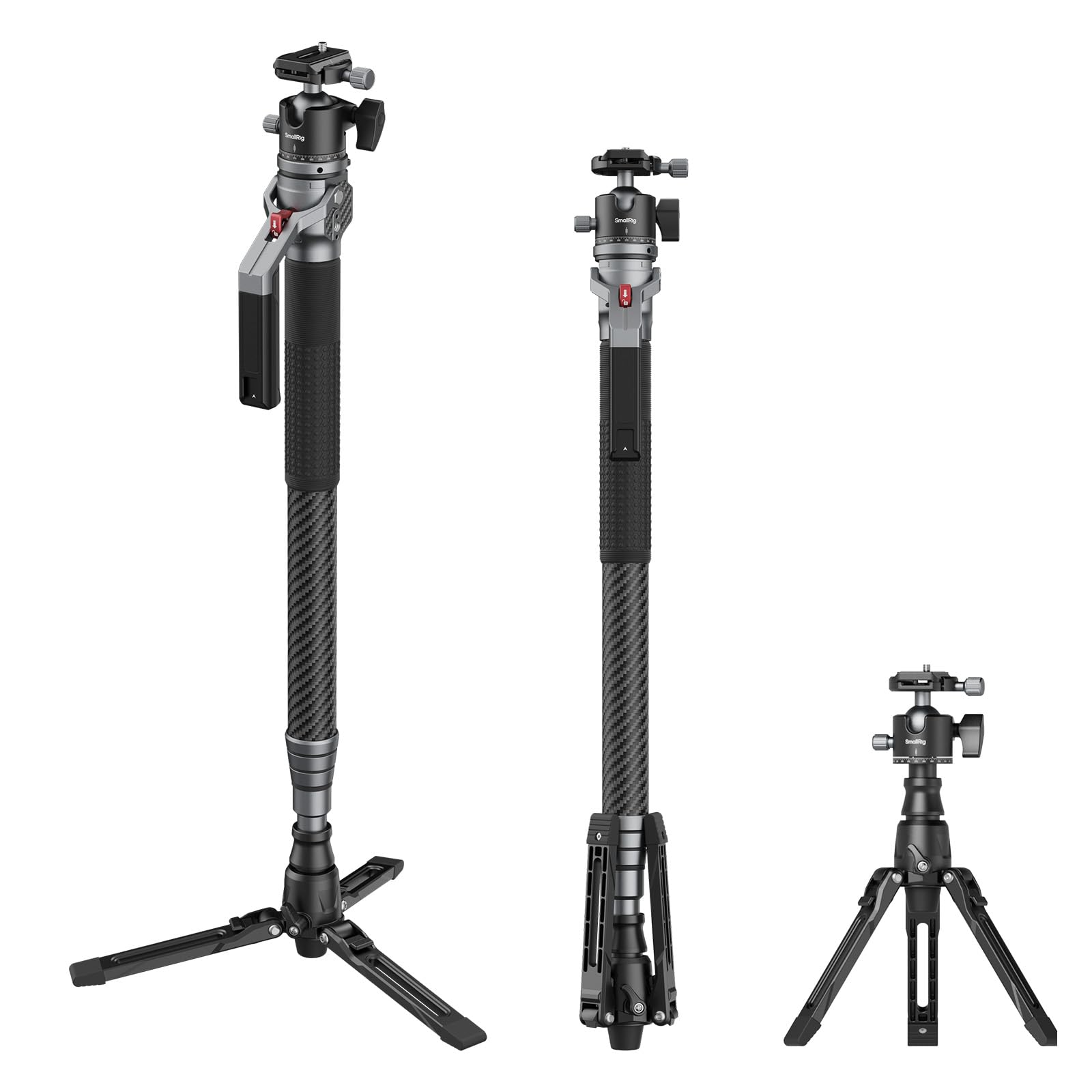
One button does the work. Press the collar and the carbon leg slides; release it and the monopod locks wherever you stopped. That sounds like a small thing until you are on a sideline with a camera in one hand and you need two more inches of height, and then it is the difference between missing the frame and getting it. It runs from about 27 inches to 65.6 on four sections, with a ball head already on top.

The ball head is what makes this a complete kit rather than a pole. It arrives with an Arca-type quick-release plate, so a body you already have a plate for drops straight on, and you can level a horizon or tip down for a low angle without changing hardware. The 11-pound rating covers a full-frame body with a fast 70-200 and leaves room. The catch is the heft: 1.73 kg is a lot for carbon, and we felt it on a long walk. What you get for it is a machined collar that does not flex under a heavy lens.

The plate clamp is the part to watch. If the lever is not fully seated the camera can twist on the plate, and a plate that lets go takes the rig with it, so check the tension before every setup, especially after the monopod has been riding in a bag. The extra 1/4-inch hole on the body of the pod is a nice touch for a small monitor arm, and it is the kind of detail that tells you someone at SmallRig actually shoots.

Pros

  • One-button lock sets height one-handed
  • Ball head and Arca-type plate included
  • 11-pound capacity covers a full DSLR kit
  • Extra 1/4-inch mount for a monitor

Cons

  • Folded length of 26.8 inches needs a big pack
Our verdict

We recommend it for a DSLR or mirrorless kit up to 11 pounds, because the head, the plate, and a one-handed lock all come in the box.

Check Latest Price
2

Best Value

Amazon Basics 67-Inch Monopod

93 /100
LBD Score Outstanding

Key details

Weight
12.8 oz
Max Height
67 in
Folded Length
21.4 in
Load Capacity
6.6 lb
View on Amazon

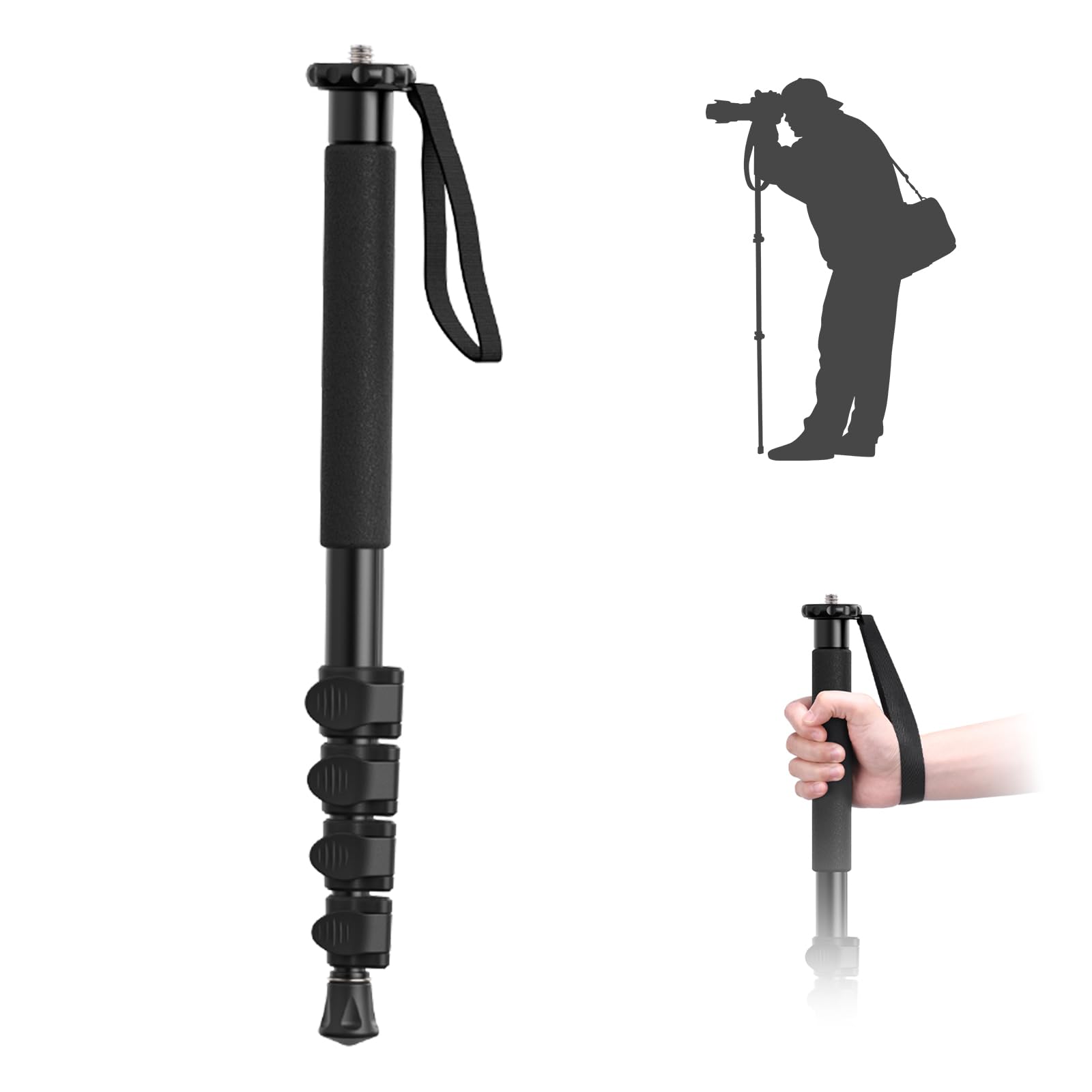
No head, no quick release, no fuss. What you get is an aluminum pole, four sections, a 1/4-inch stud rated to 6.6 pounds, a foam grip, and a rubber foot with a retractable spike underneath. For a mirrorless body and a kit zoom that is all you need, and it is why the whole thing weighs 12.8 ounces. As a first monopod, or a second one that lives in the car, this is the sensible buy.

It reaches 67 inches, which puts the finder at eye level for most adults, and the latches hold where you set them. A small ball head on that stud turns it into an angled support, and it is the upgrade we suggest before a second monopod. The one part to be careful with is the stud itself, because crank a heavy rig down hard and it is what gives out.

Where it stops is the rating. A pro body with a fast telephoto and a head on top gets close to 6.6 pounds quickly, and that is the point where the SmallRig's 11 pounds starts to look like the better buy. For everyone else this is a pole that folds to 21.4 inches, comes with a bag, and does the one job without a manual.

Pros

  • 12.8 ounces and 67 inches of reach
  • Rubber foot plus retractable spike
  • Cushioned grip and wrist strap

Cons

  • 6.6-pound ceiling rules out big telephoto rigs
Our verdict

Our advice for a first monopod on a mirrorless kit: buy this one, add a small head, and stop thinking about it.

Check Latest Price
3

Best for Travel

SIRUI P-326 Carbon Monopod

91 /100
LBD Score Outstanding

Key details

Weight
14.1 oz
Max Height
60.6 in
Folded Length
15 in
Load Capacity
22 lb
View on Amazon

Fifteen inches folded and 400 grams is the entire case for the P-326. It is the monopod that actually leaves the house, because there is no decision to make about whether it fits in the pack. Six carbon sections run out to 60.6 inches, the collars are twist locks with silicon inserts, and the plate carries a reversible stud so a 1/4-inch camera or a 3/8-inch head threads on without an adapter.

The trade is height and speed. At 60.6 inches it tops out below every other pick here, so a tall shooter ends up hunched or working from chest height, and six twist sections take longer to run out than a one-button collar. The top plate can work loose if you do not seat it firmly, particularly with a heavy lens levering against it. What we got back is a pole that stiffens up well beyond its weight class and disappears into a bag you were already carrying.

Pros

  • 400 grams and 15 inches folded
  • Carbon fiber that stays stiff for its weight
  • Reversible 1/4-inch and 3/8-inch stud

Cons

  • 60.6-inch top height is short for tall shooters
  • Six twist sections are slow to deploy
Our verdict

This is the one we pack when the bag is already full: 400 grams, 15 inches folded, and stiff enough for a real lens.

Check Latest Price
4

Best for Video

COMAN KX3232Q6 Video Monopod

85 /100
LBD Score Excellent

Key details

Head Type
Fluid head
Max Height
73.2 in
Folded Length
26 in
Load Capacity
22 lb
View on Amazon

Panning is a different job from holding still, and the Q6 head on this COMAN is built for it: a Manfrotto-style plate that presses straight down into the head instead of sliding in from the side, a smooth 360-degree pan, and a handle long enough to reach without taking your eye off the subject. The pole runs to 73.2 inches on five aluminum sections and folds to 26.

For event and field video this is the value pick of the group. The 22-pound rating swallows a built rig with a monitor and a microphone, so a mirrorless body and a zoom is barely working it, and the detachable tripod base lets you stand the whole thing up for a locked-off angle between takes. Strip the base off and the pole works at floor level or as a walking aid on the way to the location.

The fluid head is stiff at its lightest damping setting, and we had to back the knob off before a slow creeping pan felt smooth. The trade is a head that never flops on you mid-shot. At 2.08 kg with a 26-inch folded length, this is a work tool that lives in a car or a case rather than a daypack.

Pros

  • 22-pound capacity handles a built video rig
  • Fluid head with a press-in Manfrotto plate
  • Detachable tripod base for standing shots

Cons

  • Foot-lock knobs work loose in transit
Our verdict

We point video shooters here: 73 inches, 22 pounds of capacity, and a fluid head that pans without a tripod's footprint.

Check Latest Price
5

Best for Fast Setup

IFOOTAGE Cobra 3 C180F-P

88 /100
LBD Score Excellent

Key details

Weight
2.8 lb
Max Height
71 in
Folded Length
27 in
Load Capacity
17.6 lb
View on Amazon

The pedal is the trick. Step on it and the column swings free on its base, so you can drop to a low angle or sweep across a field without bending down or hunting for a knob; step off and it locks where you left it. Everything above the base is carbon, 180 centimeters of it, on a pole that weighs 1.27 kg and is rated to hold 17.6 pounds.

Deployment is quick in the other direction too. Press the sleeve at the top and the plate ejects; push it back in and it locks, which saves real time if you swap between a camera and a spotting scope or a gimbal. The base also detaches to work as a tabletop mini tripod, and the bare pole is light enough to lean on going up a hill.

This is the one we hand to a solo shooter who is constantly re-aiming: a parent on a sideline, someone tracking aircraft or wildlife. What you accept for it is visible side-to-side sway when a subject changes direction hard, and a pedal that can stay unlatched after a step if it does not seat. Check it with a toe before you let go of the camera.

Pros

  • Foot pedal re-aims without bending down
  • Press-in plate swaps cameras in seconds
  • 17.6-pound payload on a 1.27 kg pole

Cons

  • Side-to-side sway when tracking fast action
Our verdict

Buy it if you are re-aiming constantly: the pedal is worth the premium for solo shooters, and 17.6 pounds covers a real rig.

Check Latest Price
6

Best With a Stand Base

NEEWER T222 Monopod With Base

88 /100
LBD Score Excellent

Key details

Base
Detachable tripod base
Max Height
66 in
Folded Length
20.5 in
Load Capacity
11 lb
View on Amazon

A monopod that stands on its own is a tempting idea, and the T222 is the budget way to find out whether you would use one. Three short legs screw onto the bottom and give you 360 degrees of pan and about 15 degrees of tilt; the pole runs from 52 to 168 centimeters on five sections, folds to 20.5 inches, and weighs under a kilogram.

On level ground, at mid height, with a mirrorless body aboard, it does what a stand base promises: you can set the camera, step back, and shoot the group or a locked-off interview angle without a tripod's footprint. The foam grip is comfortable for carrying, and we found the pan smooth enough for slow reframing. It is a stand, though, not a tripod, so keep a hand on the pole whenever the camera is mounted.

What you are buying is the base, the low weight, and enough left over to add a ball head. If your work is mostly eye-level stills with a small body, or the occasional stand-up shot at an event, the trade makes sense. If you are chasing a long lens at full extension, spend the money on stiffness instead.

Pros

  • Detachable three-leg base with 360-degree pan
  • Folds to 20.5 inches and under a kilogram
  • 11-pound capacity at a budget price

Cons

  • Top-heavy at full extension with a heavy lens
Our verdict

We like it for locked-off shots on level ground with a light camera, where the stand base does the job without a tripod's bulk.

Check Latest Price
7

Modular Low Angles

SIRUI SVM-165 Modular Monopod

80 /100
LBD Score Excellent

Key details

Weight
3.35 lb
Max Height
65 in
Folded Length
32.3 in
Load Capacity
22 lb
View on Amazon

Three tools in one tube. The top plate, the pole, and the base on the SVM-165 all release with a pull of a collar, so the same 1.5 kg of carbon can be a full monopod, a low-angle support on a damped pan-and-tilt base, or a bare pole you carry up a trail. It reaches 65 inches and is rated for 22 pounds.

The base is the part we kept using. One knob adjusts the damping, so it can be loose enough to follow a subject across a stage or tight enough to hold an angle while you reframe, and it swivels 360 degrees with about 36 degrees of tilt. With quick releases at both ends, swapping between the bare pole and the pole with its base is a collar pull rather than a wrestle with threads.

The joints are where it asks for attention. Quick-release collars are fast, but they can introduce a little play where a threaded connection would be solid, and the adjustable feet can creep down when you lift the whole thing. Seat each collar fully and check the feet before a long lens goes on; in exchange you get a base that comes off in one motion and goes back on the same way.

This is the pick for someone who wants one support covering monopod work and the low, locked-off shots that would otherwise need a tripod, and who would rather carry one clever tube than two simple ones. We came back to the pan base far more than the modular trick, because it is the piece that changes how the shots look.

Pros

  • 22-pound capacity on a 1.5 kg carbon pole
  • Quick-release top plate and base
  • Pan base with adjustable damping

Cons

  • Folded length of 32.3 inches needs a case or a car
Our verdict

One tool instead of two: we recommend it to shooters who want monopod height and a panning low angle without carrying both.

Check Latest Price
8

Hiking Stick Duty

ULANZI TB12 Monopod

89 /100
LBD Score Excellent

Key details

Weight
13.3 oz
Max Height
61 in
Folded Length
16.9 in
Load Capacity
11 lb
View on Amazon

Two jobs on a hike: it steadies the camera when you stop, and it takes some of your weight when you do not. The TB12 is a five-section aluminum pole that folds to 16.9 inches and weighs 378 grams, and Ulanzi sells that double life as the point rather than a bonus.

As a camera support it reaches 61 inches and is rated to 11 pounds, with a 1/4-inch stud on top and a rubber foot covering a spike for soft ground. The clips are tight, cam-style latches, and we did not feel any flex under a mirrorless body and a zoom.

The foot is the detail that decides whether you keep it. The spike and rubber tip unscrew from the bottom and work loose with use; a dab of thread locker on the threads settles that, and it is worth doing on day one. Below the grip, the bottom section is the one taking the abuse when the pole is doubling as a stick, so it is the section to inspect at the end of a season.

Buy it if you hike and want camera support that earns its pack space on the walk itself. Skip it if 61 inches leaves you hunched, or if you need a pole that is always camera-ready in two seconds. At this weight, what you give up is top height and a slim bottom section, not the clips.

Pros

  • 378 grams and 16.9 inches folded
  • Doubles as a hiking stick
  • 11-pound claimed capacity

Cons

  • 61-inch maximum height is short for tall shooters
Our verdict

For hikers who want occasional camera support, this is the pick; for daily steady shooting, its 61-inch ceiling will frustrate you.

Check Latest Price

How We Tested Camera Monopods

We started with a research pass over more than 40 monopods, sorting by collapsed length, number of sections, whether the base and head could be unscrewed, published load ratings, and price. Twelve made the cut and went into rotation for six months, alongside the tripods we already owned as a reference point.

Testing happened where monopods actually live: a full weekend of sideline soccer with a 70-200 mounted, three hikes in variable weather, a dim school gymnasium, and a lot of time rattling around in car trunks and strapped to daypacks. We timed how long each took to deploy one-handed from fully collapsed, measured packed length against a standard daypack, and weighed every one on a kitchen scale to compare against the claimed figure.

Stability got the most attention. We hung a roughly six-pound body-and-lens combo on each, walked away for ten minutes, and checked whether the column had crept; then we panned and tilted to watch for flex at the joints. Collar locks, flip levers, and one-button lift mechanisms were all operated with cold, slightly damp hands to see which slipped. We also unthreaded every removable foot and stand base, fitted the pieces back on, and noted whether the monopod converted to a plain stick that packed shorter.

After six months we went back over each unit for scuffs, dented tubes, and collars that had worked loose with repeated use, and judged value by what an extra spend actually bought — damped vibration, a smoother head, a shorter packed length — rather than by the feature count on the box.

How to Choose a Camera Monopod

Load Ratings Cover the Whole Rig

The figure on the box is for everything hanging off the pole: body, lens, and any head you thread between them. A mirrorless body with a kit zoom sits far under a budget pole's limit; a full-frame body with a fast telephoto plus a ball head gets close quickly, and a long lens adds leverage the rating never describes.

Add up your heaviest working combination, include the head, and leave a margin. The Amazon Basics at 6.6 pounds is generous for a small kit and tight for a pro body with a 2.8 zoom, while the COMAN's 22 pounds is built for exactly that rig.

Height and Packed Length Pull Against Each Other

Your monopod should put the viewfinder at your eye without hunching you. Anything from roughly 65 to 73 inches covers most adults; a 60-inch pole becomes a chest-height tool for a tall shooter, which is the honest limitation of the otherwise excellent SIRUI P-326.

Packed length decides whether it travels, and it's where buyers get caught: listings call a 26-inch pole compact, and 26 inches does not fit a small daypack. If you want it in a pack, look for 15 to 17 inches folded, which is where the P-326 and the ULANZI TB12 sit.

Pick the Head Before the Pole

You can shoot straight off a 1/4-inch stud and tilt the whole pole, which is how monopods worked long before heads became standard. A ball head buys a level horizon and a quick low angle without moving your feet. A fluid head buys a smooth pan, which is why every video pick here has one.

Decide which of those you need first, because the head is what you fight with on a shoot. If you want the decision made for you, the SmallRig arrives with a ball head and plate already fitted.

Locking Systems Set the Pace

Flip latches are quick and easy with gloves. Twist collars pack tighter and allow more sections, which is how a carbon pole folds to 15 inches, but they are slower to run out. One-button and pedal systems are the fastest and the only ones you can work with one hand while the other holds the camera.

More sections means a shorter pack and more joints to check. Count how often you actually change height in a session before paying for speed.

A Stand Base Is Not a Tripod

Three folding legs let a monopod stand on its own for a locked-off angle, a self-timer group shot, or a pause where you'd otherwise lay the camera on the ground. They do not widen enough to resist wind, a nudge, or a heavy lens at full extension, and the footprint is smaller than any tripod's.

Use the base at mid height on level ground, and keep a hand on the pole whenever the camera is mounted. If you need to walk away from the shot, you need a tripod.

Frequently Asked Questions

Final Verdict

Start with the SmallRig carbon ball-head monopod if you want one support that arrives complete: the head, the plate, and a lock you can work with one hand while the other stays on the camera. Two requirements change that answer.

If the pole has to disappear into a daypack, the SIRUI P-326 at 15 inches folded is the better buy, and you give up top height to get it. If you shoot video, take the COMAN and its fluid head, because a ball head is the wrong tool for a pan.