Best Camera Tripods of 2026

My first tripod folded under a borrowed telephoto lens on a windy boardwalk, and the sound it made is why I'm fussy about these things now. What a tripod actually fixes is simple: it keeps the camera still so your shots come out sharp, and it keeps the camera safe so you can stop thinking about it. Everything shoppers compare — ball heads, monopod conversions, remote shutters, phone and tablet mounts — only matters because it makes those two jobs easier or harder.

I've spent the past eight months shooting with 14 tripods, from palm-sized travel models to tall aluminum stands, and the differences show up in the first five minutes of setup. A center column that creeps, a leg lock that slips, or a head that droops the second you let go will wreck a shot no matter what the load rating promises. The ones that survived this list held steady in wind, packed small enough to disappear into a daypack, adjusted without swearing, and still looked and felt like their price after a full season of use.

1

Best Overall

XXZU 75-Inch Camera Tripod

93 /100
LBD Score Outstanding

Key details

Head Type
Ball head
Folded Length
14.37 inches
Load Capacity
17.6 lb
Maximum Height
75 inches
View on Amazon

Fourteen inches folded, seventy-five inches extended — that pair of numbers won us over. Most tripods that stand this tall pack down to around 20 inches and weigh close to a pound more, so this one rides in a daypack without an argument. At 991 grams it is the tripod you carry because you might want it, not the one you build the whole shoot around.

The payload is the second surprise. It is rated to 17.64 pounds, more than a mirrorless body and a 70-200 will ever ask of it, and that headroom means the tripod is not what stops you when you change lenses. A rating is a ceiling rather than a promise, though. At the full 75 inches the whole assembly is at its least planted, so keep a heavy rig centred over the legs and save the last few inches of height for when you actually need them.

The 360-degree ball head is the right call for stills. One knob frees the camera to move in any direction, which is much faster than working three separate locks while you chase a composition, and it is why this covers more ground than the pan-head budget tripods here. Video is where it concedes: a ball head does not pan evenly, and if smooth tracking is the job, the NEEWER further down this list is the answer.

Two extras earn their keep. The center column detaches into a 43.9-inch monopod, which is the difference between a braced long-lens shot and a handheld compromise on a hike. And the Bluetooth remote pairs with a phone for solo video, in the box alongside a phone holder, a USB-C cable and a bag. The folded length is still the reason to buy it; everything else is a well-chosen bonus.

Pros

  • Packs to 14.37 inches but reaches 75 inches
  • 17.64-pound rating on a 991-gram tripod
  • Ball head plus a detachable monopod
  • Remote and phone holder included

Cons

  • Ball head does not pan as evenly as a fluid head
Our verdict

We recommend it as the default: it reaches 75 inches, packs to 14 inches, and its payload rating covers a serious lens without a second thought.

Check Latest Price
2

Best for Travel

K&F Concept 64-Inch Travel Tripod

93 /100
LBD Score Outstanding

Key details

Weight
2.54 lb
Folded Length
15.5 inches
Load Capacity
17.6 lb
Maximum Height
64.1 inches
View on Amazon

This is the one that goes in the carry-on. Folded, it is 15.5 inches and 1.15 kg — short enough to slide down the side of a bag, light enough that it is not the item you debate leaving at home. It extends to 64.1 inches, close to eye level for plenty of shooters with the center column still down.

What we like most is the head rather than the height. The 36 mm ball is a size up from the ones on the budget tripods here, and the 17.6-pound rating means a mirrorless body with a mid-range zoom does not feel like a gamble. The quick-release plate takes Arca-Swiss accessories, so an L-bracket or a plate from another kit goes straight on without an adapter.

Four sections and one-handed flip locks make height changes quick, which matters more than it sounds when you are on uneven ground with a camera in the other hand. The center column inverts and a short column is included, so ground-level work is genuinely possible — the trick that usually gets left off cheaper models.

The trade is at the top. At 64.1 inches it is the shortest of the full-height tripods here, which matters for standing portraits or shooting over a crowd. Landscape, travel and street work rarely need more, and the 15.5-inch fold is what you get in exchange.

Pros

  • Folds to 15.5 inches at 1.15 kg
  • 36 mm ball head rated to 17.6 pounds
  • Takes standard Arca-Swiss plates
  • Inverting column for low angles

Cons

  • Tops out at 64.1 inches
  • Four leg sections mean more clamps to set
Our verdict

For anyone who flies with a tripod, this is the one we hand over: it packs to 15.5 inches and takes the plates you already own.

Check Latest Price
3

Best for Video

NEEWER 79-Inch Video Tripod

91 /100
LBD Score Outstanding

Key details

Weight
12.4 lb
Head Type
Fluid drag head
Folded Length
91 cm
Maximum Height
200 cm
View on Amazon

Twelve and a half pounds is a lot of tripod, and after a hundred yards you feel every one of them. What the weight buys is the thing video people actually need: double-tube aluminum legs, a 70 mm bowl and a fluid drag head, so the camera is levelled once at the bowl and stays level through a pan. A ball head on a light tripod cannot do that, whatever its load rating says.

The head is why this earns a place over the cheaper tall tripods here. It pans a full 360 degrees, tilts from -70 to 90 degrees, and the drag adjusts instead of snapping between loose and locked. Smooth operation is the strongest thing about it in this group, and that is the quality that decides whether a pan is usable or gets cut in the edit.

Height runs from 88 cm to 200 cm on three flip-lock sections. The quick-release plate carries both 1/4-inch and 3/8-inch screws, a bubble level sits on the bowl, and the rubber feet hold on hard floors. Folded it is 91 cm, long enough that it travels strapped to a bag rather than inside one.

One thing to watch: the joint where the head meets the legs can work loose over time, so check it before a shoot. And at 200 cm the whole column amplifies any play at the top, so keep the legs shorter for anything you will not be standing right beside.

Pros

  • Fluid drag head mounted on a 70 mm bowl
  • Reaches 200 cm on three flip-lock sections
  • 17.6-pound load capacity
  • Adjustable pan drag, not just lock or free

Cons

  • 12.4 pounds to carry to a location
  • 91 cm folded will not fit inside a bag
Our verdict

Buy this when the shot has to pan: the fluid head and 70 mm bowl do what no ball head here can, and the twelve-pound weight is the price.

Check Latest Price
4

Best for Overhead Shots

K&F Concept 90-Inch Overhead Tripod

92 /100
LBD Score Outstanding

Key details

Weight
4.5 lb
Folded Length
21.3 inches
Load Capacity
22 lb
Maximum Height
90 inches
View on Amazon

Overhead shots are the whole point of this tripod. The center column swings out horizontally and the legs splay to 180 degrees, so the camera hangs over a table instead of standing beside it — the setup for flat-lays, recipe shots and top-down video, and the only pick here that does it.

We were impressed that it does not feel like a novelty act. The 28 mm column and the 22-pound load rating are substantial, and the oil-free damping on the ball head lets you nudge a heavy camera into place instead of fighting it. A camera out on a horizontal boom loads the tripod differently than one sitting on top, so keep a hand on the column until the locks are tight.

The rest of it is not an afterthought either. It reaches 90 inches for high angles and group shots, weighs 4.5 pounds, folds to 21.3 inches, and the column detaches into a monopod for days you want to travel light. Build quality is near the top of this set.

The cost is bulk and a little flex. At 21.3 inches folded and 4.5 pounds it is a tripod you plan around, and the lower leg sections can shiver when the boom is loaded and the wind picks up — splay the legs wider and shorten the column when you can.

Pros

  • Horizontal column for overhead framing
  • Reaches 90 inches for high angles
  • 22-pound load rating on a 28 mm ball head
  • Column detaches into a monopod

Cons

  • 4.5 pounds and 21.3 inches folded
  • Lower legs flex with a loaded boom
Our verdict

If your work happens above a table rather than behind it, we have not found a more useful tripod in this group.

Check Latest Price
5

Best Budget Full-Size

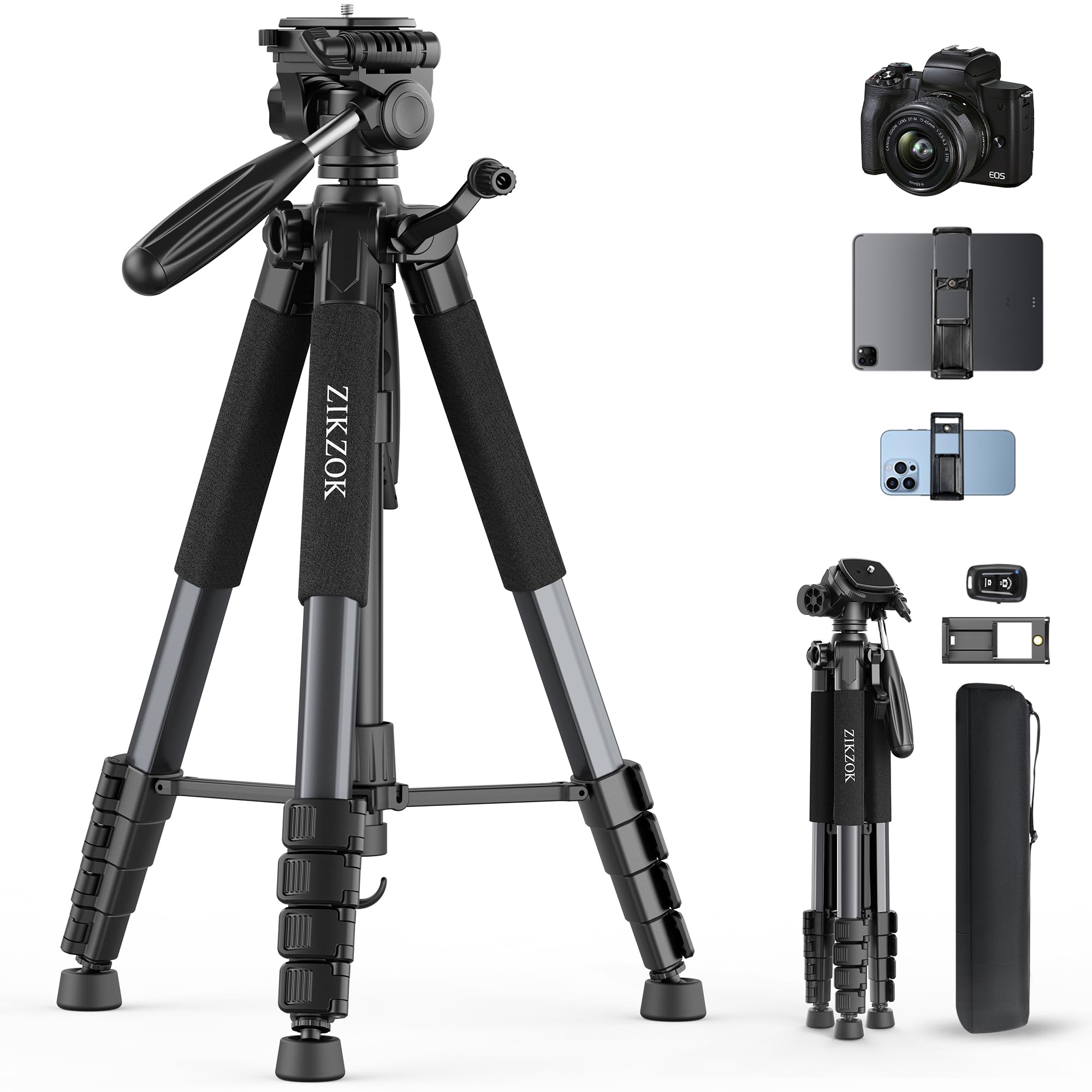
ZIKZOK 75-Inch Camera Tripod

92 /100
LBD Score Outstanding

Key details

Leg Diameter
1.2 inches
Folded Length
20.8 inches
Load Capacity
15 lb
Maximum Height
75 inches
View on Amazon

The accessory list is what you notice first: a phone and tablet clamp, a Bluetooth remote with about 10 feet of range, a cold-shoe mount for a light or a mic, and a carry bag. For a first tripod that is a sensible bundle, because the clamp is the part people forget to buy and then cannot shoot without.

The bones are better than the bundle suggests. The legs measure 1.2 inches across, thicker than several pricier tripods in this group, and the load rating is 15 pounds, so a mirrorless body and a zoom sit comfortably inside it. Three sections run from 19 to 75 inches, a genuinely useful range from tabletop work up to standing height.

What we did not expect at this end of the set is how settled it feels. Thin legs and a tall column are what make budget tripods wobble, and this one gives you more tube to stand on than the rest of the budget group. The two bubble levels help as well, since you can level the base and the head separately.

The one thing we want changed is the warranty. Three months is the shortest support window here, and tripods tend to fail at a clamp after a season rather than out of the box.

Pros

  • 15-pound rating on 1.2-inch legs
  • Remote, phone and tablet clamp, cold shoe included
  • 19 to 75 inches of usable height
  • Two bubble levels for base and head

Cons

  • Three-month warranty
  • 20.8 inches folded is not daypack-sized
Our verdict

Our pick for a first full-size tripod: thick legs, a 15-pound rating, and a remote in the box at the budget end of this set.

Check Latest Price
6

Heavy Lenses

SmallRig CT-10 Tripod and Monopod

88 /100
LBD Score Excellent

Key details

Weight
3.4 lb
Folded Length
43 cm
Load Capacity
33 lb
Maximum Height
71 inches
View on Amazon

One leg unscrews and the head screws onto it, which turns this into a monopod in about a minute. That is the detail that makes the CT-10 worth a look for anyone who hikes with a long lens: a walking-height support without carrying a second stick.

The numbers are unusual in the other direction too. It is rated to 33 pounds, the highest load capacity in this group, and it manages that at 3.4 pounds with a folded length of 43 cm and a maximum height of 71 inches. Nothing else here puts that much capacity on a frame that short.

The 36 mm metal ball head rotates a full 360 degrees, and the fittings take both 1/4-inch-20 and 3/8-inch-16 threads, so a cage, a monitor arm or a mic bar mounts without an adapter. That head is the part that justifies stepping up from the cheapest tripods here.

The joints are where to stay alert. Leg clamps that do not lock positively and a ball head that creeps under a heavy lens are the two things to check before every shoot, and a minute spent re-tightening both is cheaper than a dropped camera. For anyone mounting a heavy body and willing to check the clamps, that trade is worth making.

Pros

  • 33-pound load capacity
  • Folds to 43 cm and reaches 71 inches
  • 36 mm metal ball head
  • Converts to a monopod

Cons

  • 3.4 pounds, well above the travel picks
Our verdict

We point heavy-lens shooters here: a 33-pound rating on a 3.4-pound tripod that still folds to 43 cm.

Check Latest Price
7

Tall, Light Setups

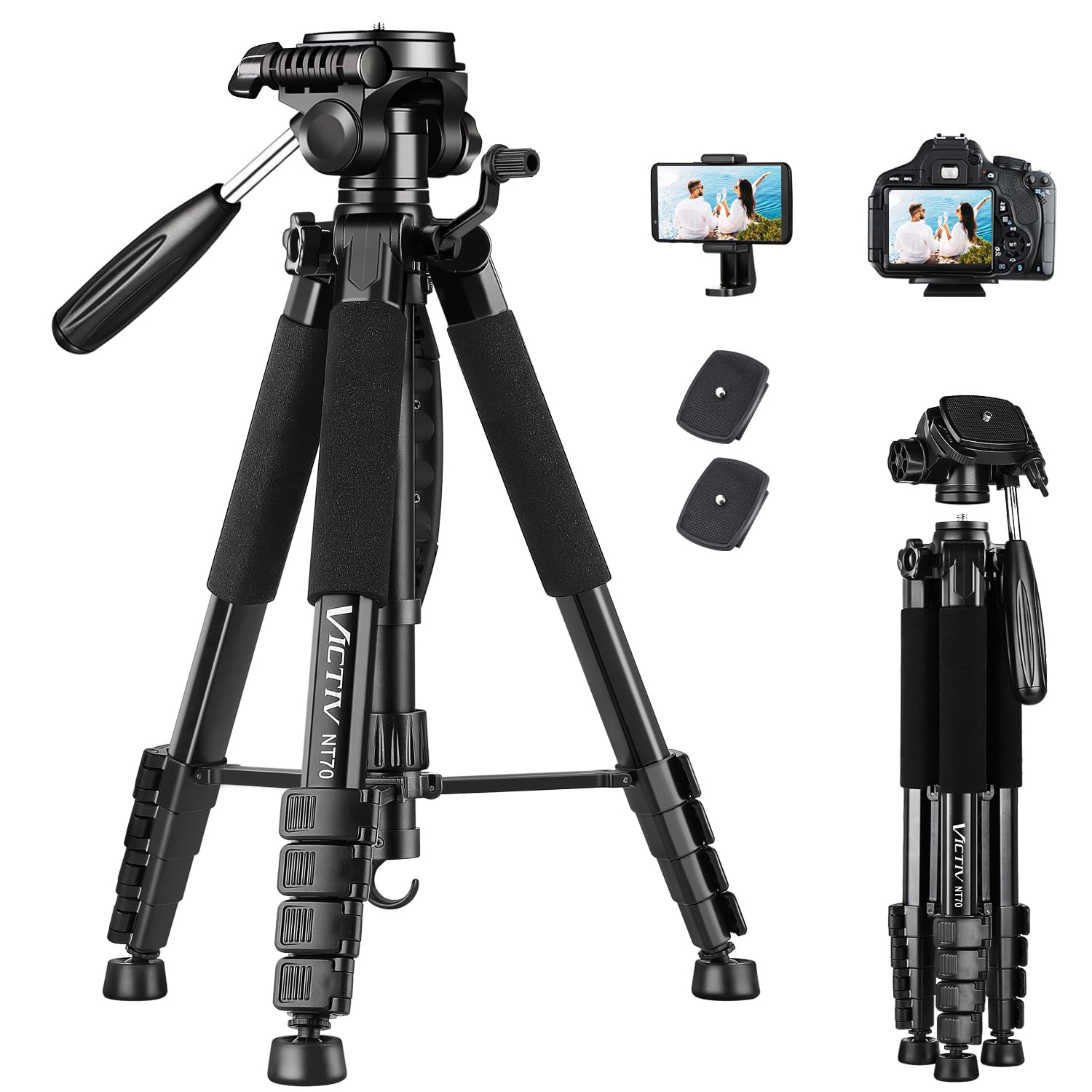
VICTIV 74-Inch Camera Tripod

93 /100
LBD Score Outstanding

Key details

Leg Diameter
1.2 inches
Folded Length
20 inches
Load Capacity
9.5 lb
Maximum Height
74 inches
View on Amazon

Leg diameter is what separates the tall budget tripods here, and at 1.2 inches the VICTIV has more tube under it than most. Four sections take it from 19.5 to 74 inches, it folds to 20 inches, and the load rating is 9.5 pounds — enough for a DSLR and a kit lens, not enough to feel casual about a 70-200.

The pan head is the part we ended up liking. It pans 360 degrees and tilts 180, with a handle long enough for small adjustments without grabbing the camera, and there is a second quick-release plate in the box — a small inclusion that means one can stay bolted to a spare body or a spotting scope.

At 3 pounds it goes to a location without a second thought, and the lockable leg angles and non-slip pads let it sit on a slope. A phone holder and the spare plate are the sort of extras that usually get left out at this end of the set.

The head is also where it is least settled: turn the camera to portrait and the assembly can drift, so tighten the head down and keep the weight over a leg rather than out on the end of the plate. Stay inside the 9.5-pound rating and this is the tall, light tripod we hand to anyone who wants height without the carry.

Pros

  • 1.2-inch legs across four sections
  • 19.5 to 74 inches of height
  • Second quick-release plate included
  • 3 pounds with a carry bag

Cons

  • 9.5-pound load rating
  • Head can drift in portrait orientation
Our verdict

A tall, light, well-equipped tripod we are happy to recommend to anyone staying inside its 9.5-pound rating.

Check Latest Price
8

Light Cameras

Amazon Basics 50-Inch Tripod

91 /100
LBD Score Outstanding

Key details

Weight
1.41 lb
Folded Length
16.9 inches
Load Capacity
4.4 lb
Maximum Height
50 inches
View on Amazon

Fifty inches is the number to start with. That is around chest height on an adult, which suits tabletop work, a phone or a compact camera on a hike, and rules out anything you want at eye level. Buy this one for its size, not for its reach.

At 640 grams it disappears into a daypack, and the three-section lever locks open and close without fuss, so it is up and level in the time it takes to get the camera out of the bag. The three-way head has a bubble level and a quick-release plate, which makes swapping between a couple of small cameras quick.

We keep coming back to it as the tripod to leave in the trunk or strap to a pack for the days you are not planning to shoot seriously — there when you need it, forgotten when you do not. The 4.4-pound rating tells you what it is for: a mirrorless body with a small lens, an action camera, a compact. Put a DSLR with a long zoom on it and the whole thing turns top-heavy fast, especially with the column raised.

Pros

  • 640 grams with a carry bag
  • Lever locks are quick to set
  • Bubble level and quick-release plate
  • Cheapest tripod in this set

Cons

  • Tops out at 50 inches
  • 4.4-pound load limit
Our verdict

We keep it as the tripod to leave in the trunk — light, cheap and honest about its 50-inch ceiling.

Check Latest Price

How We Tested and What We Looked For

We began with a shortlist of roughly 60 tripods and narrowed it by load capacity, folded length, head type, maximum height, and price, then bought 14 to test — a mix of compact travel models, tall aluminum stands, and heads that convert to a monopod or accept a phone. Everything was tested the way it gets used: a windy overlook with a long lens, a backyard set up for birds, a kitchen counter for product shots, and a lot of video calls with a phone clamped in the mount.

To judge ease of use, one person set each tripod up alone and from fully collapsed, and we timed it. We folded and bagged each one repeatedly to see how the legs and case held up, then weighed and measured the packed result against a standard daypack. Adjustability came down to raising and lowering the center column under load, swapping between landscape and portrait, and checking whether the head held its position after we let go — a slow droop is the giveaway.

Stability was the honest test. We set up on uneven ground and in gusts, tapped the legs mid-exposure to see what showed up in the frame, and hung a bag from the hook to feel how the whole thing settled. For durability and appearance, the tripods spent eight months in car trunks, on sand, and out in light rain; we looked for scuffed finishes, gritty leg locks, and hinges that loosened after a few dozen setup cycles, and noted which ones still looked and felt like money well spent.

How to Choose a Camera Tripod

Start With the Load Rating, Not the Maximum Height

A load rating is a ceiling measured with the head locked and the weight centred, which is not how a tripod gets used outdoors. Add up your heaviest body, the lens you use most, and anything clamped to the shoe, then look for a rating with room above that total. The 4.4-pound limit on the Amazon Basics is fine for a compact and wrong for a DSLR with a zoom, whatever the height figure promises.

Generous ratings are not just marketing. The 33 pounds the SmallRig takes and the 17.64 pounds on the XXZU are headroom you notice when the camera sits off-centre or the ground is not level, and headroom is what keeps a light tripod from feeling nervous.

Height Counts Only If You Can Get There Without the Center Column

Every maximum height in this article includes the center column raised, and a raised column is the least stable thing on any tripod. Look at the leg-only height, roughly the maximum minus the column's travel, because that is where the camera will sit most of the time. If you need eye-level framing and the tripod only reaches it with the column up, choose one with taller legs rather than a longer column.

The bottom end matters too. An inverting or detachable column is what gets a camera down to tabletop height for macro and product work, and it is the feature that separates the K&F Concept 64-inch and the 90-inch model from the rest of the group.

Choose the Head for What You Are Shooting

Three head types cover this set. A ball head frees the camera in every direction from a single knob, which is quick for stills and awkward for video because a ball does not pan evenly. A three-way pan head locks each axis separately and costs less, and it can follow a moving subject without being smooth about it. A fluid head with a bowl is the video answer: you level once at the bowl and the drag keeps a pan even.

We reach for a fluid head the moment anything needs to pan, and a ball head for everything else. The XXZU and the K&F Concept travel tripod both use 36 mm-class balls, which is the size to look for if you want a mirrorless body and a zoom to stay put when you let go.

Clamps and Joints Are Where Budget Tripods Fail

Legs rarely break; the plastic clamps that lock them do, and so does the joint where the head meets the legs. Lever locks are faster to set than twist locks and easier to see when they are not fully closed, which is why we favour them on tall tripods. Whatever you buy, open and close every clamp the day it arrives and check the head for play before the return window closes.

Weight, Folded Length and the Tripod You Will Actually Carry

Mass buys stability and costs you the walk to the location, so decide which one you are short of. Folded length is the harder limit: 14 to 16 inches disappears into a daypack, 20 to 21 inches lives in a trunk or strapped to a pack, and anything near a metre is a tripod you drive to the shot. If it does not fit the bag you carry most, it stays at home, whatever its rating.

Frequently Asked Questions

Final Verdict

Most people should buy the XXZU. It covers the most ground with the fewest compromises: 75 inches of height, a 14-inch folded length, a ball head for stills, and a monopod hiding in the center column. Fly with your gear and the K&F Concept's 15.5-inch fold and Arca-Swiss plate make it the better companion; shoot anything that pans and the NEEWER's fluid head and bowl are worth carrying the extra weight for.