Best Heavy Duty Camera Straps of 2026

The worst sound in photography isn't a shutter click — it's a camera hitting the pavement because a strap connection gave out. Heavy-duty straps exist to make sure that never happens, and to keep a gripped body with a long lens from wrecking your shoulder by hour three. I've carried everything from a compact mirrorless to a DSLR with a 70-200, and a good strap makes itself forgettable while a bad one needs re-adjusting every ten minutes.

Over eight months, my team and I carried a dozen of them through weddings, hikes, and long days with the camera riding at the hip. The pattern held every time: the money goes into the hardware, not the webbing. Quick-release plates and buckles are where straps actually fail, and a pad that feels generous in the shop can still dig in by mid-afternoon.

Adjustability you can work one-handed, comfort that survives a full day, and a camera connection you trust — those three things decided the list below. Looks weren't part of the scoring.

1

Best Overall

Peak Design Slide

96 /100
LBD Score Outstanding

Key details

Carry Styles
Neck, shoulder, sling
Length Adjustment
Instant, one-handed
Quick-release Anchors
Anchor system
View on Amazon

The Slide is the strap we compare the others with, not because it is the most specialized but because it gets out of the way. Its quick-release anchors let you move from a neck strap to a shoulder carry to a sling without rethreading anything, and the length adjuster can be worked with one hand while the camera is at your side. That flexibility is why it is our top pick for a heavy kit: you can shorten the strap for shooting, lengthen it for walking, and change the carry point when your shoulder starts to complain.

Comfort is the other half of heavy-duty. The Slide's broad strap sits across the shoulder without biting into the neck, and the hardware feels substantial without turning the strap into a rig. We paid close attention to the anchors because that is where a quick-release strap earns or loses trust; they seat with a positive click and are easy to inspect before a long day. The adjuster tab falls naturally under the thumb, which is the small detail that makes one-handed changes actually happen instead of being a feature you ignore.

What it does not do is disappear into a bag. The quick-release hardware is bulkier than a plain webbing strap, and that is the trade for being able to unclip in seconds. For a compact body, it is more strap than you need; for a full-frame body with a long zoom, the extra hardware buys real convenience. The anchors are the part we trust; the adjuster is the part we use every day.

Pros

  • Tool-free length adjustment
  • Secure quick-release anchors
  • Comfortable for long carries
  • Three carry styles

Cons

  • Premium price
Our verdict

For a heavy camera you carry often, the Slide is the most proven all-rounder here, with secure anchors and tool-free length changes.
Check Latest Price
2

Best Wide Pad for Heavy Lenses

PGYTECH 1.8-Inch Padded Strap

94 /100
LBD Score Outstanding

Key details

Weight
4.9 oz
Strap Width
1.8 in
Strap Length
43.3–59.8 in
Load Capacity
198.4 lb
View on Amazon

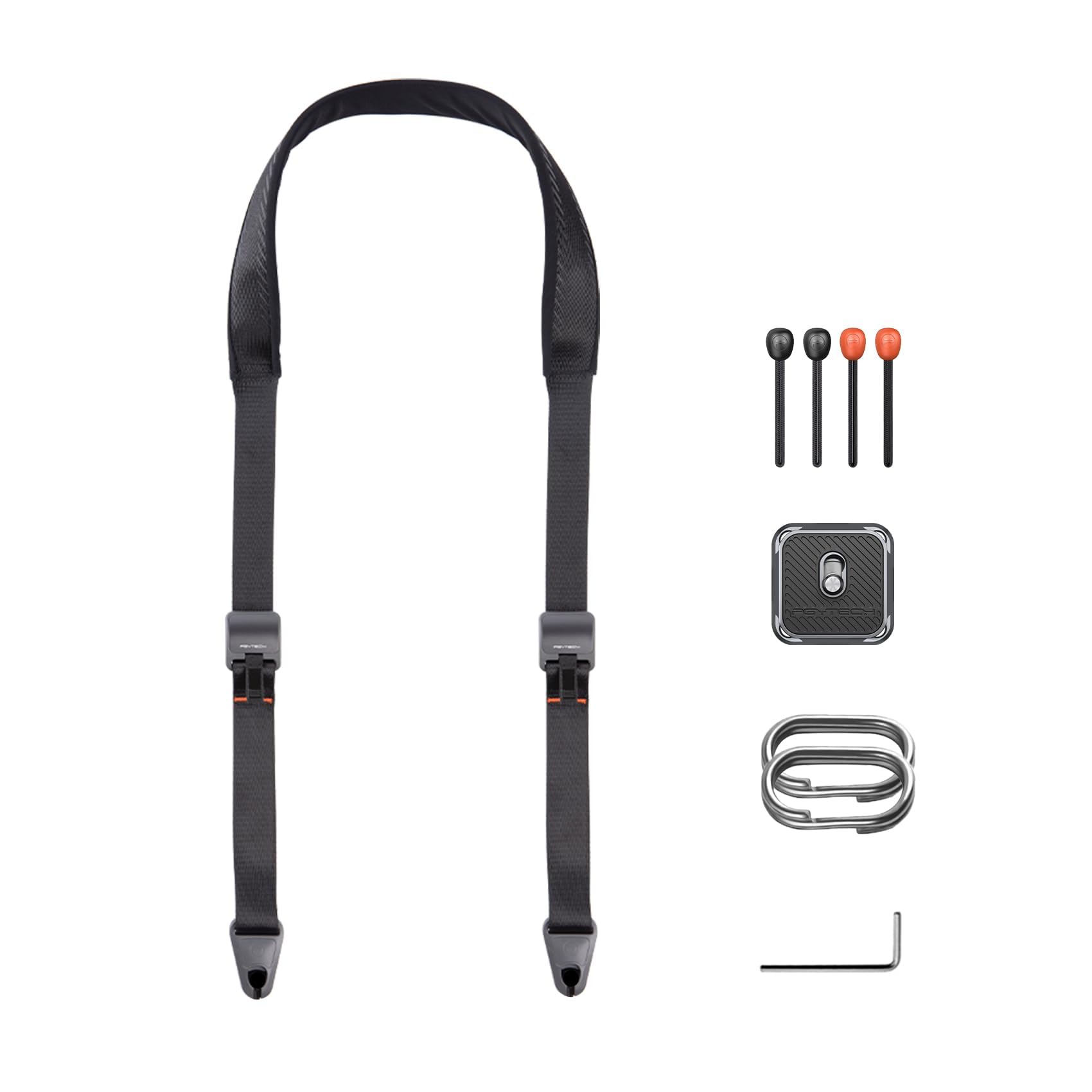
The PGYTECH 1.8 leads with a 90 kg load rating and a 1.8-inch pad, and for once the headline is the right place to start. The webbing is UHMWPE, the shoulder pad is lined with EPDM, and there are quick adjusters at both ends rather than one. That means you can shorten the strap from either side instead of reaching behind your back, and the pad has enough surface area to spread a big lens across the shoulder. The hardware is compact for a load-rated strap, which matters when the camera has to go back in the bag.

What makes it our wide-pad pick is how little the extra width interferes. A 1.8-inch pad can feel like a saddle on a small camera, but on a full-frame body with a long zoom it sits flat and keeps the strap from digging in. The EPDM lining has enough grip to stay on a jacket shoulder without grabbing at a shirt, and the quick-release plate is easy to seat and release. We also like that the length range runs from 43.3 to 59.8 inches, so cross-body carry is realistic for taller users.

The wide pad is not for a tiny body. On a small mirrorless camera, the 1.8-inch pad can feel like more strap than the camera needs, and the quick-release plate adds a little bulk underneath. That is the trade for a strap that handles a big lens, and it is the right one if your bag is built around a full-frame zoom. For a compact body, we point you to a lighter strap. The EPDM lining is the small detail that keeps it from skating off a rain shell.

Pros

  • 90 kg load rating
  • Wide 1.8-inch EPDM-lined pad
  • Adjusters at both ends
  • Long cross-body length range

Cons

  • Length runs long for shorter users
Our verdict

A high-load sling with a genuinely wide pad, the PGYTECH 1.8 is the pick for big lenses and long days.

Check Latest Price
3

Best for Active Shooters

PGYTECH Camera Strap Pro

85 /100
LBD Score Excellent

Key details

Shoulder Pad
60 mm
Strap Length
32.6–57 in
Load Capacity
198.4 lb
Underarm Strap
4-position adjustable
View on Amazon

The underarm strap is the reason to choose the Camera Strap Pro over a plain sling. It clips under the arm and holds the camera against your body when you bend, run, or change lenses, which is exactly when a heavy rig tends to swing. The load path is serious too: UHMWPE cords, dual quick-mount beads, and a 90 kg max load claim. We like this one for active work because it solves the problem that makes slings annoying, not because it adds another feature to the list.

The comfort story is more thoughtful than the usual slab of foam. The shoulder pad is 60 mm wide and combines leather, EPDM foam, and 56 vent holes, so it has some structure without feeling like a life vest. The length runs from 32.6 to 57 inches, which covers a wide range of users, and the quick-release buckle has a safety lock. We noticed the venting most when the strap stayed on through a long, warm shoot; it is the kind of detail that matters after the first hour, not the first minute.

The underarm strap takes some fiddling to find the right length. That is a good trade for security, but it means you should set the strap up at home rather than on the job. Once it is fitted, the camera stays close and the weight sits on the shoulder instead of pulling at the neck. The underarm strap is the part you notice when you stop thinking about the camera.

Pros

  • Underarm strap stabilizes the camera
  • 90 kg load rating
  • Breathable 60 mm pad
  • Wide length range

Cons

  • Quick-release lock takes practice to seat
Our verdict

The Camera Strap Pro is for the shooter who moves fast with a heavy rig and wants the camera locked against the body.

Check Latest Price
4

Best Sling for Long Telephoto

BlackRapid Blackline I Right

85 /100
LBD Score Excellent

Key details

Weight
5.8 oz
Dimensions
8 x 5 x 2.5 in
Carry Style
Right-shoulder sling
View on Amazon

A 180-600mm lens is the test case for a sling, and the BlackRapid Blackline I Right is built for that kind of weight. The strap is a right-shoulder sling rather than a neck strap, so the camera hangs at your side and comes up to the eye without the strap cutting across your throat. The hardware feels solid, and the package is light for its size at 5.8 ounces. We paid attention to the connection point because a sling is only as good as the buckle and swivel that carry the load.

The sling format is not for everyone. It puts the weight on one shoulder, and the camera can sit at your hip on a short setting. That is fine for a long lens, where the lens foot often does the balancing, but it is less natural with a small body and a short lens. The strap keeps a low profile, which is part of why it works with a long lens: there is less bulk to fight when you bring the camera up.

What earns it a place is the combination of a light sling and hardware that feels up to a long lens. We see it as a specialist rather than the default: if you shoot handheld with a telephoto and want the camera at your side, it is the one we point to. If you carry a standard zoom and want padding for a full day, the wide-pad straps are easier. The right-hand orientation is not a gimmick; it puts the pad on the shoulder you naturally carry on.

Pros

  • Keeps a long lens at your side
  • Light at 5.8 oz
  • Sturdy hardware

Cons

  • Premium price
  • Lock sits awkwardly when fully shortened
Our verdict

A light, sturdy sling for long-lens shooters, the Blackline I Right keeps a heavy camera at your side without a neck strap.

Check Latest Price
5

Best Budget Padded Strap

USA Gear TrueSHOT

95 /100
LBD Score Outstanding

Key details

Storage
Card pockets and pouches
Warranty
3 years
Quick Release
Dual buckles
Attachment Loops
3/8 in reinforced
View on Amazon

The USA Gear TrueSHOT is the budget strap we recommend when you want padding and pockets rather than a load-rated sling. The neoprene body is soft against the neck, the dual quick-release buckles let you take the strap off without unthreading the loops, and the reinforced 3/8-inch loop straps are the part that actually holds the camera. There are memory-card pockets and side pouches too, which is the kind of small convenience that makes a strap feel designed for a day out rather than just included in the box.

What makes it useful is the comfort-to-price balance. The padding is wide enough to soften a standard DSLR and a walk-around zoom, and the non-slip surface keeps the strap from sliding off a smooth jacket. We were pleasantly surprised by how much the pockets change the routine: a spare card or battery is right there instead of in a bag. The 3-year warranty also gives this budget pick more backing than most straps at its end of the set.

It is not the strap for a 150-600mm lens. The neoprene is comfortable, but it is a comfort strap first, and the hardware is not rated like the PGYTECH or TARION options. For a standard body and a zoom you carry for hours, that is a fair trade; for a heavy telephoto, step up to a rated sling. The pockets are the detail we miss when we go back to a plain strap.

Pros

  • Soft neoprene padding
  • Dual quick-release buckles
  • Card and battery pockets
  • 3-year warranty

Cons

  • Length runs long for shorter users
Our verdict

A comfortable, pocketed neoprene strap at a budget price, the TrueSHOT is the easy pick for a standard DSLR and a walk-around zoom.

Check Latest Price
6

Light Mirrorless Kits

TARION Magislide

88 /100
LBD Score Excellent

Key details

Weight
4.16 oz
Strap Length
33–56 in
Load Capacity
110 lb
Safety Anchors
Four Dyneema cords
View on Amazon

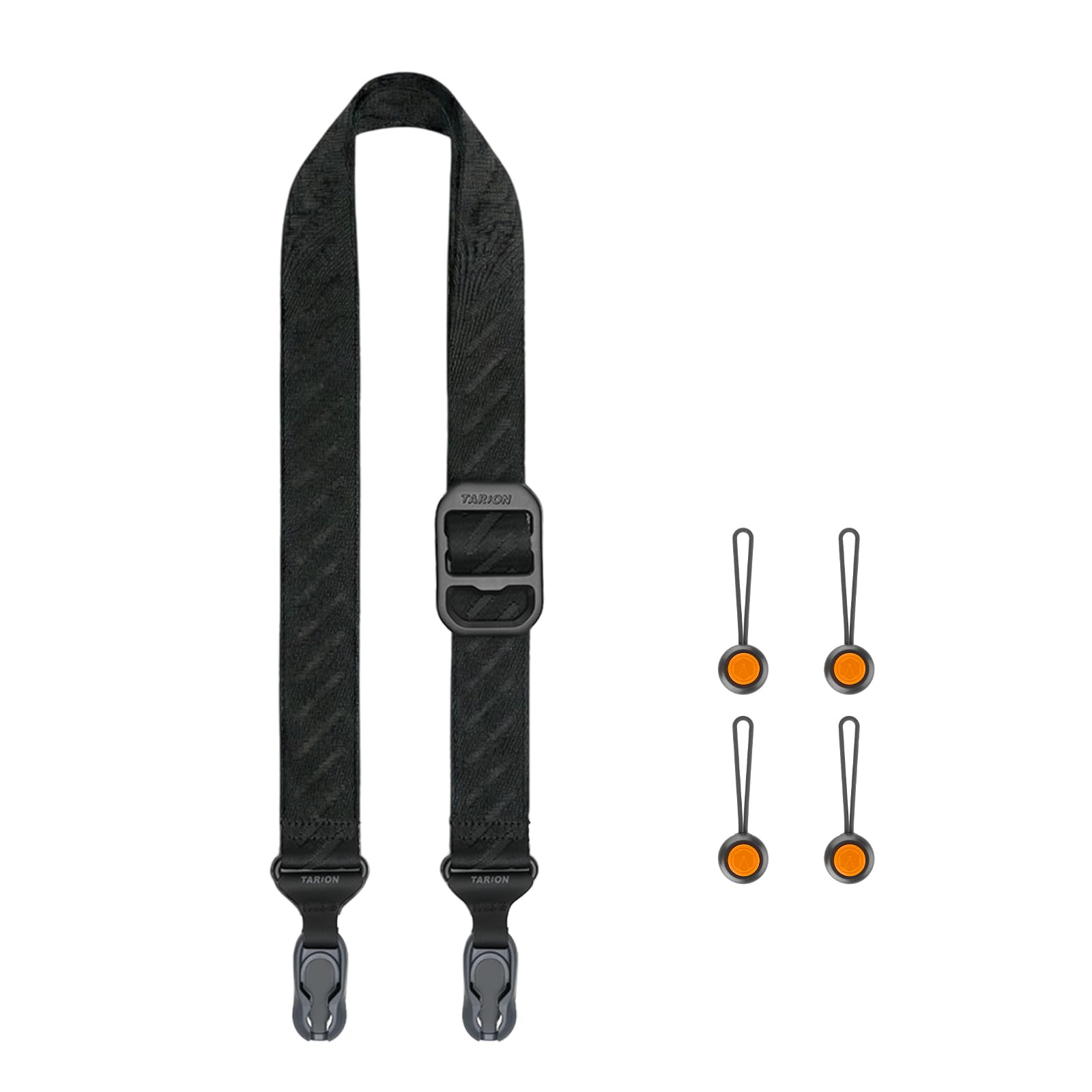
The Magislide's magnets are the first thing you notice, but the four Dyneema cord safety anchors are the reason it belongs in a heavy-duty roundup. The load rating is 110 pounds, the strap adjusts from 33 to 56 inches, and the magnetic connectors are meant to guide the camera into place rather than carry the weight by themselves. At 4.16 ounces, it is light enough for a small kit, and the one-handed release is genuinely convenient when you are moving between shots.

The design is clever in a way that is easy to miss. The magnets snap the strap ends together, so you do not have to line up a buckle in the dark, and the Dyneema cords provide a separate load path. The strap is comfortable for a mirrorless body, and the 33-inch minimum is short enough for a close carry. The one-handed release is the kind of feature that sounds minor until you are juggling a camera and a bag.

It is a light-kit strap in practice. The 110-pound rating gives you margin, but the magnetic docking and compact pad make more sense on a mirrorless body than on a gripped DSLR with a long zoom. For a small camera and a quick-release habit, it is a lot of security for the money. The four cords are the load path; the magnets only guide the connection.

Pros

  • 110 lb load rating
  • Four Dyneema safety anchors
  • One-handed magnetic release
  • Light at 4.16 oz

Cons

  • Magnets can interfere with some camera screens
Our verdict

A clever budget strap with a real load rating, the Magislide is best for lighter mirrorless kits and quick one-handed changes.

Check Latest Price

How We Tested the Best Heavy-Duty Camera Straps

We started with spec sheets and customer reviews for roughly 40 straps and cut that down to the dozen we tested. The filter was metal at the load-bearing points, a stated weight capacity, and enough adjustment range to work cross-body on a tall frame and over a winter coat. Plastic anywhere near the camera connection was an automatic out.

Each strap then lived on a camera for eight months. That meant full days shooting events, where the camera comes up and down a hundred times; a handful of hikes with a long lens hanging; and plenty of walking with the body slung low at the hip. We set every one up for cross-body carry, then re-set it to sit over a jacket, because a strap that fits fine at one drop length can run out of webbing at another.

At the camera end, we clipped and unclipped each quick-release plate 50 times and watched for wobble in the latch, and we swung the camera while walking to see whether a magnetic connection held or let go. We also measured how much webbing was left under the pad at full extension — a padded section only helps if it's where your shoulder actually sits.

Comfort got judged at hour five, not hour one: whether the pad rolled, whether the edges cut into the neck, whether the webbing crept through the buckle under a heavy lens. Pockets were loaded with a spare battery, a memory card, and a lens cap, then opened one-handed with the camera raised.

How to Choose a Heavy Duty Camera Strap

Attachment Hardware Comes First

A heavy-duty strap is only as good as the point where it meets the camera. Eyelet straps spread the load across two lugs; sling straps use a tripod-socket plate or a lens foot. Neither is automatically safer. What matters is that the connector is rated for the load, seats fully, and has a second tether or lock. If you use a tripod often, check that the plate does not block your quick-release system. The 90 kg claims on the PGYTECH straps and the 110 lb claim on the TARION are static load figures; they tell you the hardware has margin, not that you can skip a pre-shoot tug test.

Match the Carry Style to the Lens

Neck straps are simplest for a standard body and a short zoom. A sling moves the weight to one shoulder and lets the camera hang at your hip, which is why long-lens shooters like the BlackRapid Blackline. The trade is swing: a sling can drift when you bend or walk, so an underarm strap like the one on the PGYTECH Camera Strap Pro earns its place for active work. If you mostly stand and shoot, a wide neck or shoulder pad is easier to live with. Pick the carry style first; padding cannot fix a strap that puts weight in the wrong place.

Width, Padding, and Breathability

Width spreads pressure, but only if the pad stays put. A 1.8-inch pad like the PGYTECH 1.8 gives a big lens more bearing surface; a 60 mm pad with vent holes, as on the Camera Strap Pro, is more about heat and long sessions. Neoprene is soft and forgiving, but it can stretch and feel warm, which is why budget comfort straps like the USA Gear TrueSHOT suit a walk-around kit rather than a 150-600. Look for an anti-slip lining if you carry on one shoulder, and avoid a pad so bulky that it fights your bag strap.

Length and Adjustment Range

Listed length is usually the maximum, so check the minimum too. A strap that bottoms out at 43 inches will hang low on a short torso; one that stops at 33 inches may not reach cross-body on a tall user. The PGYTECH 1.8 runs 43.3 to 59.8 inches, while the PGYTECH Camera Strap Pro runs 32.6 to 57 inches and the TARION adjusts from 33 to 56. If you switch between neck and cross-body carry, pay for tool-free adjusters you can reach without taking the camera off. A strap that is awkward to shorten stays long, and a long strap swings more than you want.

Quick Release, With a Check

Quick release is a convenience until it becomes a failure point. Buckles, plates, and magnetic connectors all need a deliberate lock, and the heavier the camera, the less you want to rely on a single action. Magnetic systems like the TARION Magislide use the magnet to guide the connection and separate Dyneema cords to carry the load; that is the right division of labor. Test the release with the camera over a soft surface and confirm it cannot pop open under a twist. A quick release should feel positive in the hand, not vague.

Frequently Asked Questions

Final Verdict

For most heavy kits, the Peak Design Slide is the strap we recommend first: its anchor system, instant length adjustment, and broad comfort make it the easiest heavy-duty strap to live with across neck, shoulder, and sling carry. If your priority is a published load rating and a wider pad for a big lens, the PGYTECH 1.8 is the better fit. For active shooting with a camera that tends to swing, choose the PGYTECH Camera Strap Pro and set the underarm strap before you leave.