Best Camera Sliders of 2026

A camera slider has one job, and it's harder than it looks: move a camera in a straight line without anyone noticing the machine. The moment a move stutters, or the rail flexes under a lens that's heavier than you planned, the shot stops reading as a slow cinematic push and starts reading as a wobble. That's the tradeoff the listings never mention — the sliders that travel smoothest tend to be the heaviest, and the ones you'll actually carry to a shoot are usually the ones you have to baby.

I've hauled a three-foot rail up a fire escape for a rooftop interview, and I've also watched a bargain dolly shiver its way through a 20-second time-lapse. Over the past six months my team and I have run 12 sliders — motorized and manual, carbon fiber and aluminum — through the work these actually get hired for: product turntables on a kitchen island, talking-head push-ins in a living room, and unattended time-lapses that had to keep moving for an hour without drifting.

Two things you only learn by living with these: carbon fiber earns its price mostly through stiffness, not weight savings, and a payload rating is almost always quoted for a flat-mounted camera — hang the rig off the side for a vertical move and everything about it behaves differently. The picks below are the ones that held their line, take after take.

1

Best Overall

GVM 48-In Motorized Slider

84 /100
LBD Score Excellent

Key details

Motion
Motorized, battery included
Max Payload
11 lb
Rail Length
48 in / 120 cm
Product Weight
11.8 lb
View on Amazon

Forty-eight inches of rail is the whole argument. It gives a camera room to travel across a frame in one continuous move, so a shot does not have to be stitched together from three shorter slides — and that single take is what separates a slider shot from a pan on a tripod head. With a 5 kg payload rating, a battery in the box, and side knobs that swing to a 120-degree panorama, this is the motorized rail we reach for first.

Programming the move takes a couple of passes. The controller sets start and end points, speed, interval, and stop time, but it will not tell you where you are inside a loop, so the first run is guesswork. Our habit is to let the loop play through once before the real take; after that the timing repeats closely enough to match a second shot in the edit. Those side knobs earn their keep too — set them opposite each other for an arcing track, or leave them centered for a straight push.

It also arrives as a kit rather than a rail plus a shopping list: battery, charger, controller, six shutter-release cables, and a bag that swallows the lot. The motor is quiet enough to stand beside while it runs, and we still record room tone separately when the shot matters. What we did not expect to appreciate was the shutter-cable spread across brands — it means the rail moves between our cameras without a trip to the shop.

Pros

  • 48 in of rail for long single takes
  • Battery, charger, controller, and cables included
  • Side knobs swing to a 120-degree panorama

Cons

  • 11.8 lb rail is a two-hand carry
Our verdict

Buy this one if you want long, repeatable motorized moves and can leave the rail near the car; it is the most complete motorized kit here.

Check Latest Price
2

Best for Gimbal Rigs

IFOOTAGE Shark Nano II 660

85 /100
LBD Score Excellent

Key details

Noise
Under 20 dB
Max Payload
15.4 lb
Sliding Range
17 in
Product Weight
6.8 lb
View on Amazon

Clip a DJI RS gimbal onto the Nano II 660 and the rail stops being a straight-line tool: the carriage tracks while the head swings through an unlimited 360 degrees, and eight waypoints can be banked into a single move. The adapter for RS-series gimbals is in the box, along with a phone adapter and six shutter cables.

That pairing is why it holds a place for anyone already shooting on a gimbal. The 15.4 lb payload carries a mirrorless body, a long lens, and the gimbal itself, and one USB-C PD 60W cable feeds the slider, the gimbal, and the camera at the same time — one cable instead of the usual nest. It is the priciest slider in this group and the most capable, and we do not pretend those two facts are unrelated.

The rest is pro-kit housekeeping: an IPS touchscreen or the phone app for setup, a brushless motor rated under 20 dB, a carrying bag, and a 26-inch body that travels in a tripod bag. Worth knowing before a shoot: on a tripod, the ends of that rail want support once a gimbal is hanging off the carriage, and a sandbag under each end is quicker than discovering the sag in the edit.

Pros

  • Unlimited 360-degree pan for multi-axis moves
  • 15.4 lb payload handles gimbal rigs
  • One PD 60W cable powers the whole stack
  • Eight storable waypoints

Cons

  • Only 17 in of sliding range
  • DJI Pocket 3 needs a separately sold adapter
Our verdict

Choose this if your camera already rides a DJI gimbal and you want pan and slide in one take; nothing else here carries a rig that heavy.

Check Latest Price
3

Best Budget Manual

Zecti 24-In Carbon Slider

84 /100
LBD Score Excellent

Key details

Mounting
1/4 in and 3/8 in threads
Max Payload
4.4 lb
Rail Length
24 in / 60 cm
Product Weight
1.4 lb
View on Amazon

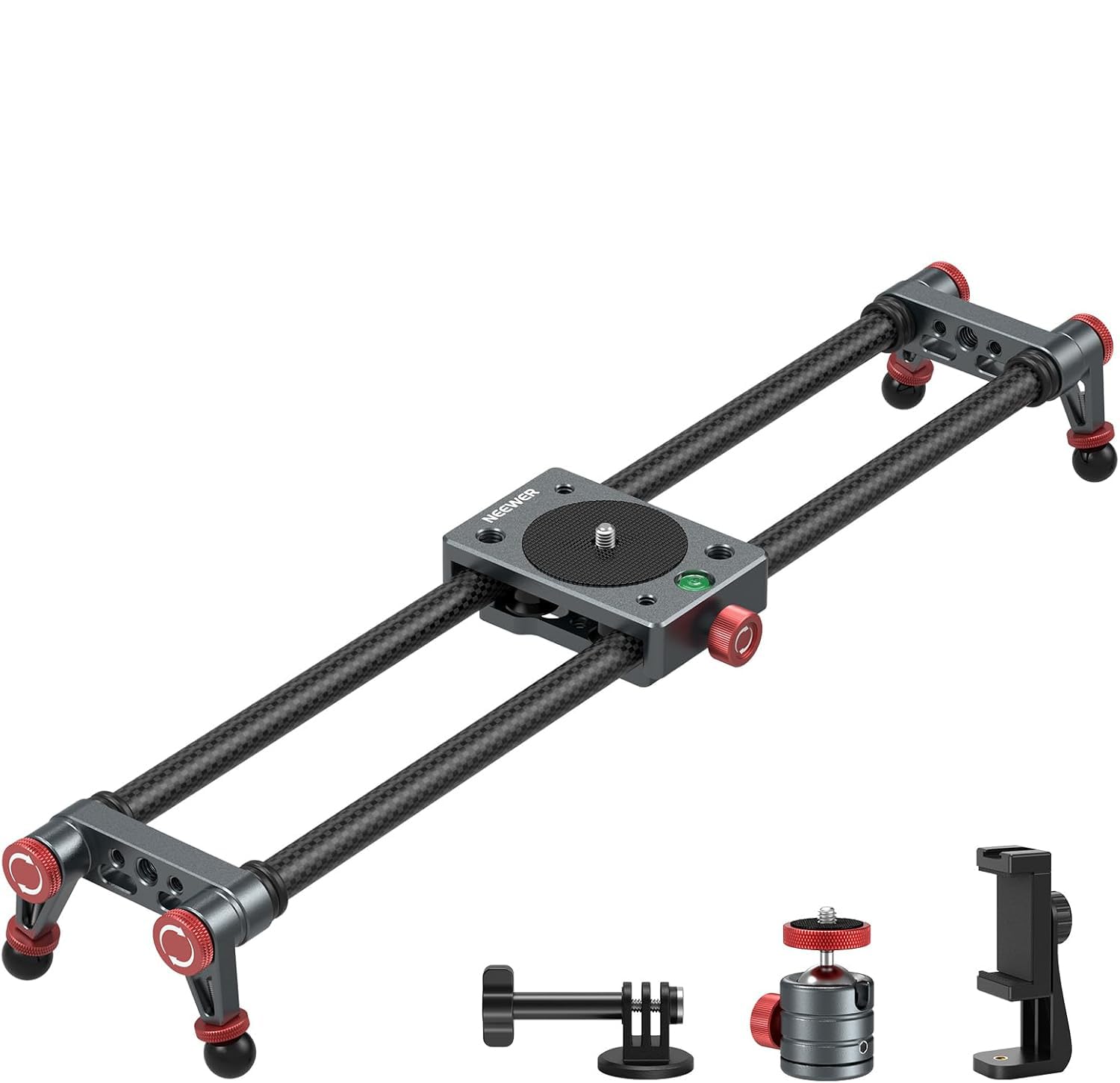
Smoothness on this rail is something you set rather than something you hope for. Under the carriage, screws hold the bearings against the rail; tightened down they make the slide drag and grumble, and backing them off a fraction frees it. A small L-shaped wrench for exactly that ships in the bag, which tells you the adjustment is expected rather than a fault.

Everything else about it is travel-first. The carbon rail runs 24 inches and weighs about 1.4 pounds, light enough to live in a backpack next to a laptop, and the included bag has room for the rail and a small ball head. Threads at the center and both ends — 1/4 inch and 3/8 inch — mean it sits on a tripod, on a light stand, or runs vertically for a top-down slide.

Where it earns its place is the shoot where the alternative is no slider at all: it is the least expensive route here to a real bearing-carriage slide, and the small footprint makes it the one that actually comes along. Run the carriage the full length by hand before the first take — a carbon rail that has been in a bag can sit slightly bowed, and the drag shows up in the middle of the move where it is hardest to hide.

Pros

  • About 1.4 lb with a carry bag
  • Carriage tension adjustable with included wrench
  • 1/4 in and 3/8 in threads at center and ends

Cons

  • 4.4 lb payload ceiling excludes caged rigs
  • No quick-release plate on the carriage
Our verdict

Buy this if the slider has to go in a backpack and the budget is tight; it slides cleanly once you set the carriage tension.

Check Latest Price
4

Best Compact Motorized

NEEWER DL100 Dolly

89 /100
LBD Score Excellent

Key details

Max Payload
6.6 lb
Battery Life
Up to 6 hrs
Product Weight
1.1 lb
Speed Settings
3 speeds
View on Amazon

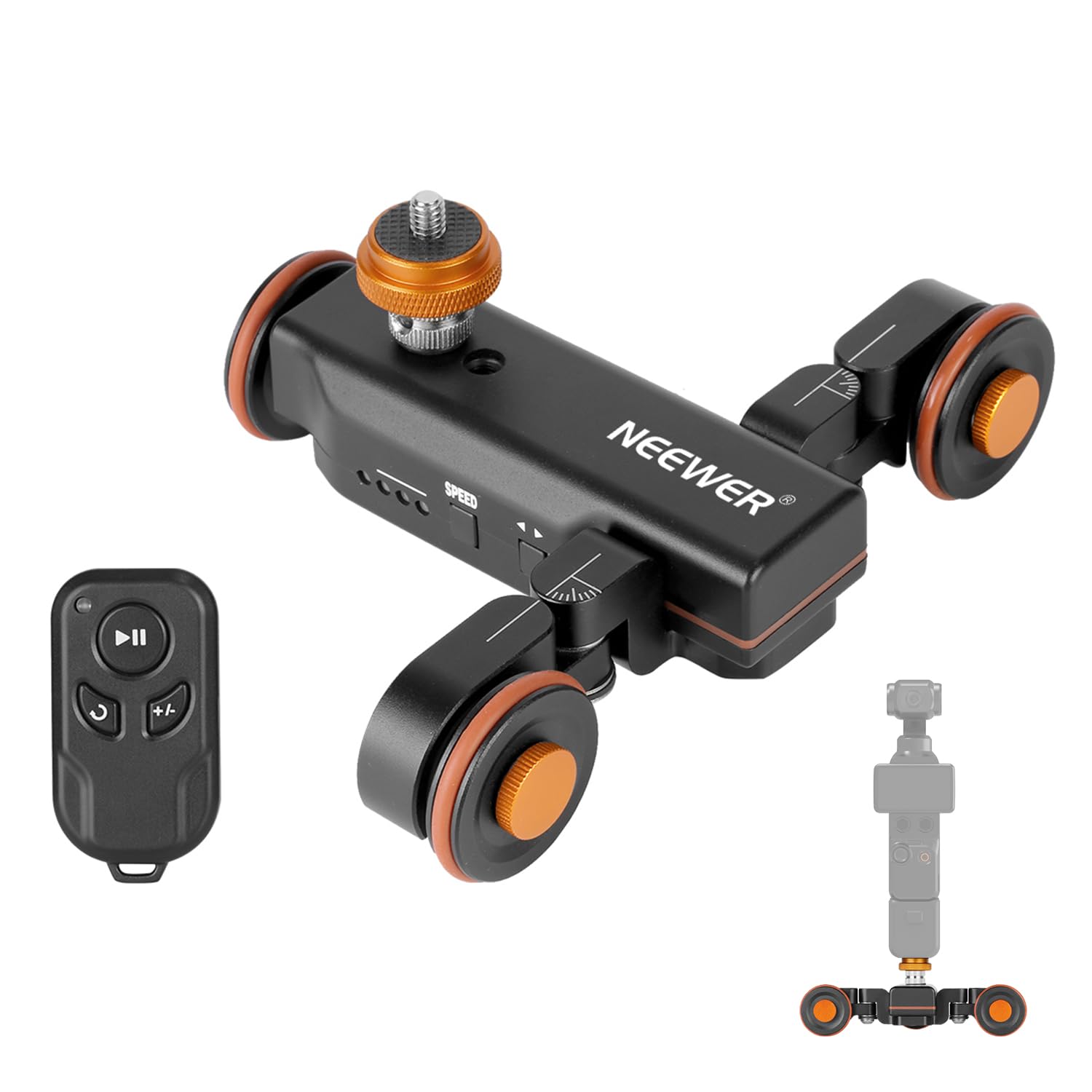
No rail, and that is the point. Give the DL100 a smooth, clean, flat surface — a countertop, a hardwood floor, a sheet of acrylic — and it tracks a straight line or a swinging arc across it, with the wheel angles set by hand and held by friction. Point it at a product on a table and it does the job a four-foot rail would need two tripods to do.

We keep it in the bag for exactly that: a slow arc around a product or a person that otherwise costs a rail and a second stand. The wireless remote runs three speeds and both directions from across the room, the 1,800 mAh battery is good for hours, and the 1/4-to-3/8 convertible screw takes a phone clamp as readily as a camera. At 1.1 pounds it is the least fuss of anything in this group.

Its limits are physical, and worth respecting. Setting an arc is trial and error — nudge the wheels, run it, nudge again — and a gritty floor or a warped tabletop shows up in the footage as surely as a bad rail would. The motor is audible too, so plan on separate audio if anyone is speaking on camera. None of that reaches a shooter cutting b-roll to music.

Pros

  • Arcs and circles without a rail
  • Wireless remote with three speeds
  • Up to 6 hrs from a built-in battery

Cons

  • Only three speeds, with no app or waypoints
Our verdict

Buy this if your shots happen on a smooth table or floor and you want motorized arcs for the price of an accessory.

Check Latest Price
5

Desktop and Phone

NEEWER CS1M Slider

80 /100
LBD Score Excellent

Key details

Mounts
Ball head, phone clamp, action cam
Max Payload
4.4 lb horizontal
Rail Length
16 in / 40 cm
Product Weight
21.7 oz (615 g)
View on Amazon

Two legs fold out of this 16-inch rail and it stands on a desk by itself — no tripod, no clamp, no overhang. That is the whole reason we keep it around: for product shots, phone video, and food photography, where a full tripod is more rig than the job needs, the CS1M is standing and framed before the other options are out of their bags. The ball head gives a full 360 degrees of rotation and 90 degrees of tilt, so framing is a wrist movement rather than a repositioning exercise.

The rail is carbon fiber and aluminum on four bearings, and at 615 g with the bag it disappears into a camera bag. You also get a phone clamp that takes devices from 2.2 to 3.4 inches, an action-camera mount, and a cold shoe on the phone holder for a small light or microphone — the accessory list is longer than the rail.

Sixteen inches is a short stage, so think of it as a tabletop tool: a product reveal across a desk, a slow push past a phone screen, a vertical slide for a top-down shot. Watch the payload when you mount it upright, because the rating is written for horizontal use and drops once the rail stands on end — a body with a heavy lens is worth checking before you trust it above a hard surface.

Pros

  • Folding legs let it stand on a desk
  • Ball head, phone clamp, and action-cam mount included
  • 615 g with a carry bag

Cons

  • Short 16 in rail limits moves to short pushes
  • Vertical payload drops to 2.2 lb
Our verdict

Buy this for tabletop and phone work where a tripod is overkill; it stands on its own legs and sets up in seconds.

Check Latest Price
6

Smaller Motorized Rigs

GVM 27-In Motorized Slider

81 /100
LBD Score Excellent

Key details

Modes
Round trip, video, time lapse
Max Payload
5.51 lb
Rail Length
27 in
Product Weight
5.2 lb
View on Amazon

Twenty-seven inches and 2.36 kg: this is the GVM you carry rather than load into a car. Same wired-controller approach as its bigger sibling, an aluminum rail instead of carbon, and a 2.5 kg payload ceiling that suits a mirrorless body with a prime rather than a built-up rig.

What it does well is small-room work. It spans a desk or a kitchen counter, the adjustable non-slip feet and bubble level let you square it up on a floor that is not level, and the threads on the ends and the middle take a tripod head or a light stand without adapters. Round trip, straight video moves, time-lapse, and vertical or angled mounting cover the shots you would actually ask a rail this size to make.

We point people here when the job is an interview cut-in or a slow push past a product and the budget has gone on glass: it delivers a repeatable motorized move at less than half the weight of the 48-inch rail, and the wired controller keeps takes consistent. The controller is a plain unit with no app behind it, so waypoints and phone control belong with the picks above. One detail worth having: a power bank adapter ships in the box, so a flat battery mid-shoot is one cable away from solved.

Pros

  • 2.36 kg body for one-person shoots
  • Adjustable feet and bubble level
  • Round-trip, video, and time-lapse modes

Cons

  • 2.5 kg payload ceiling rules out built-up rigs
Our verdict

Buy this if you want motorized moves in a small room and carry your own gear; it is the lighter half of the GVM motorized pair.

Check Latest Price

How We Tested Camera Sliders (and What Made Us Rule a Few Out)

We started by gathering every slider a working shooter might realistically buy — motorized and manual, rails from 16 inches up to four feet, carbon fiber and aluminum — then narrowed the list by what the specs promised: payload, whether the carriage rides on bearings or a belt, whether the legs adjust independently, and whether the motor can be driven by a remote, an app, or a dial on the body. That left 12 units, which we used for six months.

Testing happened where sliders actually get used. On a kitchen island we shot product turntables with a full-frame body and with a phone in a clamp; in a living room we ran slow push-ins on a talking head and played the footage back frame by frame to catch any hitch or micro-jitter; in a backyard we left time-lapses running for a full hour to see whether the motor drifted or the battery quit mid-move. We also packed each slider into a backpack and carried it to a shoot, timing how long one person needed to level the track and roll on a take.

What separated them was rarely the spec sheet. We loaded each carriage past its comfort zone to watch for rail flex, hung a camera off the side for vertical moves, and listened for motor whine on the recorded audio track. We rocked the carriage with a thumb to feel for play in the bearings, checked how securely the legs locked on uneven ground, and paired every remote and app to see how fine the speed control really went. Build quality showed up in the machining and in whether the same move repeated identically on the tenth take; value came down to whether the extras were things we'd actually use on a shoot.

A few light rails needed sandbags to stop a tall lens from tipping, and two motors were audible enough that we'd only trust them with music over the clip. The ones that made the list were the ones we stopped thinking about.

How to Choose a Camera Slider

Motorized or Manual?

A manual slider is a carriage on bearings: you push, and your hand sets the pace. That makes it light, silent, and inexpensive, which is why the 24-inch Zecti earns a place in a travel bag. A motorized rail adds a motor and a controller, and what that buys is repeatability — the same move twice for matching shots, hands-free time-lapse, and speeds slower than a wrist can hold steady. We reach for motorized whenever two shots have to cut together.

Length, Travel, and the Move You Can Finish

Listings quote overall length; what you actually shoot with is travel, which is the rail minus the carriage and its clearance. The IFOOTAGE Nano II 660 measures 26 inches and slides 17. Buy the longest rail you can realistically transport, because a move that finishes in one take is the shot you cannot rescue in the edit. Short rails are not worse, they are for different shots: product turntables, phone video, tight desk work.

Payload and the Vertical Trap

Every rating here assumes horizontal mounting. Stand a rail on end or hang a camera off an angle and the load on the carriage changes: the NEEWER CS1M is rated for 4.4 lb flat and 2.2 lb vertically. Add up the body, lens, cage, and monitor, then leave yourself a margin. A slider running close to its limit flexes at the ends, and that flex shows up in the slowest, most visible part of the move.

Smoothness Is a Setup Problem Too

Two things ruin a slide, and neither of them is the motor. The first is a dirty rail: a single grain of grit reads as a hitch on camera, so wipe the rail before every take. The second is support. A long rail on one tripod head dips as the carriage travels out, which is why the ends of a 26-inch rail want support once a gimbal is hanging off it. Dollies have the same problem in a different form — the DL100 is only as smooth as the floor beneath it.

Sound, Control, and Who Is Holding the Camera

Motor whine gets into the microphone, so if anyone speaks on camera, plan on recording sound separately. Control is the other decision. A wireless remote lets one person run the move from across the room, which is the DL100's trick; an app adds waypoints and speed ramps; a wired controller with a screen is the quickest thing to set up when you are starting from scratch on a cold morning.

Frequently Asked Questions

Final Verdict

The GVM 48-inch motorized slider is our pick because it answers the two questions behind most slider shots: is the move long enough to hold, and can I repeat it exactly? A 120 cm carbon rail, a battery, a controller, and 120-degree panorama knobs do both for midrange money.

If the rail has to ride in a backpack, the 1.4 lb Zecti does more for you than any motor. And if your camera already lives on a DJI gimbal, the IFOOTAGE is the one here built around that rig, with the payload to prove it.