Best Cell Phone Signal Boosters for Car of 2026

There's a two-lane stretch of highway on the way to my in-laws where the map goes gray and every call drops — which is where a signal booster earns its keep. It can't build a tower, but the right one latches onto a faint LTE or 5G signal a few miles out and hands it to every phone in the car.

We've spent six months with 11 of them in daily drivers, a work truck, and an RV, and the gap between first and last came down to a few things: how much signal each one added, how far the outside antenna could reach a tower, how long installation took solo, and whether the price bought real gain or just more cable.

Two things worth knowing: FCC approval isn't paperwork — an unapproved booster can interfere with carrier towers and get shut down — and low-band 700MHz signal carries farthest, so that's what most car boosters chase. The hardware also sits outside in sun and rain, which is a test all by itself; the ones that passed are below.

1

Best Overall

GAGBK Car Cell Phone Booster

85 /100
LBD Score Excellent

Key details

Max Gain
65 dB, with AGC
Warranty
3 years
Frequency Bands
Band 12, 13, 17
Outdoor Antenna
Magnetic whip, 16 ft cable
View on Amazon

Sixty-five decibels is the highest gain figure any booster here states, and on this one it comes with automatic gain control that reads the incoming signal and pulls the amplification back when it isn't needed. That pairing is what we want in a moving vehicle. Tower strength under your roof changes every few minutes on a highway, and a booster that adjusts quietly beats one that keeps shouting into a signal that's already strong. It's the main reason this is the pick we put first.

The rest of the kit is put together for a car rather than a workbench. The outdoor whip carries 16 feet of cable and the indoor patch antenna 10, more slack than anything else here, and slack is the whole game: a booster only performs when its two antennas sit far enough apart that they don't feed back into each other. Run the whip onto the roof, drop the cable through a door seal, and put the patch antenna at the far end of the cabin. The power lead is three feet, so plan on the amplifier living beside a 12V socket.

Coverage runs three years, with 30 days to return it and 90 for a replacement. Three years is long for a part that spends its life on a roof in the weather, and it's the sort of coverage we look for on anything that lives outdoors. The other thing we'd tell a friend is to buy it a week before a trip, not the night before, so the installation gets tested on ordinary roads first.

Pros

  • 65 dB gain, the highest stated here
  • Automatic gain control steadies the boost
  • 16 ft outdoor cable allows real antenna separation
  • Three-year warranty with 30-day returns

Cons

  • Covers only bands 12, 13 and 17
Our verdict

If you want one kit that covers the basics well, this is it: the highest gain here, the longest warranty, and enough cable to place the antennas properly.
Check Latest Price
2

Best for All Carriers

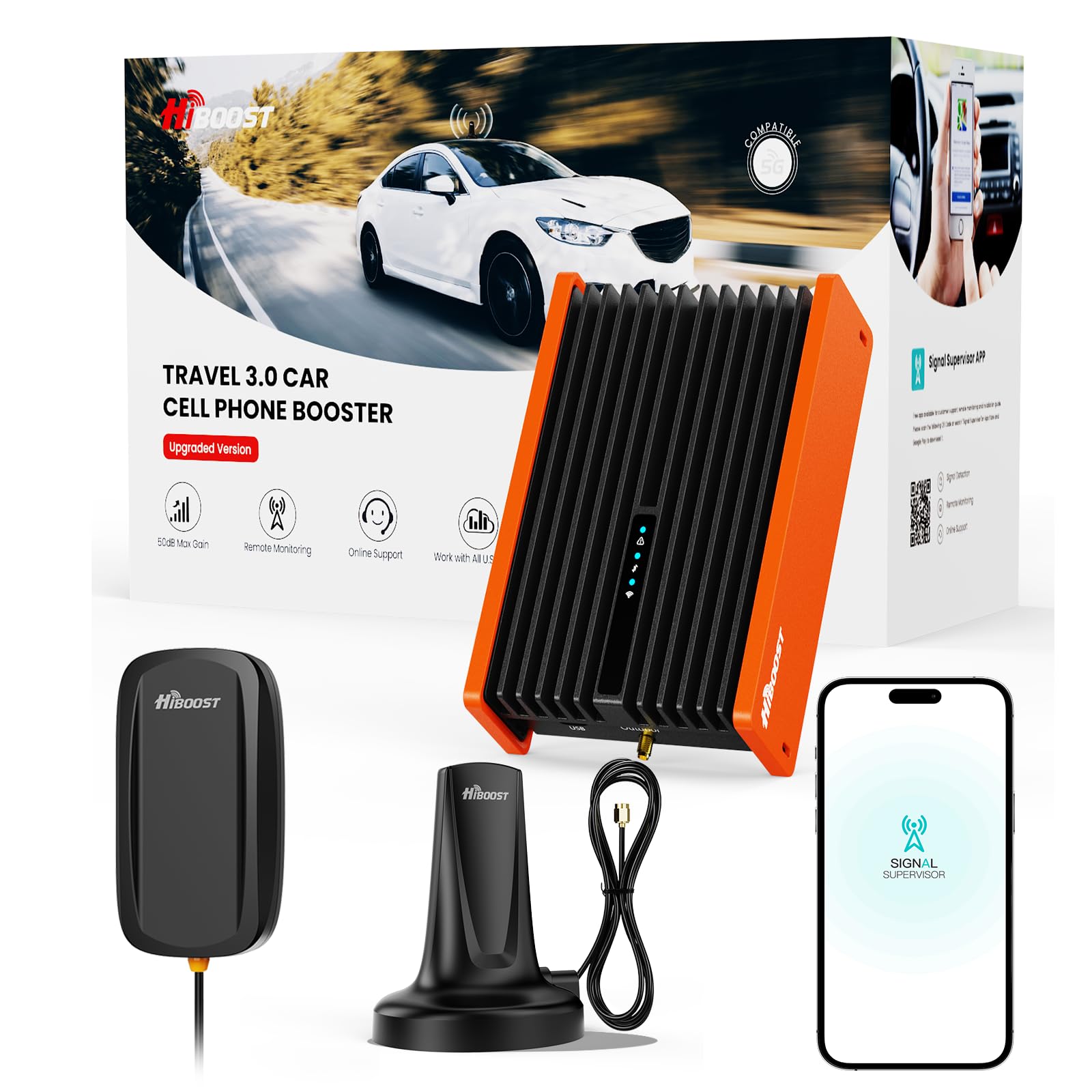
HiBoost Car 3.0 Booster

85 /100
LBD Score Excellent

Key details

Warranty
3 years
Frequency Bands
Band 12/17, 13, 5, 4, 25/2
Outdoor Antenna
Magnetic, 13.1 ft cable
Indoor Antenna Cable
9.8 ft
View on Amazon

Band 12, 13 and 17 are the low, long-range lanes at 700 MHz, and three of the four boosters here amplify nothing else. HiBoost adds Band 5 at 850 MHz, Band 4 at 1700/2100 and Band 25/2 at 1900, which is what lets it keep working when your phone hands off to a band the cheaper kits can't hear. That isn't a line on a spec sheet. It's the difference between a booster that helps on one stretch of road and one that helps on the whole route.

That coverage is why this one is here at all: on pure 700 MHz it isn't doing anything a budget kit can't, but the moment your phone moves to another band, the others go quiet and this one doesn't. The case is metal under a silicone cover, which is the right way to build something that rides outside year-round, and the three-year warranty matches the top pick's.

Thirteen feet of cable on the outdoor antenna and just under ten on the indoor one is plenty for a sedan and tight for a long wheelbase, where the top pick gives you three more feet outside. Whatever you drive, use the app's signal reading at the spot you intend to mount the antenna before you commit to it. That one check tells you more about whether any booster will help on your route than any other number on this page.

Pros

  • Seven bands, including 850 and 1900 MHz
  • Keeps boosting when the phone changes bands
  • Metal housing with a protective silicone cover
  • Three-year warranty and dedicated support

Cons

  • Premium price next to the other picks
Our verdict

Buy this one when your phone uses bands outside 12, 13 and 17 where you drive. It's the only booster here that covers them, and it's built to stay put.

Check Latest Price
3

Best for Hot Climates

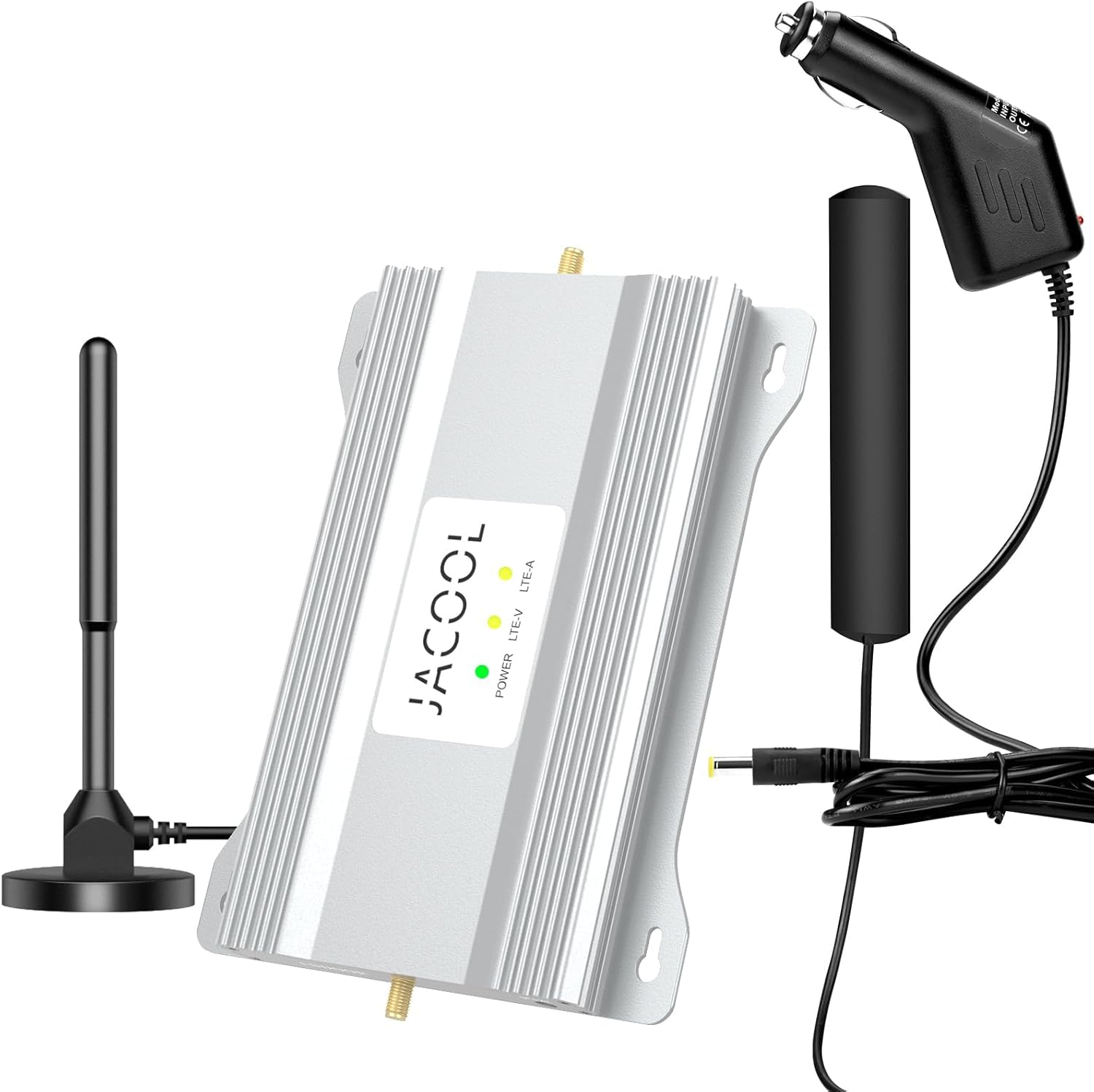
JACOOL Vehicle Signal Booster

86 /100
LBD Score Excellent

Key details

Housing
Aluminum alloy
Max Gain
50 dB, with AGC
Warranty
2 years
Frequency Bands
Band 12, 13, 17
View on Amazon

Aluminum is the reason this one is on the list. The amplifier sits in an aluminum alloy housing that does double duty as a heat sink, and that's the detail we care about in a device that runs whenever the car is on and bakes in a parking lot through July. It's the only kit here specified that way.

The amplifier itself is rated at 50 dB with automatic gain control, below the top pick's 65. What the kit gets right is everything around it: outdoor magnet antenna, indoor patch antenna, cables and a 12V adapter all in the box, no drilling, and no mounting bracket to source separately. It goes from box to working in a single sitting, which is the kind of install that actually gets finished.

Fifty decibels is the smaller number, but a compact cabin is a short distance to cover, and the indoor antenna sits within a few feet of the driver's phone in a sedan or hatchback. Where the lower figure would bite is a long vehicle with the indoor antenna banished to the back. In a small car it's headroom you won't miss.

Pros

  • Aluminum alloy housing helps shed heat
  • Complete kit with no drilling required

Cons

  • Lower gain than the top pick
  • Two years of warranty, not three
Our verdict

For a car that parks in the sun, the aluminum-bodied JACOOL makes sense: a straightforward install, a complete box, and a heat-shedding case at the top pick's money.

Check Latest Price
4

Roof-Mounted Setups

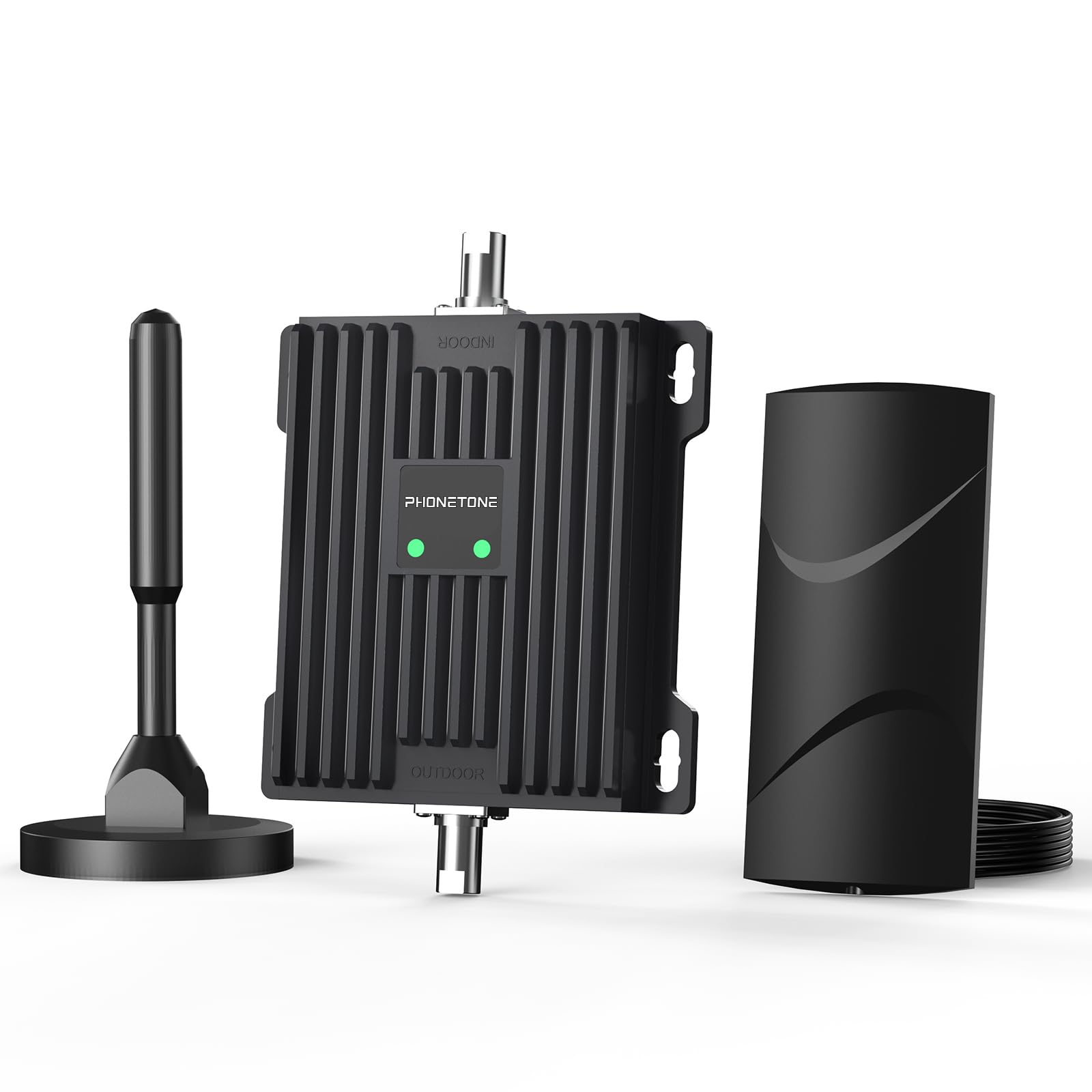
Phonetone C20 Vehicle Booster

78 /100
LBD Score Very Good

Key details

Warranty
2 years
Signal Needed
2 bars outdoors
Frequency Bands
Band 12, 13, 17
Outdoor Antenna
Omni-directional magnetic, weatherproof
View on Amazon

Phonetone asks you to do something before you order that no other kit here does: open your phone's band display and confirm that Band 12, 13 or 17 is one of the bands you're actually using, and that any 5G you're counting on arrives on one of those three. It's an odd thing to find in a product listing, and we appreciate the honesty. A booster repeats what already reaches the roof, on the bands it was built for; it can't conjure the rest.

The hardware is the appeal. An omni-directional magnetic roof antenna that's weatherproof means nothing to aim and nothing to worry about in rain, and the two-year warranty matches the JACOOL's. What holds it in the also-consider slot is the company it keeps: it covers the same three 700 MHz bands as the other budget kits without the top pick's gain figure or the HiBoost's extra bands. Where your phone is already sitting on 700 MHz, it's a tidy, weather-ready install that asks nothing of you once it's up.

Pros

  • Weatherproof magnetic roof antenna
  • Omni-directional, so nothing to aim
  • Two-year warranty and FCC approval

Cons

  • Needs about two bars of signal outdoors
Our verdict

Worth it if you've already confirmed Band 12, 13 or 17 on your phone and want a weatherproof roof antenna that needs no aiming.

Check Latest Price

How We Chose and Tested These Boosters

We started with a couple dozen listings and cut anything that wasn't FCC-approved, didn't cover the low bands U.S. carriers lean on in rural areas, or showed up without the outside antenna, inside antenna, and cabling a car install actually needs. That left 11 kits, which we ran for six months in daily drivers, a work truck, and a borrowed RV.

Every kit got the same route: a dead zone on my commute, a two-lane highway where one bar is a good day, a concrete parking garage, and a week of highway driving in the RV. At each spot I read the phone's field-test screen in dBm before and after install, then made a call, ran a speed test, and tried to stream video from three phones on three different carriers — all-carrier claims fall apart fast once you actually swap SIMs. I also drove outward from one tower until the boost stopped making a difference, which put a rough ceiling on how far each outside antenna could pull.

Installation was timed with a stopwatch and done solo, since routing cable from the roof through a door seal is where most of these live or die. Durability got checked the hard way: antennas stayed mounted through sun, rain, and drive-through car washes, and we inspected the connectors afterward for water and cracked jackets. Each brand also got one email with the same question about antenna placement, and we logged how long the reply took. Then we set each kit's measured gain next to its price to see which ones earned their keep.

How to Choose a Car Cell Phone Signal Booster

Start With the Bands, Not the Carrier Logo

Every kit here is advertised as working with Verizon, AT&T and T-Mobile, and that's true in a narrow way: all three carriers use Band 12, 13 or 17 somewhere. Those are the low 700 MHz bands that carry furthest, which is why a 700 MHz booster earns its keep on rural highways and thin suburban streets. If your phone sits on Band 4, Band 2 or Band 5 where you drive, though, a 700 MHz kit has nothing to amplify.

Check what your phone actually uses — a field-test screen or a signal app will show the band — then compare it with the kit's list. Treat a 5G badge skeptically too: these units boost 5G only when the 5G connection is running on a band they support. Of the four here, only the HiBoost reaches beyond 700 MHz.

Gain Is a Ceiling, Not a Promise

Gain, measured in decibels, is how hard the amplifier can push. In this group it runs from 50 dB on the JACOOL to 65 dB on the top pick, with two kits publishing no figure at all. More is worth having at the edge of coverage, where a faint signal needs the most help, and largely irrelevant where you already hold three bars. Automatic gain control is the counterweight: it throttles the amplifier back when the incoming signal is strong, so the output stays usable as you drive.

That's why we don't hand the win to the biggest number automatically. If your calls drop in the same two places every week, gain is what buys those back. If your signal is decent and only the data crawls, antenna placement will do more for you than another 15 dB.

Antennas, Cable, and the Separation Problem

Two antennas, one job: the outside one listens, the inside one rebroadcasts. Put them too close and the indoor antenna feeds signal back into the outdoor one, so the booster throttles itself down or drops out. That feedback is the usual reason a kit that seemed fine in the driveway disappoints on the road. Separation is limited by cable, and the cables differ: 16 feet outside on the top pick, 13.1 on the HiBoost, with indoor runs of 10 and 9.8 feet.

Measure the route from the roof, through a door seal, to the far end of the cabin before you order, and keep the excess cable coiled away from the indoor antenna rather than beside it. A crew cab has room to spare; a compact hatchback is where the longer cables earn their keep.

Power, Mounting, and Support

None of these needs drilling, and all four run from a 12V accessory socket. The adapter leads are short — three feet on the top pick — so plan on the amplifier sitting at the console or in the cargo area rather than wherever looks tidy, with the antenna cables running to it.

Support deserves weight here, because a booster that underperforms is usually a placement problem rather than a faulty unit. Two picks carry three years of coverage and two carry two years, and every one of them is FCC certified, which is the minimum you should accept.

Frequently Asked Questions

Final Verdict

The GAGBK kit is the one we point most drivers to. Sixty-five decibels with automatic gain control, 16 feet of cable on the outdoor antenna, and three years of warranty is the most complete package in this group, and it asks no more of your wallet than the other 700 MHz kits.

Change one requirement and the answer changes with it. If your phone drops to Band 4, Band 2 or Band 5 where you drive, the HiBoost is the only booster here that can follow it there, and that is what the extra money buys.