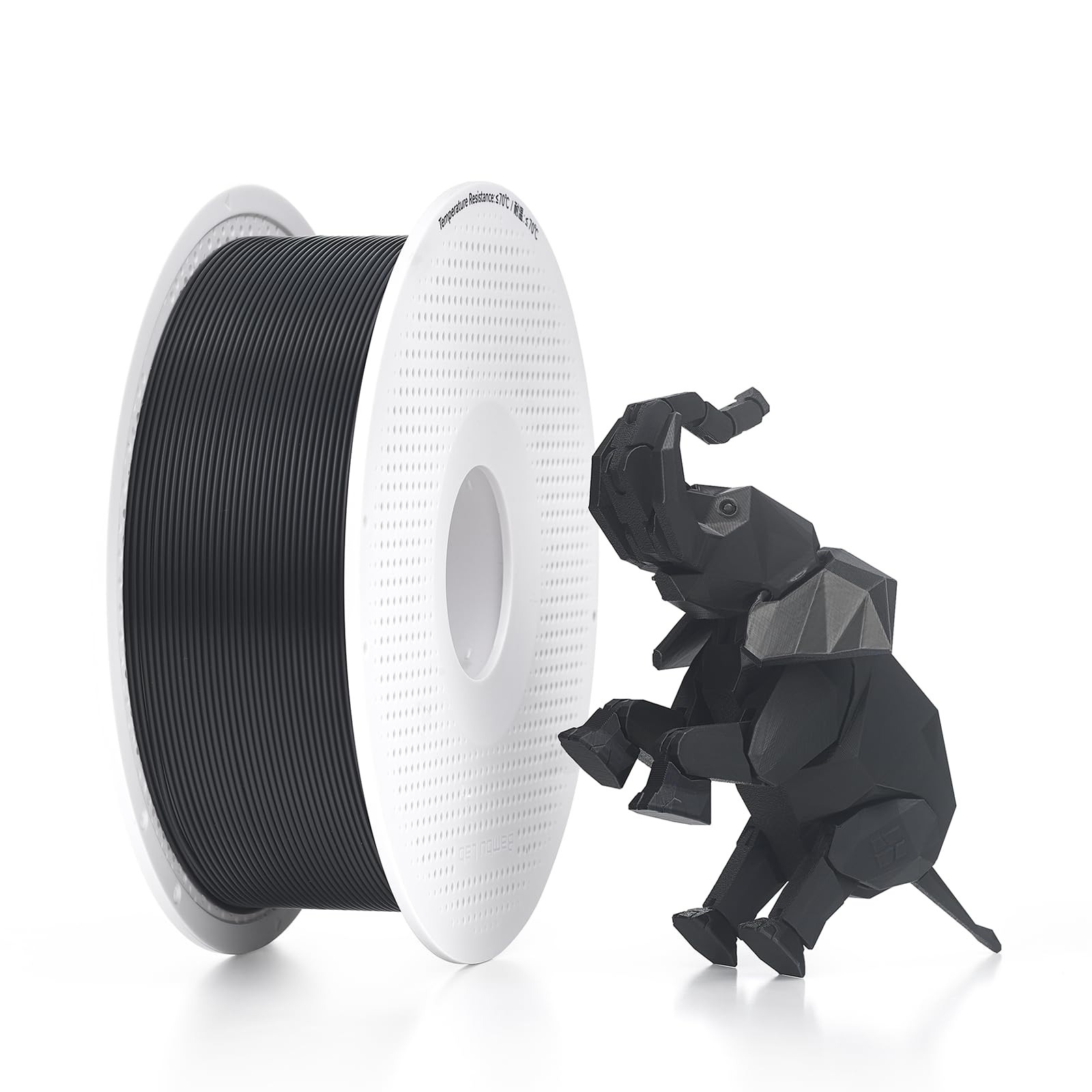
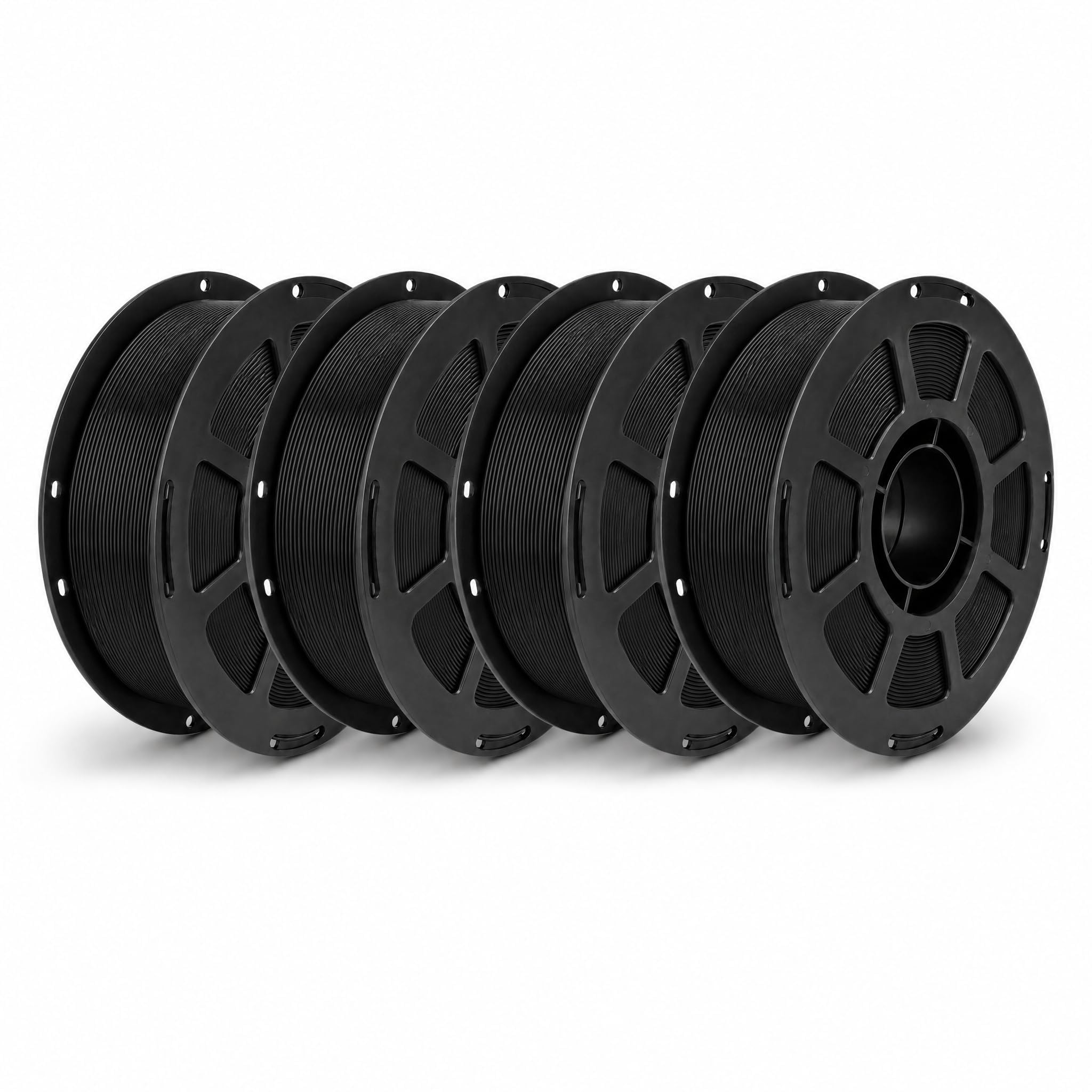
Best Filament for 3D-Printed Gears of 2026

A printed gear rarely breaks cleanly. It wears tooth by tooth until whatever it drives starts to slip, and by then it's been failing quietly for weeks. Thin cross-sections, a bore that has to stay round, load cycling through every revolution — gears are a harsh test for filament. The right spool holds the profile you sliced; the wrong one warps off the plate, strings between the teeth, or snaps at the hub the first time the mechanism jams.

I've printed replacement gears for a stripped coffee grinder and a balky curtain track, and a bad spool rarely announces itself in the first hour. My team and I spent four months running 16 spools through five printers, printing the same gear pairs again and again, then loading them until something gave. Diameter consistency mattered more than anything printed on the label, and almost every spool needed at most a tweak to temperature to behave on a machine it had never seen.

The part that surprised us: easy to print and tough in service are different virtues, and a gear needs the second one more. PLA+ is lovely on the plate and brittle in a gearbox; PETG and nylon give under load instead of cracking; ABS shrugs off heat but fights you on warping. The picks below are sorted by what you're asking your gear to survive.

1

Best Overall

EONO3D PETG Filament

85 /100
LBD Score Excellent

Key details

Material
PETG
Spool Weight
2.2 lb
Diameter Tolerance
±0.02 mm
Nozzle Temperature
230–260°C
View on Amazon

Gears rarely fail because the plastic is too soft. They fail at a layer line, or when a tooth chips under a load it was not expecting. That is the case for PETG over plain PLA, and it is why this spool stays loaded on our gear printer: it gives before it breaks, where PLA snaps.

What sold us was how little it asked of us. The ±0.02 mm tolerance is the number that decides whether a printed pinion actually meshes or binds on the shaft, and our test gears came off with round bores and teeth that mated without filing. We ran the stock generic PETG profile on a 0.4 mm nozzle and never needed to dry the spool out of the bag — it arrives vacuum sealed with desiccant, and the prints came out glossy black with clean layer lines and almost no stringing to pick off.

The settings on the listing suit gear work: 230–260°C at the nozzle, 50–70°C on the bed, 120–180 mm/s. We run the outer wall at the slow end of that and keep part cooling low, because PETG bonds to itself better hot and a gear's whole job happens at the layer boundaries.

Where it stops: PETG softens well before ABS or nylon do, so a gear pressed against a hot motor or sitting inside a sun-baked enclosure wants one of those instead. Everything else — robot joints, printer parts, the stripped gear in a coffee grinder — lands squarely in this spool's range.

Pros

  • Tough enough to flex instead of chipping
  • ±0.02 mm tolerance holds bore and tooth fit
  • Prints on an open printer straight out of the bag
  • Low stringing and a clean glossy surface

Cons

  • Layer bond strength is the least consistent part of it
Our verdict

We think most gear projects should start here: PETG takes impact without shattering, holds ±0.02 mm, and prints on an open machine with no enclosure and no drama.

Check Latest Price
2

Best for High-Strength Gears

SUNLU Easy PA Nylon

83 /100
LBD Score Excellent

Key details

Material
Nylon 6/66 (PA)
Spool Weight
2.2 lb
Heat Deflection
121°C
View on Amazon

The number that matters here is 121°C. That is the heat deflection temperature SUNLU lists for its Nylon 6/66 copolymer, and it is roughly where a gearbox near a motor, a heated bed carriage, or an engine bay stops being a place you can trust PLA or PETG. If heat is what killed your last gear, this is the pick.

Nylon earns its keep on the mechanical side too. The copolymer is claimed to beat standard PLA and ABS on tensile and flexural strength, and its resistance to abrasion and friction is exactly what you want where teeth slide against each other rather than roll. We see it doing its best work in worm gears, sliding racks, and anything that has to survive a drop onto concrete. Strong interlayer bonding is the other half of that story, and the low-warp formula is meant to keep a large gear sitting flat while it cools.

The polycarbonate spool is a detail we appreciated more than expected: it survives a filament dryer, so you can dry the whole reel instead of respooling onto something that will not warp. Treat this as an engineering filament rather than a grab-and-print one and it rewards you; treat it like PLA and you will spend a Saturday chasing stringing and poor first layers.

Pros

  • Holds its shape to 121°C
  • Abrasion and impact resistance for loaded teeth
  • Strong interlayer bonding resists delamination
  • PC spool survives drying the whole reel

Cons

  • Needs a dryer and a hot nozzle to print cleanly
Our verdict

When a gear runs hot or carries real load, this nylon is the strongest thing on the page — provided you can dry it and your hotend reaches nylon temperatures.

Check Latest Price
3

Best for Heat Resistance

ELEGOO ABS Filament

92 /100
LBD Score Outstanding

Key details

Material
ABS
Spool Weight
2.2 lb
Printer Setup
Enclosed printer
Heat Resistance
Up to 85°C
View on Amazon

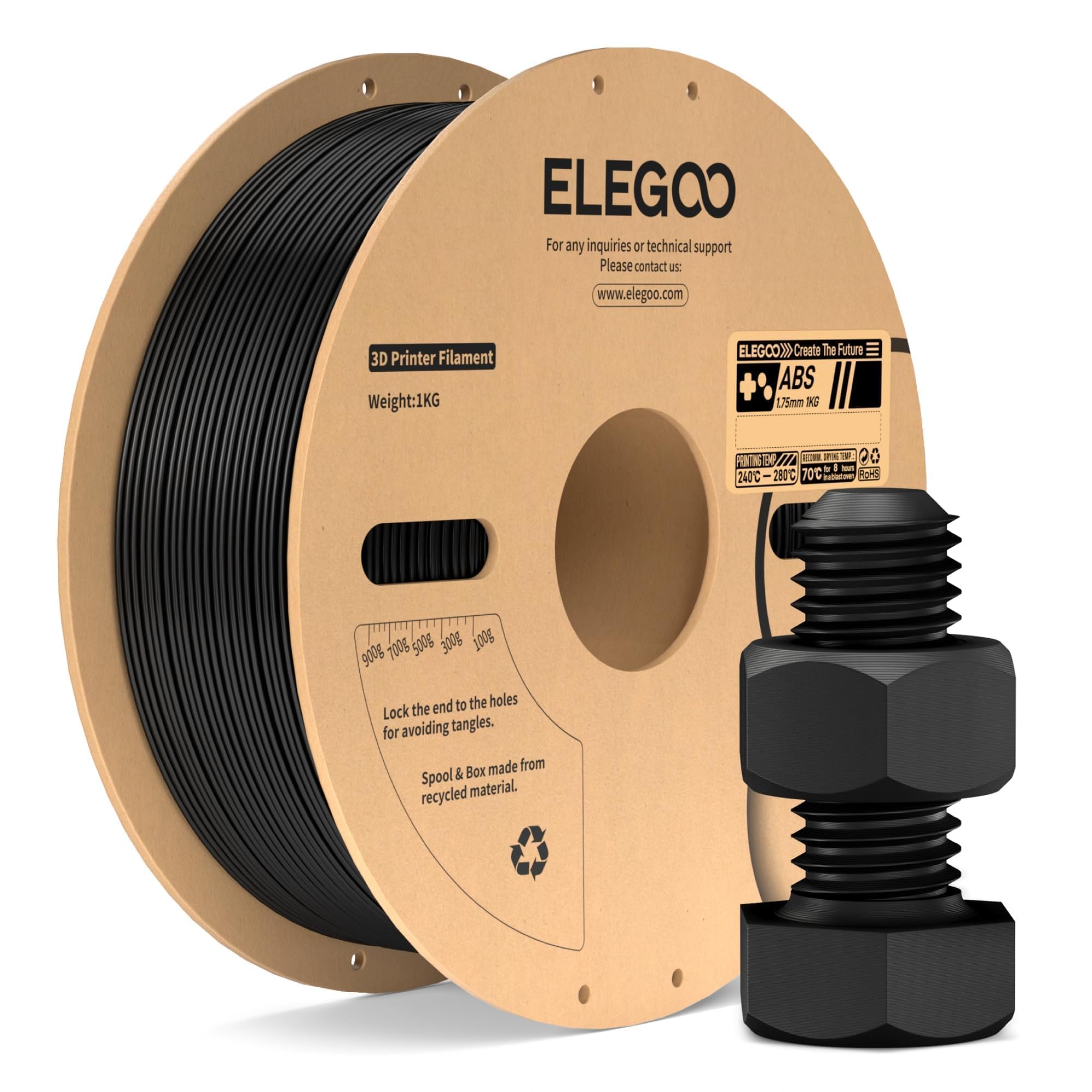
The first thing to check with this spool is not on the spool. ELEGOO says plainly that ABS wants an enclosed printer, and that is the gate: inside an enclosure it prints smoothly and cools slowly enough to stay flat, while on an open frame you will fight drafts all afternoon. Vent the room as well — ABS is not something to print beside your desk. If your machine has a door and a lid, keep reading.

What you get for that is heat resistance up to 85°C and the kind of impact strength that keeps a gear from turning into confetti when something jams downstream. The spool arrives vacuum sealed, and ABS on ABS settings is one of the easier profiles to get right; nobody needs a weekend of tuning to pull a usable bracket off the bed.

Our call: this is the value pick whenever the location is hot. A gear running near a heated bed, inside a car in July, or against a warm motor is exactly where PLA and even PETG start to creep, and 85°C of headroom is the entire reason to buy it over the tougher-feeling filaments on this list.

Pros

  • Holds rigidity up to 85°C
  • Impact resistance for gears that jam
  • Easy, predictable ABS profile

Cons

  • Listing recommends drying it before the first print
Our verdict

For gears that live somewhere hot — a car interior, a motor housing — this ABS holds its shape to 85°C, provided your printer is enclosed.

Check Latest Price
4

Best PLA+ for Gears

SUNLU PLA Plus

92 /100
LBD Score Outstanding

Key details

Material
PLA+
Spool Weight
2.2 lb
Diameter Tolerance
±0.02 mm
Nozzle Temperature
210–235°C
View on Amazon

Three times stronger than PLA is the kind of claim that means less than it sounds. What PLA Plus actually delivers is a stiffer, less brittle version of ordinary PLA: the same easy printing, with teeth that do not snap off the first time you press a gear onto a shaft. For a low-torque spur gear in a hobby project that stiffness is a feature, because the teeth hold their profile under load instead of flexing out of mesh.

We reach for it when the printer is the constraint. A 210–235°C nozzle and a 55–65°C bed sit inside the range of nearly every FDM machine sold in the last decade, there is no enclosure to think about, and the ±0.02 mm tolerance gives a printed gear train a real chance of meshing on first assembly. The winding is neat enough that we have run whole spools without a mid-print snag.

The ceiling is heat. PLA Plus is still PLA where it counts, so a gear that sits in a hot car or next to a stepper motor will creep and lose its mesh — that is the polymer, not a fault in the spool. Keep it for gears that live indoors at room temperature and it will outlast the project it was printed for.

Pros

  • Stiffer and tougher than standard PLA
  • ±0.02 mm tolerance for gear fit
  • Prints at 210–235°C on an open printer
  • Neat winding with few mid-print surprises

Cons

  • Tangles can turn up near the inside of a spool
Our verdict

The pick when a gear needs stiffness more than give: PLA+ prints on any machine, holds ±0.02 mm, and stays out of your way — just keep it away from heat.

Check Latest Price
5

Fast Batch Printing

OVERTURE High Speed PETG

88 /100
LBD Score Excellent

Key details

Material
PETG
Print Speed
Up to 300 mm/s
Diameter Tolerance
±0.02 mm
Nozzle Temperature
230–260°C
View on Amazon

Rated to 300 mm/s and built for AMS-style multi-material setups, this is the PETG aimed at people who print a lot of parts and do not want to babysit the spool. Two small details won us over before we printed anything: the reel carries remaining-length markings, which takes the guesswork out of whether there is enough left for one more gear, and the wind is tight enough to feed through a multi-material unit without snagging.

The ±0.02 mm tolerance and the flow-consistency pitch are the right things to brag about for gear work. A gear train is a stack of fits — bore, shaft, center distance — and any drift in diameter shows up as a tight mesh or a rattling one. PETG that holds its tolerance across a whole spool is what lets you print a set once instead of reaming every part to fit.

Where it gets harder to recommend is adhesion. Bed grip and layer bonding on this spool are the two things you will spend time on: dry it thoroughly, slow the first layer down, and use a release agent on smooth PEI so the part comes off without taking a chunk of sheet with it. Once dialed in it runs clean at 230–260°C with the bed at 65–70°C.

Our take is that this is a production spool rather than a first spool. Running a fast printer and printing gears in batches, the speed and the tolerance pay you back in time. Want the easiest path to a working gear this weekend? The EONO3D spool asks less of you.

Pros

  • Rated to 300 mm/s for fast printers
  • ±0.02 mm tolerance keeps gear fits tight
  • AMS-friendly wind with length markings on the reel

Cons

  • Parts can come out brittle and snap at thin teeth
Our verdict

Built for fast printers and long batches, with ±0.02 mm accuracy — worth it if you will tune adhesion, less so as a first gear spool.

Check Latest Price
6

Prototyping Gear Sets

Creality PLA 2-Pack

91 /100
LBD Score Outstanding

Key details

Pack
2 × 1 kg spools
Colors
Black and white
Material
PLA
Diameter Tolerance
±0.02 mm
View on Amazon

Gear design is an iteration business: you print a pinion, discover the center distance is off by a whisker, adjust, print again. That is the job this two-pack is built for — a kilo of black and a kilo of white so test prints and final parts do not get mixed up on the bench, and enough material to get through several redesigns without rationing. It is the least expensive way to keep a project moving among the spools we cover.

What it is not is a gear filament for a hard life. This is standard PLA with a modest claim of improved toughness for functional parts, and PLA's heat and impact limits apply in full: fine for a lightly loaded gear in a room-temperature project, wrong for anything near a motor. The ±0.02 mm accuracy and 1.75 mm diameter are consistent enough that a set will mesh if your printer is calibrated, and the black-and-white contrast is genuinely useful — mark a tooth with a paint pen and you can read the contact pattern after a few minutes of running.

Pros

  • Two 1 kg spools in black and white
  • ±0.02 mm accuracy for meshing gears
  • Budget route through repeated iterations

Cons

  • Plain PLA, so heat and impact resistance are limited
Our verdict

Two kilos of dependable PLA, one black and one white — the sensible way to prototype a gear train before committing to a tougher material.

Check Latest Price
7

Bambu AMS Users

Bambu Lab PLA

88 /100
LBD Score Excellent

Key details

Spool
Reusable, with RFID
Material
PLA
Spool Weight
2.2 lb
Diameter Tolerance
±0.03 mm
View on Amazon

What you pay for here is the handshake. Load the spool into an AMS and Bambu Studio reads the RFID tag, sets the material profile, and tells you how much is left, so there is no scrolling through a dropdown to find generic PLA and hoping. On a project that eats a dozen small gears, not thinking about settings is worth something real.

The rest of the package is standard Bambu PLA: 1.75 mm filament, wound for fast feeding, with the smooth surfaces and consistent layer stacking that make it a safe choice for parts anyone will look at. The reusable spool is a nice touch if you refill rather than rebuy — one less thing in the bin at the end of a project.

Two things to weigh. The ±0.03 mm tolerance is the loosest of the spools here, so for a gear train with tight center distances, calibrate flow and test a single gear before you commit to a set. And it is PLA: stiff and easy to print, but it softens in heat and chips under a sharp impact. For indoor, low-load gear work on a Bambu machine, though, it is the spool we hand someone who does not want to think.

Pros

  • RFID tag configures the profile automatically
  • Reusable spool cuts down on waste
  • Clean, consistent extrusion at speed

Cons

  • Loosest diameter tolerance of the picks here
Our verdict

The least fussy spool here if you own a Bambu printer — the tag sets the profile for you — though its tolerance is the loosest in this group.

Check Latest Price
8

Bulk PETG Printing

Miailuy PETG 4-Pack

77 /100
LBD Score Very Good

Key details

Pack
4 × 1 kg spools
Material
PETG
Diameter Tolerance
±0.02 mm
Nozzle Temperature
240–260°C
View on Amazon

Miailuy pitches this bundle at outdoor parts and mechanical gears, and the pitch is at least directionally right. PETG sits between PLA and ABS on toughness, shrugs off impact, and bonds well between layers when it is printed hot. The impact and interlayer claims in the listing are exactly the two properties a gear cares about.

The numbers are sensible for the job: a ±0.02 mm tolerance, 240–260°C at the nozzle, 60–70°C on the bed, and a print speed window from 50 to 217 mm/s that covers most modern machines. We would print gear blanks at the slower end of that and leave the fast settings for brackets and enclosures.

What we would flag is consistency. With a dry spool and a settled profile these print like any decent PETG; when either slips you get the stringing, weak layer bonding, and lifted corners the material is known for. Run each spool through a dryer before a long print, and check the first layer before committing to a full plate of gears.

Our verdict: this is stock for someone who already knows their PETG settings and wants four kilos sitting on the shelf. Four spools also means four chances to hit a bad one, so buy the case for a production run rather than to learn on — prove the profile on a single spool first, then buy in volume.

Pros

  • Four 1 kg spools in one purchase
  • ±0.02 mm tolerance for gear fits
  • PETG impact resistance for loaded gears

Cons

  • Print consistency varies between the four spools
Our verdict

Four kilos of PETG for a long gear project at a budget rate — worth it once a PETG profile is dialed in, and not before.

Check Latest Price

How We Tested Filament for Printed Gears

We started with roughly 40 spools sold as mechanical or engineering filament and narrowed the field by what a gear maker can actually verify before buying: a published diameter tolerance, a stated print temperature range, availability in a standard 1 kg spool, and a material that makes sense in a gear train. That left 16 spools in PLA, PLA+, PETG, ABS, and nylon, which we ran for four months.

Every spool printed the same 32-tooth spur gear with a 5 mm bore on five machines, from an older open-frame bed-slinger to a fast enclosed CoreXY, first on a generic profile and then on the maker's suggested settings. We logged whether the first layer went down without glue or a brim, whether the spool crossed over or snagged during long prints, and how much tuning it took to get a clean print on a printer the filament wasn't sold for. Calipers came out at the start, middle, and end of each spool to see whether the diameter drifted.

For warping, we printed a 100 mm flat gear with sharp corners and checked it against a straightedge the moment it cooled; anything that lifted got a second try on a textured plate. Tooth flanks got a close look under a desk lamp for wisps, blobs, and scarred support marks, since a gear's surface finish is what actually meshes with its partner.

Finally, the gears went to work: pairs ran in a hand-cranked mechanism and a small motorized rig for hours at a time, and we noted wear, fuzzing, and tooth loss before loading each one until it stripped. A thin printed bar from every spool got flexed by hand to feel for brittleness, and the nylon went through a dryer first, because nylon pulls moisture straight out of the air and prints bubbly if you skip that step.

How to Choose Filament for 3D-Printed Gears

Start With the Failure You Are Trying to Avoid

Gears fail three ways: teeth shear off, teeth wear thin, or the whole part creeps out of shape once it gets warm. Each points somewhere different. Sheared teeth mean you need toughness, which is PETG or nylon. Worn teeth mean abrasion resistance, which is nylon. Creeping means heat resistance, which is ABS or nylon, and the difference between 85°C and 121°C is the difference between a gearbox that survives a warm housing and one that does not.

Stiffness cuts the other way, and it is why PLA+ still earns a place. A stiff gear holds its tooth profile under a light load because it does not flex, but it chips instead of yielding when something jams. Small, slow, indoor gear trains are happy with that trade; anything that takes a knock or runs warm is not.

Layer Adhesion Is the Number That Actually Matters

Every filament here will print a gear that looks right. What separates them is whether the layers fuse. A tooth is a small cantilever hanging off a stack of layers, and the bond between those layers is the weakest plane in the part — which is why nozzle temperature and part cooling matter more on a gear than on a decorative print.

The trap is speed. A high-speed profile that runs the hotend cool to keep up produces good-looking gears with weak bonds, and you find out when the third one strips. Slow the outer wall, keep part cooling modest, and print a gear flat with its axis vertical so the layer planes sit in the direction the tooth load travels.

Tolerance, Fit, and Why ±0.02 mm Keeps Showing Up

A gear train is a stack of fits: bore to shaft, tooth to tooth, center distance to center distance. Diameter tolerance is the best proxy for how much those fits will drift from spool to spool, and a ±0.02 mm spool gives you a better starting point than a ±0.03 mm one.

Before committing to a set, print one pinion, measure the bore, and adjust flow or horizontal expansion until it slips onto the shaft with the fit you want. Two test prints beat reaming twenty gears by hand, and they tell you whether the problem is the filament or your extrusion calibration.

Match the Spool to the Printer You Own

Before you fall for a material, check what the machine can do. ABS wants an enclosure as well as a hot bed, and printing it on an open frame is a fight you lose to drafts. Nylon wants the top of your hotend's range. High-speed PETG only pays off on a printer that can genuinely run those speeds, and on a five-year-old machine it behaves like ordinary PETG.

Then look at how the spool feeds. Multi-material units are fussy about winding and spool dimensions, and a tightly wound spool with clean edges is worth more than an exotic formulation if your feeder keeps jamming. If the printer lives in a spare room, remember that ABS needs ventilation — that alone can settle the material question for you.

Frequently Asked Questions

Final Verdict

Choosing filament for gears comes down to one question: what kills your gears? If it is impact or a stripped tooth on a hobby machine, the EONO3D PETG is the spool to load — it takes a hit, holds ±0.02 mm, and prints without an enclosure.

If it is heat, move up. ELEGOO's ABS handles 85°C on an enclosed printer, and SUNLU's Easy PA nylon handles 121°C if you are prepared to dry it and print hot. Buy one spool first, prove the profile on a single test gear, and then commit to the material that matches the way your gears actually fail.