Best Fish Finders for Small Boats of 2026

A fish finder that lies to you is worse than no fish finder at all. You mark a brush pile that looks stacked with bass, drop a jig on it, and get nothing — or the depth drifts a foot and a half and you spend the morning plowing a crankbait through mud. On a small boat, where the transducer hangs off the transom and the screen sits an arm's length from your knee, there is no patience for a unit that needs babysitting.

I've spent the past six months running 12 fish finders on a 14-foot aluminum boat and a kayak, from plain depth readers to 7-inch units with down imaging. Screen size mattered less than I expected. What separated the keepers was whether they had charts of water I actually fish, whether the display held up in flat midday sun, and whether I could work the menu with wet hands while drifting.

Everything below earns its bracket on a johnboat, a skiff, or a kayak — no marine electrician required.

1

Best Overall

Garmin Striker 4

93 /100
LBD Score Outstanding

Key details

GPS
Built-in waypoint map
Sonar
CHIRP and ClearVü
Display
3.5 inches
Max Depth
1,600 ft freshwater
View on Amazon

A real button for depth range, a real button for zoom, and a real button for backing out of whatever screen you just opened — the Striker 4's control layout is the reason we keep coming back to it. That sounds like a small thing until you're drifting toward a brush pile with one hand on the tiller and the other on a rod. After a couple of trips we could work this unit without looking down, and on a small boat that matters more than another inch of glass.

For most people shopping for a small boat, this is the one to buy. A 3.5-inch display sounds tiny, and it is — the sonar view measures about 1.9 by 2.9 inches — yet Garmin fits CHIRP traditional sonar, ClearVü scanning, and a GPS with a waypoint map into an 8-ounce head that mounts on a tilt-and-swivel bracket or a trolling motor. Nothing else in this group packs that much into a package this small.

The 1,600-foot freshwater depth rating is far past anything a jon boat or kayak will see, which is fine; what matters is how the unit behaves in eight feet of water over a weed edge. ClearVü earns its keep there, drawing the shape of a stump or a rock pile rather than a smear along the bottom, though it softens over deep silt and heavy moss — that's the frequency, not the unit. Split the small screen between two views and each pane gets cramped fast, so we run one view at a time.

The GPS is the underrated half. Dropping a waypoint on a hump you found and coming back to it next weekend is the difference between a lucky afternoon and a pattern you can repeat, and the flasher view means the same unit goes ice fishing in January.

Pros

  • CHIRP and ClearVü in an 8-ounce head
  • Dedicated buttons you can work one-handed
  • Built-in GPS with waypoint map
  • IPX7 rated for open boats

Cons

  • No preloaded charts
Our verdict

We recommend the Striker 4 as the default small-boat unit: CHIRP sonar, ClearVü imaging, and GPS waypoints in an 8-ounce head that fits a 12-foot boat.

Check Latest Price
2

Best for Structure Fishing

Humminbird PiranhaMAX 4 DI

90 /100
LBD Score Outstanding

Key details

Mount
Tilt and swivel
Sonar
Dual beam and Down Imaging
Display
4.3 inches
Transducer
XNT 9 DI T transom mount
View on Amazon

Down imaging renders a narrow strip of bottom in hard detail — bridge pilings, sunken timber, the individual branches of a brush pile — and the PiranhaMAX 4 DI does it on a 4.3-inch screen without dragging GPS, waypoints, or charts into the price. If your fishing is about working cover rather than navigating, that's the right set of priorities, and it's why this is our pick for structure fishing.

The rest of the package is deliberately plain: a dual beam you can switch between a wide coverage swath and a narrower, more detailed look, plus fish ID, fish alarms, depth alarms, and zoom. There's no GPS, no waypoint memory, and no chart of any kind. We think that's a fair trade for the imaging, as long as you go in knowing you'll be marking spots with a float or a shoreline landmark instead of a screen.

Physically it's an easy unit to live with. The head sits on a tilt-and-swivel mount you can angle away from glare, the XNT 9 DI T transducer and hardware come in the box, and 4.3 inches of color is enough to read a depth number from the tiller without leaning in. Point it at a fallen tree and you can count the limbs before you cast.

Pros

  • Down Imaging shows timber and pilings in detail
  • Dual beam trades coverage for detail
  • 4.3-inch color screen on a tilt-swivel mount
  • Fish and depth alarms plus zoom

Cons

  • No GPS, waypoints, or charting
  • Down Imaging needs a direct pass over structure
Our verdict

Buy the PiranhaMAX 4 DI if you fish cover and don't need GPS — it's the structure-first unit here, with Down Imaging on a simple 4.3-inch screen.

Check Latest Price
3

Best for Built-In Charts

Humminbird Helix 5 CHIRP GPS G3

88 /100
LBD Score Excellent

Key details

Sonar
Dual Spectrum CHIRP
Charts
Basemap with 10,000+ lakes
Display
5 inches
Live Mapping
AutoChart Live, 8 hr recording
View on Amazon

Charts already in the box change the math. The Helix 5 CHIRP GPS G3 ships with Humminbird's Basemap — more than 10,000 lakes plus the continental U.S. coastlines — so the first time you idle onto a new lake, you can see the shape of the shoreline and the depth contours without buying a card or pairing a phone.

AutoChart Live is the quiet overachiever: it records depth contours, bottom hardness, and vegetation as you run, with eight hours of built-in recording. Fish the same water a dozen times and you've built a better map of it than any stock chart, and you can see where the hard bottom sits before you drag a jig across it.

This is the pick for anyone who fishes unfamiliar water and wants charts on the screen without another device. Dual Spectrum CHIRP gives you a wide mode for finding fish-holding structure and a narrow mode when you want detail, and we were glad of the softkeys on days when hands were wet and cold. The 5-inch display holds up in direct sun, which is the thing that actually decides whether a screen this size is useful.

The trade-offs are honest ones. It's a keypad unit with a deep menu tree that takes a few outings to feel quick, and the high-resolution LakeMaster charts are a separate card if the basemap isn't detailed enough for you. On a 16- to 18-foot boat with a console, though, it's the most complete sonar-and-charts package in this group.

Pros

  • Basemap with 10,000+ lakes preloaded
  • AutoChart Live records contours, hardness, vegetation
  • Dual Spectrum CHIRP in wide and narrow modes
  • Five-inch display readable in direct sun

Cons

  • LakeMaster detail requires a separate card
Our verdict

For anglers who want charts on the screen without adding a tablet or a card, the Helix 5's preloaded basemap and AutoChart recording are the reason to pick it.

Check Latest Price
4

Best Big Screen

Garmin Striker Vivid 7cv

88 /100
LBD Score Excellent

Key details

GPS
Waypoints and routes
Sonar
CHIRP and ClearVü via GT20
Display
7 inches
Live Mapping
Quickdraw Contours
View on Amazon

Seven inches of glass is the reason to pick this one, and also the reason it won't suit every small boat. The Vivid 7cv wants a dash, a console, or a bracket with clearance around it; on a 14-foot tiller boat that's a lot of screen to place, while on an 18-foot skiff it's the size that makes a split sonar-and-ClearVü view genuinely readable.

The included GT20 transducer handles both CHIRP traditional and ClearVü scanning, and the Vivid palettes are more than cosmetics — a high-contrast scheme pulls a fish arch away from a cluttered bottom. We found the bigger canvas the real advantage, though: traditional sonar in one pane for arches, structure view in the other, and neither one shrinking to a stripe.

Two features earn their keep over a plain sonar unit. Quickdraw Contours builds a one-foot contour map of wherever you drive, and Wi-Fi to the ActiveCaptain app moves waypoints on and off the unit from a phone. On a boat with no room for a chartplotter, that's how your home lake gets mapped — by you, one pass at a time.

What it doesn't have is a chart library, so the map you see is the map you made. That's either the appeal or the dealbreaker, and it's roughly the line between this and the Helix 5: the biggest, clearest picture here versus charts that arrive preloaded. For a console boat where the screen is the point, seven inches wins.

Pros

  • Seven-inch screen makes split views readable
  • CHIRP and ClearVü through the GT20 transducer
  • Quickdraw Contours builds one-foot maps
  • Wi-Fi waypoint transfer via ActiveCaptain

Cons

  • No preloaded charts
  • Large head needs console or dash clearance
Our verdict

Choose the Vivid 7cv when the screen is the point: seven inches make split sonar readable, and Quickdraw turns your own passes into a map.

Check Latest Price
5

Tight Dash Space

Lowrance Eagle 4X Bullet

82 /100
LBD Score Excellent

Key details

Mount
Surface, panel, or flush
Sonar
200 kHz, 44-degree beam
Display
4 inches IPS
Max Depth
500 ft
View on Amazon

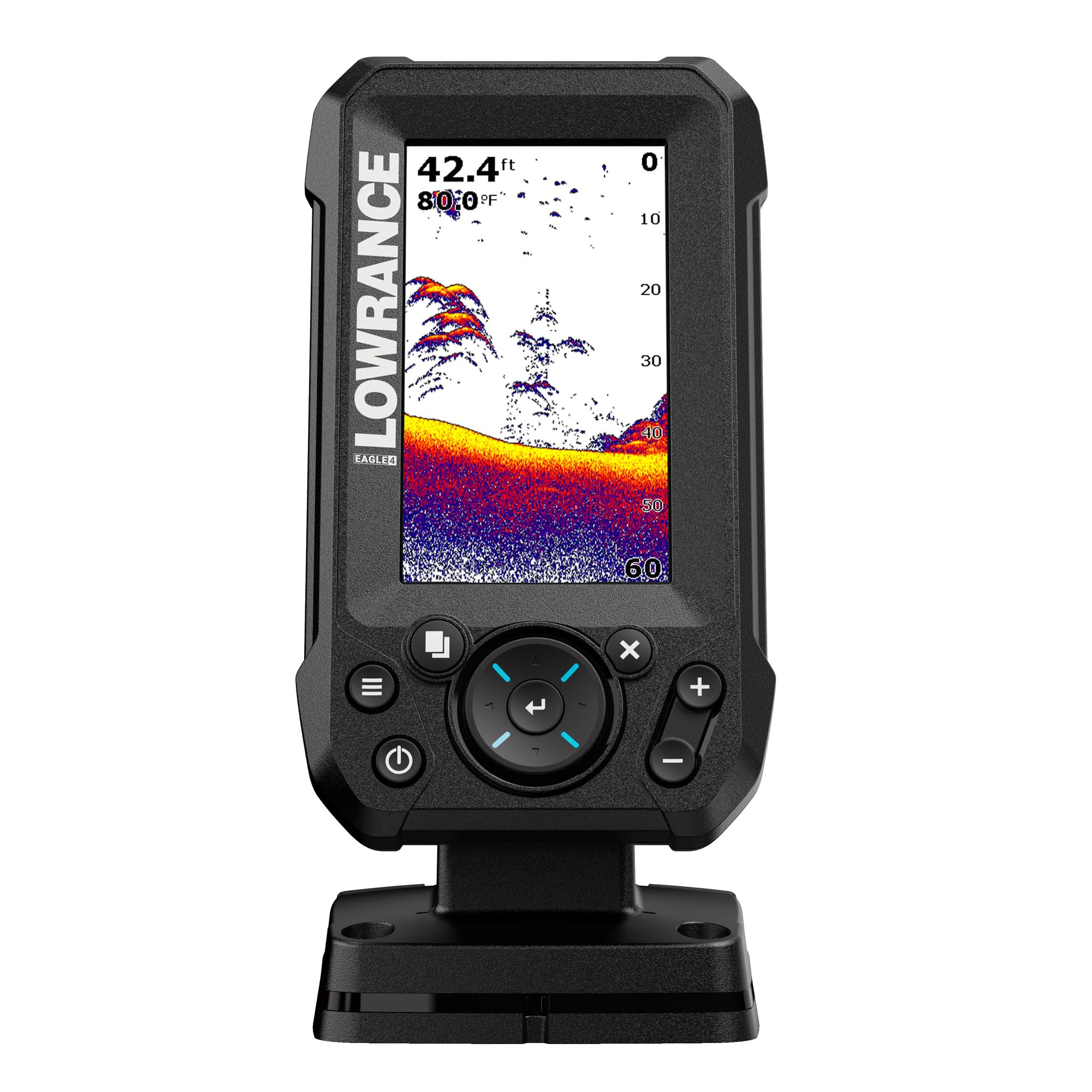
Portrait, not landscape — that's the first thing to notice about the Eagle 4X Bullet, and it's the reason it fits where other units don't. A tall, narrow panel takes less width across a dash than a landscape screen of the same size, so it slots between a tachometer and a switch panel on a small console, or onto a bracket at the helm of a skiff.

It's the right choice for the smallest consoles and for anyone who wants sonar without a wiring project. The twist-lock connector pops the display off its bracket in a second, which matters if the boat lives on a trailer or outside, and the 200 kHz Bullet Skimmer's 44-degree beam covers a wide, shallow cone — the water most small-boat anglers actually fish.

It won't keep up everywhere. There's no GPS, no waypoints, no imaging — just depth, fish icons, water temperature, and zoom — and that wide high-frequency beam does its best work at trolling and drift speed rather than wide-open throttle. Fish deep ledges or run hard between spots and the money goes further on something with CHIRP and a narrower beam.

Two details we appreciated: autotuning sonar sets the gain for you, so the picture stays usable when the bottom changes from sand to rock without touching a menu, and the IPS panel is built to stay clear through polarized sunglasses, which matters when you never take yours off.

Pros

  • Portrait 4-inch IPS fits narrow dashes
  • Twist-lock connector removes in seconds
  • 44-degree beam covers wide shallow water
  • Autotuning sonar sets gain for you

Cons

  • No GPS, waypoints, or charting
  • Single 200 kHz beam, no down imaging
Our verdict

The Eagle 4X Bullet is the right call for a tiny console or a boat you trailer: a narrow portrait display, a twist-lock release, and no wiring project.

Check Latest Price
6

Inland Lake Charts

Lowrance HOOK Reveal 5 SplitShot

82 /100
LBD Score Excellent

Key details

Power
12V DC
Sonar
SplitShot CHIRP and DownScan
Charts
C-MAP US Inland, almost 4,000 lakes
Display
5 inches SolarMAX
View on Amazon

FishReveal is the trick that makes this unit worth a look: it lays the fish targets picked out by CHIRP sonar over the DownScan image, so an arch and the structure it's holding on appear in one picture instead of two panes you cross-reference. On a small boat, where you're usually working a single brush pile rather than scanning a flat, that combined view is worth more than another inch of screen.

Aimed at inland water, the package includes C-MAP US Inland charts covering almost 4,000 lakes, and Genesis Live builds higher-detail contours over any spot you fish — the combination that makes a new lake look like something before your first cast. We had no trouble reading the 5-inch SolarMAX display in direct sun, and autotuning sonar takes the settings off your hands.

SplitShot is one transducer handling wide-angle high CHIRP and DownScan, so the transom gets one bracket and one cable instead of two. It's a 12V DC unit, which on a small boat means a fused run to the battery and a fuse holder in the box — the same job as the Helix 5, and more work than a castable unit that carries its own power.

The one thing to plan around is a shakedown trip. Transducer and GPS faults do turn up on this model, so confirm depth and position before you trust either, and buy from somewhere with a simple return. When everything works, the combined fish-and-structure view is the clearest in this group.

Pros

  • FishReveal overlays fish targets on DownScan
  • C-MAP US Inland charts for almost 4,000 lakes
  • Genesis Live custom contour mapping
  • Autotuning sonar removes manual settings

Cons

  • Preloaded charts cover inland lakes only
  • No internal battery
Our verdict

The HOOK Reveal 5 is worth it for FishReveal and preloaded inland charts, provided you wire it properly and test the transducer early.

Check Latest Price
7

Kayaks and Canoes

LUCKY MT-202

82 /100
LBD Score Excellent

Key details

Sensor
Floating and castable
Display
3.5 inches
Max Depth
147 ft
Wireless Range
853 ft
View on Amazon

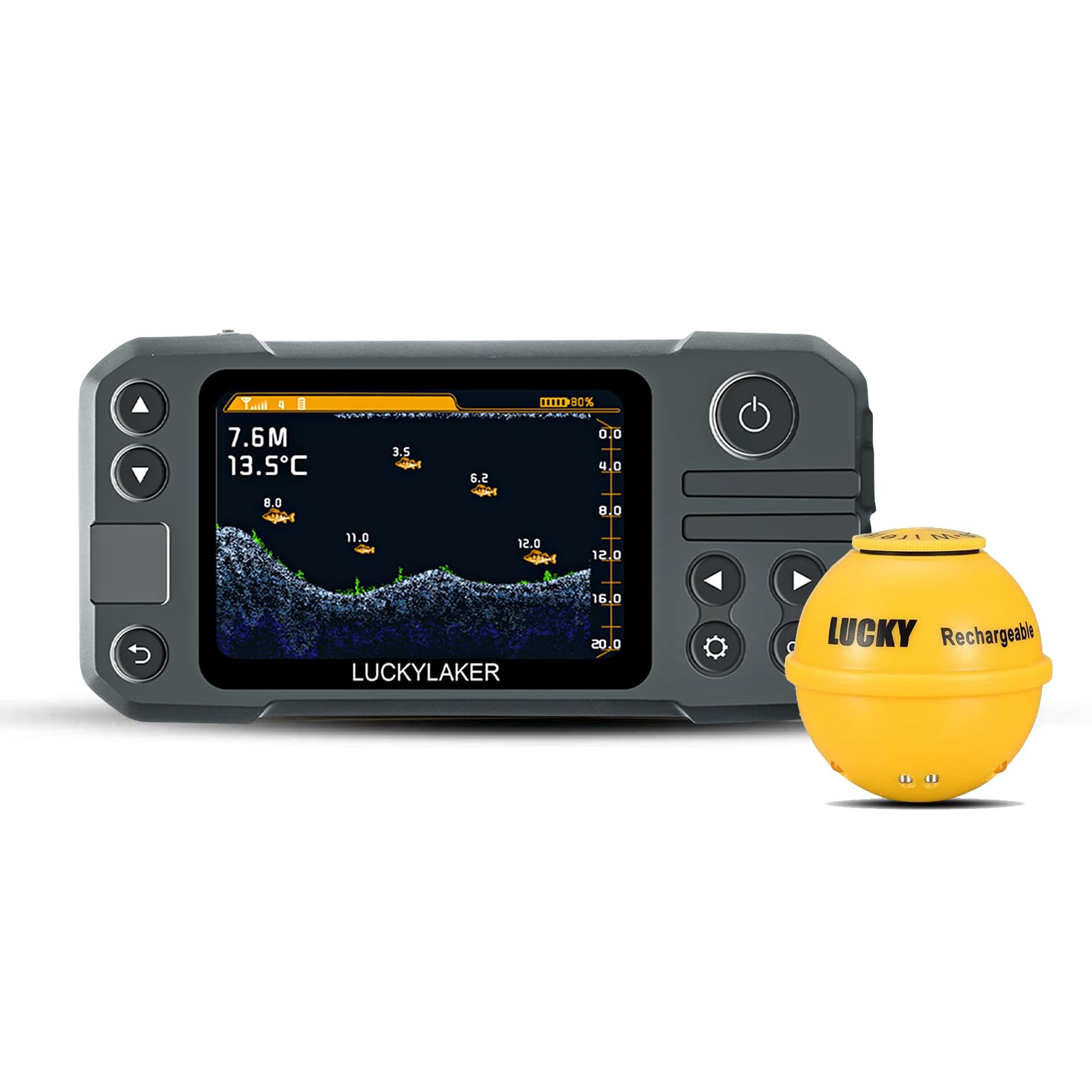
Clip the display to your belt, toss the floating sensor into the cove, and watch a depth reading and fish icons appear on the screen in your hand. That's the whole proposition of the MT-202: no transducer bracket, no cable run, no drill. For a kayak, a canoe, a battery-less dinghy, or a dock you're fishing for an afternoon, it's the difference between having sonar and not.

The sensor talks to the display over a wireless link the maker rates at 853 feet, and the unit is meant for fresh or salt water, summer or through an ice hole. Depth tops out at 147 feet, a hard ceiling: plenty for the bays, ponds, and river bends a paddle angler covers, not enough for a deep reservoir or open ocean.

We like it best as a second unit, or as a first one for someone who won't modify a boat. The 3.5-inch screen is basic — fish icons with depth numbers rather than the detailed arches a CHIRP unit draws — and there's no waypoint memory, no chart, and no bottom image worth studying. What you do get is a depth number and a rough idea of where fish are sitting, in something that fits in a jacket pocket.

Battery habits decide how much you trust it. It's rechargeable, and the readout gets less reliable as the charge falls off, so it goes on the charger the night before every trip. Treat it as a scouting tool rather than an instrument and it earns its space in the bag.

Pros

  • No mounting
  • Wireless range rated at 853 feet
  • Small enough to pocket and carry between waters
  • Rechargeable and rated for fresh, salt, and ice

Cons

  • 147-foot depth ceiling
  • No GPS, waypoints, or mapping
Our verdict

For a kayak, canoe, or dock where nothing can be mounted, the MT-202 is the simplest way to get depth and fish marks on the water.

Check Latest Price

How We Tested Fish Finders for Small Boats

We started by pulling every fish finder in the small-boat price range and checking what actually comes in the box — transducer, cabling, mounting hardware, and whether GPS and mapping are built in or sold separately — then filtered for screen sizes that fit a compact helm. That left 12 units, which we ran for six months.

Installation came first. I mounted each unit on a 14-foot aluminum boat with basic hand tools, timed the job, and noted where the instructions got vague: routing transducer cable through a transom, sealing the holes, angling the puck so it didn't rooster-tail at speed. Then I repeated it all on a kayak, where the transducer has to be reachable by hand and the display has to work with no console to bolt it to.

On the water, I fished each one the way a small-boat angler really fishes: pre-dawn launches on a local reservoir, long drifts along weedlines, jigging a hump I already know holds fish, and running back to the ramp at speed. Depth accuracy got checked against a knotted anchor rope and against a second unit's reading over a marked drop-off. Fish tracking meant watching whether arches appeared the moment I lowered a jig into a school, and whether the bottom held a clean line or smeared into clutter.

Controls got tested with wet hands, then with gloves, in flat midday sun with the screen angled low. For mapping, I looked at whether my home lake showed up with contour detail out of the box or needed a card bought on top. And we held each unit against its own listing, because a few descriptions promised more than the included transducer or the onboard charts would deliver.

How to Choose a Fish Finder for a Small Boat

Fit the screen to the boat, not the boat to the screen

On a kayak or a tiller boat, a 3.5- to 4.3-inch display bracketed within arm's reach is easier to live with than a 5-inch screen you have to twist to see. Once there's a console, 5 to 7 inches becomes an asset rather than an obstruction, because split views stop shrinking to a stripe. Measure the mounting spot before you order: a 7-inch head and its bracket take real estate a 14-foot boat may not have.

Two traps hide inside this decision. Compact in a product description means it fits a small dash, not that it reads well in split screen. And polarized sunglasses can blank out a marine LCD depending on the angle, so ask specifically whether the panel is specified to stay clear through them — the Lowrance Eagle 4X's IPS screen is.

Traditional sonar, down imaging, or both

Traditional sonar, whether CHIRP or dual beam, draws fish arches in the water column and gives you the depth number; a wide beam covers more water, a narrow beam resolves more detail. Down imaging — sold as ClearVü, DownScan, or Down Imaging — renders the bottom and structure as a picture instead, but it only sees a narrow strip directly beneath the transducer, so you have to pass over what you want to look at.

If you fish brush piles, rock, and docks, imaging is the feature worth paying for, and the Humminbird PiranhaMAX 4 DI is the plainest version of it. If you chase suspended fish over open water, traditional sonar plus GPS earns more of your money. Units that do both, like the Striker 4, are why we lean that way for a first purchase.

Waypoints, basemaps, and charts you make yourself

There are three levels of navigation here and they are easy to confuse. Waypoints mark a spot and point you back to the ramp with no map at all. A basemap, like the 10,000-plus lakes loaded on the Helix 5, gives you shoreline and contours out of the box. Preloaded charts, such as the C-MAP inland coverage on the HOOK Reveal 5, go further with detail on specific lakes.

The fourth option is building your own: Quickdraw Contours on the Vivid 7cv, AutoChart Live on the Helix, and Genesis Live on the HOOK Reveal all record the bottom as you drive. If you fish one home lake, that beats any stock chart. If you trailer to new water every weekend, buy the unit that already knows the lake.

Wiring, transducers, and where things go

Check the power source before anything else. The console units here run on a fused 12V feed, so plan a cable run and an inline fuse; the castable LUCKY MT-202 carries its own rechargeable battery and needs nothing but a charge the night before.

On a small aluminum boat a transom mount is the usual choice, while a trolling-motor bracket keeps the transducer out of the prop wash and out of the way when you beach. Placement matters more than the unit: mounted too low it throws spray, too high it loses the bottom the moment you plane.

Frequently Asked Questions

Final Verdict

Buy the Garmin Striker 4. It's the unit here that combines CHIRP sonar, ClearVü imaging, and GPS waypoints in a package small enough for a 12-foot boat, and it gives a first-time buyer nothing to grow out of for a season or two.

If you fish unfamiliar lakes and want charts without building them yourself, the Humminbird Helix 5 is the step up, and AutoChart alone justifies the learning curve. If there's nothing on your boat to bolt a bracket to, the LUCKY MT-202 is the honest workaround — as long as your water stays under its ceiling.