Best Side Imaging Fish Finders of 2026

Down-facing sonar only shows what's directly under the boat, which is why so many anglers spend a whole morning idling over water they've already passed. Side imaging throws a thin fan of sonar out to port and starboard and paints it into a scrolling picture — stumps, dock pilings, brush piles, the rock that has claimed three of your crankbaits. Instead of hunting a needle, you're reading the whole field and picking your cast.

The catch is that the electronics are only half of it. Transducer placement, screen brightness at 1 p.m., and how many button presses it takes to drop a waypoint with wet hands decide whether you actually use the thing. My team and I rigged and fished six units over eight months, from compact screens to the big ones, running them over the same stretch of timber and boat docks. Some drew images I'd frame; a couple had me squinting. The ones that held bottom at speed and kept a GPS lock through a long day are the ones we kept reaching for.

1

Best Overall

Lowrance Elite FS 10

0 /100
LBD Score Fair

Key details

Display
10-inch touchscreen
Max Depth
1,000 feet
Side Imaging
Active Imaging 3-in-1 SideScan
Included Mapping
C-MAP DISCOVER OnBoard
View on Amazon

The Elite FS 10 puts a 10-inch touchscreen at the center of the package. That width is the point: side-scan returns run across the display, so a brush pile, a bait ball, and the bottom contour need room to stay separate. Lowrance includes its Active Imaging 3-in-1 transducer, which handles SideScan, DownScan, and CHIRP, and the head unit comes ready for C-MAP charts and ActiveTarget live sonar.

We rate it as our top pick because it is the most complete side-scan package here. The touchscreen makes switching between side, down, and chart views quick, and the menus are deep enough for serious tuning without burying the basics. Where the XPLORE needs a transducer added and the Garmin leans toward coastal charts, the Elite FS 10 arrives with its 3-in-1 transducer and C-MAP mapping. That combination is why it is the one we recommend first for a general-purpose fishing boat.

The 3.7-pound control head is light enough for a bracket mount, and the 1,000-foot depth rating leaves headroom for deep coastal water. Live sonar is the optional part: ActiveTarget 2 or 2 XL is a separate purchase, so forward-facing lure tracking does not arrive with the package. If your fishing is mostly structure and bottom, that is an easy omission to accept; if you want live sonar, plan for the add-on.

Pros

  • 10-inch side-scan view with room for split screens
  • Included 3-in-1 SideScan, DownScan, and CHIRP transducer
  • C-MAP Discover charts and ActiveTarget readiness
  • 1,000-foot maximum depth rating

Cons

  • Needs generous dash space for a 10-inch display
Our verdict

The Elite FS 10 earns our overall pick for its 10-inch side-scan view, proven touch controls, and room to add live sonar.
Check Latest Price
2

Best for Tight Consoles

Humminbird Helix 7 MEGA SI

84 /100
LBD Score Excellent

Key details

Display
7-inch color TFT
Mapping
Humminbird Basemap, 10,000+ lakes
Side Imaging Range
125 feet each side
Included Transducer
XNT 9 HW MSI 150 T transom mount
View on Amazon

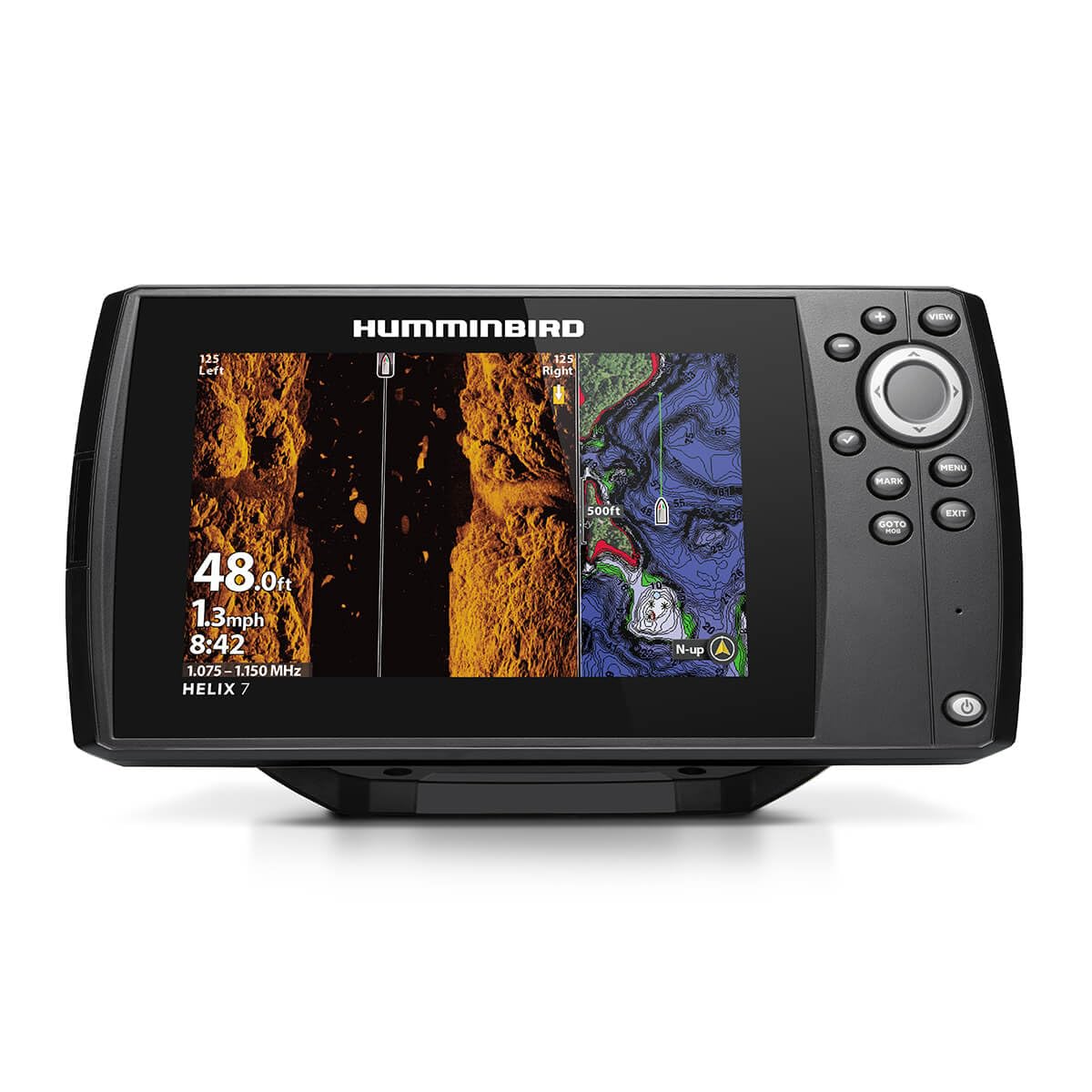
We reach for the Helix 7 when the dash is tight. Its 7-inch screen and 125-foot side range make it a compact side-imaging unit, not a stripped-down depth finder, and MEGA Side Imaging gives you a clear look at structure off both sides of the boat. The same MEGA treatment carries below the boat through MEGA Down Imaging, while Dual Spectrum CHIRP handles the traditional fish arches.

The keypad is the part we appreciate most. Humminbird's softkeys work through wet hands and spray, and the fixed buttons give you something to find without looking away from the water. The included XNT 9 HW MSI 150 T transom-mount transducer covers the sonar side, so the box is ready for a standard installation. The trade-off is the 7-inch screen: run side imaging beside a chart and both panels shrink.

GPS, the Humminbird Basemap, and AutoChart Live cover navigation and on-the-water mapping, so this is a complete unit rather than a sonar-only head. At 2.1 pounds, the control head is easy to pull for storage or move between boats, which is more than we can say for the larger 10-inch units in this group.

Pros

  • MEGA Side and Down Imaging at 125 feet
  • Dual Spectrum CHIRP for fish arches
  • Wet-hand keypad control
  • Compact 2.1-pound control head

Cons

  • Keypad-only menus take more steps than touch
Our verdict

We turn to the Helix 7 when dash space is tight: its MEGA side image is detailed and the keypad stays usable with wet hands.

Check Latest Price
3

Best Large-Screen Side Imaging

Humminbird XPLORE 10

0 /100
LBD Score Fair

Key details

Display
10-inch touchscreen
Networking
One-Boat Network, Ethernet, NMEA 2000
Down Imaging
MEGA Down Imaging+, 200 feet
Side Imaging
MEGA Side Imaging+, 200 feet each side
View on Amazon

The 200-foot side range is the number that separates the XPLORE from the compact Helix 7. MEGA Side Imaging+ reaches farther to each side, and MEGA Down Imaging+ covers the same 200 feet below the boat, so you can scan a wider lane without turning as often. For anglers who work big reservoir points or deep structure, that extra reach is the reason to move up.

The 10-inch touchscreen is paired with a keypad, which is the right combination for a wet boat: tap through sonar settings quickly, then use hard keys for the views you change most. Bluetooth, Ethernet, and NMEA 2000 support let the XPLORE talk to Minn Kota trolling motors, Cannon products, and other networked gear. At 4.8 pounds, the control head is manageable on a bracket.

We rate the XPLORE as the premium side-imaging station in this group, and its screen is the reason. The extra width makes side returns easier to interpret when you split the view, and the touch interface is faster than softkey-only navigation for jumping between sonar, chart, and network pages. The catch is the box: the included-components list covers the control head, power adapter, cover, and bracket, so you need to add a compatible MEGA Side Imaging+ transducer before the side view works.

Pros

  • 200-foot MEGA Side Imaging+ range
  • 10-inch touchscreen plus keypad
  • One-Boat Network, Ethernet, and NMEA 2000
  • Bluetooth anchor control and notifications

Cons

  • 10-inch control head needs substantial dash space
Our verdict

Our choice for a big side-imaging station is the XPLORE, whose 200-foot side range and 10-inch touchscreen make structure easier to read.

Check Latest Price
4

Best for Coastal Boaters

Garmin ECHOMAP UHD2 94sv

89 /100
LBD Score Excellent

Key details

Sonar
ClearVü and traditional CHIRP
Display
9-inch touchscreen
Side Imaging
SideVü with GT56 transducer
Included Charts
Garmin Navionics+ U.S. Coastal
View on Amazon

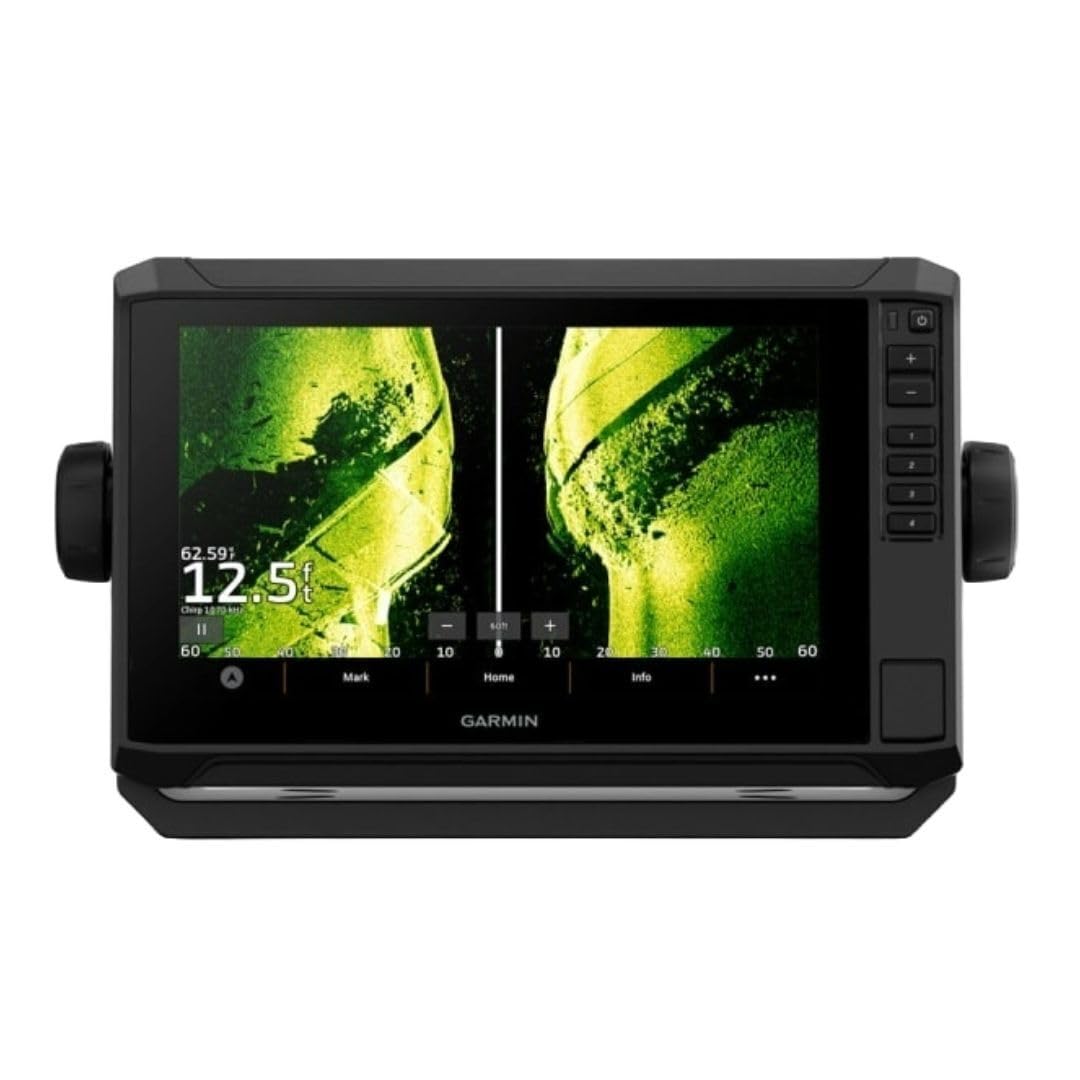
The ECHOMAP UHD2 94sv is the coastal package in this group. Garmin includes the GT56-TM transducer, so traditional CHIRP, ClearVü, and SideVü are ready to connect, and the 9-inch touchscreen is built for sunlight and wide viewing angles. Built-in Garmin Navionics+ U.S. Coastal charts give you the navigation layer without adding a card on day one.

We recommend it for coastal boaters who want a straightforward sonar-and-chart unit rather than a network project. The touchscreen is easy to learn, and the included SideVü makes this the most complete ready-to-fish package here after the Lowrance Elite FS 10. The 9-inch screen is a useful middle ground: roomier than the Helix 7 for split views, but less dash-hungry than the 10-inch units.

Wi-Fi is a practical extra. It lets you share sonar, waypoints, and routes with another compatible ECHOMAP, so a bow unit can follow the console instead of duplicating every mark. The Force trolling-motor connection adds route-following and motor control from the screen. The included flush-mount hardware gives the install a built-in look, which suits a clean helm.

Pros

  • Included GT56 transducer for SideVü and ClearVü
  • 9-inch sunlight-readable touchscreen
  • Garmin Navionics+ U.S. Coastal charts
  • Wi-Fi sonar and waypoint sharing

Cons

  • Preloaded charts focus on U.S. coastal waters
Our verdict

Coastal boaters should put the ECHOMAP UHD2 94sv on their shortlist for its included SideVü, straightforward touchscreen, and built-in charts.

Check Latest Price
5

Best for Offshore Rigs

Lowrance HDS PRO 10

0 /100
LBD Score Fair

Key details

Display
10-inch SolarMAX HD touchscreen
Max Depth
1,000 feet
Side Imaging
Active Imaging HD SideScan
Included Transducer
Active Imaging HD 3-in-1
View on Amazon

We put the HDS PRO 10 in the guide for offshore boats, where its 1,000-foot depth rating and expandable network matter more than a compact footprint. The 10-inch SolarMAX HD touchscreen is built for glare and polarized sunglasses, and the included Active Imaging HD 3-in-1 transducer covers SideScan, DownScan, and CHIRP. This is a helm unit, not a grab-and-go portable.

Lowrance's C-MAP DISCOVER OnBoard charts give you inland and coastal coverage without a separate card, and the display handles charts, sonar, and controls on one screen. Ethernet, NMEA 2000, Bluetooth, and wireless connections let the HDS PRO tie into compatible displays, radar, trolling motors, and boat systems. The included transducer saves a shopping step, and the touch controls keep sonar, chart, and system pages within a tap or two.

ActiveTarget 2 or 2 XL live sonar is a separate add-on, so the forward-looking view is not part of the base package. The 1,000-foot rating and C-MAP charts are the practical core; the live-sonar option is there for anglers who want to watch a lure rather than just read structure. The head unit's bracket and knobs are included, so the install does not stall on a separate mount.

Pros

  • 1,000-foot maximum depth rating
  • Included Active Imaging HD 3-in-1 transducer
  • 10-inch SolarMAX HD touchscreen
  • Ethernet, NMEA 2000, and Bluetooth networking

Cons

  • 11.6-pound head is heavy for temporary mounting
Our verdict

We recommend the HDS PRO for offshore boats that need a bright 10-inch display, 1,000-foot depth capability, and a network that can grow.

Check Latest Price

How We Rigged, Ran, and Compared Six Side Imaging Units

We started with the specs that change an actual day on the water: whether a transducer comes in the box, whether mapping is built in or tied to a subscription, screen size against available helm or tiller space, and the side-imaging range each unit claims. That filter narrowed the field to six, which we mounted on two boats — a tiller-steer aluminum and a console boat — and rotated between them so no unit got lucky with the cleanest water or the easiest mounting spot.

On the water, every unit ran the same 200-yard stretch of standing timber and a row of boat docks at the same speed and gain, and we compared what came back. We noted whether a brush pile read as individual branches or as a blob, whether fish showed as distinct marks or smears, and whether hard bottom separated cleanly from soft. We also made long runs at cruising speed to see if the bottom reading held or dissolved into static, and left each unit powered through six-hour days watching for dropped GPS locks, frozen menus, and surprise restarts.

Ease of use got judged with wet, cold hands: dropping a waypoint mid-drift, dialing gain, splitting the screen between mapping and sonar, and reading all of it in midday glare. We timed the rigging on each one — transducer mounting, cable routing, first-run setup — because what's included in the box is most of the value question. Two units rode out rain-soaked mornings and one took a splash over the bow, and all six lived on the boats for the full eight months, which is where the reliability picture came from. Anything that only looked good in perfect light, or sent us into a manual mid-trip, fell down the list.

How to Choose a Side Imaging Fish Finder

Let the screen size follow your split views

Side-scan returns are wide and shallow, so a 7-inch screen can make structure look cramped once you put a chart beside it. We start by deciding whether side imaging will run full-screen or share space. On a tight console, the Humminbird Helix 7 makes sense if you mostly give the sonar the whole display. A 9- or 10-inch screen, as on the Garmin ECHOMAP UHD2 94sv or Lowrance Elite FS 10, keeps a chart and side view legible together. Measure the dash opening before you fall for the bigger screen.

Match side range to the water, not the brochure

Side range tells you how far off each side the transducer looks, not how much detail you will see at every setting. The Helix 7 lists 125 feet to each side; the XPLORE lists 200 feet. More range helps you scan a wide flat or a long point without zigzagging, but it also makes a fish or a stump smaller on screen. In tight cover, a shorter range often gives a cleaner picture. Start at a midrange setting and widen only when you need to cover more water.

Read the box contents before you compare systems

A side-imaging display is only half a sonar system. The Lowrance Elite FS 10 and HDS PRO include 3-in-1 transducers; the Garmin includes its GT56; the XPLORE's included-components list stops at the control head, power adapter, cover, and bracket. Check the transducer, power cable, and mount in the box, then add what is missing. A cheaper head unit can become the more expensive path once a compatible side-imaging transducer is on the list.

Pick controls for spray and cold hands

Touchscreens are fast for jumping between side, down, and chart pages, but wet fingers and gloves can make hard keys more reliable. We like a hybrid when it is available, as on the XPLORE, because you can tap the screen for settings and use the keypad for the views you change constantly. The Helix 7 is keypad-only, which suits a small, wet center console. Decide which control style you will actually use before you pay for the larger display.

Check charts and networking for where you fish

Chart coverage is part of the purchase: Humminbird Basemap, Lowrance C-MAP DISCOVER OnBoard, and Garmin Navionics+ U.S. Coastal cover different home waters. If you fish one lake or a familiar coast, the preloaded map may be enough. If you chase fish across regions, or want radar, a second display, or a trolling motor on the network, choose the ecosystem that supports it. The HDS PRO is built for a networked helm; the Garmin's Wi-Fi sharing is the simpler two-unit route.

Frequently Asked Questions

Final Verdict

Start with the Lowrance Elite FS 10. It gives you a 10-inch side-scan view, an included 3-in-1 transducer, and C-MAP charts without turning the helm into a custom installation. If your console is tight, the Humminbird Helix 7 is the compact alternative, with a 7-inch screen and 125-foot side range. For a premium 10-inch station with 200-foot side coverage, the XPLORE is the step up, provided you add a compatible transducer.