Best Foldable Solar Panels of 2026

Every foldable solar panel arrives with a wattage printed on the box, and that number was measured in conditions you will never camp in: full sun, cool cells, a perfect angle. What matters more is what the panel still puts out at 3 p.m., when everything has heated up and the light is slanting. We have spent seven months with 12 of them — on campsites, strapped to an RV, and through a three-day blackout at my house — and the distance between the label and real life is where the whole buying decision lives.

Here's the other thing nobody tells a first-time buyer: a panel bigger than your power station's input limit is weight and money thrown away, because the station simply cannot take the extra. Under that ceiling the tradeoffs get honest — watts against packed weight, a waterproof rating against a kickstand that actually holds an angle in gusty weather. Ports and adapter cables matter too, since a box full of connectors is only useful if one of them fits the thing you brought. Below are the panels that earned their place, from phone-sized chargers to arrays that can feed a full-size station.

1

Best Overall

HQST 200W Portable Solar Panel

87 /100
LBD Score Excellent

Key details

Weight
11 lb
Rated Power
200W
Output Cable
4.9 ft 3-in-1
Weather Resistance
IP67
View on Amazon

At about 11 pounds, the HQST 200W is the lightest 200W panel in this guide, and that changes how often you move it. We carried it one-handed from the truck to a picnic table, then shifted it twice as the sun moved; a heavier panel tends to stay where it lands. The 25% N-type cells and 200W rating are the headline, but the 1.97-inch fold and built-in buckles are what make it easy to live with. For most campers and RVers, this is the right default: enough panel for a mid-size power station without turning setup into a workout.

The 4.9-foot 3-in-1 adapter cable is the practical detail we appreciated most. It ends in XT60, DC7909, or DC5521, which covers a long list of popular stations, and the extra length lets you keep the station in the shade while the panel sits in the sun. The IP67 rating is reassuring for a sudden shower, though we folded it away once the rain set in. Two kickstands adjust from 40 to 60 degrees; we found the range useful on a slope, and the rigid frame kept the panel from curling in the wind.

The panel is at its best with a power station, and the two-leg stand is simpler to deploy than a four-leg frame. It needs firm ground, though: on loose sand, shuffle the feet until they bite. The HQST is not the fanciest panel here, but it is the one we reach for when the goal is simple: set up, aim, and let the station fill.

Pros

  • 200W output at just 11 pounds
  • 25% N-type cells in a folding frame
  • 4.9-foot 3-in-1 adapter cable included
  • IP67 weather sealing for wet campsites

Cons

  • No USB ports for direct device charging
Our verdict

For most campers and RVers, the HQST 200W is the foldable panel we recommend: light enough to move alone, powerful enough for a mid-size station, and fitted with the adapter cable you need.

Check Latest Price
2

Best for Device Charging

Renogy 200W Portable Solar Panel

89 /100
LBD Score Excellent

Key details

Weight
13.9 lb
Outputs
USB-C PD 45W + 2 USB-A
Rated Power
200W
Safety Certification
UL 61730
View on Amazon

The Renogy 200W is the panel to choose when your phone should not have to wait for the power station. Built into the back are a USB-C PD port rated at 45W and two USB-A ports, enough to top up a handset, tablet, and camera without opening the station. The 25% N-type panel and 13.9-pound body are otherwise familiar 200W territory; the magnetic closure is the detail that makes the fold feel tidy rather than fussy.

We liked the four kickstands more than we expected. They set at 40, 50, and 60 degrees, so you can match a low morning sun or a steep afternoon angle without propping the panel on a cooler. The 23.72 x 22.99 x 1.97-inch fold is compact for a 200W panel, and the magnetic handles snap shut for carrying. The panel stayed put in a light breeze, though we chose a sheltered spot rather than testing it on an exposed ridge.

What separates the Renogy from the other 200W pick is the combination of direct charging and a UL 61730 listing, plus a two-year material and workmanship warranty. We see that as useful insurance for a panel that will live in a truck bed or on a picnic table. The catch is that the box is panel-only; you need to supply the MC4-to-station cable your power station takes. If you already have that lead, the Renogy is the more versatile 200W panel here; if not, factor the extra cable into the decision.

Pros

  • USB-C PD 45W and two USB-A ports
  • Four kickstands with three angle settings
  • UL 61730 listing and two-year warranty
  • Magnetic closure keeps the fold tidy

Cons

  • Kickstands feel flexy on soft ground
Our verdict

Buy the Renogy if you want to charge phones and tablets straight from the panel; the USB-C PD and dual USB-A ports are the difference, and the UL listing adds peace of mind.

Check Latest Price
3

Best for Large Power Stations

ZOUPW 450W Portable Solar Panel

89 /100
LBD Score Excellent

Key details

Weight
29.5 lb
Rated Power
450W
Weather Resistance
IP68
Open-circuit Voltage
45.9V
View on Amazon

The ZOUPW 450W is for the camper whose power station is the biggest thing in the truck. Its 45.9V open-circuit voltage and 38.3V operating output are aimed at large 40-60V stations, not the small 12V boxes that many weekenders start with. For that buyer, the extra wattage is the point: it can carry more of the recharge load than a 200W panel, and the IP68 sealing means a sudden shower is not an emergency. It is not universal, but it is purpose-built.

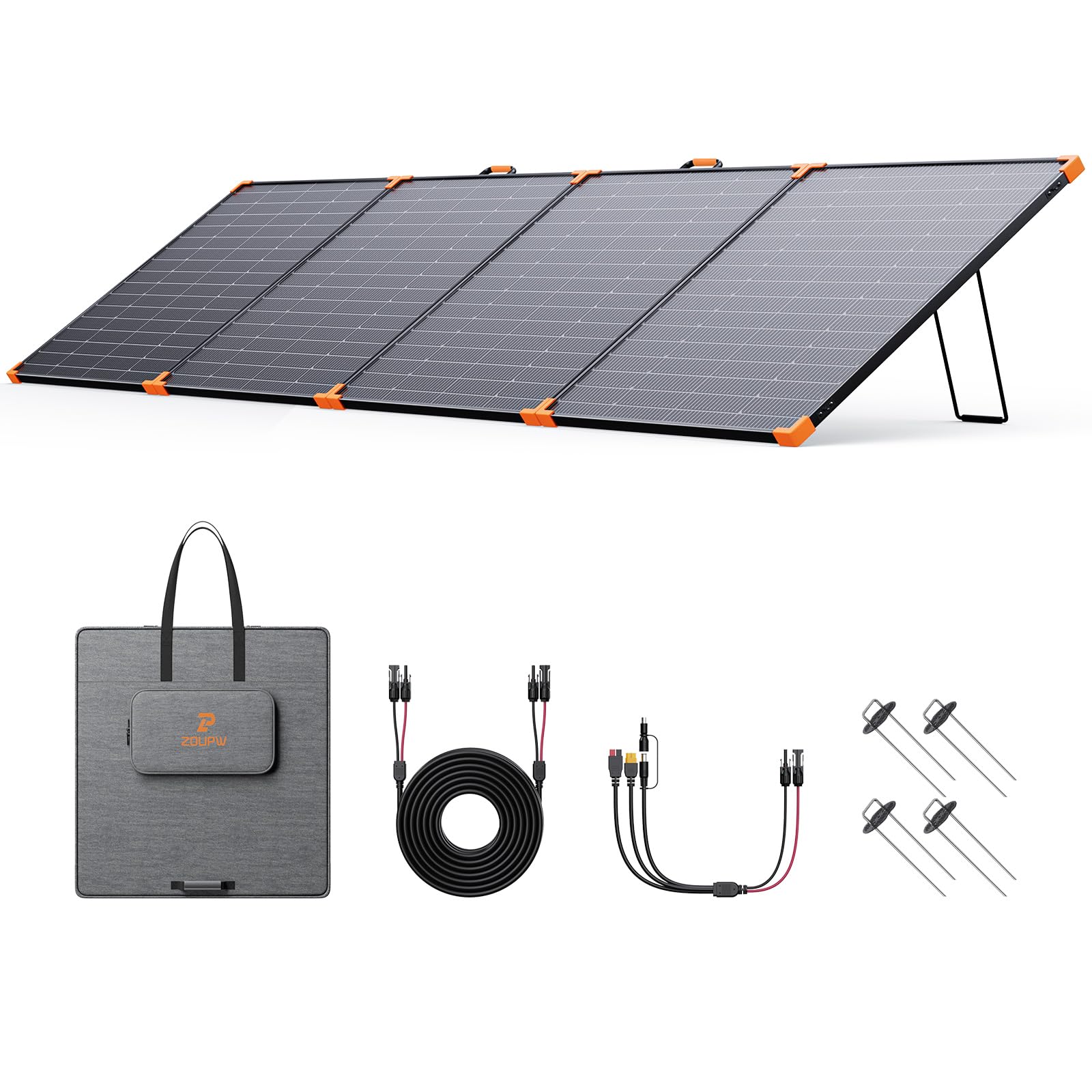
The kit is unusually complete: a 4-in-1 cable for XT60, Anderson, DC7909, and DC8020, four ground stakes, and a padded storage bag. We appreciated the stake points on a windy day; the panel stays put while you angle it. The 4-in-1 cable saves you from hunting adapters in a drawer, and the 450W rating is the headline. The cable and case are what make it usable out of the box.

The trade-off is weight and bulk. At 29.5 pounds, it is light for a 450W panel but still a two-hand lift, and the folded package is 30.43 x 34.56 x 3.54 inches, closer to a suitcase than a backpack. We found the panel itself rigid and the frame stable once staked; the four ground stakes are not an afterthought. If you move camp every day, a 200W panel is easier; if you park for a week, the ZOUPW earns its space.

Pros

  • 450W output for large power stations
  • IP68 sealing and four ground stakes
  • 4-in-1 adapter cable and storage bag

Cons

  • No USB ports for direct device charging
  • Premium price for the wattage
Our verdict

The ZOUPW 450W earns its keep with large 40-60V power stations: big output, IP68 sealing, and a useful adapter kit, but it is a two-hand, trunk-sized panel.

Check Latest Price
4

Best Budget for Power Stations

SOKIOVOLA 100W Foldable Solar Panel

85 /100
LBD Score Excellent

Key details

Weight
4.6 lb
Folded Size
14.69 x 8.67 x 1.78 in
Rated Power
100W
Output Cable
7.2 ft 4-in-1
View on Amazon

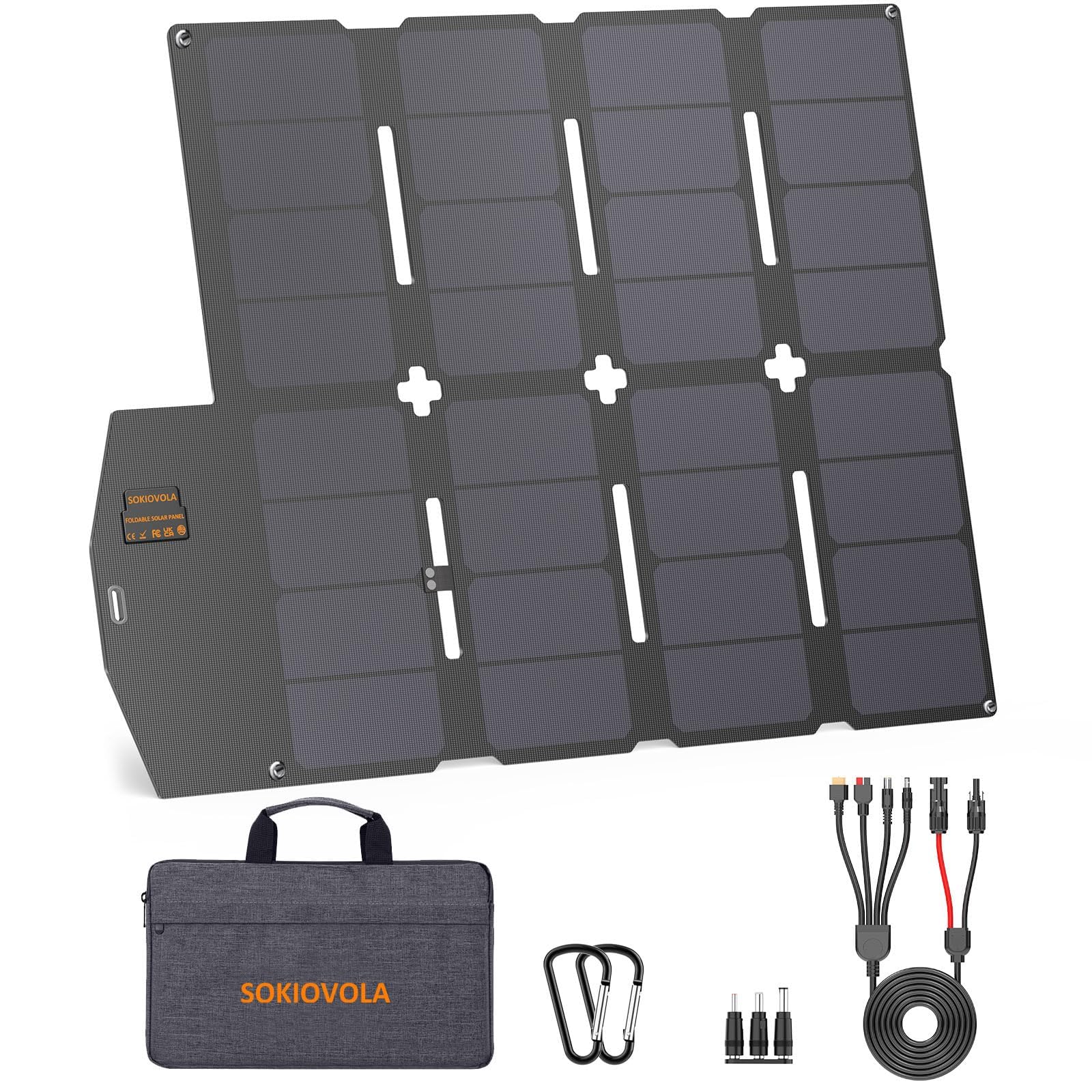
The SOKIOVOLA 100W is the panel to buy when the power station is small and the budget is tight. It weighs 4.6 pounds, folds to 14.69 x 8.67 x 1.78 inches, and uses an ETFE laminate over monocrystalline cells. The folded package is small enough to live behind a seat, and the included 7.2-foot 4-in-1 cable ends in XT60, DC5521, DC7909, or Anderson. For a weekend camper with a compact station, that is a sensible kit rather than a compromise.

We think the 7.2-foot cable is the unsung part of the package. It gives you enough slack to keep the station under a tarp while the panel sits in the sun, and the four connector ends cover most small and mid-size stations without a drawer full of adapters. The 100W rating is honest for its size, but it is a maintenance panel, not a fast refill for a large battery. We used it to hold a small station steady through a sunny afternoon, and it did that without drama.

The build is light, and the panel needs a gentle hand when you fold it; we kept it in its bag between stops and avoided setting it on sharp gravel. The included cable can feed a small power station that already has USB outputs, so the kit makes sense as a system rather than a standalone charger. For the money, this is the least intimidating way into solar charging, and it leaves room to add a bigger panel later.

Pros

  • 100W in a 4.6-pound fold
  • 7.2-foot 4-in-1 cable included
  • Folds to 14.69 x 8.67 x 1.78 inches

Cons

  • No USB ports for direct device charging
Our verdict

The SOKIOVOLA 100W is the budget pick for a small power station or a weekend camper: it folds small, includes a four-in-one cable, and asks little of your wallet.

Check Latest Price
5

Best for Backpacking

BigBlue 28W Solar Charger

88 /100
LBD Score Excellent

Key details

Weight
1.5 lb
Outputs
Dual USB-C + USB-A
Rated Power
28W
Weather Resistance
IP44
View on Amazon

The BigBlue 28W is not trying to charge your RV; it is a panel for a daypack, a phone, and a small battery bank. It folds to 11 x 6 x 1.4 inches and weighs about 1.5 pounds, which is small enough to forget in a pack until you need it. The folding face uses 25.4% cells, and the triple-port layout gives you two USB-C ports and one USB-A port. For a backpacker, that is a more useful shape than a 200W panel that stays in the car.

The three ports are the reason to choose it over a single-output charger. We charged a phone and a battery bank at the same time on a sunny lunch stop, and the shared 5V/4.8A output meant both filled steadily rather than one racing ahead. The no-metal-lines face is designed to reduce shading hot spots, and the fold feels tidy enough to clip to the outside of a pack.

The real limit is the sun. The 28W rating is a ceiling, and in anything less than direct light the output falls far enough that a phone may only trickle. We also noted that the IP44 rating is splash-resistant, not rain-proof, so a sudden storm means packing it away. For backpacking, those are acceptable trade-offs; for a basecamp, they are reasons to bring a bigger panel.

Pros

  • Folds to 11 x 6 x 1.4 inches at 1.5 pounds
  • Dual USB-C and USB-A ports
  • 25.4% cell efficiency

Cons

  • No USB-C PD; 5V charging only
Our verdict

For backpacking and phone-sized devices, the BigBlue 28W is the panel we reach for: it packs to the size of a paperback and charges three devices at once, as long as you keep it in direct sun.

Check Latest Price
6

Emergency Kits

ENOFLO 30W Solar Panel Charger

86 /100
LBD Score Excellent

Key details

Weight
1.9 lb
Outputs
USB-A QC3.0 + DC
Folded Size
13 x 8.5 x 0.3 in
Rated Power
30W
View on Amazon

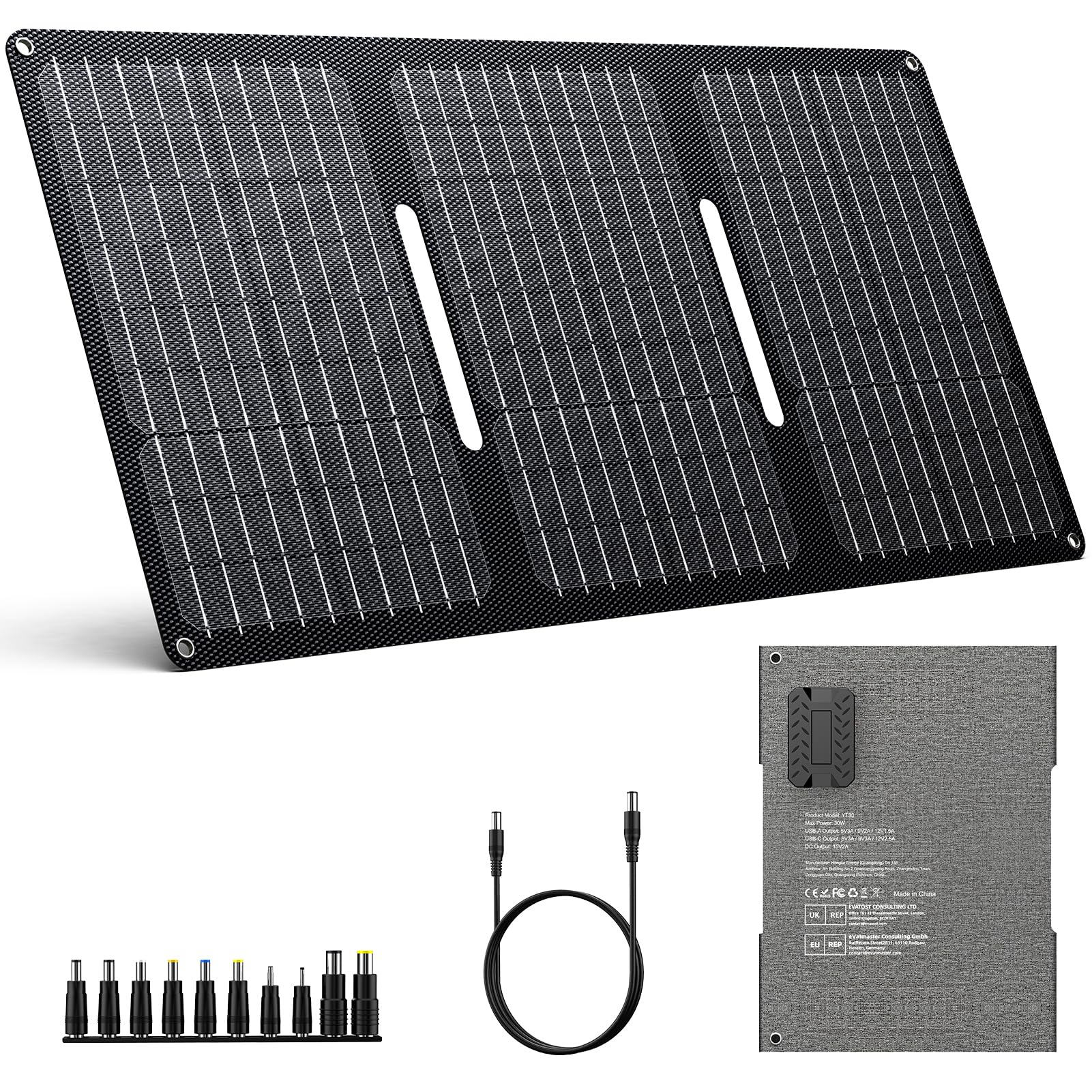
The ENOFLO 30W arrives with ten DC adapters, which tells you what it is for: keeping a small device or a compact power station alive when the grid is out. It weighs 1.9 pounds, folds to 13 x 8.5 x 0.3 inches, and uses a three-panel monocrystalline design with 24% efficiency. The folded package is about the size of a laptop sleeve, so it slides behind a seat or into a glovebox without a fight.

We see it as a glovebox panel rather than a primary power source. The USB-A port supports QC3.0, and the DC output with the 10-in-1 adapter set covers a surprising range of small stations and 12V devices. The 10 adapters are the reason to pick it over a plain USB charger, but they are also the reason to check the list before you rely on it: a barrel plug that looks close can be the wrong size. We kept the adapter bag with the panel so nothing went missing.

The output is the honest limitation. At 30W, it is a trickle for a large power station and a useful top-up for a phone, a headlamp, or a small battery. In less than direct sun, the panel may not produce enough to register a charge at all. The IP65 rating handles dust and splashes, not a downpour. For emergency prep, that is a fair trade for a panel this small and inexpensive.

Pros

  • Folds to laptop-sleeve size at 1.9 pounds
  • 10-in-1 DC adapter set
  • USB-A QC3.0 and DC outputs

Cons

  • No USB-C output
Our verdict

The ENOFLO 30W is a cheap emergency charger for small gadgets, not a power-station workhorse; its adapter bundle and laptop-sleeve fold make it easy to keep in the car.

Check Latest Price
7

Budget High Power

MHPOWOS 400W Portable Solar Panel

80 /100
LBD Score Excellent

Key details

Weight
27.9 lb
Folded Size
37 x 23 x 2.75 in
Rated Power
400W
Weather Resistance
IP67
View on Amazon

The MHPOWOS 400W is a lot of panel for the money, and the folded package tells you where the savings went: 37 x 23 x 2.75 inches and 27.9 pounds. This is not a panel you toss in a backpack. It is a basecamp or trailer panel, one that takes up a real shelf in the garage and a real chunk of the trunk. The 400W rating and 23.5% monocrystalline cells are the draw; the size is the admission price.

The 31V maximum voltage is the useful surprise. It suits many mid-size power stations that cannot accept the 45.9V ZOUPW, so the MHPOWOS is more flexible than its bulk suggests. The IP67 rating covers rain and dust, and the included Anderson, XT60, DC7909, and DC5521 connectors cover a broad spread of stations. We liked the simple fold and the zippered accessory pouch; the panel feels rigid when it is standing.

Output is the thing to watch. A 400W panel needs strong, direct sun to approach its rating, and in haze or heat it will sit well below the label. The MHPOWOS is no exception. We also found the kickstand legs less planted than the panel itself, so we chose flat ground and checked the angle before walking away. It is a fair-weather workhorse, not a panel for a windy ridge.

For a trailer, a cabin, or a long stay in one spot, the MHPOWOS buys a lot of wattage without the premium of the ZOUPW. For a daily move, it is a chore. That is the decision: if the panel lives mostly in one place, the size is manageable; if it travels every day, spend more for less weight.

Pros

  • 400W output at a lower price point
  • IP67 sealing for outdoor use
  • 31V output suits many mid-size stations

Cons

  • No USB ports for direct device charging
Our verdict

The MHPOWOS 400W is for the buyer who wants high wattage on a tighter budget and can live with the bulk; it is heavy, large, and happiest in strong sun.

Check Latest Price

How We Tested (and Measured) Foldable Solar Panels

I built the shortlist from published specs and customer reviews, filtering on wattage class, connector types, packed weight, stated waterproof rating, and price per watt. Listings that claimed high efficiency without naming a cell type, or that skipped an IP rating altogether, were cut. Then I bought across the range: pocketable chargers meant for phones and power banks, mid-size panels for weekend trips, and larger arrays built to feed a power station.

That left 12 panels, which we lived with for seven months — backyard afternoons on both clear and hazy days, three camping trips, a week in an RV, and a three-day outage at my house. Each one was set up the way a real user would, with an inline watt meter between panel and power station and readings logged every 20 minutes as I shifted the angle and as the cells warmed in the sun. I also timed charges from roughly 20 percent to 80 percent on the same station, so the panels were compared against each other rather than against a spec sheet.

We hosed every panel down for five minutes and left a few out in drizzle, folded and unfolded them one-handed and in work gloves, weighed each one packed in its own case, and propped the kickstands on gusty afternoons to see which ones held. Every connector in every box got plugged into a small and a large power station, and the USB ports on the little panels were run against a nearly dead phone. At the end, we divided price by measured watts to see which panels were genuinely the value.

How to Choose a Foldable Solar Panel

Rated Watts vs. Real Output

Treat the wattage on the box as a lab number. A clean 200W panel in strong, direct sun can approach its rating, but heat, haze, a low angle, or a shadow across one cell pulls it down, sometimes by a lot. Size the panel to your station rather than to the label: 100W suits a small weekend battery, 200W is the practical middle for a mid-size station, and 400W and up makes sense for a large 40-60V unit. We put the 200W HQST at the center of this guide for that reason: it is enough panel for most campers without becoming a two-person lift.

Match Voltage and Connectors

Before you buy, look at your power station's solar input, not just the panel's watts. A 450W panel with a 45.9V open-circuit voltage is designed for large 40-60V stations; a small 12V station cannot use that output. Check the connector, too: XT60, DC7909, DC5521, Anderson, and MC4 are not interchangeable. The HQST includes a 4.9-foot 3-in-1 cable, while the Renogy ships as a panel only, so budget for the right lead. If the panel's voltage ceiling is above your station's rating, choose a different panel.

Carry Weight and Folded Footprint

Folded size and weight are different questions. A panel can fold into a briefcase and still be too heavy for a long walk; another can be light but unfold into a long, floppy sheet that needs two people to position. For backpacking, the BigBlue at 1.5 pounds is the obvious choice. For car camping, the HQST at 11 pounds is easy enough to move alone. The ZOUPW 450W is light for its output but still a 29.5-pound, 30-by-34-inch package: fine for a trailer, awkward on a daily carry. Check the folded dimensions against your storage bay.

Legs, Cables, and Weather Sealing

Kickstands and panel leads are where folding designs earn or lose their keep. More angle positions help you chase the sun, but a four-leg frame can be fussier to level than a two-leg one. Cable length matters more than the connector count: you want the panel in the sun and the station in the shade, and a short lead forces you to move both. IP67 or IP68 gives you confidence in rain and dust, though no folding panel should be packed wet. We treat the legs and hinge points as the first things to inspect after a windy trip.

Frequently Asked Questions

Final Verdict

For most campers, the HQST 200W is the panel we point to first: it is the lightest 200W model in this guide, includes the adapter cable, and has enough output for a mid-size power station without turning setup into a chore. If your priority is charging phones and tablets directly, the Renogy 200W is the better fit; its USB-C PD and dual USB-A ports save you from routing everything through a station. For a large 40-60V station, step up to the ZOUPW 450W, provided you can store and carry its bigger folded package.