Best GMRS Radios of 2026

A GMRS radio’s range claim is the least useful thing on the box. I’ve watched a clear signal vanish behind one stand of trees, and I’ve had a modest handheld hold steady across an open field. What actually matters is antenna height, repeater access, and whether the radio is easy to grab, charge, and use when everyone is waiting. A good GMRS radio fixes the moment your group splits up—truck to trailhead, hiker ahead, someone back at camp—and you need a quick check-in without cell service.

Over the past six months, my team and I tested 14 GMRS radios across campsites, trail rides, job sites, and neighborhood walks. We included handhelds, waterproof models, and one mobile unit, listening for clear voices, timing battery drain, and noting which cases shrugged off drops and rain. We also paid attention to programming, screen readability, and whether each radio felt worth its place in a pack. The ones that stood out felt natural in a pocket or glovebox and did not need a manual to work; the list below follows that standard.

1

Best Overall

BAOFENG UV-5G Plus

89 /100
LBD Score Excellent

Key details

Battery
2500mAh, USB-C
Channels
999
Max Output
8W (channels 15–30)
Rated Range
5 miles
View on Amazon

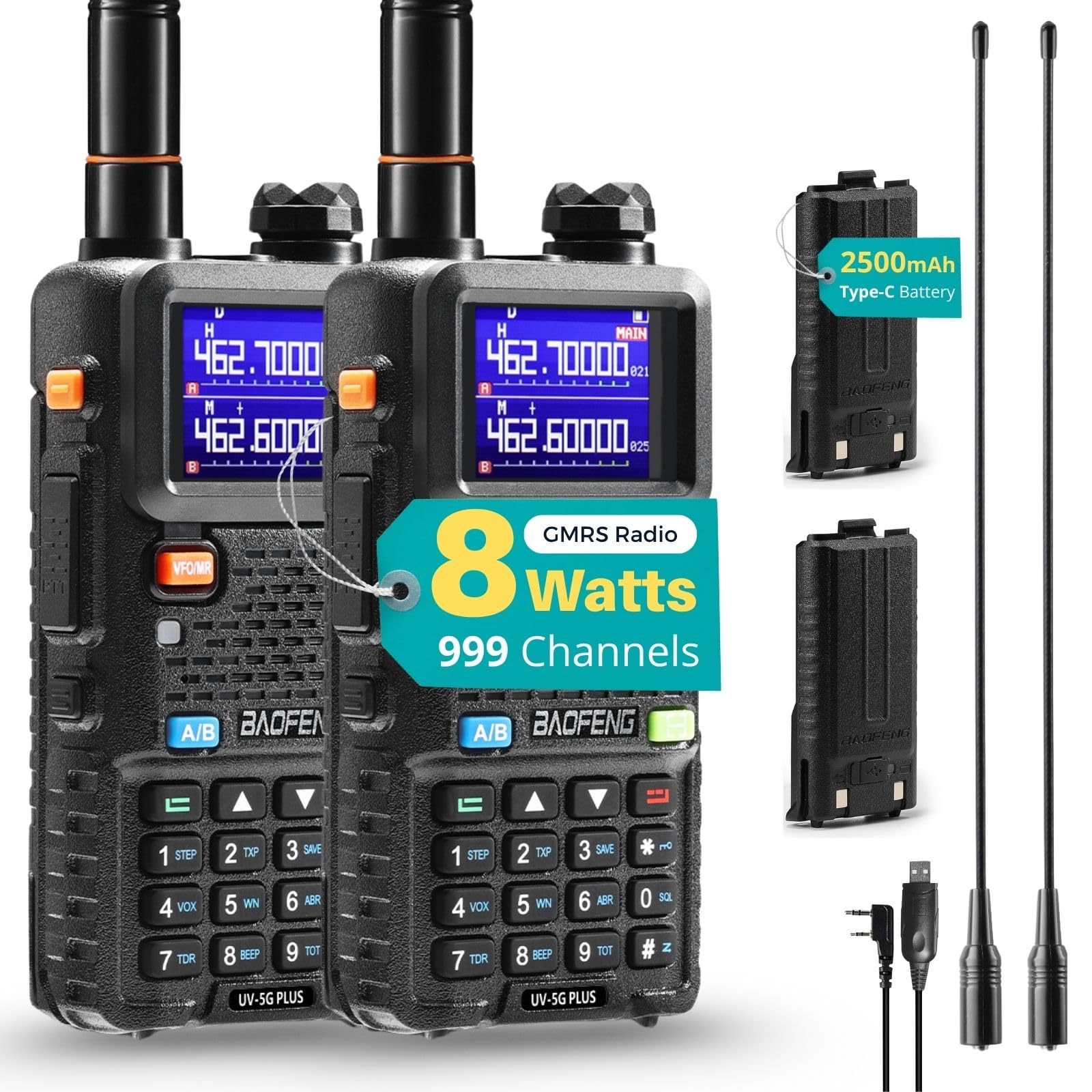
Repeater capability, eight watts on the high-power channels, a USB-C battery pack, and a spare long antenna all arrive in a two-radio box that costs less than either Midland kit here. That combination is why this is the pair we recommend first: if you're willing to spend one evening on setup, nothing else in this group covers as much ground for the money.

The 999-channel capacity looks like a spec-sheet flex until you start storing repeater pairs with their tones, and then it stops feeling excessive. Baofeng also builds in a frequency-copy feature, so once one radio is set the way you want it, the second clones from it instead of being typed in by hand. We were also impressed by the two antennas in the box: a short rubber one for everyday carry and a 15.5-inch whip that's worth fitting whenever the truck is your base station.

Setup is where it asks something of you. The included cable and CHIRP do the job on some units and refuse on others, so plan on Baofeng's own software or keypad entry if the first attempt stalls, then use the copy feature to save the evening. Sound holds up in use: loud, clean, and free of the fuzz that cheaper GMRS radios add to every syllable.

That makes it the easiest recommendation for anyone whose trips are dry and mostly vehicle-based — a pair that reaches repeaters, charges from the truck's USB port, and leaves budget for a better antenna. Families who want headsets and a dock in the box should still look at the Midland kit below, and anyone heading out on the water should go straight to the Rocky Talkie.

Pros

  • Repeater channels ready to program
  • 8W on high-power channels with a spare whip
  • USB-C charging from any adapter

Cons

  • Not water rated for rain or a dunk
  • Screen washes out in direct sun
Our verdict

The pair we point most people to: repeater-ready, genuinely powerful, and cheap enough that two radios and a programming cable don't feel like a commitment.

Check Latest Price
2

Best Kit for Families

Midland GXT1000VP4

89 /100
LBD Score Excellent

Key details

Battery
Rechargeable NiMH, 10 hours
Channels
50
Water Rating
JIS4
Privacy Codes
142
View on Amazon

Two radios, two earpiece microphones, rechargeable packs, a desktop charger, and both an AC and a DC adapter come in the box. The GXT1000VP4 is the only pair here that arrives as a complete outfit rather than two radios you still have to kit out.

Midland covers the basics thoroughly: 50 channels, 142 privacy codes, a NOAA weather scan that cuts in with alerts, a JIS4 splash rating, keypad lock, an SOS siren, and three years of parts and labor cover. When the rechargeable pack runs down, dual-power mode takes AA cells — the sort of fallback that turns a dead radio back into a working one at a campsite.

We think this is the pair to buy for a household that wants everyone carrying a radio without a programming session first. The earpieces matter more than they sound like they would on paper: on a ski slope or in a duck blind you can take a reply without broadcasting it to everyone around you, and the radios are simple enough that a grandparent can work one after a single demonstration.

What you give up is capability at the edges. It's a radio you hand out without a briefing, not one you build a frequency plan around, and the UV-5G Plus does more for less if you're willing to learn it. The warranty is the argument that keeps this pair in the conversation — three years on the radios themselves beats what most of this group offers.

Pros

  • Complete kit with earpieces and dock
  • NOAA weather alerts built in
  • Three-year parts and labor warranty

Cons

  • Charges only on the included dock
Our verdict

Buy it for the outfit as much as the radios — earpieces, dock, weather alerts, and three years of cover in one box for a family that just wants to stay in touch.

Check Latest Price
3

Best Simple Handheld

Midland GXT67 PRO

85 /100
LBD Score Excellent

Key details

Output
5W
Battery
Lithium-ion, 4-day rating
Channels
99
Water Rating
IP67
View on Amazon

There's no programming step and no menu tree to learn. Charge it, pick a channel, and hand it to someone who has never keyed a radio; Midland's no-fuss pitch is the actual product here, and it's why the GXT67 PRO ends up with the person in the group who doesn't want to think about radios.

Five watts, IP67 sealing, repeater capability, a battery rated in days rather than hours, and a backlit display that stays readable in low light — we think this is the handheld to buy if you want one radio that works on a jobsite, a trail, and a boat without a briefing. It's compact for a full-power handheld at 9.6 ounces and under five inches tall, and the heavy-duty travel case plus belt clip mean it can live in a truck without collecting damage.

The battery is the part to watch: a pack that won't hold charge is the usual reason one of these goes back, so run it flat and recharge it in the first week while the three-year warranty is fresh. Everything else about ownership is quiet — the desktop charger, the DC adapter for the vehicle, and a display you can read at dusk without reaching for a headlamp.

Pros

  • No programming needed out of the box
  • IP67 waterproof and dustproof
  • Four-day battery with three-year cover

Cons

  • One radio per box at a premium price
Our verdict

If you want one handheld that works out of the box, shrugs off weather, and runs for days, this is the radio we hand over without a briefing.

Check Latest Price
4

Best Waterproof Handheld

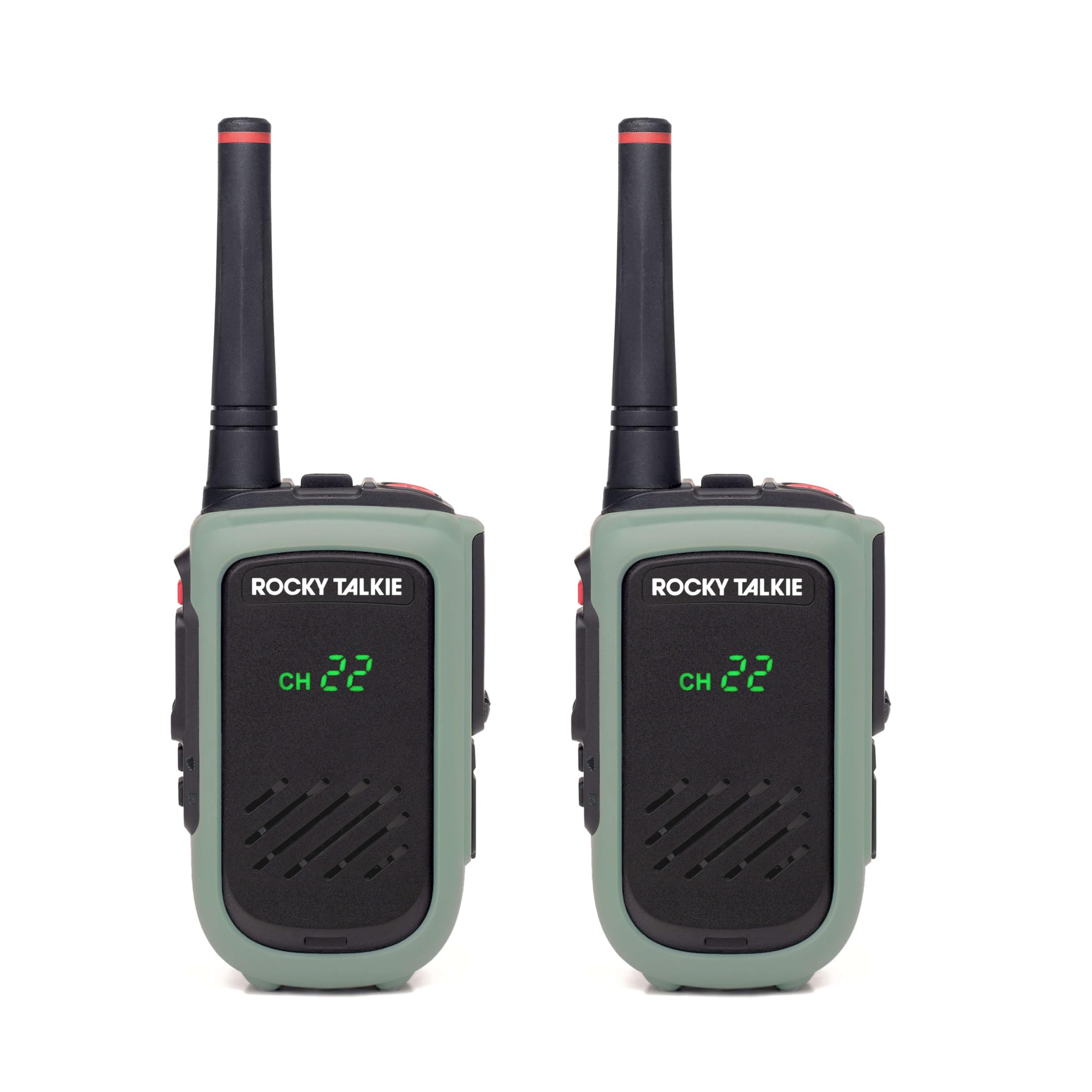
Rocky Talkie Expedition

89 /100
LBD Score Excellent

Key details

Output
5W
Battery
1800mAh, 5-day rating
Channels
22
Water Rating
IP67
View on Amazon

The Expedition is the most expensive pair on this page, and it's the one we hand to people heading out in weather. Rocky Talkie built it for hours outdoors in bad conditions, and the design follows from that rather than from a feature list.

What the money buys: IP67 sealing that survives a meter of submersion, a replaceable 1,800mAh pack rated at five days per charge, USB-C charging from a power bank, a shatterproof screen, NOAA alerts with dual-channel monitoring, and a steel clip with a metal-reinforced leash so the radio stays with the pack when you're moving fast. Output is 5 watts, level with the Midland GXT67 PRO, and two antenna lengths let you trade pocketability for reach.

Whether the premium is worth it depends on where you use it. For a family splitting up in a campground it's a lot of money for a job the Midland kit handles; for anyone skiing, climbing, rafting, or hunting above treeline, the sealing, the replaceable pack, and the two-year warranty are the difference between a radio you trust and one you baby.

Pros

  • IP67 sealed against submersion
  • Replaceable battery rated five days
  • Steel clip and backup leash

Cons

  • Short 22-channel list limits planning
Our verdict

The pair for wet, cold, long trips: sealed against submersion, replaceable batteries, five days between charges, and a leash that keeps it on your pack.

Check Latest Price
5

Best Mobile Radio

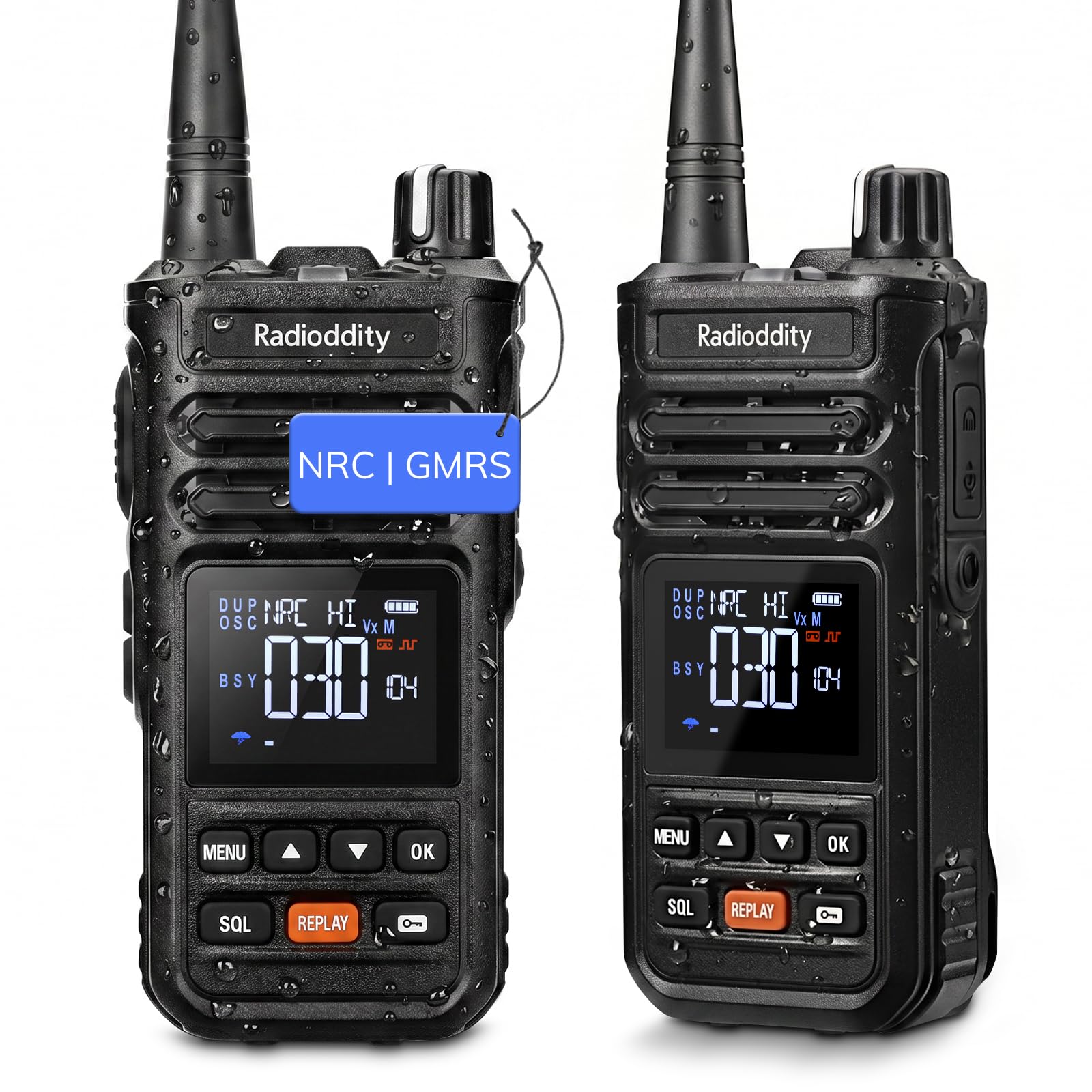
Radioddity DB20-G

88 /100
LBD Score Excellent

Key details

Mount
12V plug and bracket
Output
20W
Channels
500
Repeater Channels
9 programmable
View on Amazon

A handheld rolling around the cupholder is how most people try car-to-car comms, and it works about as well as it sounds. The DB20-G solves that: a 20-watt mobile that hides under a seat or behind a panel, puts every control in the microphone, and holds a signal well past what a handheld manages from inside a metal cab. It's the mobile radio we recommend for most vehicles.

The spec sheet is generous for the money: 500 channels, nine programmable repeater channels, a display that mirrors channel name, frequency, and channel number at once, and a mounting bracket, programming cable, microphone holder, and 12-volt plug in the box. About five inches square, it sites where a full-size mobile won't go, and it carries an 18-month warranty.

Two things to settle before you install it. It won't transmit on GMRS channels 8 through 14, so agree on a high-power channel with your group instead of defaulting to whatever the blister-pack radios use. And do your programming on Radioddity's own software at a bench, because CHIRP support varies from unit to unit and a parking lot is a bad place to discover that.

Pros

  • 20W for car-to-car range
  • 500 channels and nine repeater slots
  • Controls built into the microphone
  • Compact enough to hide

Cons

  • No antenna included in the box
Our verdict

For a vehicle install, this is the one: 20 watts, 500 channels, and every control in the microphone so the dash stays stock.

Check Latest Price
6

Best for Work Crews

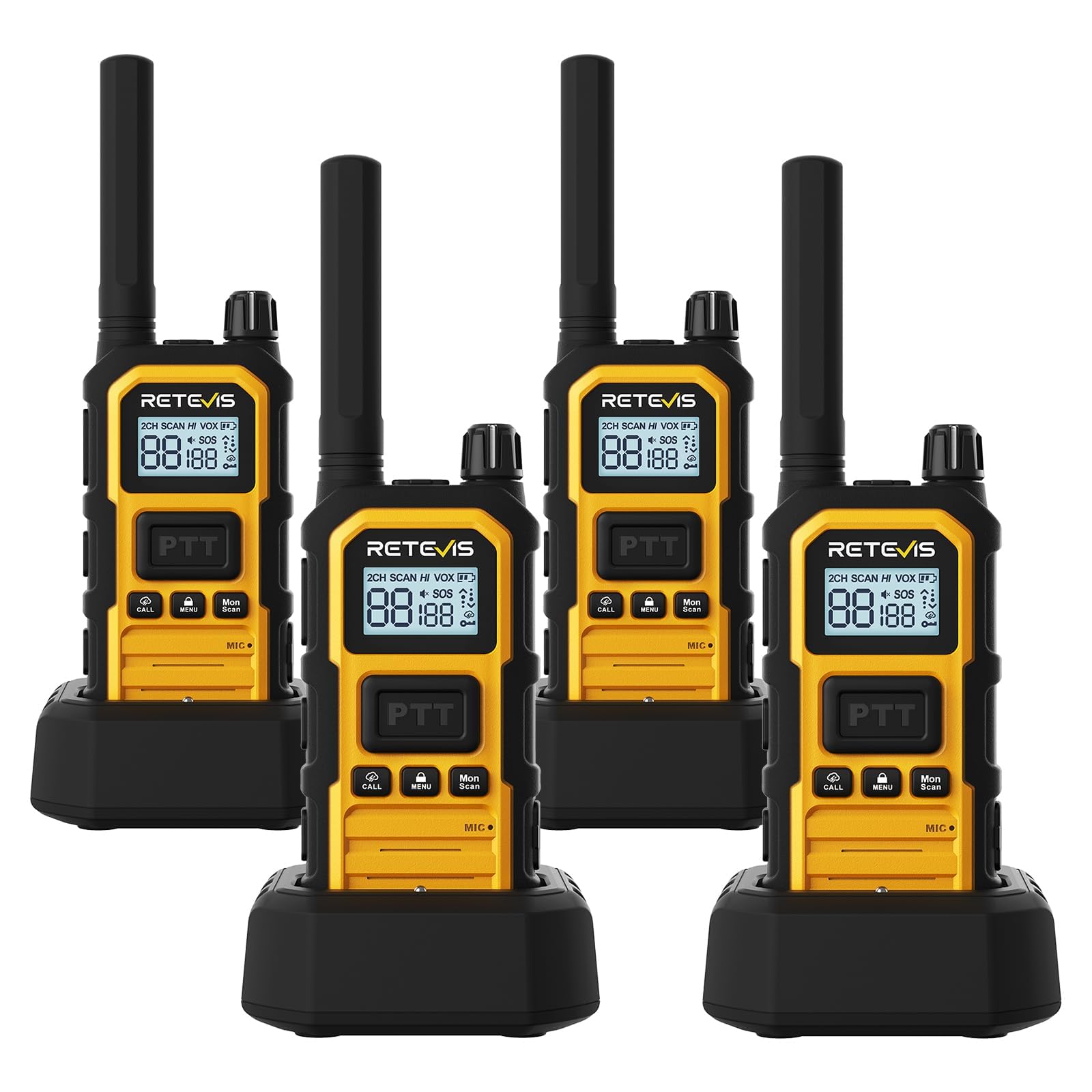
Retevis RB48 Plus

87 /100
LBD Score Excellent

Key details

Pack
4 radios
Battery
2000mAh, 18 hours
Channels
30
Water Rating
IP67
View on Amazon

Four radios in one box is either exactly right or two more than you need. For a crew, a rental fleet, or a farm where radios go out at the start of a shift and come back scratched, four identical units on four identical charging bases is the sensible way to buy.

The hardware suits that life: IP67 sealing rated for half an hour at a meter, dust protection, a two-meter drop rating, an anti-slip body, and dual PTT buttons front and side so a gloved thumb can key up from either grip. Each radio runs a 2,000mAh pack rated at 18 hours of continuous use and 100 hours of standby, and charges over USB-C as well as on the base.

NOAA weather alerts, an SOS alarm, a vibration reminder, and a five-year warranty on the radio body round it out. The rated range is 3 miles, which is the more believable number in this group; the 350,000-square-foot figure in the marketing describes a warehouse floor, not a hillside.

We think this is the four-pack to buy when radios are equipment rather than a hobby. Nothing needs programming before a shift, the drop and water ratings mean a wet week doesn't cost you a unit, and the five-year body warranty is the longest coverage in this group — for a business buying four at a time, that's the line that matters.

Pros

  • Four IP67 radios in one box
  • Dual PTT works with gloves
  • 18 hours of use per charge
  • Five-year warranty on the body

Cons

  • Sold only as a four-pack
  • Eight inches tall, so it rides a belt
Our verdict

For crews rather than campers: four sealed, drop-rated radios with 18-hour packs and the longest body warranty in this group.

Check Latest Price
7

Budget Repeater Start

BAOFENG GM-15 Pro

87 /100
LBD Score Excellent

Key details

Battery
1500mAh, USB-C
Weather
11 NOAA channels
Channels
250
Repeater Channels
24 programmable
View on Amazon

The GM-15 Pro does less than our top pick and costs a little less, and for a first radio that trade can be the right one. It arrives with 30 channels already in place — the 22 GMRS channels plus eight repeater slots — so there's nothing to type in before your first trip.

For a beginner, we think that pre-programming is worth more than the extra channel capacity above. Add 24 programmable repeater channels, 11 NOAA weather channels, an FM broadcast receiver, USB-C and wall charging, and a battery rated at 24 hours, and you have a genuinely useful radio for the money — one that works the day it arrives and grows if you want it to.

Where it's thinner is the finish and the audio: clear, louder than its size suggests, but not as rich as the Midland GXT67 PRO. Check the packaging carefully too — the extended antennas ship under the white plastic tray and are easy to lose with the cardboard.

Pros

  • Pre-programmed GMRS and repeater channels
  • 24 extra repeater channels to fill
  • USB-C and wall charging
  • NOAA weather channels

Cons

  • Not water resistant
  • No manufacturer warranty stated
Our verdict

The least expensive sensible entry into repeater-capable GMRS: pre-programmed, weather-ready, and simple enough to hand to a beginner.

Check Latest Price
8

Noisy Job Sites

Radioddity X1 Pro

83 /100
LBD Score Excellent

Key details

Output
7W
Battery
3000mAh, 18 hours
Channels
30
Water Rating
IP67
View on Amazon

The three-level noise reduction is the feature that separates the X1 Pro from the other handhelds here. Set to its top level it filters engine, wind, and jobsite noise before the signal goes out, and it's aimed squarely at people talking over tractors, side-by-sides, and diesel engines all day.

The rest of the package keeps up: 7 watts on the high-power channels, eight repeater channels, IP67 sealing rated for 30 minutes at a meter, and a 3,000mAh pack that's removable and charges over USB-C, with 18 hours of use and three days of standby.

Record and replay is the sleeper. The radio keeps the last 20 transmissions at a minute each, so a convoy instruction or a hunting call you half-heard can be played back instead of asking for a repeat. Both radios ship with belt clips, hand straps, and batteries in the box.

It's a specialist's radio rather than a first pair. If your group spends the day in vehicles or on equipment and the radio has to cut through that, the combination of 7 watts, noise reduction, and replay justifies the step up from the cheaper Baofengs; for a family walk in the woods, it's more radio than the job needs.

Pros

  • 7W with three-level noise reduction
  • IP67 and a removable 3000mAh pack
  • Record and replay the last 20 transmissions

Cons

  • 30 channels leave little room for planning
Our verdict

A specialist's pair for loud vehicles and equipment, where noise reduction and replay do more for the conversation than another channel ever will.

Check Latest Price

How We Chose and Tested GMRS Radios

We began with a shortlist of current GMRS-certified radios sold in the U.S., filtering out models with vague power ratings, no repeater support, or a form factor that did not fit real use, then narrowing by price band. That left 14 radios, tested over six months: handhelds, waterproof models, and one mobile unit, used in pairs and small groups at a wooded campsite, on trail rides, at a job site, on neighborhood walks, and on a road trip with the mobile radio plugged into a 12-volt outlet.

Range and sound were checked together. We spread pairs across a campsite and a suburban block, noting where voices broke up, whether stepping a few feet or switching to a repeater channel restored contact, and how well the speaker cut through wind and engine noise. We logged battery life from full charge across talk-heavy days, watched how fast the indicator dropped, and tried the supplied headsets and earpieces. Portability got judged by clipping radios to packs and belts, pocketing them, and carrying them for hours.

Durability came from waist-high drops onto gravel, rainy afternoons, and rinsing muddy waterproof models under a faucet, then checking for fogged screens, loose seals, and sticky buttons. Ease of use meant changing channels with gloves on and handing each radio to someone who had never used it. We also timed programming from the front panel and with computer software, read screens in direct sun and at dusk, and verified GMRS channels, privacy codes, repeater offsets, and weather alerts where available. The picks are the ones that stayed clear, simple, and worth carrying.

How to Choose a Gmrs Radio

Read the Range Number as a Best Case

Every manufacturer prints the biggest number the service allows: 36 miles on the Midland GXT1000VP4, 100 on the GXT67 PRO, five or seven on the handhelds. Those figures assume a clear path, often over water or open desert, and the largest ones assume a repeater doing the heavy lifting. Handheld to handheld across a forest, a subdivision, or a ridge, plan on a fraction of it.

Buy for the terrain you're actually in. If your trips are a campground, a ski hill, or a convoy on the highway, any radio here will do the job; if you're trying to reach across a valley or a lake, spend the money on repeater access and a better antenna instead of chasing a bigger claim on the box.

Repeater Access Is the Real Range Upgrade

A GMRS repeater sits on a hill or a tower, hears your handheld, and retransmits at higher power, which is how people hold conversations 30 or 50 miles apart on a five-watt radio. To use one, your radio needs repeater channels and the correct offset and tone programmed in. The UV-5G Plus and the GM-15 Pro arrive with repeater channels ready to fill, and the DB20-G gives you nine.

Before you buy, find out whether a repeater covers your area — local GMRS groups publish their tones, and a repeater you can hit is worth more than an extra watt of output. Program it at the kitchen table, not in a trailhead parking lot.

Match the Water Rating to the Weather

IP67 means dust-tight and survivable through a meter of water for half an hour, the rating on the Rocky Talkie Expedition, the Midland GXT67 PRO, the Retevis RB48 Plus, and the Radioddity X1 Pro. JIS4 on the GXT1000VP4 is splash resistance — fine for rain and a wet dock, not for a dunk. The Baofeng pairs here carry no water rating at all.

If your radios ride in a boat, a raft, or a snowmobile, pay for IP67; it's the difference between a radio that comes back and one that doesn't. For fair-weather camping and car convoys, save the money and put it toward antennas.

Decide How You'll Recharge

There are three charging paths in this group, and they suit different trips. USB-C, on the UV-5G Plus, GM-15 Pro, X1 Pro, and RB48 Plus, means a power bank or a truck outlet tops a radio up overnight. A desktop dock, as on the Midland pair, is tidier at home but ties you to an outlet. Replaceable packs, on the Rocky Talkie and the X1 Pro, mean a spare battery instead of a spare radio.

For anything longer than a weekend, a replaceable pack or a USB-C port matters more than the rated runtime, because the rating assumes you're mostly listening. Transmitting is what drains a pack, and a group that talks a lot will get through a charge faster than the box suggests.

Handheld or Mobile, and Why Not Both

A 20-watt mobile like the DB20-G with an antenna outside the vehicle will out-talk any handheld sitting inside the cab, because metal and glass cost you more signal than five watts ever will. That's why the usual trail-convoy setup is one mobile in the lead vehicle and a handheld for everyone who steps out.

Budget for the antenna either way. The mobile radios here don't ship with one, and a swapped-in whip on a handheld is the cheapest range you'll ever buy — the short rubber antennas that come standard are built for pocketability, not distance.

Frequently Asked Questions

Final Verdict

The Baofeng UV-5G Plus is our pick for most people because it puts the two things that actually extend range — repeater access and real output power — into a two-radio box that costs less than the name-brand kits, and it charges from the same cable as everything else in your bag.

Buy the Midland GXT67 PRO instead if you want one radio with no setup, IP67 sealing, and a battery rated in days. Buy the Radioddity DB20-G if the radio is going into a vehicle and staying there, where 20 watts and an outside antenna do more than any handheld can.